 HOME > BLOG > HR Management > XLRI HR Analytics vs IIM Trichy Strategic HR Management: Which Should You Choose?
XLRI HR Analytics vs IIM Trichy Strategic HR Management: Which Should You Choose?
 August 20, 2026
 7 min read




Table Of Content
- XLRI HR Analytics vs IIM Trichy Strategic HR Management: An Overview
- XLRI HR Analytics Programme: What Does It Offer?
- IIM Trichy Strategic HR Management Programme: What Does It Offer?
- XLRI HR Analytics vs IIM Trichy SHRM: Key Differences
 Key Insights
- XLRI HR Analytics programme focuses on data-driven HR decision-making, covering descriptive, predictive, and prescriptive analytics to help professionals use workforce data effectively.
- The programme covers practical areas such as data capturing and cleaning, HR metrics, predictive models, Natural Language Processing, and HR analytics projects, with applications across staffing, training, performance management, and organisational development.
- IIM Trichy Strategic HR Management programme offers broader strategic HR exposure, covering talent management, performance management, compensation, digital HR, AI, employee relations, change management, leadership, and ethics.
- The key difference in XLRI HR Analytics vs IIM Trichy Strategic HR Management is career focus: XLRI is more analytics-oriented, while IIM Trichy provides broader strategic HR management expertise.
- In this blog, you'll learn how XLRI HR Analytics and IIM Trichy Strategic HR Management compare across curriculum, eligibility, learning experience, analytics focus, career goals, and programme duration to choose the right option for your career.
Human Resource Management is changing rapidly. HR professionals are no longer expected to focus only on recruitment, employee engagement, training, and administration. Organizations increasingly need HR leaders who can connect people strategies with business objectives, interpret workforce data, and make informed decisions.
This shift has made specialized executive programmes increasingly relevant for working professionals. Two options that stand out are the XLRI HR Analytics programme and the IIM Trichy Strategic HR Management programme. While both are designed for professionals looking to strengthen their HR capabilities, their learning focus is different.
The XLRI HR Analytics vs IIM Trichy Strategic HR Management comparison therefore comes down to your career goals. The XLRI programme focuses strongly on analytics, evidence-based decision-making, and people data, while the IIM Trichy programme provides broader exposure to strategic human resource management and its functional dimensions.
 ChatGPT
 Perplexity
 Claude
 Grok
GrokXLRI HR Analytics vs IIM Trichy Strategic HR Management: An Overview
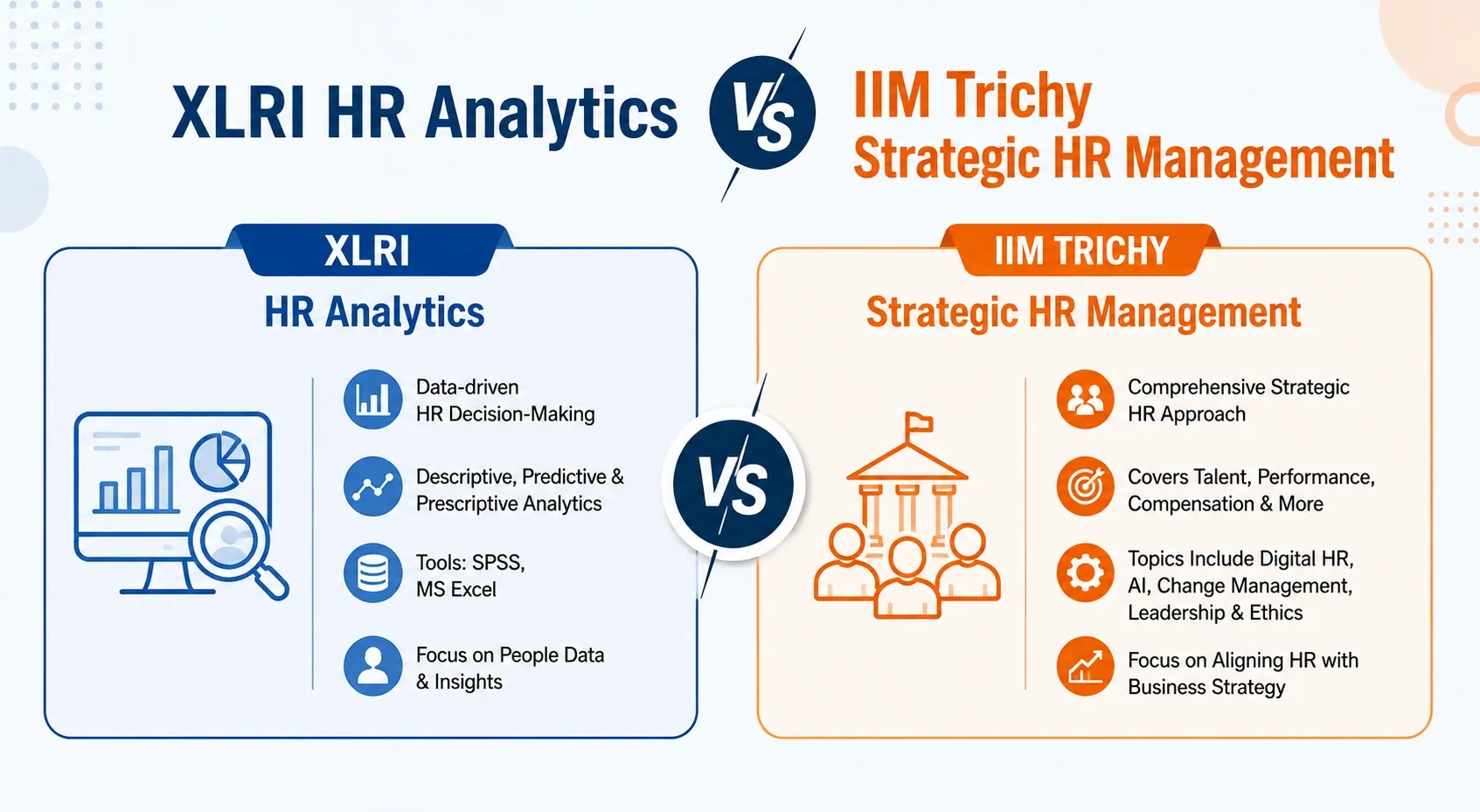
The XLRI HR Analytics programme is designed around a data-centric approach to Human Resources. It covers descriptive, predictive, and prescriptive analytics and helps professionals understand how data can support people-management decisions. The programme also uses SPSS and MS Excel for illustrations and is designed to accommodate participants who may not have strong mathematics or statistics backgrounds.
The IIM Trichy Strategic HR Management programme, on the other hand, takes a broader strategic approach. It covers areas such as managing people and organisations, HR processes, performance management, training and development, talent management, compensation and benefits, HR metrics and analytics, AI and the future of work, digital HR, employee relations, change management, leadership, and ethics.
In simple terms, XLRI places greater emphasis on using data to understand and solve HR problems, while IIM Trichy focuses on understanding and strategically managing the wider HR function.
XLRI HR Analytics Programme: What Does It Offer?
The XLRI programme has a clear focus on people analytics and data-driven HR decision-making. Its objective is to help HR professionals use analytics to develop deeper insights into workforce-related challenges and identify appropriate solutions.
A key feature is its progression through three major types of analytics.
Descriptive HR Analytics
The programme introduces participants to HR measurement and metrics. Learners explore how to develop and modify HR metrics, including proprietary metrics that may be relevant to an organisation.
Predictive HR Analytics
Predictive analytics moves beyond understanding what has happened. Participants learn how existing data and metrics can be used to make predictions about people-management decisions and potential future outcomes.
Prescriptive HR Analytics
Prescriptive analytics focuses on using predictions to recommend future actions. The programme also covers contextualized prescriptions, optimization, stakeholder influence, and organizational network analysis.
The curriculum also addresses evidence-based approaches, HR analytics projects, data capturing and cleaning, HR metrics, predictive models, qualitative data, Natural Language Processing, and practical applications across staffing, training, performance management, leadership, organizational culture, and organizational development.
This makes the programme particularly relevant for professionals who want to build analytical capabilities without moving away from HR.
IIM Trichy Strategic HR Management Programme: What Does It Offer?
The IIM Trichy programme provides a wider view of strategic HR management. It is structured as a 12-month programme with live online classes and campus immersion. The programme includes 171 hours of interactive learning, workshops, case studies, experiential learning, projects, and lectures.
Its curriculum begins with foundational HR areas such as managing people, managing organisations, HRM processes and practices, and an introduction to strategic HRM.
It then moves into strategic alignment through topics such as:
- Performance Management
- Training and Development
- HR Metrics & Analytics
- Talent Management
- Compensation and Benefits
- Design Thinking
- AI & Future of Work
- Digital HR
- Managing SHRM for Different Stakeholders
- Internationalisation
- Employee and Industrial Relations
- Change Management
- Team Dynamics
- Work, Wellness & Wellbeing
- Leadership & Ethics
The programme therefore provides a comprehensive perspective of how HR functions can be aligned with organisational objectives.
XLRI HR Analytics vs IIM Trichy SHRM: Key Differences
When comparing XLRI HR Analytics vs IIM Trichy SHRM, it is useful to look beyond the institute names and examine what each programme actually teaches.
| Parameter | XLRI HR Analytics | IIM Trichy Strategic HR Management |
| Primary Focus | HR analytics and people data | Strategic Human Resource Management |
| Duration | 8–9 months | 12 months |
| Learning Mode | Live lectures, hybrid mode | Live online + campus immersion |
| Analytics Focus | Descriptive, predictive and prescriptive analytics | HR Metrics & Analytics as part of broader SHRM |
| Tools/Approach | SPSS, MS Excel and analytical methods | Case studies, projects, workshops and experiential learning |
| Major Strength | Data-driven HR decision-making | Strategic and holistic HR management |
| Suitable For | HR professionals seeking analytics capabilities | HR professionals and executives seeking broader strategic HR exposure |
| Campus Component | 6 days of mandatory on-campus immersion in two phases | 3 days of mandatory campus immersion |
| Certificate | Certificate of completion from XLRI Jamshedpur, subject to criteria | PG Certificate Programme in Strategic Human Resource Management |
The programme details above are based on the respective Jaro Education programme pages and may be updated for future batches.




Curriculum Comparison: Which One Has the Right Focus?
If you want to understand how HR data can be captured, cleaned, measured, analyzed, interpreted, and used for decision-making, XLRI offers a more specialized path. The curriculum progresses from analytical foundations to predictive and prescriptive analytics and includes practical HR applications.
For example, the XLRI curriculum discusses applications such as identifying employees with high attrition risk, comparing candidates based on predicted performance, improving staffing processes, optimizing compensation, and analyzing organizational culture.
IIM Trichy, meanwhile, is broader. Analytics is included within a larger strategic HR framework. Professionals are exposed to performance management, training, talent management, compensation, digital HR, AI, employee relations, internationalization, change management, leadership, and ethics.
Therefore, the choice depends on whether you want specialization in HR analytics or broader strategic HR expertise.
Eligibility and Work Experience
Eligibility is another factor to consider.
The XLRI HR Analytics programme accepts graduates or eligible diploma holders from recognized institutions. HR professionals require a minimum of two years of HR work experience, while non-HR professionals require a minimum of five years of overall work experience.
The IIM Trichy Strategic HR Management programme requires a minimum of 50% in graduation or post-graduation from a recognized university, with 45% applicable for SC/ST applicants, along with at least three years of work experience. Selection is based on the candidate’s profile and Statement of Purpose.
This means your current professional background can also influence which programme is more suitable.
Learning Experience and Campus Exposure
The learning format is another important consideration.
The XLRI programme is structured for professionals through live lectures in a hybrid format. Its pedagogy includes peer group work, case studies, and hand-holding sessions. The programme also includes six days of mandatory on-campus immersion conducted in two phases.
The IIM Trichy programme follows live online learning combined with campus immersion. Its pedagogy includes experiential learning, live class discussions, online assessments, workshops, case studies, and projects. Three days of mandatory campus immersion are part of the programme structure.
Both programmes therefore offer opportunities to learn through interaction and practical activities, but the structure and duration of campus exposure differ.
Which Programme Is Better for HR Analytics Careers?
If your primary career objective is to develop HR analytics and people analytics capabilities, the XLRI HR Analytics programme may be the more focused option.
Its curriculum specifically covers descriptive, predictive, and prescriptive analytics. It also explores data capturing, data cleaning, HR metrics, predictive models, qualitative data, Natural Language Processing, and evidence-based HR decision-making.
Professionals working in HR operations, talent management, workforce planning, recruitment, employee engagement, or HR business partnering may find these analytical capabilities useful when their roles increasingly involve workforce data.
The programme is also explicitly designed for participants who may not be proficient in mathematics or statistics, with SPSS and MS Excel used for illustrations.
Which Programme Is Better for Strategic HR Leadership?
If your objective is to develop a broader understanding of HR strategy and eventually take on wider HR leadership responsibilities, the IIM Trichy Strategic HR Management programme may be a stronger fit.
Its curriculum covers multiple dimensions of HR and connects them with strategic alignment. Learners explore performance management, training and development, talent management, compensation and benefits, employee relations, change management, digital HR, AI, leadership, and ethics.
The programme’s stated learning outcomes include analyzing strategic HRM challenges, understanding SHRM models and frameworks, strategically aligning HR functions, understanding the link between SHRM and performance, and examining SHRM across industries and stakeholders.
XLRI HR Analytics vs IIM Trichy Strategic HR Management: Which Should You Choose?
There is no universal winner in the XLRI HR Analytics vs IIM Trichy Strategic HR Management comparison. The right choice depends on the direction you want your career to take.
Choose the XLRI HR Analytics programme if:
You want to specialise in HR analytics, people analytics, and evidence-based decision-making. It is particularly relevant if you want to develop capabilities in descriptive, predictive, and prescriptive analytics and understand how data can support HR decisions.
Choose the IIM Trichy Strategic HR Management programme if:
You want a broader understanding of strategic HRM. It can be suitable if your career goals involve managing multiple HR functions and developing expertise across talent management, performance management, employee relations, digital HR, change management, leadership, and other strategic areas.
In short, XLRI is more analytics-focused, while IIM Trichy is broader and strategy-focused.
Final Verdict
The decision between these two executive programmes should be based on the skills you want to develop rather than simply comparing institutional names.
The XLRI HR Analytics programme is a specialised choice for professionals who want to bring data, analytics, and evidence-based decision-making into HR. Its focus on descriptive, predictive, and prescriptive analytics makes it particularly relevant for professionals interested in people analytics and data-driven HR practices.
The IIM Trichy Strategic HR Management programme takes a broader approach by covering the functional and strategic dimensions of HR, including talent, performance, compensation, digital HR, AI, employee relations, change, leadership, and ethics.
Therefore, if you are asking “XLRI HR Analytics vs IIM Trichy Strategic HR Management: Which should I choose?”, the answer is straightforward: choose XLRI if HR analytics is your primary specialization; choose IIM Trichy if you want broader strategic HR management exposure.
Frequently Asked Questions
Neither programme is universally better. XLRI is more focused on HR analytics and data-driven decision-making, while IIM Trichy offers broader exposure to strategic HR management and multiple HR functions. Your career objective should determine the better fit.
Yes. The programme specifically states that it is designed for participants who may not be proficient in mathematics or statistics. SPSS is used primarily, with MS Excel used initially for illustrations.
The programme covers strategic HRM along with performance management, training and development, HR metrics and analytics, talent management, compensation and benefits, AI and future of work, digital HR, employee relations, change management, leadership, and ethics.
The XLRI HR Analytics programme has a duration of approximately 8–9 months, while the IIM Trichy Strategic HR Management programme runs for 12 months.
Yes. Both programmes are structured around live learning formats for working professionals. XLRI offers live lectures in a hybrid mode, while IIM Trichy combines live online learning with campus immersion.






Find a Program made just for YOU
We'll help you find the right fit for your solution. Let's get you connected with the perfect solution.
Is Your Upskilling Effort worth it?
 ROI Calculator

Are Your Skills Meeting Job Demands?
Try our Skill Gap tool
Experience Lifelong Learning and Connect with Like-minded Professionals
Explore Jaro Connect
