
Workforce Planning: Definition, Types, Importance, and Steps
 June 6, 2026
 8 min read




Table Of Content
- What Is Workforce Planning?
- Why Workforce Planning Matters in Today’s Business Environment
- Types of Workforce Planning
- Key Components of Workforce Planning
Modern organizations no longer view workforce management as just a hiring function. Instead, companies are strategically aligning talent acquisition, employee development, leadership planning, and skill forecasting with long-term business goals. This shift has significantly increased demand for HR professionals, workforce strategists, talent managers, and business leaders who understand strategic workforce planning and organizational capability development.
The growing importance of workforce strategy is also influencing compensation trends across industries. In India, workforce planning professionals, HR business partners, talent management specialists, and organizational development managers generally earn between ₹6 LPA and ₹25 LPA depending on industry, experience, and leadership responsibilities. Senior workforce strategy professionals in sectors such as IT, consulting, BFSI, manufacturing, and healthcare often command even higher salary packages.
For professionals exploring leadership opportunities, career transitions, or management-focused roles, understanding what is workforce planning and how organizations implement workforce strategies can open doors to long-term growth opportunities. Businesses today are actively seeking professionals who can balance talent management, business forecasting, employee engagement, and future skill requirements.
This blog explores the meaning of workforce planning, its types, importance, implementation steps, industry trends, salary insights, and how upskilling through industry-oriented learning programs can help professionals build future-ready capabilities.
 ChatGPT
 Perplexity
 Claude
 Grok
GrokWhat Is Workforce Planning?
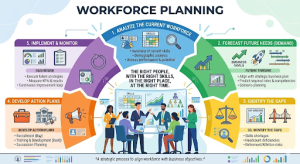
Workforce planning refers to the process of analyzing, forecasting, and planning workforce requirements to ensure organizations have the right people with the right skills at the right time.
The primary objective of workforce planning is to align business goals with talent strategies while preparing organizations for future operational challenges and workforce demands.
Key Objectives of Workforce Planning
- Identify future workforce needs
- Address skill gaps proactively
- Improve employee productivity
- Support business expansion plans
- Enhance succession planning
- Optimize talent acquisition strategies
- Improve workforce utilization
Organizations implementing effective strategic workforce planning are often better prepared to adapt to market changes, technological advancements, and evolving workforce expectations.
Why Workforce Planning Matters in Today’s Business Environment
The business environment is changing rapidly due to digital transformation, AI adoption, changing consumer behavior, and evolving employee expectations. As a result, workforce planning has become a core business function rather than just an HR activity.
Key Reasons Why Workforce Planning Is Important
| Importance Area | Business Impact |
| Talent forecasting | Helps avoid workforce shortages |
| Skill gap analysis | Supports employee development |
| Cost optimization | Reduces unnecessary hiring expenses |
| Succession planning | Ensures leadership continuity |
| Employee retention | Improves workforce stability |
| Business agility | Supports organizational adaptability |
Organizations across industries increasingly rely on workforce planning tools and analytics-driven workforce strategies to make informed talent decisions.
Types of Workforce Planning
*saviom.com
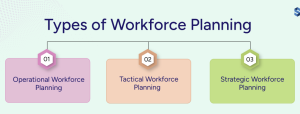
Different organizations implement different types of workforce planning depending on their business goals, industry requirements, and operational priorities.
1. Strategic Workforce Planning
Strategic workforce planning focuses on long-term workforce requirements aligned with business objectives.
Key Focus Areas
- Leadership planning
- Future skill forecasting
- Workforce transformation
- Business expansion support
This type of planning is commonly used by large organizations and enterprises undergoing rapid growth or digital transformation.
2. Operational Workforce Planning
Operational workforce planning focuses on short-term workforce needs and day-to-day staffing requirements.
Common Applications
- Shift scheduling
- Project staffing
- Temporary hiring
- Workforce allocation
Organizations use operational planning to ensure smooth business continuity and workforce efficiency.
3. Tactical Workforce Planning
Tactical planning bridges short-term operations with long-term business strategies.
Key Objectives
- Resource optimization
- Departmental workforce management
- Performance tracking
- Team restructuring
This approach helps organizations improve workforce productivity and responsiveness.
4. Succession Planning
Succession planning focuses on preparing future leaders within the organization.
Benefits of Succession Planning
| Benefit | Organizational Value |
| Leadership continuity | Reduces business disruption |
| Internal talent development | Improves retention |
| Reduced hiring dependency | Saves recruitment costs |
| Career growth opportunities | Enhances employee motivation |
Succession planning has become a critical component of modern strategic workforce planning initiatives.
Key Components of Workforce Planning
Effective workforce planning involves several interconnected components that help organizations manage talent efficiently.
Important Workforce Planning Components
Effective workforce planning requires organizations to evaluate multiple workforce factors, including current employee capabilities, future talent requirements, skill gaps, and business growth objectives. These components help businesses build data-driven workforce strategies that support long-term organizational stability and operational efficiency.
| Component | Purpose |
| Workforce analysis | Understand current workforce capabilities |
| Demand forecasting | Predict future workforce needs |
| Supply forecasting | Analyze available talent supply |
| Gap analysis | Identify missing skills |
| Action planning | Develop workforce strategies |
| Performance tracking | Measure workforce effectiveness |
Organizations increasingly use digital workforce planning tools to automate workforce analysis and forecasting processes.
Steps Involved in Workforce Planning
Implementing successful workforce planning strategies requires a structured and data-driven approach.
Step 1: Analyze Current Workforce
Organizations begin by assessing existing workforce capabilities, employee performance, skill levels, and departmental structures.
Areas to Evaluate
- Employee skills
- Workforce demographics
- Productivity levels
- Attrition trends
- Leadership pipeline
This stage helps businesses identify current strengths and workforce gaps.
Step 2: Forecast Future Workforce Needs
The next step in strategic workforce planning involves predicting future workforce requirements based on business objectives and market trends.
Factors Influencing Forecasting
| Factor | Impact |
| Business growth | Increases hiring needs |
| Technology adoption | Creates new skill requirements |
| Market expansion | Demands workforce scaling |
| Automation | Changes workforce structures |
Forecasting helps organizations prepare for future workforce challenges proactively.
Step 3: Identify Skill Gaps
Skill gap analysis helps organizations compare current workforce capabilities with future business needs.
Common Skill Gaps in Modern Organizations
- Digital literacy
- Data analytics
- Leadership skills
- AI and automation understanding
- Communication and collaboration
Addressing skill gaps has become a major focus area in modern workforce planning strategies.
Step 4: Develop Workforce Strategies
Organizations create targeted workforce strategies to address talent shortages and future workforce requirements.
Workforce Strategy Examples
| Strategy | Objective |
| Internal training programs | Build employee capabilities |
| Recruitment planning | Address hiring gaps |
| Leadership development | Prepare future managers |
| Flexible workforce models | Improve agility |
| Employee engagement initiatives | Improve retention |
Strong workforce strategies help organizations maintain operational stability while supporting business growth.
Step 5: Implement Workforce Planning Tools
Modern businesses increasingly rely on digital workforce planning tools for workforce analytics, forecasting, and employee management.
Popular Workforce Planning Tools Features
- Workforce analytics dashboards
- Skill tracking systems
- AI-powered forecasting
- Employee performance monitoring
- Recruitment analytics
- Resource allocation tracking
Technology-driven workforce planning improves decision-making and operational efficiency.
Step 6: Monitor and Adjust Workforce Plans
Successful workforce planning is an ongoing process that requires continuous monitoring and adjustments.
Key Workforce Metrics to Track
| Metric | Why It Matters |
| Employee turnover | Measures retention |
| Hiring efficiency | Tracks recruitment effectiveness |
| Productivity levels | Evaluates workforce performance |
| Training outcomes | Assesses skill development |
| Workforce costs | Supports budget management |
Organizations that continuously monitor workforce trends are often better prepared to adapt to market changes.
Benefits of Workforce Planning for Organizations
*edureka.co
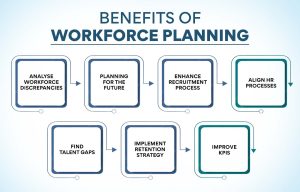
Implementing effective strategic workforce planning offers long-term organizational advantages.
Major Benefits of Workforce Planning
- Better talent management
- Improved workforce productivity
- Reduced hiring costs
- Stronger leadership pipelines
- Increased employee engagement
- Better business continuity planning
- Enhanced organizational agility
As industries become more competitive, workforce strategy is increasingly influencing overall business performance.
Career Opportunities in Workforce Planning
The growing focus on workforce optimization has created demand for professionals skilled in workforce analytics, HR strategy, and talent management.
Popular Career Roles
| Role | Average Salary Range |
| Workforce Planning Analyst | ₹5 LPA – ₹10 LPA |
| HR Business Partner | ₹8 LPA – ₹20 LPA |
| Talent Management Specialist | ₹6 LPA – ₹15 LPA |
| Organizational Development Manager | ₹10 LPA – ₹22 LPA |
| Workforce Strategy Consultant | ₹12 LPA – ₹25 LPA |
Salary estimates are based on publicly available industry reports and recruitment trends.
Professionals with expertise in strategic workforce planning are increasingly valuable across industries such as IT, healthcare, BFSI, manufacturing, consulting, and e-commerce.
Challenges Organizations Face in Workforce Planning
Despite its importance, implementing effective workforce planning strategies can be challenging.
Common Workforce Planning Challenges
| Challenge | Recommended Solution |
| Skill shortages | Invest in employee training |
| Rapid technology changes | Promote continuous learning |
| Workforce resistance | Improve communication |
| Data limitations | Use analytics-driven tools |
| Leadership gaps | Strengthen succession planning |
Organizations increasingly recognize that workforce strategy requires continuous improvement and long-term planning.
How Upskilling Supports Workforce Planning Careers
As workforce management becomes more technology-driven, professionals are increasingly pursuing specialized education and executive learning programs.
Why Professionals Pursue Workforce Planning and HR Programs
- To develop strategic leadership capabilities
- To understand workforce analytics
- To improve business decision-making
- To strengthen HR and organizational management skills
- To prepare for leadership and consulting roles
Continuous learning is becoming essential for professionals involved in modern workforce planning and organizational strategy functions.



How Jaro Education Supports Future Workforce Leaders
Professionals aiming to strengthen their expertise in workforce strategy, leadership, operations management, and organizational development can explore industry-oriented executive education programs through Jaro Education.
As an online higher education and upskilling platform, Jaro Education collaborates with reputed institutions to help professionals access flexible and career-oriented learning opportunities aligned with evolving market demands.
Executive Programme in Operations Management and Analytics – IIT Delhi
The Executive Programme in Operations Management and Analytics by IIT Delhi is a comprehensive course designed to help professionals develop expertise in operations, analytics, and data-driven decision-making. Offered through the Continuing Education Programme (CEP), the programme equips participants with practical knowledge of process optimization, operational strategy, supply chain management, and business analytics. By combining academic learning with real-world business applications, the course enables professionals to improve organizational performance, enhance operational efficiency, and make informed decisions in today’s rapidly evolving business environment.
Programme Highlights
| Category | Details |
| Programme Name | Executive Programme in Operations Management and Analytics |
| Institution | IIT Delhi (CEP) |
| Duration | 9 Months |
| Batch | 07 |
| Learning Format | Synchronous Live Online |
| Ideal Learners | Working professionals, managers, team leaders, and aspiring business strategists |
| Key Skills Covered | Operations management, business analytics, process improvement, data-driven decision-making |
Eligibility Criteria
- Graduates and diploma holders (10+2+3) are eligible to apply.
Screening and Selection
- Screening and selection will be conducted by IIT Delhi.
Admission Criteria
- Admissions are based on a holistic evaluation of the candidate’s academic qualifications and professional experience.
- Shortlisting will be conducted by the Programme Coordinators.
- If required, one-on-one interviews may be scheduled as part of the selection process.
Attendance Requirement
- A minimum of 50% attendance is mandatory, subject to IIT Delhi’s guidelines.
Bridging the Gap: Turning Insights into Strategy
By equipping professionals with advanced analytical tools, the IIT Delhi programme acts as a vital catalyst for modern workforce planning. Today, managing a team is no longer just a simple task—it requires a deep understanding of operational bottlenecks and data-driven forecasting.
Graduates learn to view talent management through the lens of optimization and predictive modeling, enabling leaders to:
- Forecast Demand: Use data to predict future business volumes, matching the exact headcount and skill sets needed to scale.
- Optimize Resources: Identify operational gaps and streamline workflows so the right people are always in the right roles.
- Improve Decision-Making: Rely on clear metrics instead of guesswork to manage attrition risks, succession planning, and capacity.
Ultimately, blending operational excellence with talent strategy ensures organizations stay lean, agile, and ready for whatever comes next.
Conclusion
As businesses increasingly adopt AI, automation, and data-driven decision-making, professionals who understand what is workforce planning and how to implement modern workforce strategies are becoming increasingly valuable across industries.
For professionals aspiring to leadership roles, HR strategy positions, or organizational development careers, continuous learning and upskilling can play a crucial role in long-term career growth. Choosing the right educational ecosystem can help professionals strengthen strategic thinking, workforce management expertise, and leadership capabilities relevant to modern business environments.
Jaro Education, through its collaborations with premier institutions, offers industry-oriented executive education programs that help professionals cultivate a strategic mindset, enhance data-driven decision-making, and develop the advanced leadership capabilities required to lead through complex, modern workforce and organizational challenges.
The future of workforce management is becoming increasingly strategic, technology-driven, and people-focused. Professionals who invest in continuous development today may be better prepared to lead tomorrow’s organizations.
Frequently Asked Questions
Workforce planning tools are digital platforms and analytics systems that help organizations manage workforce forecasting, talent analysis, employee performance, and resource allocation.

Related Courses
Explore our programs
 Admission Open
 Admission Open
 Admission OpenAdmission Open
Find a Program made just for YOU
We'll help you find the right fit for your solution. Let's get you connected with the perfect solution.

Is Your Upskilling Effort worth it?
 ROI Calculator

Are Your Skills Meeting Job Demands?
Try our Skill Gap tool
Experience Lifelong Learning and Connect with Like-minded Professionals
Explore Jaro Connect
