What Is the PMT Exam? Eligibility, Exam Pattern & Career Scope
J
By Bhargavi R
September 21, 20267 min read
Published on September 21, 2026
SHARE THIS ARTICLE
Table Of Content
What Is PMT Exam?
PMT Exam vs NEET
PMT Eligibility Criteria
PMT Question Paper and Exam Pattern
Key Insights
PMT stands for Pre Medical Test and was historically used for medical entrance examinations in India. AIPMT was replaced by NEET in 2017, which is now the common national entrance exam for undergraduate medical education.
The older PMT question paper focused on Physics, Chemistry, and Biology, while current aspirants should follow the latest NEET syllabus and examination pattern instead of relying on old PMT papers.
Effective PMT preparation involves building strong concepts, following the official syllabus, practicing questions, taking mock tests, and revising consistently. Students should prioritize recent NEET study material and official examination information.
The historical PMT entrance exam was linked to undergraduate medical education, while today's medical entrance pathway can lead to areas such as clinical practice, research, public health, healthcare administration, and other healthcare fields.
In this blog, you'll learn what the PMT exam, how it differs from NEET, its historical eligibility and exam pattern, the PMT question paper and preparation approach, and the career scope after medical entrance exams.
For students dreaming of a career in medicine, the entrance exam is often the first major step toward that goal. But if you have come across the term PMT exam while researching medical admissions, you may wonder what it actually means and whether it is still conducted today.
So, what is PMT exam? PMT stands for Pre Medical Test. The term was historically used for medical entrance examinations in India, including the All India Pre Medical Test (AIPMT). However, AIPMT was replaced by the National Eligibility cum Entrance Test (NEET) in 2017. Today, NEET UG is the common national entrance examination used for undergraduate medical admissions in India.
Understanding the difference between the older PMT system and the current NEET system is important for students planning their medical careers. This blog explains the meaning of PMT, its historical eligibility and pattern, how the PMT question paper was structured, what students should know about PMT preparation, and how medical entrance exams connect with career opportunities today.
PMT stands for Pre Medical Test. It was a term commonly associated with entrance examinations conducted for students seeking admission to undergraduate medical programs.
The All India Pre Medical Test (AIPMT) was one of the major national level medical entrance examinations before the introduction of NEET. Various states and institutions also used their own medical entrance tests for admissions.
The medical entrance system changed with the introduction of NEET. According to the National Testing Agency, NEET UG is now the common and uniform entrance examination for undergraduate medical education in medical institutions across India. It also applies to several other undergraduate health programs, including BAMS, BUMS, BSMS, and BHMS.
Therefore, students searching for PMT entrance exam information today should understand that PMT is mainly a historical term. Students currently preparing for undergraduate medical admission generally need to focus on NEET UG and the latest official eligibility, syllabus, and examination rules.
PMT Exam vs NEET
The biggest difference between the older PMT system and today’s medical entrance system is the structure of the examination process.
Earlier, students could encounter different medical entrance examinations depending on the institution or state. AIPMT was used as a national-level examination for medical admissions before NEET became the common entrance test.
NEET UG is now conducted by the National Testing Agency as the common national entrance examination for undergraduate medical education.
Feature
Earlier PMT System
Current System
Meaning
Pre Medical Test
National Eligibility cum Entrance Test
Purpose
Medical entrance admissions
Undergraduate medical admissions
National exam
AIPMT was a major national exam
NEET UG
Conducting body
Different exams had different authorities
National Testing Agency
Current status
Historical term
Current medical entrance system
This distinction is useful because many students still use the term PMT while searching online for medical entrance information.
The eligibility requirements associated with earlier PMT examinations varied depending on the specific examination. Generally, medical entrance aspirants needed a background in science subjects, particularly Physics, Chemistry, and Biology or Biotechnology.
For students preparing for medical admission today, it is better to refer to the latest NEET UG information bulletin rather than relying on older PMT eligibility rules.
The National Testing Agency publishes the official examination information, while the National Medical Commission finalizes the NEET syllabus. The NEET UG 2026 syllabus, for example, was finalized by the Undergraduate Medical Education Board of the NMC.
Students should check the latest requirements related to:
Educational qualifications
Required subjects
Age requirements
Qualifying examination
Category related requirements
Application documents
Admission rules
Eligibility can change, so students should always verify the requirements for the examination year in which they plan to apply.
PMT Question Paper and Exam Pattern
The older PMT question paper generally tested students on the core science subjects required for medical education. Physics, Chemistry, and Biology formed the foundation of medical entrance preparation.
However, students should not use an old PMT paper as the primary reference for today’s examination pattern. The current NEET UG pattern is determined by the NTA and the applicable NMC syllabus.
For NEET UG 2026, the examination consists of Physics, Chemistry, and Biology, with Biology divided into Botany and Zoology. The official pattern specifies 180 compulsory questions to be attempted in 180 minutes.
NEET UG 2026 Exam Pattern:
Subject
Questions
Marks
Physics
45
180
Chemistry
45
180
Biology
90
360
Total
180
720
The questions are multiple choice questions with four options and a single correct or best answer. The 2026 examination is conducted in pen and paper mode.
This is why students should always distinguish between an old PMT question paper and the latest NEET question paper when preparing for medical entrance examinations.
What Subjects Were Covered in the PMT Paper?
The older medical entrance examinations focused heavily on the science subjects studied at the senior secondary level.
Physics
Physics tested students on concepts, formulas, numerical problems, and their ability to apply scientific principles. Topics generally required both conceptual understanding and problem solving.
Chemistry
Chemistry required students to understand concepts across physical, organic, and inorganic chemistry. Regular practice was important because students needed to combine conceptual knowledge with accurate problem-solving.
Biology
Biology was particularly important for students targeting medical education. Questions focused on areas related to living organisms, human biology, plant biology, genetics, ecology, and other topics included in the prescribed syllabus.
For today’s preparation, students should follow the official NEET syllabus rather than relying entirely on old PMT papers. The NTA has published the NEET UG 2026 syllabus based on the syllabus finalized by the NMC.
Free Courses
Mastering Product Management: Roadmap,Vision, and Strategy
Although PMT preparation is often used as a search term, students preparing for medical entrance today should plan their preparation around the current NEET UG syllabus and examination pattern.
A good preparation strategy can begin with a clear understanding of the syllabus. Instead of studying every topic randomly, divide the syllabus into manageable sections and create a realistic study schedule.
1. Build Strong Concepts
Start by understanding the basic concepts in Physics, Chemistry, and Biology. Memorizing answers without understanding the underlying concept can make it difficult to handle unfamiliar questions.
2. Follow the Official Syllabus
The syllabus should be the foundation of your preparation. The NTA advises NEET candidates to refer to the finalized syllabus while preparing for the examination.
3. Practice Questions Regularly
Solving practice questions helps students become familiar with different question formats. It can also help identify topics that require additional revision.
4. Use Previous Papers Carefully
Old PMT papers can provide historical context and may help students understand how medical entrance examinations were structured in the past. However, current aspirants should prioritize recent NEET question papers and official examination material.
5. Take Mock Tests
Mock tests can help students practice time management and develop a strategy for attempting questions under examination conditions.
6. Revise Consistently
Regular revision is especially important for Biology and Chemistry, where students need to retain a large amount of information. Physics also benefits from repeated practice of formulas and numerical problems.
PMT Entrance Exam and Medical Career Scope
The historical PMT entrance exam was associated with the path toward undergraduate medical education. Today, NEET UG serves this role for undergraduate medical admissions in India.
Qualifying the current medical entrance examination can allow eligible students to participate in the admission process for various undergraduate healthcare programs, depending on the applicable rules and course requirements.
Medicine can lead to a wide range of professional areas. Students may eventually explore clinical practice, medical research, public health, healthcare administration, and specialized medical fields after completing the required education and training.
Medical education is only one part of the broader healthcare sector. Students can also explore areas such as dentistry, nursing, pharmacy, physiotherapy, biotechnology, nutrition, and other life science related fields through the relevant admission routes.
The specific course and career path will depend on the student’s qualifications, entrance examination performance, admission rules, and further education.
Career Scope After Medical Entrance Exams
Students who successfully enter undergraduate medical or related healthcare programs can build careers across several areas.
Some may choose direct patient care, while others may become interested in research, public health, medical education, healthcare organizations, or specialized fields.
The healthcare sector also continues to evolve with developments in medical technology, diagnostics, biotechnology, and digital healthcare. This creates different areas for students to explore as they progress through their education.
However, students should remember that qualifying an entrance examination is only the beginning. Professional healthcare careers generally require completion of the relevant degree, practical training, and any additional qualifications or registration required for the chosen profession.
Why Understanding the Old PMT System Still Matters
You may wonder why students should learn about PMT when NEET is the current national medical entrance examination.
The answer is simple. The term PMT exam still appears frequently in study material, websites, conversations, and searches related to medical entrance preparation. Understanding its history helps students avoid confusion when they come across old PMT question papers, preparation guides, or references to AIPMT.
It also makes it easier to distinguish older examination information from current admission requirements.
For current aspirants, the safest approach is to use official NEET information from the NTA and NMC for the latest syllabus, examination pattern, eligibility requirements, and application updates.
So, what is PMT exam? PMT stands for Pre Medical Test and was a term used for medical entrance examinations before the current NEET system. AIPMT, one of the major national level medical entrance examinations, was replaced by NEET in 2017.
Today, students planning undergraduate medical admissions should focus on NEET UG rather than preparing specifically for an old PMT entrance exam.
Understanding the history of PMT, reviewing old PMT papers for context, and then shifting to the latest NEET syllabus and examination pattern can help students approach medical entrance preparation more effectively. With consistent study, regular practice, revision, and a clear understanding of the current requirements, students can prepare for the next stage of their academic journey.
Frequently Asked Questions
PMT stands for Pre Medical Test. It was a term used for medical entrance examinations in India, but AIPMT was replaced by NEET in 2017. NEET UG is currently the common national entrance examination for undergraduate medical education in India.
Old PMT question papers can help students understand the history and style of earlier medical entrance examinations. However, current aspirants should prioritize the latest NEET syllabus, question papers, and official examination pattern.
The current NEET UG examination covers Physics, Chemistry, and Biology, with Biology including Botany and Zoology. For NEET UG 2026, the test has 180 compulsory questions to be attempted in 180 minutes.
PMT was a general term used for earlier medical entrance examinations, while NEET is the current common national entrance examination for undergraduate medical education in India. AIPMT was replaced by NEET in 2017.
Bhargavi R
HR Professional
Bhargavi Reddy is an HR professional with over 6 years of experience in IT recruitment and talent acquisition. She specializes in hiring across technologies like Java, DevOps, Python, and Data Engineering. With strong expertise in full-cycle recruitment and stakeholder management, she focuses on building high-performing teams. Currently, she works as an HR Manager driving strategic hiring initiatives.
Get Free Upskilling Guidance
Fill in the details for a free consultation
Related Courses
Explore our programs
Executive Programme in Healthcare Entrepreneurship and Management

 September 21, 2026
 7 min read





 Key Insights
 ChatGPT
 Perplexity
 Claude
 Grok
Grok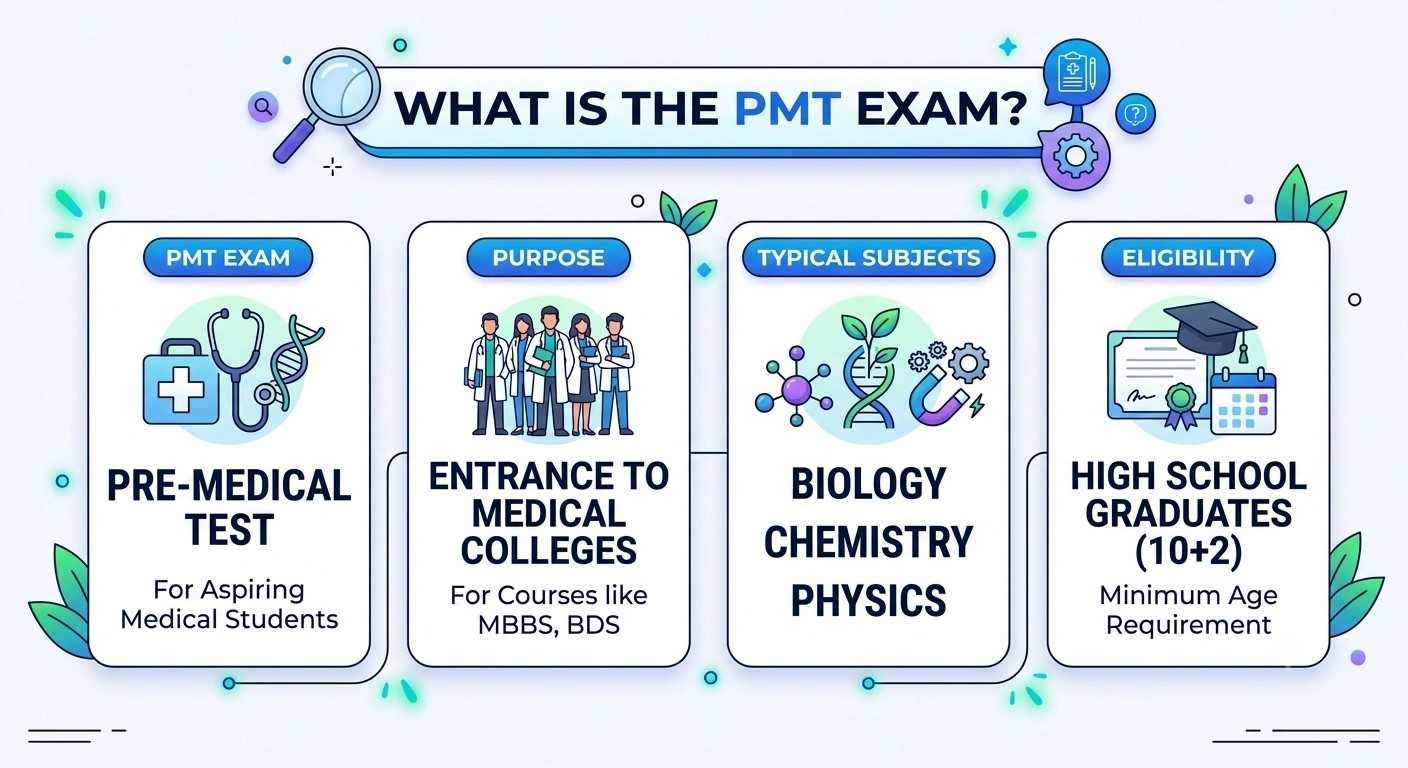









 ROI Calculator