The GRE is a standardized test used for admission to various graduate-level programs, assessing verbal reasoning, quantitative reasoning, and analytical writing skills.
GRE preparation should combine concept revision, practice, reading skills, vocabulary in context, quantitative problem-solving, and time management.
GRE General Test dates offer flexible scheduling based on available test-center slots, while the 2026–27 GRE Subject Test windows are September 14–27, 2026; October 19–November 1, 2026; and April 19–May 2, 2027.
Candidates should plan their test date around university application deadlines and allow enough time for preparation and scores to reach institutions.
In this blog, you'll learn about the GRE full form, exam structure, eligibility, sample questions, fees, dates, registration process, preparation strategies, scoring, and the difference between the General and Subject Tests.
The GRE exam is one of the widely recognized entrance tests for students planning to pursue graduate-level education. It is commonly considered by universities and business schools when evaluating applicants for master’s, specialized graduate, and other advanced degree programs. The test focuses on skills such as verbal reasoning, quantitative reasoning, and analytical writing rather than testing knowledge from one specific academic subject.
If you are planning to study abroad or apply to graduate programs that accept GRE scores, understanding the exam structure, eligibility requirements, registration process, fees, dates, and question types can help you plan your preparation more effectively.
This guide explains what is GRE exam, the GRE full form, GRE exam eligibility, GRE exam fee, GRE exam dates, sections, sample questions, preparation tips, and other important details.
The Graduate Record Examination, commonly known as the GRE, is a standardized test used as part of the admission process for various graduate-level programs. The GRE exam is designed to assess skills that can be useful for advanced academic study, including reading comprehension, quantitative reasoning, critical thinking, and written analysis.
The exam is available as the GRE General Test, while GRE Subject Tests assess knowledge in specific academic areas. The General Test is the version most students consider when applying to graduate and business programs.
A GRE score may form one part of an overall application. Universities can also consider academic records, statements of purpose, recommendation letters, work experience, and other admission requirements.
GRE Full Form
The GRE full form is Graduate Record Examination.
The examination is designed to evaluate skills rather than simply measure memorization. Its questions require candidates to understand information, interpret relationships, solve problems, analyze arguments, and communicate ideas clearly.
Why Take the GRE Exam?
The GRE can be useful for students who want to apply to graduate-level programs where the test is accepted or required. It can also provide an additional standardized measure that universities may use while reviewing applications.
Some common reasons students consider taking the GRE include:
Applying to certain business or specialized programs.
Demonstrating quantitative and verbal reasoning abilities.
Meeting the admission requirements of universities that accept GRE scores.
Keeping multiple graduate-study options open.
However, GRE requirements vary by university and program. Students should always check the admission requirements of their preferred institutions before registering for the examination.
One of the most common questions students ask is about GRE exam eligibility. Unlike examinations that require candidates to meet a specific academic percentage or age requirement, the GRE generally does not have a universal academic eligibility criterion for appearing in the General Test.
Students planning to take the GRE should primarily ensure that they have valid identification documents and meet the registration requirements applicable to their test location.
However, eligibility for admission to a particular graduate program is separate from eligibility to take the GRE. A university may have specific requirements related to undergraduate education, academic performance, work experience, prerequisite subjects, or other qualifications.
Therefore, before preparing for the GRE, candidates should review both the test registration requirements and the admission requirements of their target programs.
GRE Exam Pattern
The GRE General Test evaluates three major areas:
1. Analytical Writing
This section assesses your ability to express ideas clearly, support arguments, examine claims, and construct logically organized responses.
Candidates need to demonstrate clear reasoning and effective written communication. Strong grammar is helpful, but the section also emphasizes how effectively you analyze and present an argument.
2. Verbal Reasoning
The Verbal Reasoning section measures your ability to understand written material, analyze relationships between words and concepts, and reason from information provided in passages.
Questions can involve reading comprehension, text completion, and sentence equivalence. Vocabulary knowledge can be useful, but understanding context and identifying logical relationships are equally important.
3. Quantitative Reasoning
The Quantitative Reasoning section tests mathematical reasoning and problem-solving abilities. Questions generally involve concepts such as arithmetic, algebra, geometry, and data interpretation.
The focus is not simply on performing calculations. Candidates also need to identify relationships, interpret information, and select appropriate methods to solve problems.
GRE Exam Sample Questions
Practicing GRE exam sample questions can help candidates understand how questions are framed and where they need additional preparation.
Here are a few representative examples.
Sample Question 1: Verbal Reasoning
Question: Although the manager was initially ______ about the proposal, additional evidence eventually convinced her to support it.
A. enthusiastic B. skeptical C. certain D. indifferent E. confident
Answer: B. skeptical
The sentence indicates that the manager was initially doubtful but later changed her opinion after receiving more evidence.
Sample Question 2: Quantitative Reasoning
Question: If a number is increased by 20% and becomes 120, what was the original number?
A. 80 B. 90 C. 100 D. 110
Answer: C. 100
If the original number is x, then 120% of x equals 120. Therefore, x = 100.
Sample Question 3: Quantitative Reasoning
Question: A rectangle has a length of 12 units and a width of 5 units. What is its area?
A. 17 square units B. 30 square units C. 60 square units D. 120 square units
Answer: C. 60 square units
Area = length × width = 12 × 5 = 60 square units.
Sample Question 4: Reading Comprehension
Question: A passage explains how urban transportation systems have changed because of increasing populations and changing commuter preferences.
If the author discusses several transportation alternatives and compares their advantages, what is the most likely purpose of the passage?
A. To describe one transportation system B. To compare different transportation options C. To criticize urban development D. To explain population growth
Answer: B. To compare different transportation options
These examples demonstrate the importance of reasoning and interpretation. Candidates should practice different question formats instead of focusing only on memorizing formulas or vocabulary.
Free Courses
Stakeholder Communication & Negotiation Skill Sets
The GRE exam fee can vary depending on the test type and location. For candidates taking the GRE in India, the General Test fee is listed at ₹22,550. Additional charges may apply for services such as rescheduling, changing a test center, requesting additional score reports, or score-related services.
Because examination fees can change, candidates should verify the applicable fee when completing registration.
Planning the overall budget is also important. Apart from the GRE exam fee, students may need to consider preparation materials, coaching, travel to a test center if applicable, and university application expenses.
GRE Exam Dates
Unlike examinations that have one fixed annual date, the GRE General Test offers flexible scheduling. Candidates can select available test dates based on their preferred location and available slots.
Therefore, GRE exam dates can vary depending on the test center and location. Students should ideally plan their test date according to their university application deadlines.
For students taking a GRE Subject Test, the schedule is different. The Subject Tests are conducted during designated testing windows. For the 2026–27 testing year, the listed testing windows are September 14–27, 2026; October 19–November 1, 2026; and April 19–May 2, 2027.
Candidates should avoid selecting a test date too close to an application deadline. Giving yourself sufficient preparation time and allowing time for scores to reach institutions can make the application process more manageable.
How to Register for the GRE Exam
GRE registration involves several basic steps:
Create or access your test account.
Select the GRE test you want to take.
Choose a test location and available date.
Provide the required personal and identification details.
Review the registration information carefully.
Pay the applicable examination fee.
Save the confirmation and test details for future reference.
Candidates should ensure that the name and identification information used during registration match their valid identification documents.
GRE Exam Preparation Tips
Preparing for the GRE requires a combination of concept revision, practice, and time management. A structured study plan can make preparation more manageable.
Understand the Exam First
Before beginning intensive preparation, understand the sections, question types, scoring approach, and test structure. This helps you identify which areas require more attention.
Take a Diagnostic Test
Begin with a practice test to understand your current level. A diagnostic score can help you identify whether verbal reasoning, quantitative reasoning, or analytical writing requires greater focus.
Build Vocabulary Through Context
For verbal preparation, do not rely only on memorizing long vocabulary lists. Learn how words are used in context and practice identifying relationships between words.
Practice Quantitative Concepts
Revise fundamental mathematical conceptsand solve different types of problems. Focus on understanding the method rather than memorizing answers.
Improve Reading Skills
Read different types of passages and practice identifying the main idea, supporting information, author’s purpose, and logical relationships.
Practice Under Time Limits
Solving questions correctly is important, but completing them within the available time is equally valuable. Include timed practice sessions as your preparation progresses.
Review Your Mistakes
After every practice session, analyze incorrect answers. Identify whether the mistake occurred because of a concept gap, calculation error, misunderstanding, or time pressure
GRE General Test vs GRE Subject Test
The GRE General Test and GRE Subject Tests serve different purposes.
The General Test focuses on verbal reasoning, quantitative reasoning, and analytical writing. It is the more commonly considered GRE option for students applying to graduate and business programs.
Subject Tests, on the other hand, measure achievement in specific academic disciplines. Currently, the available Subject Tests include Mathematics, Physics, and Psychology.
Students should select the test based on the requirements of their target university and program rather than assuming that every graduate program requires the same examination.
The ideal preparation period depends on your existing skills, target score, academic background, and daily study schedule.
Some students may need a few months of structured preparation, while others may require more time to strengthen vocabulary, mathematics, reading comprehension, or analytical writing.
A practical preparation plan can include three stages:
Stage 1: Assessment – Take a diagnostic test and identify strengths and weaknesses.
Stage 2: Skill Building – Revise concepts and practice individual question types.
Stage 3: Test Practice – Take full-length practice tests and work on accuracy, timing, and test-taking strategy.
Consistency is generally more useful than studying for long hours only occasionally.
GRE Score and Its Importance
GRE scoring depends on the individual sections of the General Test. Verbal Reasoning and Quantitative Reasoning are scored separately, while Analytical Writing receives its own score.
A strong GRE score can support an application, but there is no single score that guarantees admission. Universities and programs can have different expectations, and the importance given to GRE scores can vary.
Students should therefore research the score expectations of their preferred programs and set a target based on those requirements.
Final Thoughts
The GRE exam can be an important part of the graduate school application process for students applying to programs that accept or require GRE scores. Understanding what is GRE exam, its structure, GRE exam eligibility, sample questions, registration process, GRE exam fee, and GRE exam dates can help candidatesplan their preparation with greater confidence.
Rather than preparing only by solving random questions, candidates should first understand the exam, assess their current abilities, build a realistic study schedule, and regularly review their mistakes. Most importantly, check the requirements of your target universities before registering because GRE policies and admission requirements can vary across programs.
Frequently Asked Questions
The GRE is a standardized test used by many graduate and business programs as part of their admission process. It assesses verbal reasoning, quantitative reasoning, and analytical writing skills.
The GRE General Test fee in India is currently listed at ₹22,550. Additional charges may apply for services such as rescheduling, changing a test center, or requesting additional score reports.
There is no universal academic eligibility requirement for taking the GRE General Test. However, individual universities and graduate programs can have their own admission requirements, so candidates should check them before applying.
Candidates can take the GRE General Test multiple times, subject to the applicable testing rules and scheduling availability. Students should also consider how each attempt fits into their application timeline.
Start by understanding the exam pattern and taking a diagnostic test. Then focus on your weaker areas, practice GRE-style questions, take timed tests, and analyze your mistakes regularly.
Shubham Lal
Lead Software Developer
Shubham Lal joined Microsoft in 2017 and brings 8 years of experience across Windows, Office 365, and Teams. He has mentored 5,000+ students, supported 15+ ed-techs, delivered 60+ keynotes including TEDx, and founded AI Linc, transforming learning in colleges and companies.

 August 26, 2026
 8 min read





 Key Insights
 ChatGPT
 Perplexity
 Claude
 Grok
Grok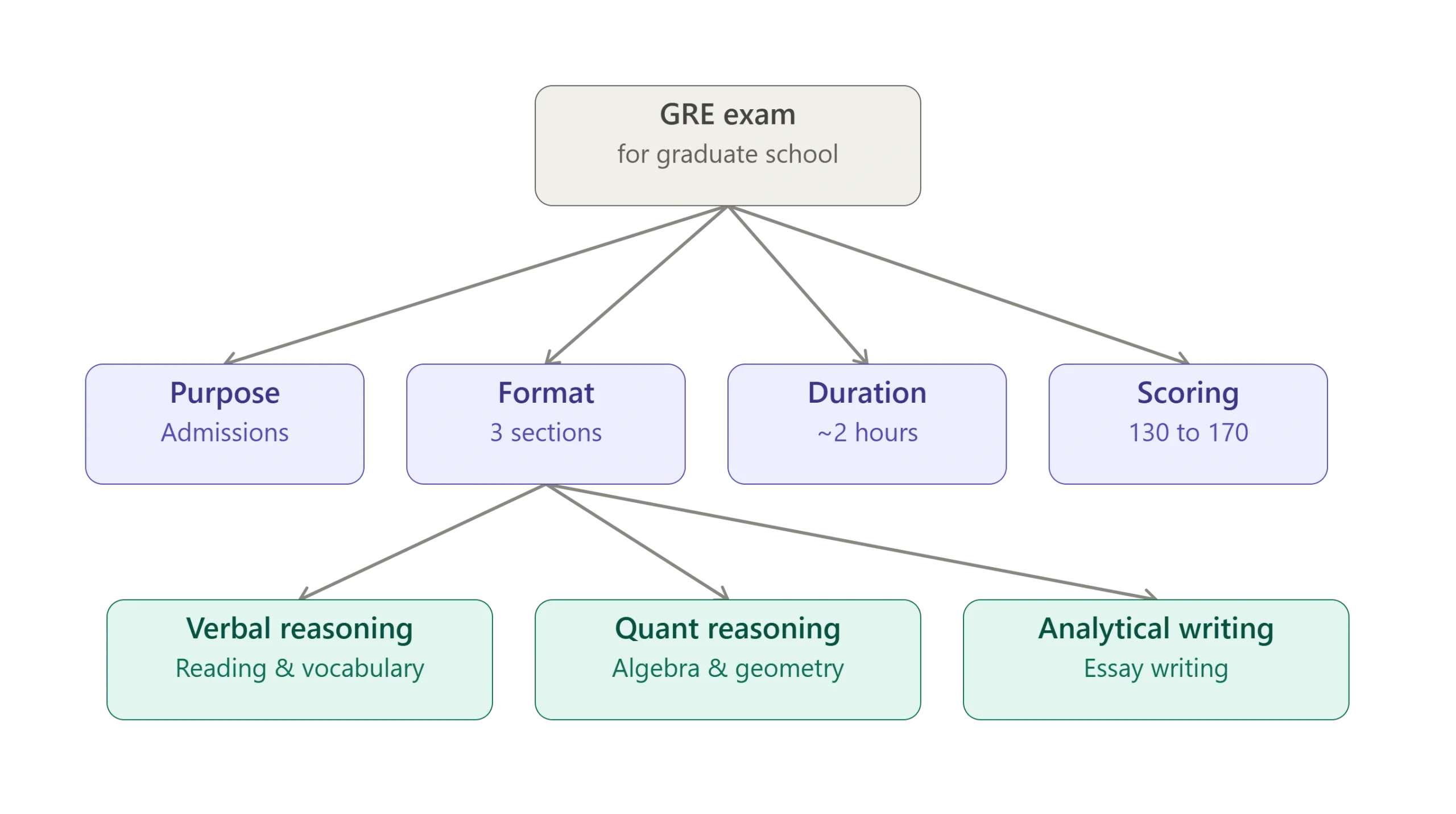












 ROI Calculator