
Complete Guide to CET Exams in India: Types & Preparation Tips
 March 25, 2026
 6 min read





Table Of Content
- Types of CET Exams in India
- Expected CET Exam Timelines for 2026
- CET Exam Preparation Tips
- Conclusion
Common Entrance Test, or CET, is an umbrella term that covers a large array of entrance exams conducted at the state and university levels in India. The Common Entrance Test is conducted to simplify the admissions procedure in professional courses. The test is an assessment of the student’s readiness and is based on the principle of fairness and merit-based selection. The test is generally a set of multiple-choice questions related to the chosen field.
 ChatGPT
 Perplexity
 Claude
 Grok
GrokTypes of CET Exams in India
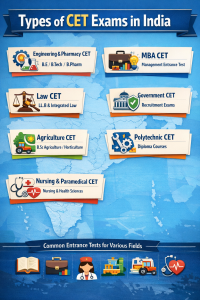
Now that you have clarity on what is CET exam, the next step is understanding the range it actually covers because this is where most confusion begins.
1. Engineering & Pharmacy CET Exams
This is perhaps one of the most popular categories. Exams such as MHT CET (Maharashtra Common Entrance Test) come under this category, which is conducted for admission to Engineering (B.E./B.Tech.) and Pharmacy (B.Pharm, Pharm .D.)
Subjects Covered:
- Physics
- Chemistry
- Mathematics (for engineering students)
- Biology (for pharmacy/medical students)
While both fall under the same CET framework, the preparation approach differs slightly.
2. MBA CET (Management Entrance CET)
If your goal is management programs such as Master of Business Administration or Master of Management Studies, then this is where everything changes completely. Unlike the engineering CET exam, this exam does not test your knowledge in academic subjects. Instead, it tests your aptitude and your ability to make decisions.
Core Sections Include:
- Logical reasoning
- Quantitative aptitude
- Verbal ability
- Abstract reasoning (in some cases)
This exam is less about what you have studied in school and more about your way of thinking. And here’s something that students realize a bit too late, practice matters more than theory. The more questions you solve, the more your approach will improve.
3. Law CET (For Legal Studies)
For students who are interested in pursuing a career in law, CET examinations are conducted for courses such as the 3-year LL.B. and 5-year integrated law programs. This category is a bit different from others as it requires a mix of knowledge and awareness.
Subjects Typically Covered:
- Legal aptitude
- General knowledge & current affairs
- Logical reasoning
- English comprehension
What makes this exam unique and exciting is that it requires curiosity. Students who are aware and keep themselves updated about current affairs and have a fair idea about law and other subjects will be able to perform better in this exam. It’s not just about studying; it’s about being aware.
4. Government CET (Recruitment-Based CET Exams)
But now this is where CET extends beyond academics. Several states have also introduced CET as an examination for screening candidates for government jobs. One such prominent example is the Rajasthan CET. Instead of taking several preliminary examinations, the candidates can now qualify and move ahead with the examination process by clearing the CET examination.
Subjects Covered:
- General knowledge
- Current affairs
- Reasoning ability
- Basic mathematics
- Language proficiency
These examinations are more generic and require constant preparation and study over time. For several students out there, the promise of job security and growth with government jobs is well worth the struggle.
5. Agriculture CET Exams
This is a field that usually does not get enough recognition but it should. Agriculture CET exams are conducted for admission into courses such as B.Sc Agriculture, B.Sc Horticulture, B.Sc Forestry, and B.Tech Agricultural Engineering.
Subjects Usually Include:
- Biology
- Chemistry
- Agriculture-related concepts
- Physics/mathematics
With India’s growing interest in sustainable farming practices, this field is offering more job opportunities than ever before. Students interested in science but looking for options other than engineering and medicine often look to this category as an interesting opportunity.
6. Polytechnic CET Exams (Diploma Courses)
The Polytechnic CET exams are for students who want to pursue diploma courses in technical fields. The courses are usually taken after Class 10 and lead to Diploma in Engineering, technical certifications, and early employment.
Subjects Covered:
- Mathematics
- Science
- Basic reasoning
The practicality of this route lies in the skill-based training and the exposure it provides.
7. Nursing & Paramedical CET Exams
Unlike pharmacy, this field focuses more on patient care and clinical support within the healthcare system. The CET exam in this field is conducted for admission into Nursing programs, Paramedical courses, and Allied health sciences.
Subjects Include:
- Biology
- Chemistry
- Basic physics
- Health-related awareness
The healthcare industry is growing at a rapid pace, and this field promises stability as well as growth in the long run.
Expected CET Exam Timelines for 2026
While official notifications are released closer to the exam cycle, here is a general timeline based on recent trends:
| CET Exam Type | Expected Timeline (2026) |
| Engineering CET (e.g., MHT CET) | April – May |
| MBA CET | March – May |
| Government CET (State-level) | Varies (often mid-year) |
In recent developments, several CET exams are expected to be conducted multiple times a year, offering students more than one opportunity to appear. But remember this shift brings with it flexibility, as well as competition.
CET Exam Preparation Tips
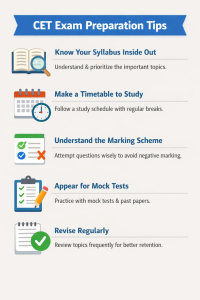
The CET entrance is very competitive but can be easily passed with the right preparation. Here are some tips to improve your success:
1. Know Your Syllabus Inside Out
First and foremost, it is imperative that you know your CET exam syllabus. You need to mark the important points and prioritize them based on your strengths, weaknesses, and the weightage of the topics. This will help you in your preparation and guide your overall strategy.
2. Make a Timetable to Study
It is very important that you make a timetable and stick to it while preparing for the exam. Break your study time into smaller intervals and take short breaks in between. This will help you stay refreshed and maintain consistency throughout your preparation.
3. Understand the Marking Scheme & Attempt Strategically
The marking scheme of most CET exams is fixed. They offer +1 for the correct answer and negative marking for incorrect ones. So, it is important that you do not attempt the exam blindly. In case of doubt, it is better to leave the question than attempt it and lose marks. A strategic approach can significantly improve your overall score.
4. Appear for Mock Tests
Mock tests and previous years’ papers are essential parts of preparation. They not only help you understand how to take the test and manage time but also highlight areas where you need improvement.
5. Revise the Study Material at Regular Intervals
It is not just the new material that matters; revision is equally important. Regularly revisiting what you have already studied helps in better retention and improves accuracy during the exam.
Conclusion
Think of the CET exam syllabus as a roadmap. It shows you the destinations, but the way you reach them depends entirely on your strategy. A systematic and consistent approach, even with the same level of effort, is far more effective than a disorganized one.
If you are someone who is interested in exploring direct and career-focused programs without the need for multiple MBA entrance exams, there are options available.
For instance, Jaro Education offers access to professional programs from top B-schools and top-rated institutions, including:
- MBA and Management programs
- Technology and data-driven programs
- Executive programs
These programs are designed for students who are looking for a more structured, career-focused approach, often with industry exposure integrated into the learning experience.
Frequently Asked Questions
Yes, while CET exams are a common route, students can also explore alternative pathways such as professional programs offered by reputed institutions. Platforms like Jaro Education provide access to industry-relevant programs in management and technology without relying solely on entrance exams.

Related Courses
Explore our programs







Find a Program made just for YOU
We'll help you find the right fit for your solution. Let's get you connected with the perfect solution.

Is Your Upskilling Effort worth it?
 ROI Calculator

Are Your Skills Meeting Job Demands?
Try our Skill Gap tool
Experience Lifelong Learning and Connect with Like-minded Professionals
Explore Jaro Connect
