MBA students aiming for top B-schools often go for the NMAT by GMAC as one of the most flexible and easy entrance exams. Every year, thousands of students take the NMAT because it is not as difficult as CAT, yet it offers a flexible exam window and the option to retake it multiple times.
For NMAT 2026, over 75,000 people plan to take it. They are aiming to join MBA or PGDM courses at schools like NMIMS and at more than 20 partner universities in India and abroad, places like South Africa, Morocco, Hungary, the Philippines, and Nigeria.
Unlike many MBA entrance exams, NMAT allows candidates to retake the exam up to three times within the testing window. The best score among the attempts is considered for admission shortlisting. This feature significantly reduces exam pressure and allows students to improve their scores.
Another unique aspect of the exam is that it is a computer-adaptive test (CAT). This means the difficulty level of questions changes depending on how you answer previous questions.
Although NMAT is often considered easier than exams like CAT or XAT, it still requires structured preparation, strong fundamentals, and consistent practice. In this detailed guide, we will cover the NMAT 2026 exam pattern, section-wise preparation strategy, syllabus understanding, test-taking strategies, and expert tips to help you prepare effectively.
Before starting your preparation, it is essential to understand the basic structure and format of the exam. Knowing the exam pattern helps candidates build a realistic preparation plan.
Here are the key highlights of the NMAT 2026 exam.
Feature
Details
Conducting Body
Graduate Management Admission Council (GMAC)
Exam Window
Tentatively November – December 2026
Exam Mode
Test Centre (Computer Based) or Online Proctored at Home
Attempts Allowed
Up to 3 attempts
Gap Between Attempts
Minimum 15 days
Type of Test
Computer Adaptive Test
Score Range
36 – 360
NMAT 2026 Exam Pattern
NMAT consists of three sections, and each section has a fixed number of questions and a specific time limit. Candidates cannot save time in one section and use it for another section.
Section
Number of Questions
Time Limit
Score Range
Language Skills
36
28 minutes
12–120
Quantitative Skills
36
52 minutes
12–120
Logical Reasoning
36
40 minutes
12–120
Total
108
120 minutes
36–360
Important Features of NMAT
No negative marking
Sectional time limits
Adaptive question difficulty
Candidates cannot return to previous questions
The section order can be chosen by the candidate
The NMAT Syllabus
*collegedunia.com
NMAT doesn’t list a set syllabus, but past papers show it mostly covers high school math, logic, and English. Here’s the detailed overview of the syllabus for each section:
1. Language Skills
In the NMAT Syllabus, the Language Skills section checks how well you read English and use grammar. Thus, it is advised to increase your reading habits and vocabulary knowledge. This also helps you score well in this section.
You’ll face:
Reading long texts with many questions
Vocabulary drills
Synonyms and antonyms
Filling gaps in sentences
Fixing wrong sentences
Reordering paragraph parts
Cloze tests
Matching words and phrases
2. Local Reasoning
Local reasoning helps to test a candidate’s analytical thinking abilities, and this is one of the most important parts of the test. This part is used to identify your patterns, thoughts, and methodologies. The topic generally covers:
Syllogism
Blood relations
Input-output
Data sufficiency
Seating arrangements
Critical reasoning
Series and pattern recognition
3. Quantitative Skills
The Quantitative Skills section focuses on mathematics concepts commonly taught in high school.
Preparing for NMAT comes with aligning your study with a plan that targets each exam section specifically. Time in the exam is quite tight, and every section has a fixed number of questions, so candidates are advised to focus their preparation on perfecting speed and accuracy simultaneously.
Here is a sectional preparation strategy for the NMAT exam that covers all three sections.
Strategy for Quantitative Skills
Quantitative Skills is a 36-question section to be finished in 52 minutes. Usually, the 4 main areas of mathematics are the basis of the problem for this section.
Conceptual understanding of math basics is the first thing one should get right in preparing for this section. The candidates should start by making sure that they know very well the basic topics like number properties, odd and even numbers, prime numbers, LCM, and HCF before tackling tougher problems.
Since NMAT has strict time limits, calculation speed plays an important role. Improving your mental math ability can help you solve questions much faster.
Strategy for Logical Reasoning
There are 36 logic questions, and you get 40 minutes to solve them. This part checks how well you read, identify patterns, and figure out what makes sense. Questions usually come in two types: Verbal Reasoning and Analytical Reasoning.
Verbal reasoning generally takes more time than analytical reasoning. You will need to practice thoroughly both to gain speed and accuracy in the section.
We suggest that you never use any information that is not mentioned in the questions, as there is no standard formula set for this section. Thus, you can go through various NMAR previous papers to understand question types.
You need to have a solid understanding to identify the questions to be done first and those you do not want to opt for. For example, if you know you can solve data sufficiency questions, then you should attempt them; otherwise, leave the section and move on.
Last thing, yet very important: logical reasoning skills do not develop overnight. You need regular practice and the right approach to deal with the section.
Strategy For Language Skills
This section has 36 questions to be solved in 28 minutes. Most questions are vocabulary-based, which can be quickly solved.
As mentioned above, the section tests your three aspects, i.e., grammar, comprehension, and vocabulary. Now, how to deal with this section? Well, here’s the right strategy.
First things first, to enhance the vocabulary and comprehension, make sure to regularly read the editorial section of newspapers. This will increase your contextual usage of words and improve your comprehension skills.
Get on grammar rules; this should be revised properly, as it solves 50% of the problem. For learning English grammar rules, go through English Grammar in Use by Raymond Murphy.
General Tips for NMAT 2026
Honestly, preparing for the NMAT exam is more than just subject knowledge; it is about time management, demand strategy, and a deep understanding of the exam’s syllabus and format. So, here we have shared NMAT exam tips by GMAC.
Understand the Syllabus
The first approach for NMAT prep is understanding the syllabus and the type of each question in different sections. The exam pattern is categorised into two arts, i.e., concept-based and practice-based. Thus, start by learning the core concept of each section. Go through formulas, rules, and different solving strategies that save your time.
Plan your Strategy that meets the NMAT’s Unique Format
The NMAT exam is a computer-adaptive test. It means that the level of difficulty of each following question changes based on your response to the current one. For example, a correct answer will prompt a more difficult question, whereas an incorrect answer reduces the difficulty level. You cannot revise the previous question to alter the answers. Thus, it is essential to answer questions in each section within the allotted time. An overall score of 235+ is considered excellent, with benchmarks of 71 in QS, 75 in LR, and 80 in LS.
Attempt With Strategy: Build Accuracy, Maintain Flow, Finish Fast
A smart way to attempt each NMAT section is to divide it into three stages. First, focus on accuracy while solving the initial questions. A strong start helps maintain a good difficulty level in the adaptive test.
Next, during the middle part, try to maintain consistency. Solve questions steadily and skip those that seem too time-consuming to avoid losing valuable time.
Finally, in the last phase, increase your speed so that all questions are attempted before time runs out. Since NMAT has no negative marking, making educated guesses for difficult questions is better than leaving them unanswered.
The role of mock tests
While preparation is crucial, it is not sufficient on its own. Thus, we recommend you take a mock test with real exam conditions. This helps you acclimate to NMAT’s actual format and create a better strategy. You can go for the official NMAT mock tests by GMAC, which are still the perfect and trusted resources available.
*bschool.careers360.com
Explore MBA Learning Opportunities with Jaro Education
If you are planning to pursue an MBA after clearing NMAT, Jaro Education can help you explore the right learning opportunities. Jaro Education collaborates with leading universities and offers online MBA and executive programmes designed to build strong business, leadership, and analytical skills for working professionals and graduates. Their programs include industry-relevant specialisations such as marketing, finance, operations, and business analytics while offering flexible learning formats and career support.
You can also read their insightful guide on “Online MBA Programs: The Ultimate Guide” to understand MBA options, career opportunities, and how to choose the right program for your goals.
Preparing for NMAT 2026 is not just about completing the syllabus but also involves devising a strategy, consistent practice, and smart test-taking skills. Having a solid grasp on quantitative concepts, regular practice of reasoning questions, and enhancement of vocabulary and reading ability are key factors that can help candidates substantially increase their performance.
Besides that, one needs to take mock tests and timed practice to get familiar with the speed and confidence required for the exam. Also, it is to be noted that NMAT allows multiple attempts, which means you can try to get a better score. In short, with the right preparation, regular study, and a focused mindset, one can achieve the highest NMAT score and come one step closer to pursuing an MBA at a prestigious university.
Frequently Asked Questions
The official cut-off for NMAT 2026 will be announced after the exam results. Based on previous trends, the expected cut-off for NMAT college for NMIMS Mumbai is around 209 overall score, with sectional cut-offs around 62. Note, for MBA Pharmaceutical Management, the cut-off may be slightly lower.
Candidates must have a Bachelor’s degree with at least 50% marks from a recognised university. Final-year undergraduate students are also eligible to apply. There is no age limit and no mandatory work experience requirement.
The NMAT exam consists of 108 questions divided into three sections:
Language Skills
Quantitative Skills
Logical Reasoning
The total exam duration is 120 minutes, and there is no negative marking.
Candidates can attempt the NMAT exam up to three times within the testing window. There must be a minimum gap of 15 days between two attempts. Only the best score is considered for admission shortlisting.
The official NMAT registration fee for 2026 will be announced by GMAC. Based on previous years:
One attempt: around ₹3,000
Two attempts: around ₹5,400
Three attempts: around ₹7,800
Bhargavi R
HR Professional
Bhargavi Reddy is an HR professional with over 6 years of experience in IT recruitment and talent acquisition. She specializes in hiring across technologies like Java, DevOps, Python, and Data Engineering. With strong expertise in full-cycle recruitment and stakeholder management, she focuses on building high-performing teams. Currently, she works as an HR Manager driving strategic hiring initiatives.

 April 23, 2026
 7 min read





 ChatGPT
 Perplexity
 Claude
 Grok
Grok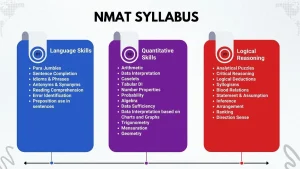




 Admission Open
 Admission Closed

 Admission Closed
 Admission Open

 ROI Calculator



