Brand equity is the value a brand adds to a product beyond its features and price, built on customer trust and perception.
A strong brand brings customer loyalty, premium pricing, a competitive advantage, and lower marketing costs over time.
Keller's brand equity model is a four-level pyramid (identity, meaning, response, and relationships) that leads to brand resonance.
Brand equity grows through a clear identity, consistent quality and messaging, positive customer experiences, and steady effort over time.
No single method measures brand equity perfectly, so combining customer-based and financial methods gives a more balanced view.
In this blog, you'll learn the meaning, types and components of brand equity, Keller's model, and how to build and calculate brand equity.
Why do many people pay more for a certain pair of sneakers, a smartphone, or a cup of coffee when a cheaper option offers nearly the same quality? The answer is often the brand. A strong name builds trust, creates a feeling of familiarity, and makes customers feel confident about their choice. This hidden value is known as brand equity.
In this blog, we explain brand equity in simple terms, along with its types, components, models, and the steps to build and measure it. Whether you are a student, a marketer, or a business owner, these basics will help you understand why a brand can be one of a company's most valuable assets.
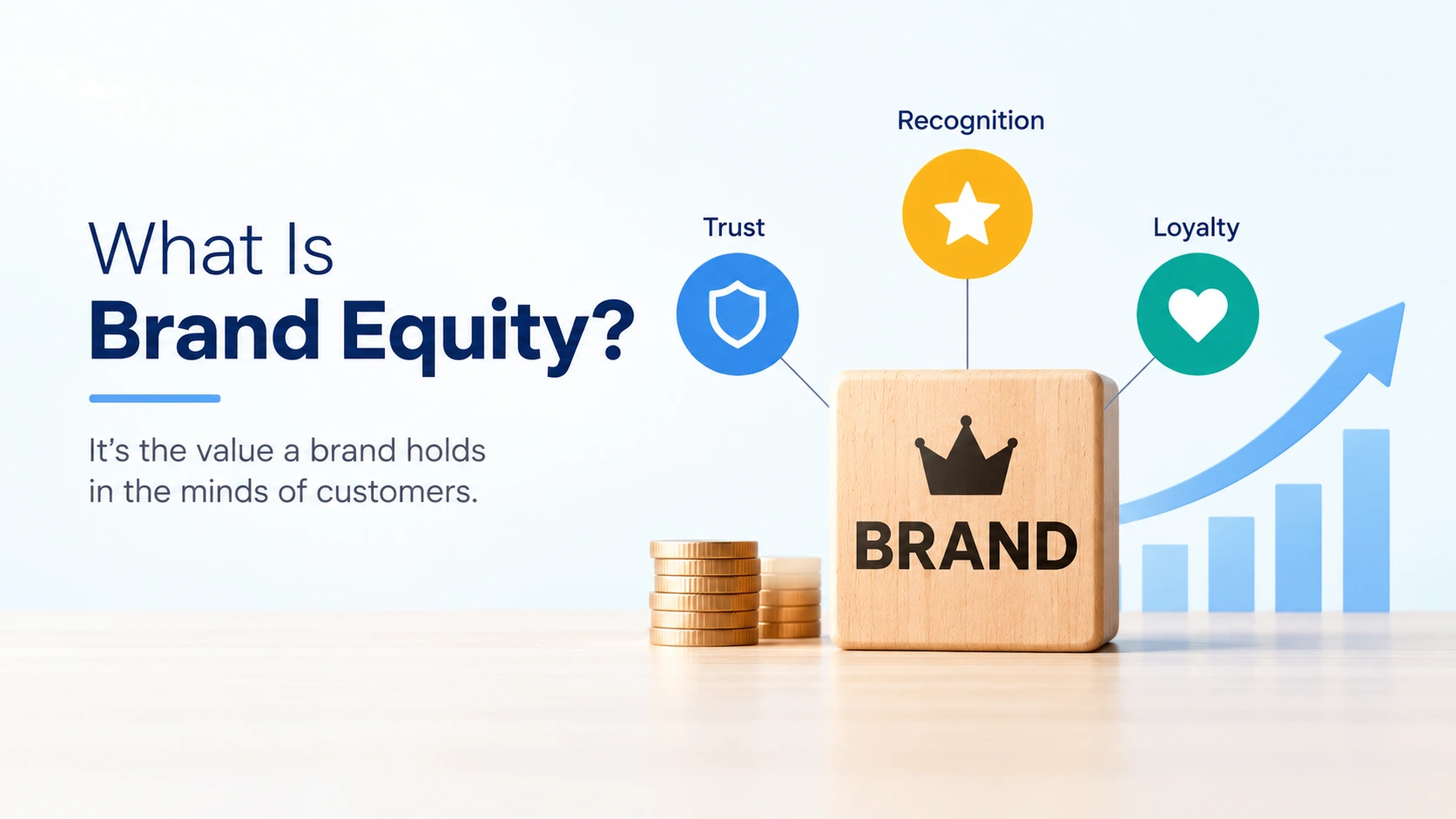
The brand equity meaning is straightforward. Brand equity is the value a brand adds to a product or service, beyond its basic features and price. It reflects how customers think, feel, and act toward a brand based on their past experiences and perceptions.
Consider two bottles of water that are identical in quality. If customers are willing to pay more for one simply because they trust and recognize the name, that extra value comes from brand equity.
Brand equity can be positive or negative:
Positive brand equity: Customers prefer the brand, trust it, recommend it, and are ready to pay more for it.
Negative brand equity: Customers avoid the brand because of poor quality, bad service, or a damaged reputation. They may choose competitors even at a higher price.
Because it shapes buying decisions, brand equity is considered a long-term asset that grows with consistent effort.
Why Brand Equity Is Important
A strong brand does more than make a company look good. It supports business growth in many practical ways:
Customer loyalty: People who trust a brand tend to buy again and stay loyal, even when competitors offer discounts.
Premium pricing: Customers are often willing to pay more for brands they value, which improves profit margins.
Competitive advantage: A well-known brand is difficult to copy, which helps it stand out in a crowded market.
Easier product launches: When a trusted brand introduces a new product, customers are more likely to try it.
Lower marketing costs over time: Strong brands benefit from word-of-mouth and repeat business, which reduces the need for heavy promotion.
Better talent and partnerships: Employees, investors, and business partners are more attracted to respected brands.
Stronger business value: Brand equity adds to the overall worth of a company, which matters in investments, mergers, and acquisitions.
In short, brand equity helps a company earn trust today and protect its future.
Brand equity can be understood from different angles. Two common ways of classifying it are explained below.
1. Customer-based brand equity
This type looks at how customers see the brand. It depends on their awareness, knowledge, and feelings about it. If customers recognize a brand, associate it with quality, and feel positive about it, its customer-based equity is high. Most marketing strategies aim to improve this type.
2. Financial brand equity
This type looks at the monetary value of the brand to the company. It considers how much extra revenue, profit, or business value the brand creates compared with an unbranded or weaker alternative. It is often used by finance teams, investors, and analysts.
3. Positive, neutral, and negative equity
Based on customer perception, brand equity can also be seen as positive, neutral, or negative. A neutral brand has little impact on buying choices, while a negative one actively pushes customers away.
Marketing scholar David Aaker described brand equity as a set of assets that add to or subtract from the value of a product. These are commonly grouped into five components:
Brand awareness: How easily customers can recognize or recall the brand.
Brand associations: The thoughts, images, and values that come to mind when people hear the brand name.
Perceived quality: The customer’s opinion of how good the product or service is compared with others.
Brand loyalty: The tendency of customers to keep choosing the same brand.
Other proprietary assets: Items such as trademarks, patents, and distribution relationships that protect the brand.
When these five elements work together, they create strong and lasting brand equity.
Keller's Brand Equity Model
One of the most widely taught frameworks is Keller’s brand equity model, also called the Customer-Based Brand Equity (CBBE) model. Developed by Professor Kevin Lane Keller, it explains that a strong brand is built step by step, starting with basic awareness and moving toward deep customer connection. It is often shown as a pyramid with four levels.
Level 1: Brand identity (Who are you?)
The first step is to make customers aware of the brand and ensure they connect it with a specific product category or need. This is known as brand salience.
Level 2: Brand meaning (What are you?)
Here, customers learn what the brand stands for. This includes performance, which is how well the product meets practical needs, and imagery, which is the emotional and social picture the brand creates.
Level 3: Brand response (What do I think or feel about you?)
At this stage, customers form opinions and emotions. Judgments relate to quality, credibility, and value, while feelings relate to warmth, excitement, or security.
Level 4: Brand relationships (What about you and me?)
The top of the pyramid is brand resonance, where customers feel a strong bond with the brand. They are loyal, they engage with it, and they may even become advocates who recommend it to others.
The model shows that building brand equity is a gradual process. Each level depends on the one before it, so skipping steps rarely works.
How to Build Brand Equity
If you are wondering how to build brand equity, the process takes patience and consistency. These practical steps can help:
Define a clear brand identity: Decide your purpose, values, and personality, and be clear about what makes you different.
Know your audience: Understand customer needs, habits, and expectations so your message feels relevant.
Deliver consistent quality: Reliable products and service are the base of trust. Even great marketing cannot fix a poor experience.
Keep messaging and visuals consistent: Use the same logo, tone, and style across your website, packaging, social media, and advertising.
Create positive customer experiences: Helpful support, simple processes, and respectful communication encourage loyalty.
Tell authentic stories: Share your brand’s purpose and values honestly so customers can connect emotionally.
Encourage reviews and word-of-mouth: Satisfied customers are a powerful source of credibility.
Engage on digital platforms: Respond to feedback, share useful content, and stay active where your audience spends time.
Protect your reputation: Handle complaints quickly and openly, since one poor experience can spread fast.
Stay consistent over time: Brand equity grows through steady effort, not short-term campaigns.
How to Calculate Brand Equity
Measuring brand equity is not as simple as measuring sales, because part of it lies in the minds of customers. Businesses usually combine several methods to get a clear picture. Here is how to calculate brand equity using common approaches.
1. Customer-based methods
These methods measure perception through surveys, interviews, and focus groups. Companies track factors such as brand awareness, recall, perceived quality, customer satisfaction, loyalty, and willingness to recommend. Tools like the Net Promoter Score (NPS) are often used to understand how likely customers are to recommend the brand.
2. Price premium method
This approach compares the price of a branded product with a similar unbranded or generic product. The difference shows how much extra customers are willing to pay because of the brand.
Price premium = Price of branded product – Price of comparable generic product
Revenue premium method
This method compares the revenue earned by the branded product with that of a similar unbranded product. The extra revenue earned is credited to the strength of the brand.
Financial valuation methods
These methods estimate the brand’s overall monetary worth. Common approaches include:
Cost approach: Estimates how much it would cost to create a similar brand from scratch.
Market approach: Uses the price paid for similar brands in the market, such as in acquisitions.
Income approach: Estimates the future earnings the brand is expected to generate and converts them into a present value.
A simple formula often used for a basic estimate is:
Brand equity = Value of the branded business – Value of the same business if it were unbranded
No single method is perfect. Using both customer-based and financial measures gives a more balanced view, and tracking results over time shows whether your brand-building efforts are working.
Brand equity is the extra value a brand creates through trust, recognition, and positive experiences. It influences customer loyalty, pricing power, and long-term business success. By understanding its components, learning from models like Keller’s pyramid, and using practical steps to build and measure it, businesses can turn a simple name into a lasting asset. For anyone studying or working in marketingand management, brand equity remains a core concept worth mastering.
Frequently Asked Questions
Brand equity is the added value a brand gives to a product or service because of customer trust, recognition, and perception. It explains why people may choose or pay more for one brand over another, even when the products are similar.
According to David Aaker, the main components are brand awareness, brand associations, perceived quality, brand loyalty, and other proprietary assets such as trademarks and patents.
Keller’s brand equity model, or the CBBE model, is a four-level pyramid that shows how brands build strength with customers. The levels are identity, meaning, response, and relationships, which together lead to brand resonance.
Yes. Small businesses can build brand equity by offering consistent quality, giving excellent customer service, sharing an honest brand story, and staying active on digital platforms. Size matters less than trust and consistency.
Priya Sahu
Sales & Digital Marketing Strategist
Sales and Marketing professional with 6+ years of experience in B2B and B2C growth, specializing in business development and digital marketing. Skilled in CRM systems, paid campaigns, and AI-driven strategies to drive revenue, optimize performance, and build lasting client relationships.
Get Free Upskilling Guidance
Fill in the details for a free consultation
Related Courses
Explore our programs
Post Graduate Certificate Programme in Strategic Product Management

 October 28, 2026
 7 min read





 Key Insights
 ChatGPT
 Perplexity
 Claude
 Grok












 ROI Calculator