Price is one of the most powerful profit levers. McKinsey estimates that a 1% price increase raises operating profit by about 8.7% on average, assuming no loss of volume.
The ten strategies in this guide are cost-plus, competitive, value-based, dynamic, penetration, skimming, psychological, bundle, freemium and subscription, and consumption-based pricing.
Value-based pricing sets price by what customers believe the product is worth, not by what it costs you to make.
Dynamic pricing changes prices with demand and supply, and in some sectors, such as ride-hailing in India, it operates within regulatory limits.
The right pricing model depends on your costs, customers, competition and product, and it should be tested before it is scaled.
In this blog, you'll learn ten pricing strategies, how pricing models differ, how to choose and test a price, and common mistakes.
Most businesses spend months on product features and marketing, then set the price in an afternoon. That is a costly habit. Price decides who can buy, how your product is perceived and how much of every sale becomes profit.
According to McKinsey, a 1% price increase translates into an 8.7% increase in operating profit on average, assuming volume does not fall. That assumption is crucial, but the point stands: small pricing improvements can have an outsized effect. This guide explains ten pricing strategies, the main pricing models and how to choose between them.
A pricing strategy is the method a business uses to set the price of its products or services. It considers costs, customer willingness to pay, competitor prices and business goals such as growth, profit or market share. Pricing is one of the four elements of the marketing mix, so it helps to understand the 4Ps of marketing first.
Pricing Strategy vs Pricing Model
The two terms are often confused. A pricing strategy is the approach to deciding the price level, such as premium, low-cost or value-based. A pricing model is the structure of how customers pay, such as one-time purchase, subscription, tiered plans or pay-per-use. You choose a strategy to set the level and a model to set the structure, and the best results come from aligning them.
Add a fixed margin to your cost of making the product. It is simple and ensures every sale covers costs, but it ignores what customers are willing to pay and can leave money on the table. Always check against your break-even point so you know the minimum viable price.
Best for: commodity goods, contract work and businesses with stable costs.
2. Competitive Pricing
Set your price relative to competitors, at, above or below the market rate. It keeps you in line with the market, but it can start price wars and ignores your own differentiation. A low-price approach only works if your costs are lower too, as our guide to cost leadership and competitive pricing explains.
Best for: markets with similar products and price-sensitive buyers.
3. Value-Based Pricing
Value-based pricing sets the price according to the value customers perceive, such as time saved, revenue gained or risk reduced. To use it well, you need to understand customer segments and their needs, so read about market segmentation and positioning.
A simple example: a software tool that saves a finance team 100 hours a month can reasonably be priced against that saving, not against the cost of the servers that run it.
Best for: differentiated products, B2B services and software where value is measurable.
4. Dynamic Pricing
Dynamic pricing adjusts prices in response to demand, supply, time or customer behaviour. Airlines, hotels and ride-hailing apps are well-known users. Done well, it improves capacity use and revenue. Done poorly, it can anger customers.
In India, regulation matters. Under the Motor Vehicle Aggregator Guidelines 2025, as reported by Business Standard, aggregators can charge up to twice the base fare at peak times and must charge at least 50% of the base fare off-peak. States can set their own rules, and some have taken a stricter stance, so always check the local position.
Best for: perishable inventory, variable demand and platform businesses.
5. Penetration Pricing
Launch with a low price to win customers quickly and gain market share, then raise prices later. It works when there are network effects, high switching costs or large scale advantages, but it requires the financial strength to absorb early losses. Disruptive entrants often use it, as our article on disruptive business models shows.
Best for: new entrants in crowded markets with scale economics.
6. Price Skimming
Start with a high price for early adopters, then lower it over time as demand from that group is exhausted. Technology products and new launches commonly use this approach. It recovers development costs fast, but it can attract competitors who undercut you.
Best for: innovative products with few substitutes.
7. Psychological Pricing
Small presentation choices can change how a price feels. Examples include ending prices in 9, such as ₹499 instead of ₹500, anchoring a standard plan next to a premium one and offering “3 for 2” bundles. These tactics work because of how people judge value, which you can explore in our guide to consumer behaviour and psychology. Use them honestly and test their effect.
Best for: retail, e-commerce and consumer services.
8. Bundle Pricing
Sell several products together at a combined price that is lower than buying them separately. Bundles raise average order value and move slower-selling items, but you must make sure the discount still protects your margins.
Best for: businesses with complementary products or services.
9. Freemium and Subscription Pricing
Freemium offers a free basic version and charges for premium features. Subscription pricing charges a recurring fee, usually monthly or annually, often in tiers. Both lower the barrier to entry and create predictable revenue, but you need a clear upgrade path and strong retention. Our guide to SaaS models for business explains the economics.
Best for: software, media, education and membership businesses.
10. Consumption-Based Pricing
Consumption-based pricing, also called usage-based or pay-as-you-go pricing, charges customers according to how much they use, such as per API call, per gigabyte or per transaction. Cloud infrastructure and utilities commonly work this way. It aligns cost with value and removes upfront commitment, but revenue is less predictable, so forecasting and clear usage dashboards are important.
Best for: infrastructure, data and platform services with measurable usage.
Pricing Models Compared
Pricing model
How customers pay
Strength
Watch out for
One-time (fixed)
A single price per unit
Simple and clear
No recurring revenue
Subscription
Recurring fee
Predictable revenue
Churn
Tiered
Plans with different features
Serves several segments
Complex packaging
Per-user or per-seat
Price per user
Easy to scale with teams
Customers limiting seats
Usage or consumption-based
Pay for what you use
Fair and flexible
Revenue variability
Freemium
Free base, paid upgrades
Fast adoption
Low conversion if value is unclear
Dynamic
Price changes with demand
Maximises revenue and capacity
Customer backlash and regulation
Which Pricing Strategy Fits Which Business?
There is no universal winner, but some pairings work more often than others. A manufacturer with stable costs often starts with cost-plus and adds competitive checks. A software company usually combines value-based pricing with subscription tiers and, increasingly, usage-based components. A retailer relies on psychological pricing, bundles and promotions. A marketplace or ride-hailing platform uses dynamic pricing to balance supply and demand. A new entrant with deep pockets may use penetration pricing, while a company with a breakthrough product may use skimming. Many businesses blend two or three strategies, for example value-based pricing for the core product, bundles for add-ons and dynamic discounts for slow periods.
Understand your customers: research willingness to pay across segments through surveys, interviews and data.
Study competitors: know where you sit in the market, and why.
Decide your goal: growth, profit, market share or premium positioning lead to different choices.
Match strategy to product: a commodity suits competitive pricing, while a differentiated product suits value-based pricing.
Understand demand: concepts like elasticity help you predict how volume responds to price. Our overview of managerial economics is a useful primer.
How to Test and Improve Your Prices
Prices should be tested, not guessed. Run controlled experiments such as A/B tests on pricing pages, regional trials or limited-time offers, and track conversion, revenue per customer and churn rather than only unit sales. Use data to find patterns, such as which customers accept higher prices, which discounts actually drive purchases and where you lose deals. Our guides to marketing analytics for business decisions and how small businesses can use data science to maximise profits show practical approaches.
Pricing only on cost: you may undercharge for the value you deliver.
Copying competitors blindly: their costs and customers differ from yours.
Discounting too often: frequent discounts train customers to wait and erode brand value.
Ignoring segments: one price rarely fits every customer.
Hiding fees: surprise charges damage trust.
Never revisiting prices: costs, competition and demand change, so prices should too.
Skipping tests: small experiments are cheaper than big mistakes.
Forgetting the sales team: if reps do not understand the value story behind a price, they will default to discounting.
Conclusion
Pricing is one of the fastest ways to improve profit, and one of the easiest to get wrong. Start with your costs and customers, choose a strategy that fits your product and goals, structure it with the right pricing model and test before you scale. Revisit prices regularly as your market changes, and treat every price as a hypothesis that data can confirm or correct.
If you want to learn pricing and product strategy in depth, the Advanced Strategy for Products and Marketing and Advanced Analytics for Products and Marketing programmes from IIM Kozhikode are delivered online live over 14 months as a dual certification, or 7 months for a single programme, for graduates with at least three years of work experience. The strategy programme covers pricing strategy and positioning, and the analytics programme covers methods such as conjoint analysis used in pricing decisions. Check the programme page for current details.
Frequently Asked Questions
Pricing strategies are the methods businesses use to set prices, based on costs, customer value, competition and goals. Common ones include cost-plus, competitive, value-based, dynamic and penetration pricing.
Value-based pricing sets the price according to the value customers perceive, such as savings or benefits, rather than the cost of producing the product.
Dynamic pricing changes prices in response to demand, supply, timing or customer behaviour. Airlines, hotels and ride-hailing apps commonly use it, and some sectors have regulatory limits.
Consumption-based pricing charges customers according to usage, such as per transaction, gigabyte or API call. It is common in cloud and data services.
A strategy decides the price level and positioning, such as premium or low-cost. A model decides how customers pay, such as subscription, tiered or pay-per-use.
Common models are one-time pricing, subscription, tiered, per-user, usage-based, freemium and dynamic pricing.
Understand your costs, customers and competitors, define your goal, match the strategy to your product and test prices before scaling.
Review at least annually and whenever costs, competition or demand change significantly. Track conversion, margins and churn to spot when a change is needed.
Priya Sahu
Sales & Digital Marketing Strategist
Sales and Marketing professional with 6+ years of experience in B2B and B2C growth, specializing in business development and digital marketing. Skilled in CRM systems, paid campaigns, and AI-driven strategies to drive revenue, optimize performance, and build lasting client relationships.
Get Free Upskilling Guidance
Fill in the details for a free consultation
Related Courses
Explore our programs
Achieving Excellence in Marketing: Programme for Marketing Executives

 October 11, 2026
 7 min read




 Key Insights
 ChatGPT
 Perplexity
 Claude
 Grok
Grok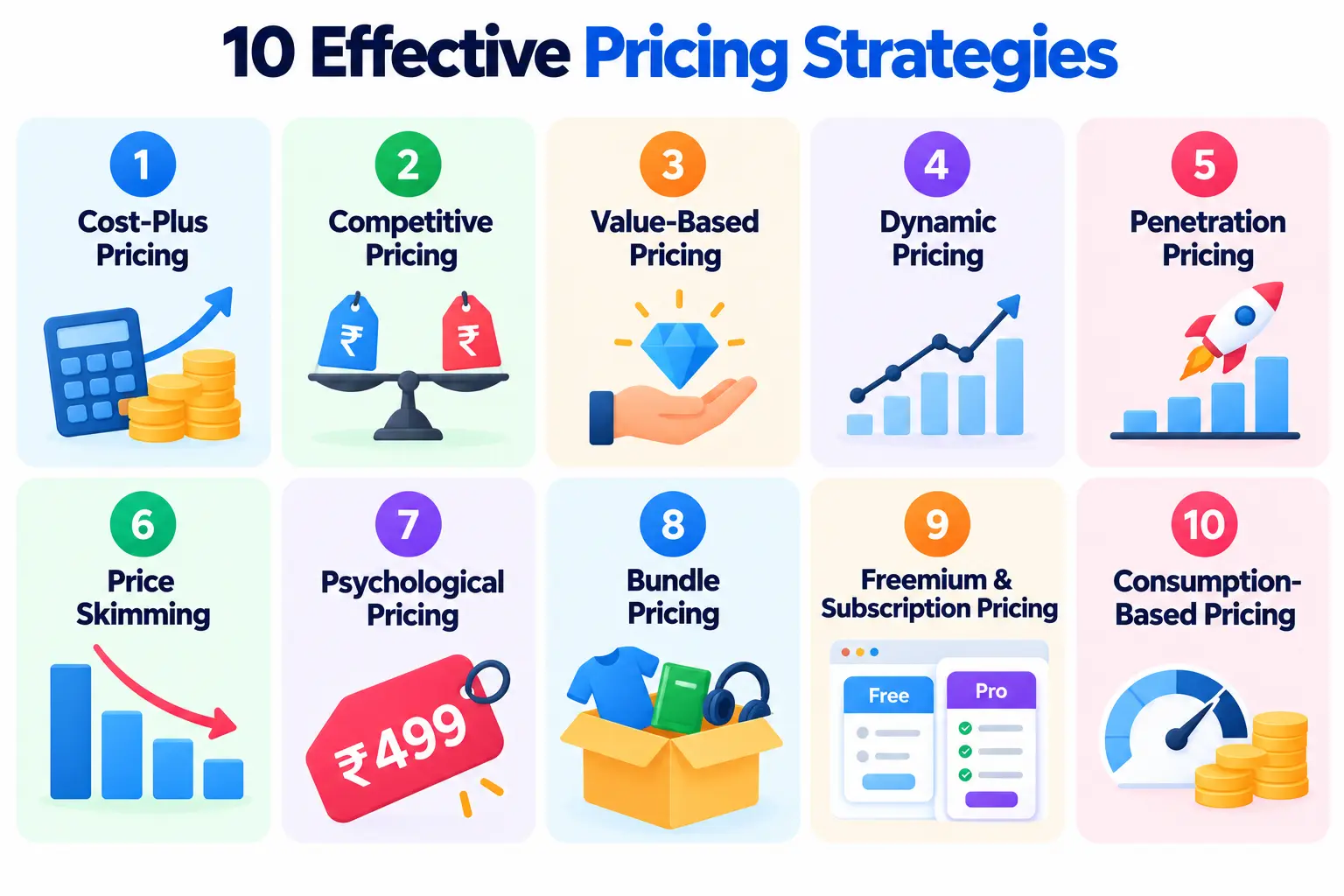











 ROI Calculator



