HOME > BLOG > Business Analytics > Business Analyst Certification: Courses, Eligibility & Career Scope in 2026
Business Analytics
Business Analyst Certification: Courses, Eligibility & Career Scope in 2026
J
By Shubham Lal
September 30, 20268 min read
Published on September 30, 2026
SHARE THIS ARTICLE
Table Of Content
What Is a Business Analyst Certification?
Why Consider a Business Analyst Certification in 2026?
Business Analyst Certification Courses
Business Analyst Certification Online: What Can You Learn?
Key Insights
A business analyst certification provides structured knowledge in areas such as requirements analysis, stakeholder communication, business processes, data analysis, and solution evaluation.
Certification options such as IIBA ECBA, CCBA, and CBAP are designed for different career stages, from beginners to experienced business analysis professionals.
Business analyst certification online programs can offer flexible learning and may cover requirements gathering, process analysis, data analysis, documentation, problem-solving, and Agile business analysis.
Business analyst training can help develop analytical thinking, communication, stakeholder management, requirements management, problem-solving, and data skills. However, certification alone does not guarantee a job or career advancement.
In this blog, you'll learn about business analyst certification courses, eligibility requirements, online learning options, Google’s relevant Career Certificates, essential skills, career scope, and how to choose the right certification course in 2026.
Businesses today generate large amounts of information, manage complex processes, and constantly look for better ways to improve performance. But data and information alone do not create business value. Organizations need professionals who can understand business needs, analyze problems, communicate with stakeholders, and translate requirements into practical solutions.
This is where business analysts play an important role.
If you are considering a career in business analysis, a business analyst certification can help you build structured knowledge and demonstrate your understanding of business analysis practices. There are also several business analyst certification online options that allow learners to study at their own pace while continuing their education or careers.
From entry-level credentials such as IIBA's ECBA to advanced certifications such as CBAP, there are learning paths for different experience levels. Google also offers career certificates in areas such as data analytics and business intelligence that can complement business analysis skills.
Let's explore business analyst certification courses, eligibility, skills, and career scope in 2026.
A business analyst certification is a professional credential that validates knowledge or skills related to business analysis. Depending on the certification, it may cover areas such as requirements analysis, stakeholder communication, business processes, data analysis, solution evaluation, and planning.
Certification is different from a degree. A degree provides broader academic education, while a certification generally focuses on a particular professional skill set or standard.
For example, the International Institute of Business Analysis (IIBA) offers three core certifications at different career stages:
Entry Certificate in Business Analysis (ECBA)
Certification of Capability in Business Analysis (CCBA)
Certified Business Analysis Professional (CBAP)
IIBA also offers specialized certifications in areas such as Agile Analysis, Business Data Analytics, Cybersecurity Analysis, and Product Ownership Analysis.
Why Consider a Business Analyst Certification in 2026?
Business analysts work between business teams, technical teams, customers, and other stakeholders. Their work can involve understanding requirements, analyzing processes, identifying business problems, and helping teams make informed decisions.
A certification can provide a structured way to develop this knowledge.
Some potential benefits include:
Builds Structured Business Analysis Knowledge
A certification course can help you learn business analysis concepts in an organized manner instead of relying only on scattered online resources.
Supports Career Development
A recognized credential can demonstrate that you have studied a defined body of knowledge. This can be useful when building a resume or preparing for business analysis roles.
Develops Practical Skills
Good business analyst training can cover requirements gathering, stakeholder communication, process analysis, documentation, and analytical techniques.
Provides a Learning Roadmap
For beginners, choosing what to study can be confusing. A certification provides a defined learning path and examination goal.
However, certification should not be viewed as a replacement for practical experience. Business analysis also requires communication, problem-solving, analytical thinking, and the ability to work with different stakeholders.
Business Analyst Certification Courses
There is no single certification that every business analyst must complete. The right option depends on your experience, career goals, and the type of work you want to pursue.
1. IIBA ECBA
The Entry Certificate in Business Analysis (ECBA) is designed for people developing foundational business analysis knowledge. IIBA states that there are no specific eligibility requirements to sit for the ECBA exam, although candidates must agree to its professional standards and certification terms.
This makes the ECBA relevant for beginners, students, professionals moving into business analysis, and people who want to establish foundational knowledge.
The ECBA competency areas include business analysis knowledge, planning and monitoring, elicitation and collaboration, requirements life cycle management, and requirements analysis and design definition.
2. IIBA CCBA
The Certification of Capability in Business Analysis (CCBA) is intended for professionals with approximately two to three years of business analysis experience.
According to IIBA’s current eligibility requirements, candidates need at least 3,750 hours of business analysis work experience within the previous seven years, 21 hours of professional development within the previous four years, and two references. The work experience must also meet specific BABOK Guide knowledge-area requirements.
Therefore, CCBA is generally more suitable for professionals who have already gained practical experience.
3. IIBA CBAP
The Certified Business Analysis Professional (CBAP) is an advanced business analysis certification for experienced professionals.
IIBA requires at least 7,500 hours of business analysis work experience within the previous 10 years, 35 hours of professional development within the previous four years, and two references. Specific experience requirements across BABOK Guide knowledge areas also apply.
This makes CBAP more appropriate for experienced business analysis professionals rather than someone just starting out.
4. PMI Professional in Business Analysis
Another option is the PMI Professional in Business Analysis (PMI-PBA) from the Project Management Institute. PMI describes it as a certification focused on business analysis skills and currently lists it among its professional certifications.
The PMI-PBA eligibility requirements vary according to educational background and experience. For example, candidates with a secondary degree need 60 months of business analysis experience within the previous eight years, while candidates with a bachelor’s degree or higher need 36 months. The certification also requires 35 contact hours of business analysis education.
Business Analyst Certification Online: What Can You Learn?
A business analyst certification online can be a convenient option for learners who want flexible study.
Depending on the program, online business analyst training may cover topics such as:
Business analysis fundamentals
Requirements gathering
Stakeholder communication
Requirements life cycle management
Business process analysis
Data analysis
Problem-solving techniques
Documentation
Solution evaluation
Agile business analysis
IIBA also provides online remote-proctored certification exams for its certifications, while CCBA and CBAP are additionally available at PSI test centers.
When choosing an online course, look beyond the certificate name. Check the curriculum, instructor experience, practical assignments, exam preparation, learning format, and whether the course fulfills any professional development requirement associated with the certification you want.
Google Business Analyst Certification: What Should You Know?
The term Google business analyst certification is commonly used when people search for Google programs related to business analysis. However, Google’s current Career Certificate offerings include Google Data Analytics and Google Business Intelligence rather than a certificate officially titled “Google Business Analyst Certification.”
The Google Data Analytics Certificate is available online and is designed for beginners, with no prior experience or degree required. It covers areas such as data analysis, data visualization, SQL, spreadsheets, and Tableau. Google states that the program can generally be completed in three to six months with flexible study.
Google also offers a Business Intelligence Certificate for learners with some prior experience. The program covers business intelligence analysis, data modeling, ETL processes, dashboards, reporting, and stakeholder engagement, with tools including BigQuery, Tableau, and SQL.
These programs can complement business analysis skills, particularly if you are interested in data-driven decision-making and business intelligence.
Eligibility for Business Analyst Certification
Eligibility depends entirely on the certification you choose.
For an entry-level business analyst certification course, prior professional experience may not be necessary. For example, IIBA’s ECBA currently has no specific eligibility requirements.
Intermediate and advanced certifications generally require professional experience. CCBA requires 3,750 hours of business analysis experience, while CBAP requires 7,500 hours.
Similarly, PMI-PBA has experience requirements based on educational qualifications.
Before enrolling, always check the current requirements of the certification body because eligibility rules, examination policies, and professional development requirements can change.
Skills Covered in Business Analyst Training
A good business analyst training program should help you develop both technical and professional skills.
Analytical Thinking
Business analysts need to examine information, identify patterns, understand problems, and break complex situations into manageable parts.
Requirements Management
Understanding and documenting what stakeholders need is a core part of business analysis.
Communication
Business analysts regularly communicate with different groups. Clear writing, active listening, questioning, and presentation skills can therefore be valuable.
Stakeholder Management
Different stakeholders may have different priorities. Business analysts need to understand these perspectives and help create clarity around requirements and expectations.
Problem-Solving
The role often involves identifying business problems and helping teams evaluate possible solutions.
Data Skills
Modern business analysis increasingly involves working with data. Knowledge of spreadsheets, SQL, dashboards, and visualization can complement traditional business analysis skills.
The exact role depends on the candidate’s education, work experience, technical knowledge, industry, and career goals.
For example, someone interested in data may combine business analysis with SQL, visualization, and business intelligence. Someone working in technology may focus more on requirements, systems, Agile methods, and stakeholder collaboration.
How to Choose the Right Business Analyst Certification Course
Choosing a business analyst certification course becomes easier when you first understand your current career stage.
If you are a beginner, look for a foundational program that introduces business analysis concepts and practical techniques. ECBA is one example of a certification designed for this stage.
If you already have two to three years of business analysis experience, you may explore an intermediate certification such as CCBA. Experienced professionals with five or more years of relevant experience may consider CBAP, subject to its detailed eligibility requirements.
You should also consider whether you want to specialize in areas such as Agile, data analytics, cybersecurity, or product ownership. IIBA offers specialized credentials in these areas.
Is Business Analyst Certification Worth It in 2026?
A certification can be useful when it matches your career stage and learning objectives. It can provide structured learning, help demonstrate knowledge, and support professional development.
At the same time, a certificate alone does not guarantee a job or career advancement. Employers may also look at practical experience, communication abilities, analytical thinking, industry knowledge, technical skills, and the ability to solve real business problems.
For beginners, combining certification with projects, case studies, data tools, and practical exercises can create a more well-rounded learning journey.
Conclusion
Business analysis continues to connect business needs with practical solutions, making it a relevant career area for professionals interested in problem-solving, technology, data, and business strategy.
A business analyst certification can give learners a structured way to develop their knowledge, while business analyst certification online programs provide flexibility for students and working professionals. Certifications such as IIBA ECBA, CCBA, and CBAP cater to different experience levels, while PMI-PBA offers another professional pathway.
If you are considering a Google business analyst certification, it is important to understand that Google’s current relevant career certificate options include Data Analytics and Business Intelligence rather than a credential officially named “Google Business Analyst Certification.”
Ultimately, the right business analyst certification course depends on where you are today and where you want your career to go. A combination of certification, practical business analyst training,technical skills, and real-world experience can help you build a stronger foundation for this career path.
Frequently Asked Questions
IIBA’s ECBA is designed for foundational business analysis knowledge and currently has no specific eligibility requirements. It can be considered by students, beginners, and professionals entering business analysis.
Yes. Several business analysis certifications and training programs can be completed online. IIBA also offers its certification exams through online remote proctoring, while some exams have additional test-center options.
Google currently offers career certificates such as the Google Data Analytics Certificate and Google Business Intelligence Certificate, rather than a certificate officially titled “Google Business Analyst Certification.” These programs can develop data and business intelligence skills relevant to business analysis.
Yes, some entry-level certification pathways do not require prior professional experience. For example, IIBA states that there are no specific eligibility requirements for the ECBA exam. Building practical skills through projects and training can also help you develop a foundation for entry-level roles.
Shubham Lal
Lead Software Developer
Shubham Lal joined Microsoft in 2017 and brings 8 years of experience across Windows, Office 365, and Teams. He has mentored 5,000+ students, supported 15+ ed-techs, delivered 60+ keynotes including TEDx, and founded AI Linc, transforming learning in colleges and companies.
 HOME > BLOG > Business Analytics > Business Analyst Certification: Courses, Eligibility & Career Scope in 2026
 September 30, 2026
 8 min read





 Key Insights
 ChatGPT
 Perplexity
 Claude
 Grok
Grok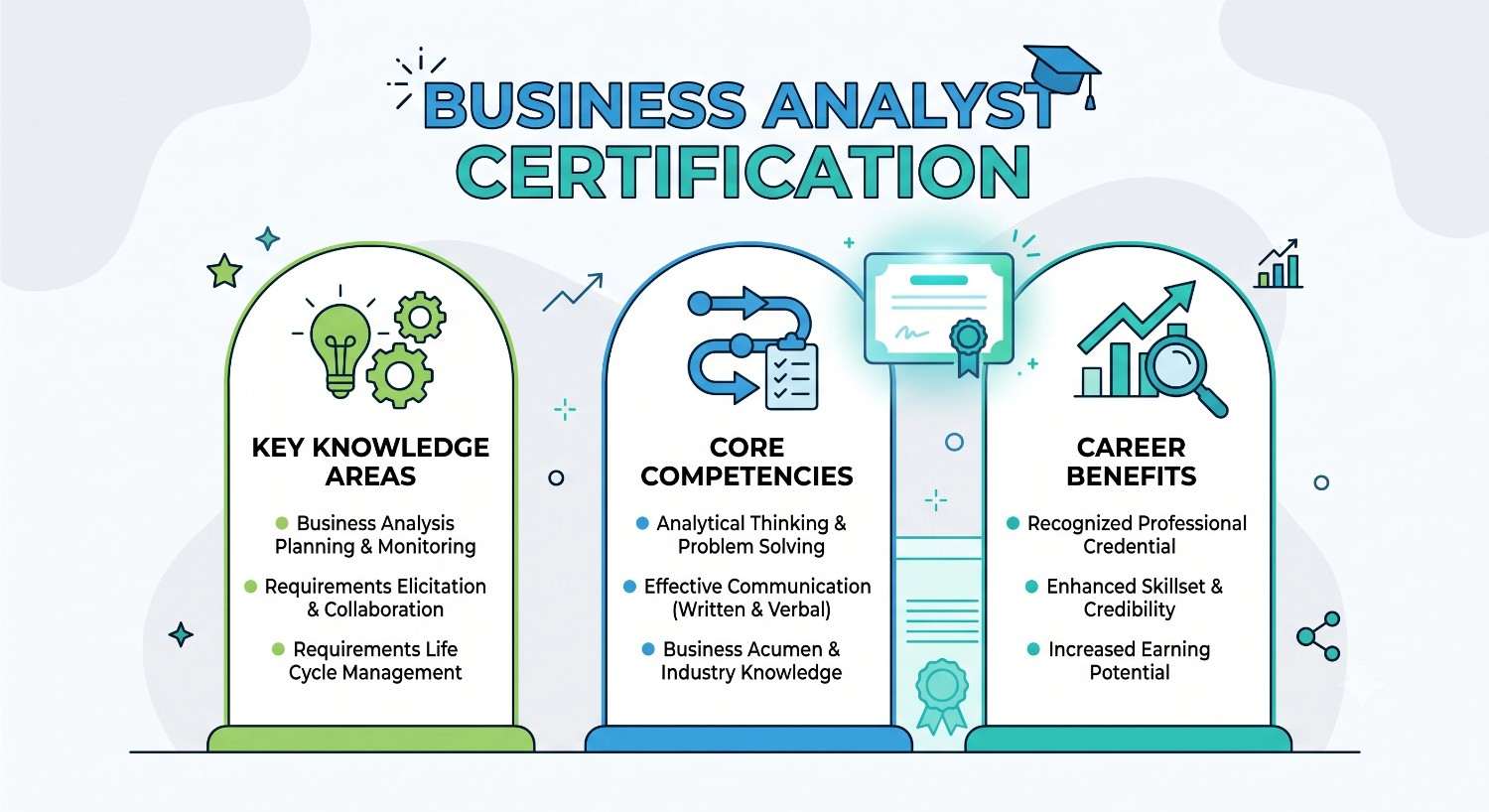









 ROI Calculator