
What Are Management Trainee Qualifications? (With Skills)
 March 17, 2026
 7 min read





Table Of Content
- What Is a Management Trainee?
- What Does a Management Trainee Do?
- Management Trainee Qualifications
- Essential Skills for a Management Trainee
Many organizations today seek young professionals who can grow into leadership roles and contribute to business success. One common entry-level pathway is the management trainee program. These programs train new graduates or early-career professionals in various business functions and prepare them for managerial positions.
Before pursuing this career path, many candidates ask important questions like what a management trainee is, what they do, and what qualifications are necessary for this field.
A management trainee program provides structured training in areas such as operations, marketing, finance, human resources, and strategic decision-making. During this period, individuals gain practical knowledge about how organizations operate and develop essential leadership skills.
This blog explores everything you need to know about becoming a management trainee, including necessary qualifications, key skills, responsibilities, and a wide range of management trainee roles available across industries.
 ChatGPT
 Perplexity
 Claude
 Grok
GrokWhat Is a Management Trainee?
A management trainee is an entry-level professional who undergoes structured training within an organization to develop the skills required for future leadership or managerial roles.
Companies hire management trainees to groom them into future leaders. During the training program, trainees rotate through various departments to gain a thorough understanding of business operations.
Typically, large corporations, multinational companies, banks, consulting firms, and manufacturing organizations offer these programs.
Key Objectives of Management Trainee Programs
- Develop leadership potential
- Provide hands-on experience in multiple departments
- Train employees in strategic decision-making
- Build managerial and operational expertise
Understanding what a management trainee is helps candidates see that this role is not just a job but a stepping stone toward long-term leadership positions.
What Does a Management Trainee Do?
Many candidates wonder about the day-to-day responsibilities of a management trainee. The role involves learning business processes, supporting managers, and participating in decision-making activities.
A management trainee works closely with senior managers and department heads to understand how different business functions operate.
Typical Responsibilities of a Management Trainee
- Learning Business Operations
Management trainees spend time understanding the organization’s internal processes, business models, and operational strategies.
- Assisting Managers
They assist department managers with daily tasks such as preparing reports, analyzing data, and coordinating team activities.
- Participating in Training Programs
Companies conduct workshops, seminars, and practical training sessions to develop leadership and management skills.
- Rotating Across Departments
One crucial part of the training is departmental rotation. Trainees may work in marketing, operations, HR, finance, and customer service departments.
- Conducting Research and Analysis
Management trainees analyze business performance, customer behavior, and industry trends to support strategic decisions.
- Developing Leadership Skills
Throughout the program, trainees develop leadership qualities that prepare them for future managerial roles.
Understanding what a management trainee does helps candidates prepare for the dynamic and learning-focused nature of the role.
Management Trainee Qualifications
To secure management trainee positions, candidates need a mix of educational qualifications and professional skills.
Most companies hire management trainees through campus recruitment or entry-level hiring programs.
Educational Qualifications
Bachelor’s Degree
A bachelor’s degree is usually the minimum requirement to apply for a management trainee position.
Common degree programs include:
- Business Administration
- Commerce
- Economics
- Engineering
- Marketing
- Finance
These programs build foundational knowledge about business and management.
Master’s Degree (Preferred)
Many organizations prefer candidates with a Master of Business Administration (MBA) degree for management trainee programs.
An MBA provides advanced knowledge in areas such as:
- Strategic management
- Business analytics
- Marketing management
- Financial management
- Human resource management
Graduates with an MBA often receive better opportunities and faster career growth in management trainee jobs.
Relevant Certifications
Professional certifications in project management, analytics, or leadership can also boost job prospects.
Examples include:
- Project management certifications
- Data analytics certifications
- Leadership development programs
Essential Skills for a Management Trainee
Apart from academic qualifications, candidates must develop several key skills to succeed as a management trainee.
Communication Skills
Strong communication skills are essential because trainees interact with team members, managers, and clients. Clear communication promotes smooth collaboration across departments.
Leadership Skills
A major goal of management trainee programs is to develop leadership potential. Candidates must show initiative, responsibility, and the ability to motivate teams.
Analytical Thinking
Business decisions require data analysis and problem-solving. Management trainees should interpret data, spot trends, and make informed recommendations.

Problem-Solving Ability
Companies expect trainees to analyze operational challenges and suggest effective solutions.
Adaptability
Since trainees work across multiple departments, they must be flexible and open to learning new tasks and responsibilities.
Time Management
Managing multiple assignments, projects, and training sessions requires solid organizational and time management skills.
Types of Management Trainee Jobs
There are several types of management trainee jobs across various industries. Each industry focuses on specific skills and responsibilities.
Marketing Management Trainee
Marketing trainees learn about branding, advertising, digital marketing, and customer engagement strategies.
Typical tasks include:
- Market research
- Campaign analysis
- Social media management
- Customer segmentation
Operations Management Trainee
Operations trainees focus on improving business processes, supply chain management, and production efficiency.
Responsibilities may include:
- Process optimization
- Logistics coordination
- Quality control analysis
Human Resource Management Trainee
HR trainees learn about recruitment, employee engagement, training programs, and workplace policies.
Typical responsibilities include:
- Recruitment support
- Employee onboarding
- Performance evaluation analysis
Finance Management Trainee
Finance trainees work with financial data, budgeting, and investment planning.
Tasks may include:
- Financial reporting
- Cost analysis
- Budget planning
Retail Management Trainee
Retail companies often hire management trainees to train future store managers and operations leaders.
Responsibilities include:
- Store operations
- Inventory management
- Customer service supervision
Career Growth After a Management Trainee Role
The management trainee role is often the starting point for a successful management career.
After completing the training program, individuals typically move into permanent managerial positions.
Typical Career Progression
- Management Trainee
- Assistant Manager
- Manager
- Senior Manager
- Director or Department Head
Some professionals eventually move into executive leadership roles such as operations director or business unit head.
Industries That Offer Management Trainee Jobs
Management trainee programs are available across multiple industries.
Banking and Finance
Banks recruit trainees for roles in operations, credit analysis, and financial planning.
Consulting Firms
Consulting companies hire trainees to tackle business challenges and develop strategic solutions.
Manufacturing Companies
Manufacturing organizations train candidates in production management, logistics, and operations.
Retail and E-commerce
Retail companies train trainees to manage store operations and customer experience.
Technology Companies
Technology firms prepare future managers in product management, operations, and digital strategy.
Because of these opportunities, management trainee jobs are seen as an excellent entry point into corporate careers.
How to Become a Management Trainee
For students and new graduates wondering what a management trainee is and how to enter this field, the following steps can help.
Step 1: Complete a Relevant Degree
A bachelor’s degree in business, engineering, or commerce provides a strong foundation.
Step 2: Pursue Higher Education (Optional but Beneficial)
Many candidates pursue an MBA or postgraduate management program to improve their career prospects.
Step 3: Gain Internship Experience
Internships help students gain practical knowledge about corporate environments.
Step 4: Build Key Skills
Develop leadership, analytical, communication, and problem-solving skills.
Step 5: Apply for Management Trainee Programs
Many companies offer graduate trainee or management trainee programs through campus recruitment and online job portals.





Why Management Trainee Programs Are Valuable
Management trainee programs offer several benefits for young professionals.
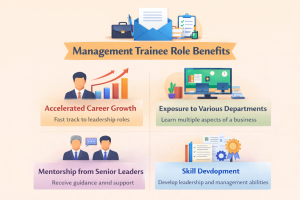
Accelerated Career Growth
These programs help individuals quickly gain experience and move into leadership roles.
Exposure to Multiple Business Functions
Departmental rotations allow trainees to view the organization from different perspectives.
Mentorship from Senior Leaders
Trainees often receive guidance from experienced managers and executives.
Skill Development
Programs focus on developing leadership, strategic thinking, and operational expertise.
Due to these advantages, many graduates actively pursue management trainee jobs to start their careers.
Future Scope of Management Trainee Careers
The need for management trainee jobs is always on the rise because organizations want young professionals in their business organizations who have the potential to become future business leaders. Organizations want to hire management trainees because through these programs, they can train their employees in accordance with their business culture and strategies.
The growth of industries in the areas of technology, consulting, banking, and retail has increased significantly in recent times. Hence, the role of a management trainee in these organizations is of paramount importance. After successful completion of a management trainee program, professionals have the potential to become business leaders in a short time. If one wants to know what a management trainee does, then one should develop skills in leadership and analysis.
Conclusion
The management trainee role is one of the most effective entry points for aspiring business leaders. These programs aim to develop talented individuals into future managers by providing structured training, hands-on experience, and mentorship.
Understanding what a management trainee is and what they do helps candidates prepare for the responsibilities and expectations of the role. From learning business operations to developing leadership skills, management trainees gain valuable experience that prepares them for long-term career growth.
With the right educational qualifications, strong analytical and communication skills, and a willingness to learn, candidates can build successful careers through management trainee jobs in industries such as finance, consulting, retail, manufacturing, and technology.
For graduates who want to speed up their career growth and gain exposure to various business functions, pursuing a management trainee program can be an excellent step toward becoming a future business leader.
Frequently Asked Questions
A management trainee role can be challenging, as it requires learning about multiple business functions and adjusting to different responsibilities. However, with the right skills and training, professionals can manage tasks effectively and progress to higher-level management trainee jobs and leadership roles.

Related Courses
Explore our programs




Find a Program made just for YOU
We'll help you find the right fit for your solution. Let's get you connected with the perfect solution.

Is Your Upskilling Effort worth it?
 ROI Calculator

Are Your Skills Meeting Job Demands?
Try our Skill Gap tool
Experience Lifelong Learning and Connect with Like-minded Professionals
Explore Jaro Connect

