Top Business Management Books To Improve Your Knowledge
How to Choose the Right Business Management Book Based on Your Career Stage
Why Business Management Books Still Matter in the Age of AI and Automation
Common Mistakes Professionals Make When Reading Business Management Books
Pick any successful leader, founder, or manager and you’ll notice one quiet habit they almost always share: reading. Not just random titles, but business management books that sharpen decision-making, strategy, and leadership instincts over time.
Whether you’re stepping into management for the first time or recalibrating your leadership style mid-career, the right business management books can change how you think, plan, and execute, often in ways no classroom ever does.
Top Business Management Books To Improve Your Knowledge
*readingraphics.com
The market is flooded with management reads, but only a handful truly earn their place on your desk. The business management books listed below are not trend-driven titles. They’re foundational, field-tested, and still relevant in modern boardrooms.
1. The One Minute Manager – Kenneth Blanchard & Spencer Johnson
This is one of those business management books that looks deceptively simple. Short chapters, plain language, almost story-like with teaching around clarity beats control. Blanchard’s ideas around goal setting, feedback, and accountability are timeless.
The biggest takeaway? People perform better when expectations are visible and recognition is immediate. For those stepping into leadership rolesfor the first-time, this book’s teaching on how to maximize team productivity and morale is a must-know to thrive.
2. Good to Great – Jim Collins
Among all business management books, this one feels like a long-term investment. Collins doesn’t rely on motivation or hype. He relies on data. The book reflects years of research, disciplined comparison, and uncomfortable truths. Concepts like Level 5 Leadership and the Hedgehog Principle still influence CEOs globally.
This book is slow and self-reflective reading with insight on how companies transition from being good companies to great companies. It’s perfect for you if you are an entrepreneur, business owner or a leader who wants sustainable growth, not short-term wins.
3. The Lean Startup – Eric Ries
Modern businesses move fast. The methodology presented in this book helps founders to adapt quickly to changing market conditions and maximize their chances of success. It introduces lean thinking beyond manufacturing and applies it to innovation, risk, and learning loops.
The core idea is brutal but useful: build less, test earlier, learn faster. Entrepreneurs, product managers, and even corporate teams will find this book of great help specifically for willingness to take risks, embrace change, and remain adaptable in the face of uncertainty.
4. Thinking, Fast and Slow – Daniel Kahneman
Not a traditional management read, yet one of the most impactful business management books ever written. Kahneman explains how decisions are actually made, not how we assume they are. Cognitive bias, intuition traps, overconfidence, this book exposes all of it.
Managers who understand this book stop blaming people and start fixing systems. It’s dense, yes. But once it clicks, your decision-making lens changes for good.
5. How to Win Friends and Influence People – Dale Carnegie
Decades old, still unmatched. Very few business management books understand human behaviour the way this one does. Carnegie teaches empathy, listening, and respect to succeed in professional as well as personal life. Skills that sound soft but drive hard results.
Whether you manage clients, teams, or stakeholders, this book improves how you communicate without forcing scripts or fake confidence.
6. The Effective Executive – Peter Drucker
If business management books had a philosopher, it would be Drucker. This book teaches that efficiency means doing things well, but effectiveness means doing the right things. It trains you to focus on contributions that have a genuine impact. Time management, decision discipline, and responsibility sit at its core.
Drucker’s writing is slow, intentional, sometimes uncomfortable. But it forces managers to ask the right questions: What should I be doing? And what should I stop doing? Senior professionals benefit most from this one.
7. Start with Why – Simon Sinek
Purpose is often misunderstood in business. Sinek simplifies it without diluting it. Among modern business management books, this one stands out for leadership communication.
The idea is simple: people don’t buy what you do, they buy why you do it. Managers leading change, culture shifts, or growth initiatives will find clarity here. It’s inspiring, but not empty motivation.
8. Measure What Matters – John Doerr
Execution fails more than strategy. This is one of those business management books that puts the focus on the fact that systems matter. Doerr introduces OKRs with real-world examples from Google and Intel. The value lies in alignment, which is how goals connect teams instead of isolating them.
If you struggle with tracking performance beyond KPIs, this book offers structure without micromanagement.
9. The 7 Habits of Highly Effective People – Stephen R. Covey
This book sits at the intersection of personal discipline and professional leadership. Many business management books focus only on output. Covey focuses on character.
Proactivity, long-term thinking, and principle-based leadership form the backbone here. It’s not a quick win book. It’s a life framework. Managers who stick with it tend to outgrow reactive leadership patterns.
10. Financial Intelligence for Managers – Karen Berman & Joe Knight
Every manager touches numbers, whether they admit it or not. This is arguably the best book for financial management for non-finance professionals. It breaks down balance sheets, cash flow, and profitability without jargon overload.
Among practical business management books, this one fills a critical gap. You stop fearing financial reports and start using them to ask better questions. If you’ve read this far, one thing must have become clear for sure, which is that business management books are not about memorizing frameworks. They’re about rewiring how you think about people, performance, and purpose. The best business management books don’t shout answers; they nudge better questions. And that’s where real growth begins.
How to Choose the Right Business Management Book Based on Your Career Stage
Not all business management books are meant for everyone at the same time. Early-career professionals often benefit from books that focus on communication, self-management, and basic leadership behaviours. Titles like The One Minute Manager or How to Win Friends and Influence People build foundational confidence without overwhelming theory.
Mid-level managers should look for best management books that address execution, decision-making, and team alignment. This is where books like Measure What Matters or Thinking, Fast and Slow become powerful. They help you manage complexity instead of reacting to it.
Senior professionals and leaders need business management books that challenge assumptions. Drucker, Collins, and Covey work best here. These books don’t give answers quickly. They reshape how you define success, responsibility, and impact.
The mistake most readers make is choosing popularity over relevance. The best business management books are not the ones everyone is reading. They are the ones that solve your current problems. So, make sure that you choose a read that is based on your role.
Why Business Management Books Still Matter in the Age of AI and Automation
With AI tools, dashboards, and real-time analytics everywhere, some question whether business management books are still relevant. The answer is yes, and arguably more than ever. Technology accelerates execution, but it doesn’t replace judgment. And judgment is exactly what the best management books develop.
Automation can process data. It cannot understand nuance, ethics, or human motivation. Business management books fill that gap by focusing on decision-making, leadership behaviour, and organisational dynamics, areas where human judgment still dominates.
In an AI-driven workplace, managers are expected to make fewer routine decisions and more complex ones. That requires depth, not speed. Reading the best business management books builds mental models that help leaders ask better questions of both people and systems.
As roles evolve, the managers who continue learning through business management books will adapt faster, lead better, and remain relevant longer. Tools change. Thinking endures.
Common Mistakes Professionals Make When Reading Business Management Books
Reading business management books doesn’t automatically make someone better at management. In fact, many professionals unknowingly sabotage the value they could gain by treating reading as consumption instead of application.
Another issue is binge-reading without reflection. Jumping from one of the best business management books to the next may feel productive, but without pause, insights blur together. Strong ideas need time to settle. A single well-applied concept often delivers more value than ten half-understood frameworks.
Some readers also look for universal answers. But business management books are context-driven. What works for a Silicon Valley startup may not translate directly to a manufacturing firm or an IT services company. Mature readers adapt principles instead of copying tactics.
Finally, many professionals avoid revisiting books. Yet the best book for financial management or leadership often reveals new meaning as your responsibilities evolve. The goal isn’t to read more. It’s to read smarter, slower, and with intent.
Business Management Books vs Formal Business Education: How They Complement Each Other
Now, another most common debate is whether business management books are better or formal business education. As if one has to cancel the other out. In reality, they work best when paired intentionally.
Business management books offer immediacy. You can pick one up when a problem appears, like poor team performance, budgeting confusion, leadership friction, and gain perspective fast. They are flexible, personal, and often experiential. You learn through stories, mistakes, and frameworks that others have tested in real environments. Many professionals credit best business management books for shaping their instincts long before any formal title did.
Formal education, on the other hand, gives structure. It connects dots that books often leave scattered. You learn theory, models, analytics, and systems thinking in a disciplined sequence. Classroom discussions, peer learning, and faculty mentorship create depth that even the best management books can’t fully replicate on their own.
The real advantage comes when professionals use business management books to reinforce formal learning or vice versa. A finance concept from a course suddenly makes sense after reading the best book for financial management. A leadership framework from a book becomes actionable when tested through coursework or projects. Together, they build both speed and substance.
How Jaro Bridges Business Knowledge with Career-Ready Learning
Reading business management books builds perspective. Applying that knowledge requires guidance, structure, and industry alignment. That’s where we, at Jaro Education, step in.
We are a learning platform designed for professionals who want more than surface-level understanding. While business management books sharpen thinking, our programs help convert that thinking into career outcomes. We work with leading institutions to offer structured learning paths in business management, programs that align academic rigour with real-world relevance.
Our portfolio includes programs for early-career learners, working professionals, and domain specialists who want to expand into leadership roles. These courses complement insights gained from the best business management books, giving learners a way to apply concepts at scale, with mentorship and industry context.
Each program is designed to meet learners where they are, building clarity, confidence, and capability beyond theory.
Free Courses
Stakeholder Communication & Negotiation Skill Sets
The right business management books don’t just make you smarter. They make you calmer under pressure, clearer in decisions, and more intentional in leadership. Whether you’re starting out or scaling up, invest in reading widely, learning deeply, and applying consistently. Growth follows those who do all three.
Frequently Asked Questions
Books give strong thinking frameworks, but careers are built by applying them in real situations, making mistakes, and learning on the job.
Start with The Lean Startup, Good to Great, and Atomic Habits, simple ideas, practical examples, and easy to apply early on.
A few well-chosen books a year is enough if you actually use the ideas instead of just finishing pages.
Yes, they sharpen judgment and long-term thinking, but real financial decisions still depend on data, context, and experience.
They can’t replace the network, structure, and exposure of an MBA, but they can deliver similar knowledge at a fraction of the cost if you’re self-driven.
Both work equally well. The effectiveness of business management books depends more on reflection and application than on the format you choose.
Identify your current gap, leadership, strategy, finance, or communication. Then choose business management books that directly address that need rather than generic recommendations.
Manya Tohani
Personal Growth Mentor
Manya Tohani is a Personal Growth Mentor and content strategist, helping individuals build strong personal brands and accelerate career growth. With 8M+ impressions and experience mentoring students, she empowers others through actionable guidance, resilience, and real-world insights.
 HOME > BLOG > Career Guidance > Best Business Management Books to Read in 2026 for Beginners and Professionals
 March 10, 2026
 9 min read





 ChatGPT
 Perplexity
 Claude
 Grok
Grok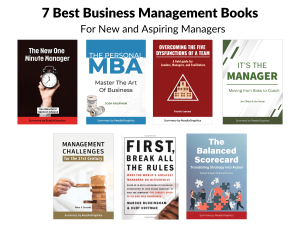





 Admission Closed
 Admission Closed
 Admission Closed
 Admission Open
 ROI Calculator