HOME > BLOG > Supply Chain > Supply Chain Manager Career Path in India 2026: How to Go from Executive to VP and What It Pays
Supply Chain
Supply Chain Manager Career Path in India 2026: How to Go from Executive to VP and What It Pays
J
By Nuthana Reddy
August 1, 20266 min read
Published on August 1, 2026
SHARE THIS ARTICLE
Table Of Content
Why Supply Chain Management Is a High-Growth Career in 2026
Understanding the Supply Chain Career Ladder
Salary Progression in India's Supply Chain Industry
Skills That Help Professionals Reach Leadership Roles
The supply chain industry has undergone a remarkable transformation over the past decade. What was once viewed primarily as a logistics and procurement function has evolved into a strategic business capability that directly impacts profitability, customer satisfaction, and business resilience. In 2026, supply chain management sits at the heart of digital transformation, powered by artificial intelligence (AI), automation, predictive analytics, Internet of Things (IoT), blockchain, and sustainable business practices.
As companies across manufacturing, retail, e-commerce, healthcare, pharmaceuticals, FMCG, automotive, and technology sectors continue investing in smarter operations, the demand for skilled supply chain professionals is rising rapidly. Organizations are no longer looking for managers who can simply move products efficiently—they need leaders capable of making data-driven decisions, managing global supplier networks, mitigating risks, and driving innovation across the value chain.
For professionals entering the field as Supply Chain Executives, the career path today offers tremendous opportunities to grow into senior leadership roles, including Vice President (VP) of Supply Chain. This blog explores the typical career progression, salary expectations, essential skills, and educational pathways required to advance from an entry-level executive role to executive leadership in India's evolving supply chain ecosystem.
Why Supply Chain Management Is a High-Growth Career in 2026
India’s manufacturing expansion, rapid growth of e-commerce, government initiatives such as “Make in India,” increased exports, and rising consumer expectations have made supply chain management one of the country’s fastest-growing career domains.
Organizations now compete not only through product quality but also through operational efficiency. Customers expect faster deliveries, greater visibility into orders, and resilient supply chains capable of responding to disruptions. Consequently, businesses are investing heavily in professionals who can optimize inventory, reduce operational costs, improve supplier relationships, and leverage technology for smarter decision-making.
In 2026, supply chain professionals are expected to possess both operational expertise and strategic business acumen, making this career path increasingly rewarding.
Supply chain management offers structured career progression, with increasing responsibilities at each stage. While timelines vary depending on performance, industry, and organization size, most professionals move through several common roles.
Stage 1: Supply Chain Executive
Most professionals begin their careers as Supply Chain Executives after completing an undergraduate degree in engineering, commerce, logistics, operations, or business management.
At this stage, responsibilities typically include inventory tracking, vendor coordination, purchase order management, shipment monitoring, documentation, and supporting warehouse operations. Executives gain exposure to ERP systems, procurement processes, demand planning, and logistics operations.
The primary objective during this phase is to develop a solid understanding of end-to-end supply chain processes.
Stage 2: Supply Chain Analyst
After gaining practical experience, many professionals transition into analytical roles.
Supply Chain Analysts focus on improving operational performance through data analysis. They identify inefficiencies, forecast demand, monitor inventory levels, optimize transportation routes, and generate reports for management.
Professionals with strong Excel, ERP, SQL,Power BI, and analytical skills often progress faster into these positions.
Stage 3: Assistant Manager or Operations Manager
As professionals gain experience, they begin managing teams, coordinating cross-functional activities, and overseeing larger operational responsibilities.
Operations Managers supervise procurement activities, warehouse management, transportation planning, supplier performance, and inventory optimization while ensuring operational targets are achieved.
Leadership, communication, and decision-making become increasingly important at this stage.
Stage 4: Supply Chain Manager
This is where professionals transition from operational execution to strategic management.
Supply Chain Managers oversee the complete flow of goods from procurement to customer delivery. They collaborate closely with procurement, manufacturing, sales, finance, and logistics teams while managing supplier relationships and controlling operational costs.
This role often serves as the gateway to senior leadership.
Stage 5: Senior Manager or General Manager
Senior Managers handle larger business units, multiple facilities, regional operations, or global supply chain functions.
Rather than focusing only on execution, they develop long-term strategies, manage large budgets, negotiate with strategic suppliers, and lead organizational transformation initiatives.
Professionals at this level often mentor future leaders while driving business growth.
Stage 6: Director of Supply Chain
Directors oversee enterprise-wide supply chain strategies across multiple locations or countries.
Their responsibilities extend beyond logistics and procurement to include:
The Vice President of Supply Chain represents one of the highest leadership positions within operations.
The VP works closely with the CEO, COO, finance leadership, manufacturing teams, and business heads to define organizational supply chain strategy.
Responsibilities include building resilient supply chains, managing large-scale transformation projects, overseeing international operations, improving profitability, and ensuring long-term business continuity.
At this stage, professionals become business leaders rather than functional managers.
Salary Progression in India's Supply Chain Industry
Salary depends on industry, company size, experience, qualifications, and geographic location. The following table provides indicative annual salary ranges for 2026.
Career Stage
Average Annual Salary (INR)
Supply Chain Executive
₹4 LPA – ₹7 LPA
Supply Chain Analyst
₹6 LPA – ₹10 LPA
Assistant Manager / Operations Manager
₹8 LPA – ₹15 LPA
Supply Chain Manager
₹15 LPA – ₹28 LPA
Senior Manager
₹22 LPA – ₹38 LPA
Director – Supply Chain
₹35 LPA – ₹60 LPA
Vice President – Supply Chain
₹60 LPA – ₹1.2 Cr+
Note: Salary ranges are indicative and may vary based on company, experience, industry, and location.
Skills That Help Professionals Reach Leadership Roles
Moving into senior leadership requires more than operational experience. Employers increasingly seek professionals who combine technical expertise with strategic thinking.
As organizations embrace Industry 4.0 technologies, professionals who understand automation, predictive analytics, and digital supply chains are likely to enjoy stronger career prospects.
This diversity provides professionals with significant career flexibility throughout their journey.
Educational Qualifications That Accelerate Career Growth
Although experience remains essential, specialized education often helps professionals move into management and leadership positions faster.
An MBA in Operations Managementremains one of the most popular pathways for professionals aiming to develop expertise in operations strategy, procurement, project management, and organizational leadership.
Executive programmes in Supply Chain Management are also valuable for mid-career professionals. These programmes typically focus on digital supply chains, strategic sourcing, warehouse automation, sustainability, AI-enabled forecasting, and global supply chain practices.
Certifications in Lean Six Sigma, SAP, Power BI, project management, and business analytics further strengthen a professional’s profile and improve competitiveness for senior roles.
Common Challenges Along the Career Journey
The path from executive to VP is rewarding but comes with significant challenges. Supply chain professionals must continuously adapt to changing technologies, evolving customer expectations, geopolitical uncertainties, and fluctuating market conditions.
Managing supplier disruptions, balancing inventory costs with service levels, addressing sustainability requirements, and implementing digital transformation initiatives require continuous learning and strategic thinking.
Professionals who remain proactive, embrace technology, and build strong leadership capabilities are better equipped to overcome these challenges.
Career progression is influenced not only by years of experience but also by the ability to create measurable business impact.
Professionals can accelerate their growth by taking ownership of high-impact projects, developing expertise in analytics and digital tools, improving stakeholder management, and consistently delivering operational improvements. Seeking cross-functional exposure, mentoring junior team members, and pursuing executive education can also strengthen leadership readiness.
Building a reputation as a problem solver rather than simply an operations manager often opens doors to senior leadership opportunities.
Future Outlook for Supply Chain Careers
The future of supply chain management is increasingly digital, intelligent, and sustainable. AI-powered forecasting, autonomous warehouses, robotics, blockchain-enabled traceability, predictive maintenance, and green supply chains are reshaping the industry.
Organizations are actively investing in professionals capable of leading these transformations. Leadership roles will increasingly require expertise in technology adoption, business strategy, and organizational change managementalongside traditional operational excellence.
For professionals willing to continuously learn and adapt, supply chain management offers one of the strongest long-term career growth trajectories in India.
Conclusion
Supply chain management has evolved into a strategic leadership function that drives business performance across industries. In 2026, professionals entering the field as Supply Chain Executives have a clearly defined path toward senior roles such as Supply Chain Manager, Director, and Vice President, provided they continuously develop their technical, analytical, and leadership capabilities.
While experience remains the foundation of career progression, combining practical expertise with advanced education, digital skills, and strategic thinking can significantly accelerate growth. As organizations continue investing in resilient, technology-driven supply chains, professionals equipped to lead this transformation will be among the most sought-after leaders in the business world.
Whether you are just starting your journey or preparing for your next leadership role, building expertise in modern supply chain management can position you for a rewarding career with strong salary potential and long-term opportunities.
Frequently Asked Questions
On average, it takes 5–8 years of relevant experience to become a Supply Chain Manager. Progression depends on factors such as industry, performance, technical skills, leadership abilities, and professional qualifications.
Entry-level Supply Chain Executives typically earn ₹3–6 LPA, while Supply Chain Managers can earn ₹10–20 LPA. Senior Managers, Directors, and Vice Presidents in large organizations may earn ₹30 LPA to ₹1 crore+ annually, depending on the company and experience.
Professionals should develop expertise in supply chain planning, procurement, logistics, inventory management, ERP systems (such as SAP), data analytics, Lean Six Sigma, strategic sourcing, leadership, and stakeholder management. Strong decision-making and digital transformation skills are increasingly important in 2026.
Supply Chain Managers are in demand across industries such as e-commerce, manufacturing, FMCG, retail, automotive, pharmaceuticals, healthcare, logistics, electronics, and renewable energy. Companies investing in digital supply chains and automation often offer the highest growth opportunities.
Yes. An MBA in Supply Chain Management, Operations Management, or Logistics can strengthen managerial, strategic, and analytical skills, making professionals more competitive for leadership roles such as Supply Chain Manager, Director, and Vice President. Combined with industry experience, it can significantly accelerate career growth.
Nuthana Reddy
Nuthana Reddy is a Senior Manager at Procter & Gamble, specializing in operations, digitization, and cross-functional leadership. She has driven multimillion-dollar impact through innovation, process optimization, and strategic execution across global markets.
Get Free Upskilling Guidance
Fill in the details for a free consultation
Related Courses
Explore our programs
Executive Programme in Operations Management and Analytics
 HOME > BLOG > Supply Chain > Supply Chain Manager Career Path in India 2026: How to Go from Executive to VP and What It Pays
 August 1, 2026
 6 min read




 ChatGPT
 Perplexity
 Claude
 Grok
Grok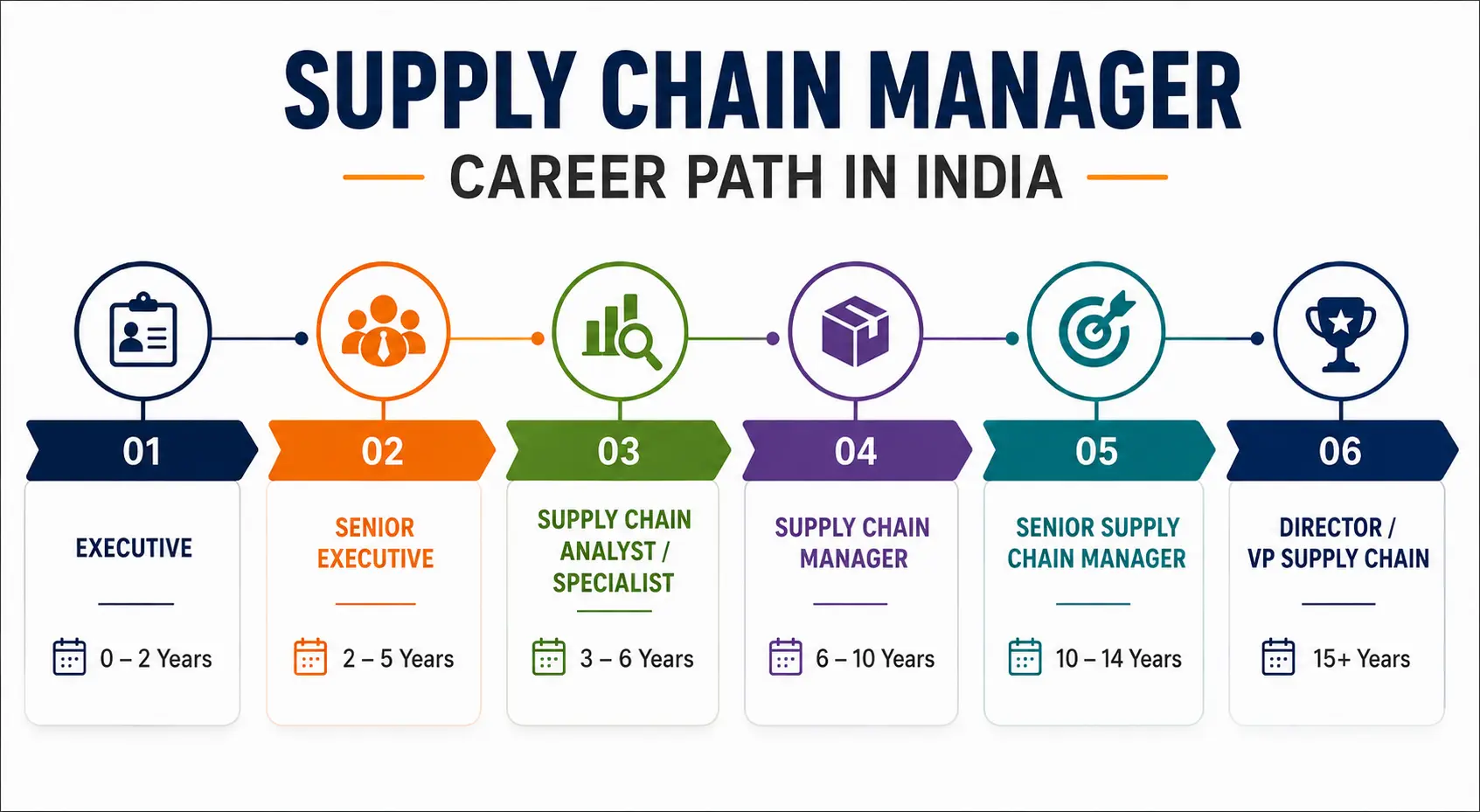







 ROI Calculator