HOME > BLOG > Supply Chain > Top Responsibilities of a Logistics Manager in 2026
Supply Chain
Top Responsibilities of a Logistics Manager in 2026
J
By Jaro Education
December 9, 20257 min read
Last updated on September 2, 2026
SHARE THIS ARTICLE
Table Of Content
What is Logistics Management?
What Does A Logistics Manager Do?
How Much Does a Logistics Manager Make in India? 2026 Salary Insights
What Education Is Needed to Become a Logistics Manager?
Did you know? Logistics is the backbone of international trade, and the global logistics industry is projected to surpass 11 trillion euros by 2028.
How does your Flipkart or Amazon purchase from a warehouse get to your door? Well, that wonder happens due to logistic management. In a world where everything is accessible with a click of a button, logistics can make or break a company. Here, logistics is the process of moving inventory from point A to Point B. The person who oversees this process is a logistics manager. They are responsible for working on matching demand to capacity, guiding the team, keeping customers informed, and so on. Indeed, they are excellent negotiators, organisers, and problem solvers who utilise their skills to keep operations smooth.
This guide offers a practical look at the logistics manager's responsibilities, exploring what logistics management is, the essential skills required, and how much a logistics manager earns in India. You’ll also get a clear, step-by-step understanding of how to become a logistics manager, from the qualifications you need to the career path you can follow. So, stay tuned to get real, updated, and easy-to-understand insights and decide whether this field matches your goals or not.
Logistics management is the process of planning, implementing, and controlling the movement of goods and services from one place to another. It also involves the integration of various activities such as transportation, warehousing, inventory management, material handling, security, and packaging.The ultimate goal of logistics management is to make sure that goods are delivered at the right place at the right time and in the right condition, while minimising the cost. This consists of optimising the supply chain to create a balance between customer service and cost-effectiveness. Logistics management is important in industries like retail, automobile manufacturing, and e-commerce, where timely delivery is of utmost importance for customer satisfaction.
What Does A Logistics Manager Do?
A logistics manager’s responsibilities align with storing, transporting and timely delivery of goods in a supply chain from the point of source to the point of destination. However, the roles and responsibilities of a logistics manager are vast. To understand those roles, refer to the list of some of their common responsibilities.
1. Supply Chain Planning
A logistics manager acts as the central hub of the supply chain, overseeing overall strategies. They are involved in creating a comprehensive plan that includes predicting customer behaviours and requirements. In addition, a logistics manager responsibilities are also related to identifying the cost-effective routes for moving products from the manufacturer to distribution centres.
2. Transportation Management
Transportation management is one of the most important parts of the logistics manager responsibilities. This comprises deciding the most favourable methods for transportation, whether it is done by road, rail, or air. However, it is also essential for a logistics manager to choose reliable carriers while maintaining safety standards. Essentially, they design the logistics of product travel.
3. Inventory Management
Logistics managers responsibilities are also to create a balance between inventory levels. This is based on the fact that having too little can cause shortages, while excess results in wastage. Thus, to manage this efficiently, a logistic manager utilises inventory management systems that monitor stock quantities, reorder thresholds, and order amounts in real time. This proactive approach in logistics manager responsibilities ensures that businesses are always prepared to satisfy customer demand effectively.
4. Warehousing and Distribution Management
Large supply chain networks connect various warehouses used for storage and distribution purposes. A logistics manager’s responsibilities also include overseeing the management of warehouse operations, with a focus on optimising storage space utilisation and ensuring on-time order fulfilment.
How Much Does a Logistics Manager Make in India? 2026 Salary Insights
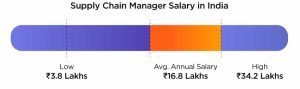
In India, the average yearly salary for a Logistics Manager can range anywhere from ₹5L – ₹14.0L/yr (base pay). These salaries do vary considerably by location, experience, and sector of employment. Let us review all the details.
Logistics Manager Salary by Experience
Here is an easy breakdown of the salary of a logistics manager according to experience:
Experience
Avg. Annual Salary
4 years
INR4.8 Lakhs
5 years
INR5.1 Lakhs
6 years
INR5.6 Lakhs
7 years
INR6.1 Lakhs
8 years
INR6.3 Lakhs
9 years
INR7 Lakhs
10 years
INR7.5 Lakhs
11 years
INR8.5 Lakhs
Source: AmbitionBox
Logistics Manager Salary by Industry
Here’s a quick overview of a logistics manager’s salary in India across industries:
Industry
Avg. Annual Salary
Manufacturing
INR 13.9L
Industrial Machinery
INR 12.6L
Food Processing
INR 9.9L
Consumer Goods
INR 15.4L
Building Material
INR 14.6L
Automobile
INR 14.3L
Semiconductors
INR 13.4L
Emerging Technologies
INR 14.6L
FMCG
INR 11.5L
Electronics
INR 14.4L
Source: AmbitionBox
Logistics Manager Salary by Geography
Here’s a snapshot of the salaries of logistics managers in major Indian metro cities:
City
Avg. Annual Salary
Mumbai
INR12.1 Lakhs
New Delhi
INR9.9 Lakhs
Bangalore / Bengaluru
INR11.3 Lakhs
Chennai
INR9.6 Lakhs
Pune
INR11.3 Lakhs
Gurgaon / Gurugram
INR11.8 Lakhs
What Education Is Needed to Become a Logistics Manager?
Want to become a logistics manager? Here are some quick, practical tips that can guide you to be on the right track:
Step 1 – Start with the Right Bachelor’s Degree
Typically, your journey will begin with a bachelor’s degree. If you choose a program for logistics, supply chain management, business administration, or industrial engineering, you’ll learn the fundamentals of transportation systems, warehouse management, inventory management, and supply chain operations as a whole.
Many of these degrees are recognised as being in the “top tier” of high-paying choices to enter in your career because of how valued supply chain positions are becoming in today’s world.
Step 2 – Add Certifications to Your Resume
If you want to stand out from other candidates or enhance your flexibility in terms of salary or hours, adding certifications to your skill set might be worth your time. For instance, the Post Graduate Certificate Programme in Supply Chain Operations & Analytics (SCOA) – IIM Nagpur can deepen understanding of the complexities of operations and analytics. This programme provides a pathway for career advancement in supply chain management and operations.
Step 3- Consider a Master’s for Senior Positions
A master’s degree isn’t a requirement, but it can help you stand out, particularly if you’re focused on leadership or strategy roles.
Advanced degree programs, such as a Master’s in Supply Chain Management or a specialised online MBA from an accredited university, will enhance your skills in strategic thinking, decision-making, planning, analytics, and team leadership.
Future Job Outlook for Logistics Managers: Growth in India and Worldwide
If you’re looking at a career in logistics management, you’re in luck; the future is exceptionally bright. In fact, the global need for logistics managers is increasing more quickly than ever before. The U.S. Bureau of Labour Statistics is predicting that there will be 26,100 new openings for logisticians each year until 2033. That’s simply a lot of job openings, and certainly shows how important this field of work is becoming.
The E-Commerce Boom
Online shopping is not just growing, it’s booming. Every single order placed with Amazon, Flipkart, Meesho, or any D2C brand is generating a system of logistics actions: last-mile delivery, warehouse management, live tracking, packaging and returns. And who is overseeing all of these components? Logistics Managers.
Infrastructure Initiatives Supported by the Government
Large projects such as Gati Shakti, Bharatmala, and dedicated freight corridors are changing the logistics space as we know it in India. These projects will establish new logistics hubs, expand transport routes and create new job opportunities across Tier 2 and Tier 3 cities.
Logistics Transformation Driven by Technology
Logistics today isn’t just trucks and warehouses; it’s IoT sensors, automation, WMS (Warehouse Management Systems), AI-driven forecasting, and digital route planning. This evolution has created a high demand for managers who can comprehend operations and technology.
Sustainability and Green Logistics
Companies are feeling pressure to limit carbon emissions, waste reduction, and route optimisation for fuel savings. This has led to an increase in demand for logistics managers who can redesign supply chains using green transport, smart packaging, and optimised routing.
A logistics manager doesn’t just move products – they provide stability in an environment often coloured by delays, supply shortages, and unforeseen challenges. So, if you enjoy leading, putting systems in place, and ensuring everything runs smoothly, logistics management may be the exciting, future-oriented career path you are looking to pursue.
The good news is that you do not have to travel this pathway alone. For anyone who is considering a career in logistics, Jaro Education can help guide you with the appropriate programs and support for your logistics education. Our online courses are aligned with industry-recognised certifications and will help strengthen your strategic thought process, creating a pool of career opportunities.
It’s time to take that next step with confidence. With the right support and an ideal learning partner, your logistics career can reach new heights.
Frequently Asked Questions
A logistics manager handles the planning, movement, and storage of goods across the supply chain. Their key duties include coordinating transportation, managing inventory levels, supervising warehouses, resolving delivery issues, and ensuring products reach customers on time and in good condition.
Yes, logistics management is a fast-growing and future-proof career. With the rise of e-commerce, global supply chains, and automation, skilled logistics managers are in high demand across manufacturing, retail, FMCG, and tech industries. The field also offers strong career growth and competitive salaries.
The average logistics manager salary in India is around INR10.2 lakh per year, but it can go much higher depending on your experience, location, and the industry you work in. Cities like Mumbai, Pune, and Bengaluru generally offer higher compensation due to larger logistics networks and industry demand.
Most employers look for a bachelor’s degree in logistics, supply chain management, business administration, or industrial engineering. Certifications like CSCP, CLTD, or PMP can boost your profile, and advanced programs offered through Jaro Education can help you build leadership and strategic skills for senior roles.
Get Free Upskilling Guidance
Fill in the details for a free consultation
Related Courses
Explore our programs
AI-Driven Global Supply Chain Management & Transformation

 December 9, 2025
 7 min read




 ChatGPT
 Perplexity
 Claude
 Grok
Grok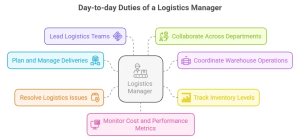







 ROI Calculator