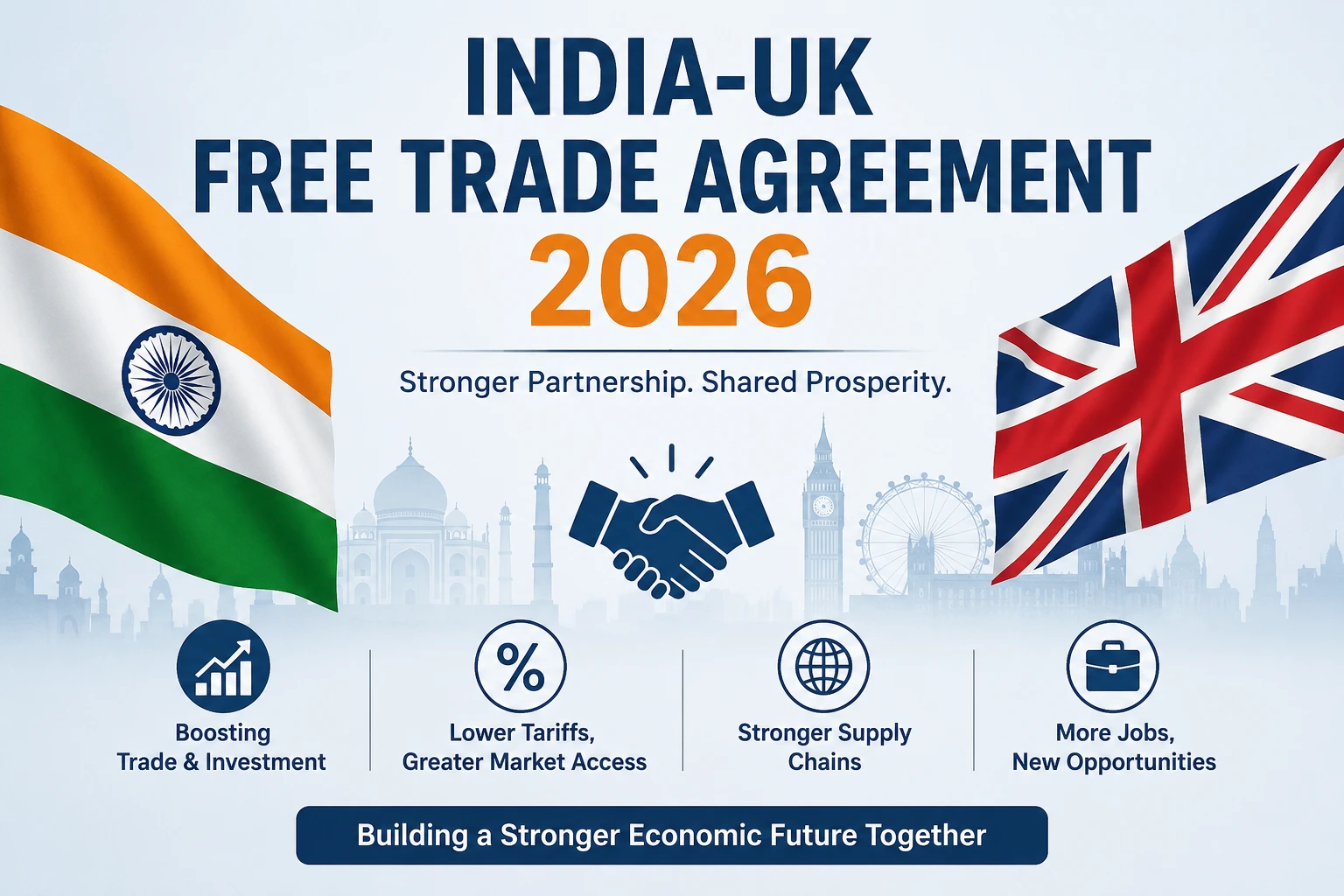
The India–UK Free Trade Agreement (FTA), officially known as the Comprehensive Economic and Trade Agreement (CETA), has officially come into force on 15 July 2026, marking one of India's most significant trade milestones with a major developed economy. After years of negotiations, the agreement aims to strengthen bilateral trade, reduce tariffs, improve market access, and create new opportunities for businesses across sectors.
For India, the agreement goes beyond increasing exports. It is expected to boost manufacturing, strengthen global supply chains, attract foreign investment, encourage innovation, and generate employment. For the United Kingdom, the deal provides improved access to one of the world's fastest-growing economies while supporting long-term economic cooperation.
The implications extend far beyond governments and multinational corporations. Professionals working in supply chain management, finance, international business, logistics, operations, consulting, and trade compliance will experience growing demand for specialized skills. Consequently, MBA graduates with expertise in these domains are likely to find new career opportunities in both domestic and global organizations.
This article explores the key highlights of the India–UK FTA and explains why it matters for businesses, supply chain professionals, finance leaders, and MBA aspirants.
A Free Trade Agreement (FTA) is an agreement between two countries to reduce or eliminate trade barriers such as import duties, quotas, and restrictive regulations.
The India–UK Comprehensive Economic and Trade Agreement aims to:
Increase bilateral trade
Reduce tariffs on thousands of products
Improve customs procedures
Promote investment
Strengthen digital trade
Enhance professional mobility
Improve cooperation in services
The agreement represents one of India’s most comprehensive trade partnerships with a developed Western economy.
UK removes tariffs on most Indian exports; India phases reductions across around 90% of tariff lines
Trade Facilitation
Faster customs clearance and simplified procedures
Services
Improved market access for professional services
Investment
Encourages cross-border investments
Supply Chains
Stronger integration into global value chains
Professional Mobility
Supports movement of eligible professionals under agreed provisions
Source: UK Department for Business & Trade, Government of India, Economic Times.
Why This Agreement Matters for India
India has been actively expanding its network of trade agreements to position itself as a global manufacturing and export hub.
The UK remains one of India’s largest trading partners in Europe. Reduced tariffs and easier market access are expected to improve the competitiveness of Indian exports, particularly in sectors such as:
Experts believe the agreement will also encourage more British companies to invest in India, creating additional employment opportunities and accelerating technology transfer.
Impact on Global Supply Chains
Supply chains have undergone significant transformation since the COVID-19 pandemic. Companies are increasingly diversifying manufacturing locations, reducing dependence on single-country sourcing, and building resilient supply networks.
The India–UK FTA supports these objectives by making trade smoother and more predictable.
1. Better Market Access
Lower tariffs make Indian products more price competitive in the UK market.
Manufacturers can now explore larger export volumes while maintaining healthier profit margins.
Industries expected to benefit include:
Electronics
Machinery
Automotive components
Textile manufacturing
Medical devices
Processed food
This could encourage Indian manufacturers to expand production capacity and integrate more deeply into international supply chains.
2. Faster Customs Processes
Modern supply chains depend heavily on efficient customs clearance.
The agreement introduces provisions aimed at:
Simplifying documentation
Improving transparency
Reducing customs delays
Digitizing trade processes
Facilitating smoother border movement
These improvements can reduce lead times, helping businesses better manage inventory and fulfill customer demand.
3. Increased Manufacturing Investments
As export opportunities grow, companies may invest in:
India is one of the world’s leading pharmaceutical exporters.
Improved market access to the UK can strengthen exports of generic medicines andhealthcareproducts while supporting greater collaboration in life sciences.
Textile and Apparel Industry
Reduced tariffs significantly improve the competitiveness of Indian textile exports.
Manufacturers may witness increased demand for:
Cotton garments
Home furnishings
Fashion apparel
Technical textiles
This creates opportunities across manufacturing, merchandising, sourcing, and export management.
Automotive Components
Although vehicle-related tariff concessions are being implemented in phases and subject to specific conditions, the broader agreement is expected to enhance collaboration across the automotive value chain. Component manufacturers, engineering firms, and logistics providers may benefit from increased cross-border trade.
Gems and Jewellery
The gems and jewellery industry is expected to be among the major beneficiaries of duty-free access to the UK market. Industry estimates suggest exports could grow significantly over the coming years as Indian products become more competitive.
Food Processing
Indian exporters of processed foods, spices, tea, coffee, and specialty agricultural products may gain better access to UK consumers, creating opportunities for value-added exports while complying with food quality and safety standards.
Organizations expanding exports to the UK will require professionals who can efficiently manage international operations while ensuring compliance with evolving trade regulations.
Impact on Finance Professionals
While the India–UK Free Trade Agreement (FTA) is often viewed through the lens of trade and manufacturing, it also has far-reaching implications for finance professionals. As trade volumes increase and businesses expand their international operations, financial planning, compliance, taxation, and risk management become increasingly complex.
Professionals working in corporate finance, investment banking, treasury, taxation, financial planning, and auditing will need to understand the financial impact of international trade agreements and cross-border transactions.
1. Growth in Cross-Border Investments
The FTA is expected to strengthen investor confidence by creating a more predictable and transparent business environment. Easier market access and stronger economic ties may encourage UK companies to expand operations in India while Indian firms explore new opportunities in the UK.
As foreign direct investment (FDI) grows, finance professionals will play an important role in:
2. Increased Demand for International Taxation Experts
Businesses engaged in international trade must comply with multiple tax regulations and customs requirements.
Finance professionals with expertise in:
GST implications on exports
International taxation
Customs duties
Transfer pricing
Double Taxation Avoidance Agreements (DTAA)
will become increasingly valuable as organizations expand globally.
3. Better Financial Risk Management
International trade involves several financial risks, including:
Currency fluctuations
Interest rate changes
Commodity price volatility
Geopolitical uncertainties
Trade compliance risks
Finance managers will be expected to develop effective hedging strategies, monitor global markets, and ensure financial stability.
4. Rise in Trade Finance
Trade finance supports international business by facilitating payments between exporters and importers.
Products such as:
Letters of Credit (LC)
Bank Guarantees
Export Credit
Supply Chain Finance
Invoice Discounting
are expected to witness increased adoption as India–UK trade volumes grow.
Banks, NBFCs,fintech companies, and export finance institutions are therefore likely to require professionals with expertise in trade finance.
Why MBA Professionals Should Pay Attention
The India–UK FTA creates opportunities that extend beyond traditional export businesses. It is expected to influence hiring across consulting, logistics, finance, operations, international business, analytics, and strategy.
MBA graduates who understand global trade dynamics will be better positioned to take on leadership roles.
Career Opportunities After the India–UK FTA
The agreement is expected to create demand across multiple industries.
Some promising roles include:
MBA Specialisation
Potential Job Roles
Supply Chain Management
Supply Chain Manager, Procurement Manager, Logistics Head
Export Manager, Global Business Development Manager
Business Analytics
Trade Analyst, Market Intelligence Analyst
Marketing
International Marketing Manager, Export Sales Manager
Skills Employers Will Look For
As businesses adapt to new trade opportunities, employers are expected to prioritize professionals who combine business knowledge with global awareness.
Reduced trade barriers will create opportunities for Indian businesses but will also expose domestic industries to greater competition from UK firms.
Organizations will need to focus on:
Product quality
Cost efficiency
Innovation
Customer service
Sustainability
Supply Chain Resilience
Global disruptions, geopolitical events, and climate-related risks continue to impact international trade.
Businesses must invest in:
Supplier diversification
Digital supply chain visibility
Risk assessment
Business continuity planning
to remain competitive.
The Long-Term Outlook
Industry experts believe the India–UK FTA will strengthen economic cooperation over the coming decade.
The agreement is expected to:
Increase bilateral trade significantly
Promote manufacturing growth
Attract foreign investments
Support the Make in India initiative
Enhance global competitiveness
Generate employment opportunities
Encourage technology transfer
Strengthen India’s integration into global value chains
As companies expand internationally, demand for skilled professionals in supply chain, finance, international business, and operations is likely to continue growing.
The India–UK Free Trade Agreement 2026 represents more than just a reduction in tariffs—it is a strategic partnership designed to strengthen trade, investment, innovation, and economic cooperation between two major economies. For businesses, it opens the door to new markets, streamlined trade processes, and stronger global supply chains. For professionals, particularly those in supply chain management, finance, operations, and international business, the agreement creates new opportunities to build globally relevant careers.
MBA graduates with expertise in areas such as supply chain management, finance, international business, and business analytics are likely to be among the biggest beneficiaries. Employers increasingly seek professionals who understand global trade regulations, digital transformation, financial risk management, and cross-border business strategies.
As India continues to expand its global trade footprint, professionals who invest in developing these capabilities will be well-positioned to lead the next phase of international business growth.
Frequently Asked Questions
The India–UK Free Trade Agreement (CETA) is a bilateral trade pact that reduces tariffs, improves market access, promotes investment, and strengthens economic cooperation between India and the United Kingdom.
Key sectors include pharmaceuticals, textiles and apparel, engineering goods, automotive components, gems and jewellery, food processing, chemicals, and professional services.
MBA graduates in Supply Chain Management, Finance, International Business, Operations, and Business Analytics can benefit from increased demand for professionals with expertise in global trade, logistics, financial planning, and cross-border business strategy.
Employers are expected to value skills such as trade compliance, procurement, logistics management, financial risk analysis, international taxation, data analytics, AI-driven supply chain management, and strategic decision-making.
Yes. The agreement is expected to boost exports, attract foreign investment, expand manufacturing, and strengthen global supply chains, creating new employment opportunities across multiple industries.
Manya Tohani
Personal Growth Mentor
Manya Tohani is a Personal Growth Mentor and content strategist, helping individuals build strong personal brands and accelerate career growth. With 8M+ impressions and experience mentoring students, she empowers others through actionable guidance, resilience, and real-world insights.
Get Free Upskilling Guidance
Fill in the details for a free consultation
Related Courses
Explore our programs
Admission Closed
Executive Programme in Operations Management and Analytics

 July 21, 2026
 8 min read





 ChatGPT
 Perplexity
 Claude
 Grok
Grok








 ROI Calculator