Data now sits at the center of almost every business decision, and SQL (Structured Query Language) is the key that unlocks it. Banks, e-commerce platforms, hospitals, telecom firms, and start-ups all store information in relational databases, and they need people who can retrieve and interpret it. That is why SQL courses have become some of the most searched learning options among students, freshers, and working professionals in India. The good news is that there are many ways to start, from a Free SQL course with a certificate to paid, job-focused training. In this guide, we explain why SQL matters, how to choose the right program, and list the top SQL courses in India for 2027, with a clear look at what each one offers.
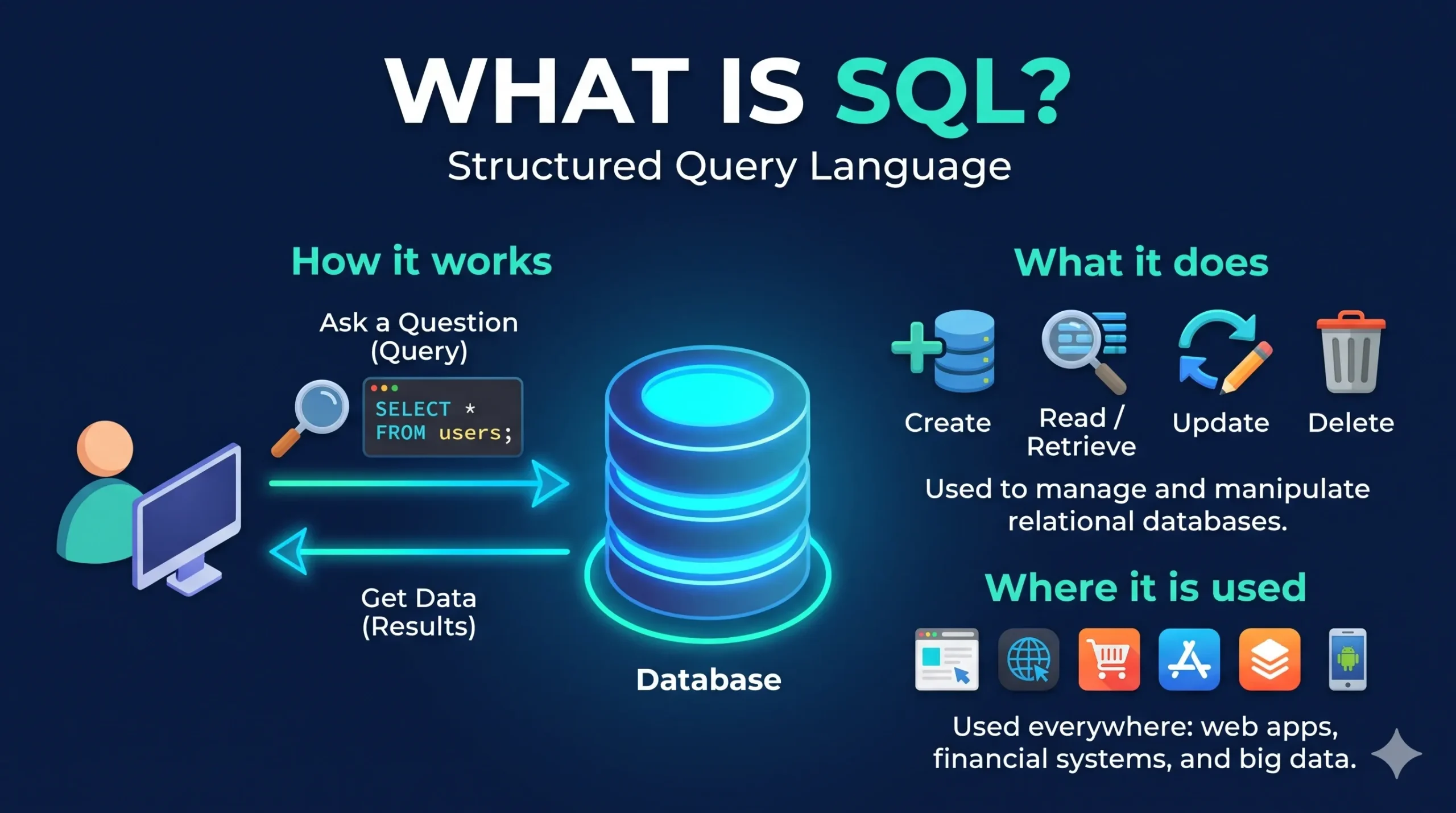
SQL is the standard language used to create, read, update, and manage data stored in relational databases. Unlike some trending tools that appear and fade, SQL has remained relevant for decades, and it continues to appear in job descriptions across many roles.
Here is why it is worth your time:
It is useful in many careers. Data analysts, business analysts, software developers, product managers, marketers, and finance professionals all use SQL to answer business questions.
It is beginner-friendly. SQL reads almost like plain English, so you can write meaningful queries within days.
It supports other skills. Whether you plan to learn Python, Power BI, Tableau, or machine learning later, SQL gives you the data foundation they depend on.
It is in demand. Employers regularly list SQL among the first technical skills they look for in analytics, reporting, and database roles.
If you have been postponing the decision to learn SQL, 2027 is a good time to begin.
With so many options available, picking the right program can feel confusing. Keep these points in mind before you enroll:
Your current level. Absolute beginners need a course that starts with database basics. If you already know the fundamentals, look for joins, window functions, and query optimization.
Hands-on practice. SQL is a skill you learn by doing. Choose courses with real datasets, exercises, and projects.
Database flavor. SQL varies slightly between MySQL, PostgreSQL, SQL Server, and Oracle. Check which one the course uses and whether it matches your goals.
Certification value. A certificate can add credibility to your resume or LinkedIn profile, but it works best when supported by projects you can show.
Cost and time. Decide whether a free option is enough or whether you want mentorship, career support, and a structured paid program.
Learning format. Self-paced courses give flexibility, while instructor-led programs offer accountability.
Use these factors as a checklist while you read the list below.
Top SQL Courses in India 2027: The List
Below are eight well-known options for learners in India. They include free and paid choices, so you can pick according to your budget and goals. Course content, pricing, and certificate terms change from time to time, so always confirm the latest details on the provider’s website before enrolling.
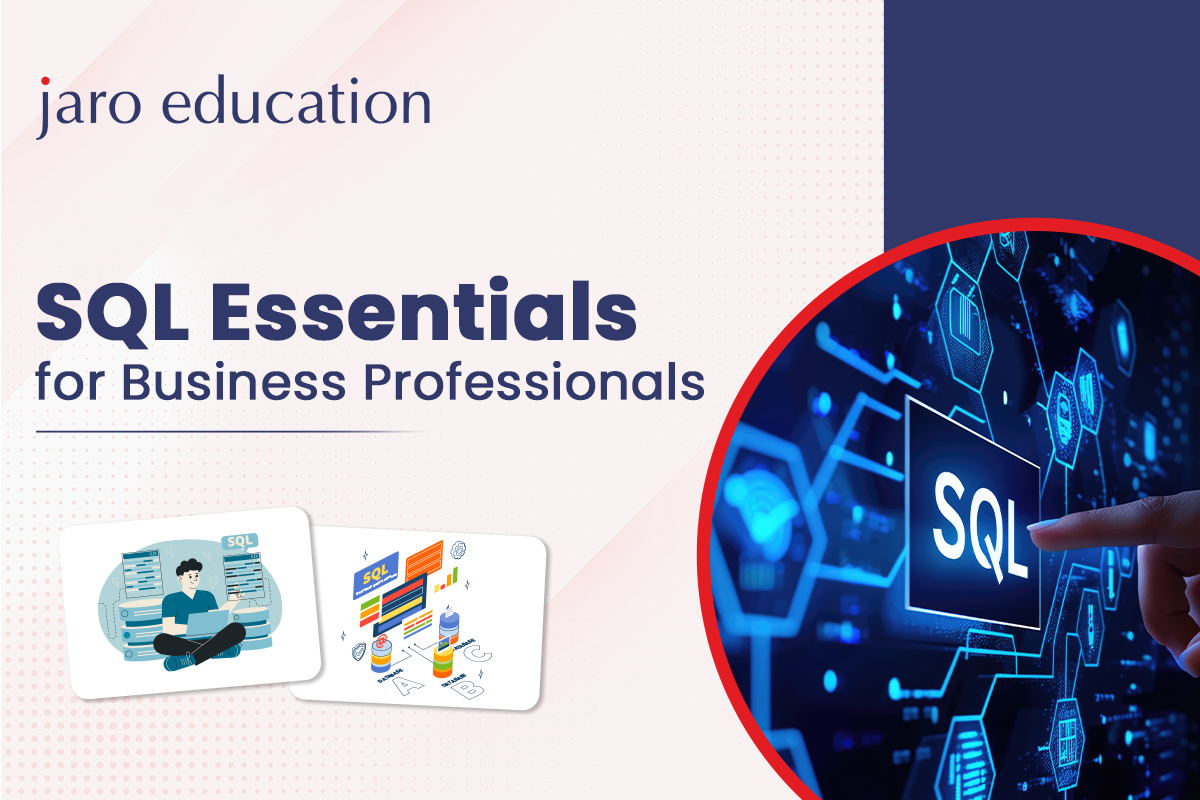
1. SQL Essentials for Business Professionals (Jaro Education)
We begin with a free SQL course designed for working learners. SQL Essentials for Business Professionals is a self-paced program from Jaro Education that teaches SQL using PostgreSQL. It is structured into six modules that take you from the basics to more advanced skills:
SQL fundamentals and database setup
Data filtering, sorting, and aggregation
Joins, subqueries, and set operations
SQL functions and window analytics
Database design, normalization, and ACID principles
Query optimization and performance tuning
The course is free, and learners receive a certificate of completion, subject to the applicable terms. It also touches on interview-friendly topics such as primary and foreign keys, normalization, and ACID compliance, which makes it a practical pick for students, freshers, business professionals, and aspiring data analysts. No prior experience is required, so it is a comfortable place to learn SQL online without any financial commitment.
Best for: Beginners and working professionals who want a free, structured start with a certificate.
2. Great Learning Academy Free SQL Courses
Great Learning Academy, an India-based learning platform, offers a collection of free SQL courses that range from basic to advanced topics. Titles include Practical SQL Training, SQL Projects for Beginners, Advanced SQL, Oracle SQL, and SQL for Data Science. Most are short, self-paced modules, and enrolled learners get lifelong access to the material.
These courses are handy for quick practice and for exploring specific topics such as MySQL operators or database projects. Note that the platform lists some certificates as optional paid add-ons, so check the certificate terms for each course.
Best for: Learners who want short, topic-specific lessons and project practice at no cost.
3. Simplilearn SQL Courses (Free SkillUP and Paid Certification Training)
Simplilearn offers two routes. Its SkillUP platform provides free SQL courses, such as Fundamentals of Database: What is SQL? and SQL for Data Science, which come with completion certificates. For learners who want more depth, the platform also offers a paid SQL Certification Training program with a self-paced format, hands-on labs, real-world projects, and certification preparation. Fees for the paid course vary and are sometimes discounted, so confirm the current price on the official page.
Best for: Learners who want to start free and later move to a more detailed paid certification.
4. SQL for Data Science (UC Davis on Coursera)
This well-known program from the University of California, Davis, is available on Coursera, which is widely used by Indian learners. It focuses on writing queries, working with data, and applying SQL to analysis, and it is often recommended for beginners moving toward data science. Coursera usually offers a certificate on completion, and financial aid options may be available for eligible learners.
Best for: Beginners who prefer a university-backed curriculum with a global certificate.
5. Associate Data Analyst in SQL Track (DataCamp)
DataCamp’s Associate Data Analyst in SQL is a career track of roughly 39 hours, aimed at learners from beginner to intermediate level. It combines short video lessons with interactive coding exercises in the browser and also supports a certification path, which suits people who want to prove their core SQL skills.
Best for: Hands-on learners who like interactive practice and want a certification route.
6. Udemy SQL Courses
Udemy hosts a large number of SQL courses at beginner, intermediate, and advanced levels, including options in Indian languages such as Hindi and Tamil. Quality varies by instructor, so read reviews, check the syllabus, and look at the number of practice exercises before buying. Udemy frequently runs discounts, which can make a well-rated course quite affordable.
Best for: Budget-conscious learners who want flexibility and a wide variety of choices.
7. SQL Developer Course (Henry Harvin)
Henry Harvin, an Indian training institute, offers an SQL Developer course through online and classroom-style batches in several cities. The institute states that its certification is aligned with NSDC and recognized by the government of India. This type of instructor-led program may suit learners who prefer live interaction and a fixed schedule over self-paced study. As with any paid program, review the syllabus, batch details, and placement claims carefully before joining.
Best for: Learners who want live, instructor-led training with a defined timetable.
8. SQL Basics and Intermediate Courses (Nano School)
Nano School offers short, skill-based SQL courses, including SQL Basics for Work, which covers core commands such as SELECT, JOIN, and GROUP BY, and an SQL Intermediate course that covers topics such as CTEs, window functions, and time series. They are suitable for learners who prefer compact modules and an e-certificate.
Best for: Professionals who want short, focused lessons on specific SQL skills.
When people search for SQL certification, they usually mean one of two things.
Course completion certificates are issued by learning platforms after you finish a program. They show that you have completed a course and help you present your learning on LinkedIn or your resume. Most of the options above fall into this group.
Vendor certifications are exams offered by technology companies, such as Oracle and Microsoft, that validate skills on their own database products. These are more formal, often involve an exam fee, and are valuable if you plan to work specifically as a database administratoror developer on those platforms.
For most beginners and aspiring analysts, a recognized course certificate plus a few real projects is a strong starting point. Employers usually care more about whether you can write correct queries than about the certificate alone. If you plan to pursue a vendor exam later, build your fundamentals first through one of the courses above.
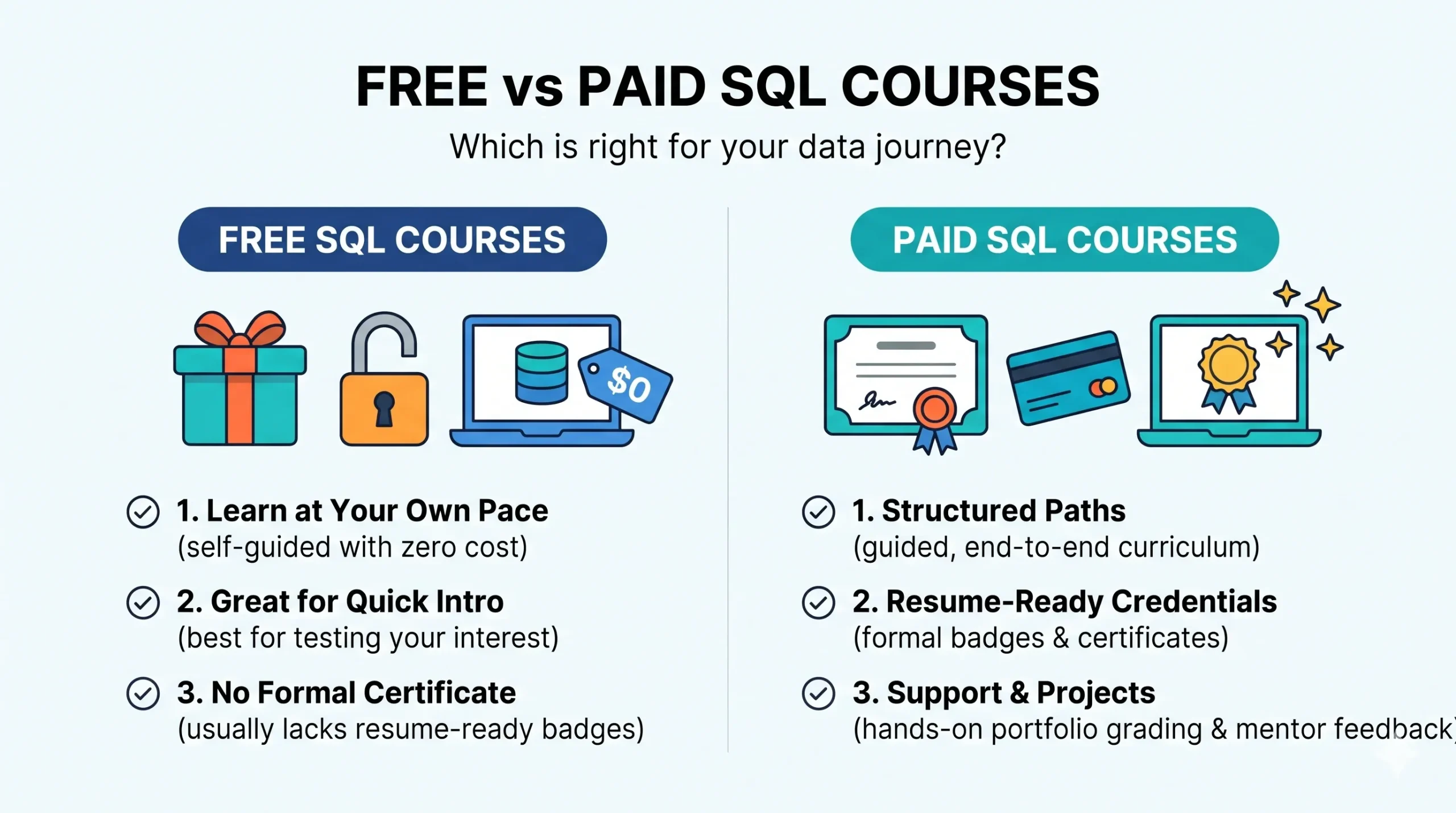
Free SQL Course vs. Paid Program: Which One Should You Pick?
A free SQL course is a great way to test your interest without risk. It helps you understand the basics, practice simple queries, and decide whether you enjoy working with data. Free options such as the Jaro Education Free courses, Great Learning Academy modules, and Simplilearn SkillUP are ideal for this stage.
Paid programs make sense when you need more structure and support. They often provide mentors, graded projects, doubt-clearing sessions, interview preparation, and career assistance. If you are changing careers or aiming for a specific job, that extra support may be worth the investment.
A smart approach is to begin with a free course, build confidence, and then upgrade to a paid program only if you feel you need deeper guidance.
Tips to Learn SQL Online Effectively
Taking a course is only the first step. These habits will help you learn SQL online with better results:
Practice daily. Even 30 minutes of writing queries is better than one long session a week.
Use real datasets. Public datasets on sales, movies, or sports make practice more interesting.
Build small projects. An employee database, a sales dashboard query set, or a library management system can go into your portfolio.
Master the core topics first. Focus on SELECT, WHERE, GROUP BY, joins, and subqueries before moving to window functions and optimization.
Solve interview questions. Practice on coding platformsto prepare for technical rounds.
Learn alongside other tools. Pair SQL with Excel, Python, or a BI tool to make your skill set stronger.
Once you build confidence with SQL, several career paths open up. Common roles include data analyst, business analyst, reporting analyst, database administrator, SQL developer, BI developer, and data engineer. SQL also helps in roles that are not purely technical, such as marketing analyst, operations analyst, and product manager, where understanding data directly improves decision-making.
Salaries depend on your role, experience, city, and company, so it is wise to check current job listings to understand realistic expectations. What matters most is combining SQL with problem-solving ability and a portfolio that shows how you have used it.
Conclusion
SQL remains one of the most practical and accessible skills you can add to your profile in 2027. Whether you choose a free SQL course such as Jaro Education’s SQL Essentials for Business Professionals, short modules from Great Learning Academy, a structured track on Coursera or DataCamp, or an instructor-led program, the key is to start and keep practicing. Compare the options against your level, budget, and goals, confirm the latest details on each provider’s website, and then commit to a steady routine. With consistent effort, the right SQL courses can help you turn raw data into insights and open the door to a rewarding career.
Frequently Asked Questions
Beginners can start with free, structured options such as Jaro Education’s SQL Essentials for Business Professionals or Great Learning Academy’s introductory courses. Those who want a university-backed curriculum can consider SQL for Data Science on Coursera. The best choice depends on your goals, budget, and preferred learning style.
Yes. Several platforms offer a free SQL course, including Jaro Education, Great Learning Academy, and Simplilearn SkillUP. Some provide a free certificate of completion, while others charge for the certificate, so read the terms before you enroll.
Most beginners can understand the basics in a few weeks with regular practice. Mastering advanced topics such as window functions and query optimization may take a few months, depending on how much time you give each week.
A certification is not mandatory, but it can strengthen your resume, especially for freshers. Employers mainly look for the ability to write accurate queries, so pair your certificate with practical projects and strong interview preparation.
Shubham Lal
Lead Software Developer
Shubham Lal joined Microsoft in 2017 and brings 8 years of experience across Windows, Office 365, and Teams. He has mentored 5,000+ students, supported 15+ ed-techs, delivered 60+ keynotes including TEDx, and founded AI Linc, transforming learning in colleges and companies.

 November 23, 2026
 9 min read




 ChatGPT
 Perplexity
 Claude
 Grok








 ROI Calculator