
MBA in HR Management: Subjects, Eligibility, Fees & Salary
 June 14, 2025
 6 min read





Table Of Content
- What is an MBA in HR Management?
- Core Subjects in HR Management MBA Programs
- MBA in HR Management Eligibility and Course Fees
- Scope of MBA in Human Resources: Careers and Growth
 Key Insights
- An MBA in HR Management covers key areas such as recruitment, employee relations, compensation, training, and organisational behaviour.
- Admission generally requires a bachelor’s degree, while fees vary based on the institute and mode of study.
- Graduates can pursue roles in talent acquisition, HR analytics, employee relations, training and development, and HR management.
- For those looking for a flexible learning format, the Online MBA Degree Programme from Symbiosis SSODL allows learners to pursue higher education alongside their professional commitments.
An organisation’s success depends not only on its products, technology, or finances but also on the people who drive its day-to-day operations. This makes human resource management an important part of modern business. From hiring the right talent to supporting employee development and maintaining a positive workplace, HR professionals contribute to several areas of an organisation.
 ChatGPT
 Perplexity
 Claude
 Grok
GrokWhat is an MBA in HR Management?
An MBA in HR Management is typically a two-year postgraduate programme that covers key areas of human resource management, including recruitment, employee relations, compensation, labour laws, training and development, and organisational behaviour.
The programme combines core business management concepts with specialised HR knowledge. This approach helps students understand both the broader business environment and the workforce-related functions within an organisation. It prepares graduates to handle HR responsibilities while developing the knowledge and skills required to contribute to workforce planning, employee development, and strategic business decisions.
Core Subjects in HR Management MBA Programs
The curriculum is designed to give students an understanding of both the strategic and operational aspects of HR, helping them develop the knowledge required to manage various workforce-related functions. Some of the core subjects generally covered in an HR Management MBA programme include:
| Core Subject | Description |
| Human Resource Management | Covers the fundamentals of managing employees, including recruitment, development, and workplace practices. |
| Organizational Behavior | Explores how individuals and groups behave and interact within an organisation. |
| Talent Acquisition & Retention | Focuses on developing effective approaches to attract suitable talent and retain employees. |
| Employee Relations & Labor Laws | Covers workplace policies, labour regulations, employee concerns, and conflict resolution. |
| Compensation & Benefits | Examines the design and management of salaries, incentives, benefits, and other employee rewards. |
| Training & Development | Focuses on planning and implementing programmes that support employee learning and professional growth. |
| Performance Management Systems | Introduces methods for assessing, managing, and improving employee performance. |
| Strategic HR Management | Examines how HR practices can support broader organisational goals and business strategies. |
| Workforce Planning & Analytics | Uses workforce data and forecasting to understand staffing requirements and support HR decisions. |
| Leadership & Team Management | Develops skills for leading teams, managing diverse groups, and building effective workplace collaboration. |
MBA in HR Management Eligibility and Course Fees
Candidates seeking admission to an MBA in HR Management generally need a bachelor’s degree from a recognised university with at least 50% marks. Some institutes may provide relaxation in the minimum marks for candidates from reserved categories. Admission requirements can also include entrance exams, academic performance, or other selection criteria, depending on the institute.
The MBA HR course fees generally range from ₹2 lakh to ₹10 lakh for a two-year programme, depending on the institute and mode of study. Online and executive programmes may have different fee structures. Students should also check whether the stated fees include examination, registration, study material, and other applicable charges.
Scope of MBA in Human Resources: Careers and Growth
The scope of an MBA in HR extends across diverse organisational functions and industries. With experience, professionals can move from specialised positions to managerial and leadership roles. Some of the career options include:
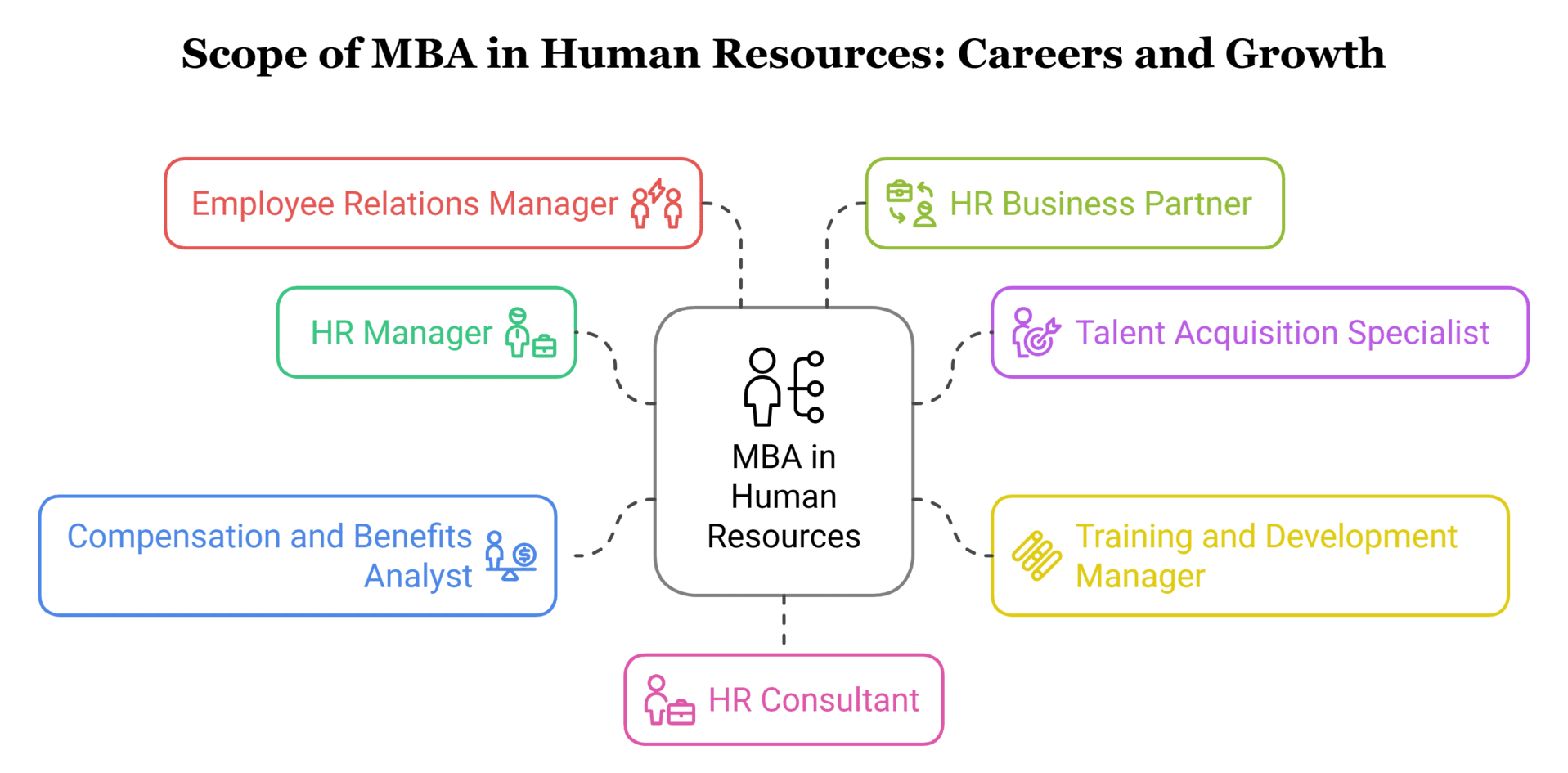
- HR Manager: Oversees employee relations, HR policies, and day-to-day HR functions while ensuring that HR practices support broader business objectives.
- Talent Acquisition Specialist: Manages recruitment activities, including identifying candidates, conducting interviews, and supporting employer branding initiatives.
- Training and Development Manager: Plans and manages learning programmes designed to enhance employee skills, knowledge, and professional development.
- Compensation and Benefits Analyst: Works on salary structures, incentive programmes, employee benefits, and compensation-related analysis.
- Employee Relations Manager: Handles employee engagement initiatives, workplace concerns, grievance resolution, and disciplinary processes.
- HR Business Partner: Works closely with business teams to address workforce requirements and connect HR practices with business priorities.
- HR Consultant: Provides organisations with specialised guidance on areas such as talent management, HR transformation, workforce practices, and compliance.
Skills Developed Through an MBA in HR Management
An MBA in HR Management helps students build a combination of interpersonal, analytical, and managerial skills that can be applied across different HR functions. Key skills developed through the programme include:
- Communication Skills: Communicating clearly with employees, candidates, managers, and other stakeholders.
- Leadership Skills: Guiding teams, handling responsibilities, and supporting effective workplace collaboration.
- Decision-Making: Evaluating workplace situations and making informed HR-related decisions.
- Negotiation Skills: Managing discussions related to employee concerns, compensation, and workplace matters.
- Conflict Resolution: Addressing disagreements and finding practical solutions to workplace issues.
- Analytical Skills: Interpreting HR data to understand workforce trends and support decision-making.
- Problem-Solving: Identifying workplace challenges and developing suitable solutions.
- Strategic Thinking: Understanding how HR practices can contribute to wider organisational objectives.
Salary Trends After MBA in HR Management
Salary expectations can vary considerably after an MBA in HR Management based on the role, experience, industry, location, and skill set. Professionals can see their earning potential increase as they gain experience and take on greater responsibilities. The following table provides indicative annual salary ranges for different HR roles:
| Job Role | Average Annual Salary (INR) | Experience Level |
| HR Executive | ₹3–₹5 LPA | Entry-level / Freshers |
| HR Analyst | ₹4–₹6 LPA | Entry-level / 0–2 years |
| Talent Acquisition Specialist | ₹4.5–₹7 LPA | 1–3 years |
| HR Generalist | ₹5–₹8 LPA | 2–4 years |
| Training & Development Manager | ₹7–₹12 LPA | Mid-level / 4–6 years |
| Compensation & Benefits Manager | ₹8–₹14 LPA | Mid to senior level |
| HR Business Partner | ₹10–₹18 LPA | 5–8 years |
| HR Manager / Senior HR Manager | ₹10–₹20+ LPA | 6–10 years |
| Head of HR / CHRO | ₹25 LPA and above | 10+ years / Senior leadership |





Build Your HR Career with an Online MBA from Symbiosis SSODL
The Online MBA Degree Programme from Symbiosis School for Online and Digital Learning (SSODL) is designed for learners looking to strengthen their management knowledge and prepare for leadership responsibilities. Its flexible, industry-relevant format allows students to continue their professional commitments while pursuing higher education.
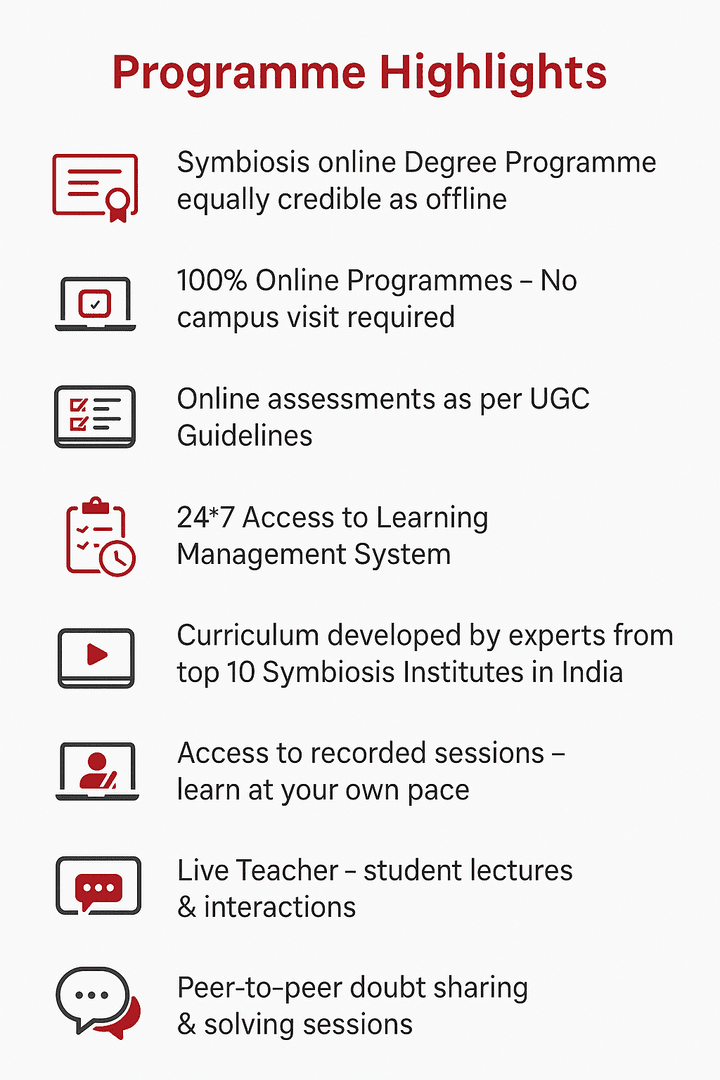
With an MBA in HR Management, learners gain knowledge of key HR functions such as recruitment, performance management, employee engagement, and compliance. The programme also develops management skills that can support career progression and opportunities across different industries.
Delivered by experienced faculty from Symbiosis, the programme offers a structured learning experience for professionals seeking career growth or a transition into management.
Fee Structure:
- Application Fee INR 1,000/
- Programme Fee (Indian): INR 3,15,000/-
- Programme Fee (International): USD 2065
Why Choose Jaro Education for Your MBA Journey?
Jaro Education provides learners with comprehensive career guidance and dedicated student support throughout their educational journey. It focuses on creating immersive and lifelong learning experiences while helping learners stay connected with relevant professional insights. With an alumni network of 3,50,000+ professionals, learners can gain access to alumni events, benefits, and opportunities to connect with a wider professional community. Jaro Education also maintains an active presence across major social media platforms, helping learners stay updated with the latest educational and industry-related information.
Conclusion
An MBA in HR Management goes beyond hiring and employee management, helping learners understand how people contribute to an organisation’s growth. From talent acquisition and employee relations to performance management and strategic HR practices, the programme covers several aspects of the modern workplace. Exploring its curriculum, eligibility, fees, and career scope can help learners understand what the programme offers and where it can lead.
For learners looking to strengthen their understanding of HR while building relevant business and management skills, the Online MBA Degree Programme from Symbiosis School for Online and Digital Learning (SSODL) offers a flexible learning option. The programme can help working professionals and graduates develop knowledge across key management areas while balancing their education with other commitments.
Frequently Asked Questions
An MBA in HR Management is a postgraduate programme that focuses on areas such as talent acquisition, employee relations, performance management, compensation, training, and strategic HR practices. It combines HR concepts with broader business and management knowledge.
An MBA HR Management course generally covers subjects such as human resource management, organisational behaviour, talent management, employee relations, compensation and benefits, training and development, performance management, and strategic HR management.
Candidates who have completed a bachelor’s degree from a recognised university can generally apply for an MBA in HR. Specific eligibility requirements, minimum marks, and admission criteria may vary between institutions.
An MBA in HR is generally designed for graduates seeking comprehensive management and HR knowledge, while an Executive MBA in HR is typically intended for working professionals with prior experience who want to develop advanced management and leadership capabilities.
Students can develop communication, leadership, negotiation, decision-making, analytical, problem-solving, conflict-resolution, and strategic-thinking skills. These capabilities can be applied across different HR functions and workplace situations.





Find a Program made just for YOU
We'll help you find the right fit for your solution. Let's get you connected with the perfect solution.
Is Your Upskilling Effort worth it?
 ROI Calculator

Are Your Skills Meeting Job Demands?
Try our Skill Gap tool
Experience Lifelong Learning and Connect with Like-minded Professionals
Explore Jaro Connect
