7 Steps to Create a Professional Development Plan (PDP)
J
By Bhargavi R
September 2, 20267 min read
Published on September 2, 2026
SHARE THIS ARTICLE
Table Of Content
What Is a Professional Development Plan?
7 Steps to Create a Professional Development Plan
Examples of Professional Development Goals
How to Use a Career Development Planner
Key Insights
A Professional Development Plan (PDP) connects your current skills and experience with your future career objectives while helping you track progress and adapt to changing priorities.
Start by assessing your current skills, defining professional development goals and career development goals, and identifying the skill gaps between your current position and desired career path.
A professional development action plan turns goals into specific, measurable actions with clear timelines, resources, milestones, and progress measures.
Regularly reviewing and updating your PDP keeps it practical, flexible, and aligned with your evolving skills, career priorities, and opportunities.
In this blog, you'll learn the 7 steps to create a Professional Development Plan, set effective career goals, identify skill gaps, build an action plan, use a career development planner, and track your progress.
Career growth rarely happens by accident. Whether you want to move into a leadership position, develop new skills, change career paths, or take on greater responsibilities, having a clear plan can help you turn professional ambitions into actionable steps.
A Professional Development Plan (PDP) is a structured roadmap that connects your current skills and experience with your future career objectives. It helps you identify where you are, where you want to go, what skills you need, and what actions can help you get there. A well-designed PDP can also be updated as your priorities, responsibilities, and career opportunities change.
In this guide, we explore seven practical steps to create a PDP, along with examples of professional development goals, career development goals, and actions you can include in your own professional development action plan.
A Professional Development Plan is a document that outlines your career goals, existing skills, areas for improvement, and the actions needed to achieve your professional objectives.
It can be as simple as a document or spreadsheet or as detailed as a structured career development planner containing goals, timelines, resources, milestones, and progress updates.
A PDP can help you:
Identify your professional strengths and skill gaps
Set short-term and long-term career objectives
Prioritize learning and development activities
Create actionable steps toward your goals
Track progress over time
Adjust your career strategy when circumstances change
The most effective plans are not static. They can evolve as your skills, interests, responsibilities, and career goals develop.
Before deciding where you want to go, understand where you are today.
Start with an honest self-assessment of your current role, responsibilities, skills, experience, interests, and professional strengths. Think about what you currently do well and where you may need improvement.
Ask yourself:
What are my strongest professional skills?
Which skills do I need to improve?
What responsibilities do I currently handle?
Which tasks do I enjoy most?
What feedback have I received from managers or colleagues?
What accomplishments am I most proud of?
What areas of my work do I find challenging?
You can also review your resume, previous performance feedback, completed courses, certifications, and major projects.
This assessment creates the foundation for your Professional Development Plan because it helps you identify the difference between your current capabilities and the capabilities you need for your desired career path.
Step 2: Define Your Professional Development Goals
Once you understand your current position, determine what you want to achieve.
Your professional development goals should be connected to your broader career ambitions. Instead of setting vague objectives such as “improve my skills,” define exactly what you want to develop and why.
It can be useful to divide your goals into short-term, mid-term, and long-term objectives.
For example, your short-term goal could be completing a relevant course, while a longer-term goal could be moving into a managerial role.
Using SMART principles can also make goals easier to track. SMART goals are specific, measurable, achievable, relevant, and time-bound.
Step 3: Identify Your Career Development Goals
Professional development goals and career development goals are closely connected, but they do not always mean exactly the same thing.
Professional development goals generally focus on developing skills, knowledge, experience, or capabilities. Career development goals focus more broadly on where you want your career to go.
For example:
Professional development goal: Develop advanced project managementskills.
Career development goal: Move into a project manager position within the next two years.
Your career development goals should give your PDP direction. Once you know the position or professional outcome you want to work toward, you can determine the skills and experiences required to get there.
Consider asking:
Where do I want my career to be in one year?
Where do I want to be in three to five years?
What type of responsibilities do I want?
Do I want to specialize or move into management?
Do I want to remain in my current industry?
What does career success mean to me?
Your answers can help you create goals that reflect your own ambitions rather than simply following someone else’s career path.
Step 4: Identify Skill Gaps and Resources
After defining your goals, identify what stands between your current position and your desired outcome.
You may already possess many of the skills required for your next career step, while others may need to be developed.
For example, if your goal is to become a team leader, you may already have strong technical knowledge but need to strengthen skills such as delegation, communication, conflict management, and leadership.
Once you identify the gaps, determine how you can address them.
Potential resources include:
Online courses
Professional certifications
Workshops and webinars
Books and industry publications
Mentors
Managers and colleagues
Professional communities
Stretch assignments
Cross-functional projects
Networking opportunities
Learning does not have to happen only through formal education. Practical workplace experiences, feedback, mentoring, and project-based learning can also contribute to professional development.
Step 5: Create a Professional Development Action Plan
Now turn your goals into specific actions.
A professional development action plan explains exactly what you will do to move toward each goal. It should answer four basic questions:
What will I do? Identify the specific activity.
Why will I do it? Connect the activity to your professional or career goal.
When will I do it? Set a realistic deadline.
How will I measure progress? Define an outcome or milestone that shows whether you are moving forward.
Breaking larger goals into smaller actions can make them easier to manage and track.
Step 6: Set Timelines and Milestones
A goal without a timeline can be difficult to prioritize.
Add deadlines to your development activities and divide larger objectives into smaller milestones. This gives you specific points at which you can evaluate your progress.
For example, if your long-term goal is to move into a management position, your development timeline could include:
Month 1–2: Identify leadership skill gaps.
Month 3–4: Complete leadership training.
Month 5–6: Take responsibility for a team project.
Month 7–9: Request feedback from your manager.
Month 10–12: Review progress and identify the next development opportunity.
Your timeline should be realistic. Trying to complete too many development activities simultaneously can make your plan difficult to maintain.
A career development planner can help you organize goals, deadlines, resources, and milestones in one place.
Step 7: Review, Measure, and Update Your Plan
Creating your PDP is not the final step. You need to review it regularly.
Set aside time to evaluate:
Which goals have been completed?
Which actions are currently in progress?
What skills have improved?
What challenges have affected progress?
Have your career priorities changed?
Are new opportunities available?
Do any goals need to be modified?
For example, you may initially plan to develop a technical skillbut later discover that leadership development is more relevant to your career path. Your PDP should be flexible enough to accommodate such changes.
Regular reviews can also help you recognize progress that might otherwise go unnoticed.
A PDP should function as a working career roadmap rather than a document that is created once and forgotten.
Free Courses
Stakeholder Communication & Negotiation Skill Sets
For example, if your career goal is to become a marketing manager, your planner could include goals related to leadership, campaign management, analytics, budgeting, communication, and team management.
Reviewing your planner regularly helps you keep development activities connected to your broader career objectives.
A Professional Development Plan can turn broad career ambitions into a structured roadmap. By assessing your current skills, defining professional development goals, identifying career development goals, addressing skill gaps, creating a professional development action plan, setting timelines, and reviewing your progress, you can make your career development more intentional.
The most effective PDP is one that you actually use. Keep it practical, measurable, and flexible. As your skills and career priorities evolve, update your career development planner so that it continues to reflect where you want to go and the actions required to get there.
Frequently Asked Questions
A Professional Development Plan is a structured document that outlines your career goals, current skills, areas for improvement, resources, and specific actions needed to support your professional growth.
A PDP can include your current skills, professional development goals, career development goals, skill gaps, development activities, resources, timelines, milestones, and methods for measuring progress.
You should review your PDP regularly to assess progress and update goals when your career priorities, skills, responsibilities, or opportunities change. A PDP is intended to evolve as your career develops.
Examples include developing leadership skills, improving communication, learning data analytics, completing a professional certification, taking on a stretch project, or strengthening project management capabilities.
Bhargavi R
HR Professional
Bhargavi Reddy is an HR professional with over 6 years of experience in IT recruitment and talent acquisition. She specializes in hiring across technologies like Java, DevOps, Python, and Data Engineering. With strong expertise in full-cycle recruitment and stakeholder management, she focuses on building high-performing teams. Currently, she works as an HR Manager driving strategic hiring initiatives.

 September 2, 2026
 7 min read





 Key Insights
 ChatGPT
 Perplexity
 Claude
 Grok
Grok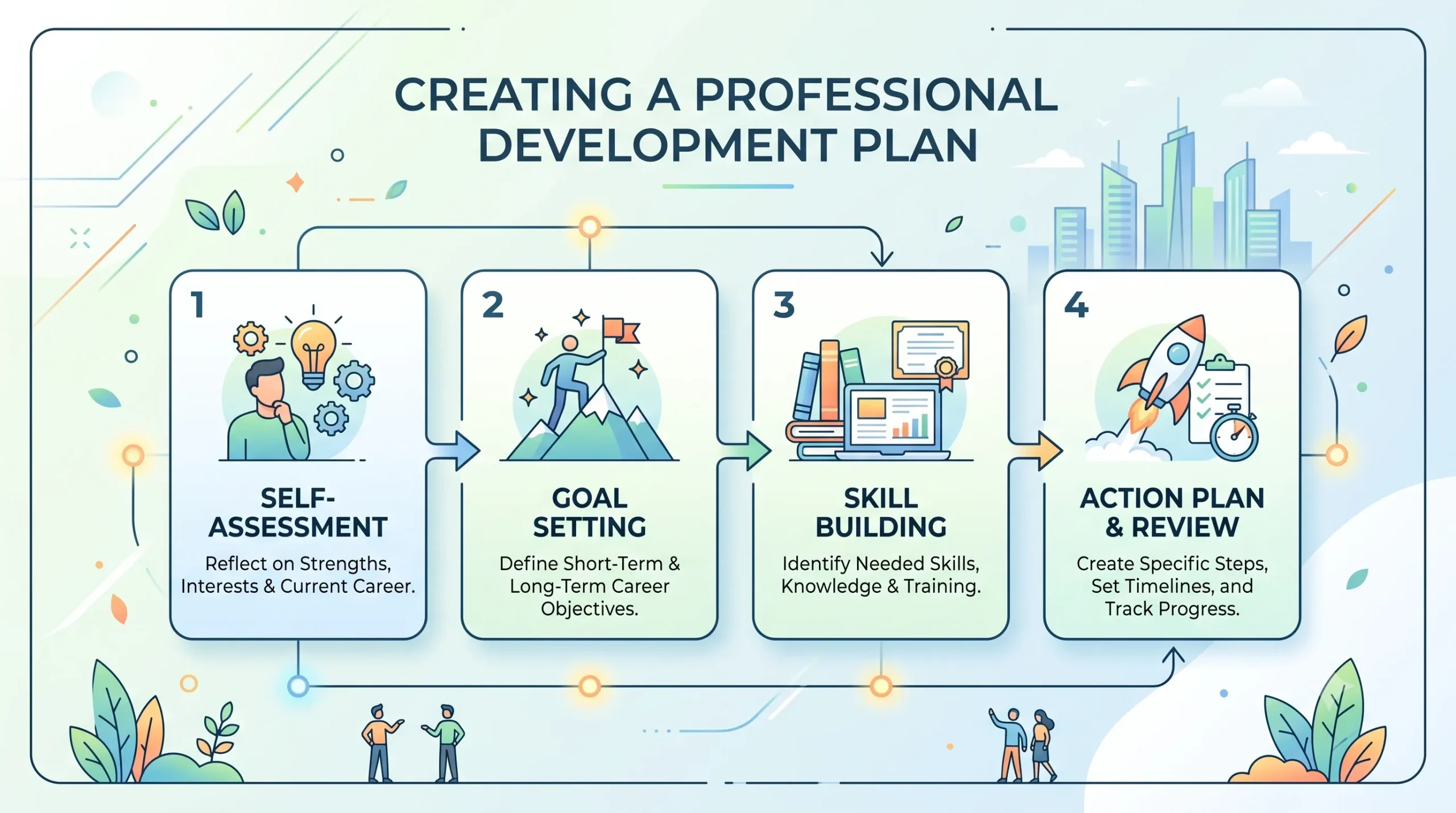







 ROI Calculator