IoT projects help engineering and CSE students apply programming, electronics, networking, cloud computing, and automation to real-world problems.
Students can choose projects based on their skill level, available components, project duration, and academic objectives, progressing from basic prototypes to projects involving analytics, security, edge processing, or machine learning.
Simple projects such as smart plant watering, temperature monitoring, gas leakage alerts, and water-level monitoring help beginners develop skills in sensors, automation, data logging, alerts, and remote monitoring.
CSE students can strengthen IoT mini projects by integrating databases, dashboards, APIs, authentication, analytics, and mobile interfaces with hardware components.
Students can make IoT projects more innovative by adding measurable outcomes, data logging, dashboards, alerts, security, edge processing, analytics, or machine learning while documenting limitations and testing conditions.
In this blog, you'll learn about IoT project ideas for beginners, CSE students, engineering students, and final-year projects, along with project development steps and the technical skills students can gain.
The Internet of Things (IoT) has changed how physical devices collect, exchange, and use data. For engineering and CSE students, building an IoT project is a practical way to connect programming, electronics, networking, cloud computing, and automation. Students can combine these concepts to create a working solution for a real-world problem.
Choosing the right project can be difficult. Some ideas are too basic, while others require skills beginners may not yet have. This guide brings together IoT project ideas across beginner, intermediate, and advanced levels, focusing on learning outcomes and practical extensions.
An IoT project connects physical devices to a network so they can sense conditions, exchange data, trigger actions, or provide information to users. A typical setup includes sensors, a microcontroller or single-board computer, connectivity, a cloud or local data layer, and a user interface such as a web or mobile dashboard.
For example, a smart irrigation system can use a soil-moisture sensor to detect dryness. A microcontroller processes the reading, sends information through Wi-Fi, and activates a pump when the moisture level falls below a chosen threshold. A dashboard can then display readings and system activity.
This basic flow—sense, connect, process, and act—helps students understand the foundation of connected systems.
How to Choose the Right IoT Project
Before selecting from the many IoT project ideas available online, consider four factors: your skill level, available components, project duration, and academic objective.
Beginners should start with a single sensor, one controller, and a simple output. Intermediate students can add cloud storage, dashboards, alerts, or multiple sensors. Final-year students can make the project more substantial by adding automation, analytics, security, edge processing, or machine learning.
It also helps students compare projects before committing time and resources. The best project is not necessarily the most complicated one. A focused project that works reliably, explains the problem clearly, and demonstrates measurable results can be more valuable than a complex prototype that is difficult to test or explain.
A smart plant watering system is one of the most approachable simple IoT projects for beginners. A soil-moisture sensor measures the moisture level, while an ESP32 or similar controller activates a small water pump when the soil becomes dry.
Students learn sensor reading, threshold logic, relay control, and basic automation. To make the project more meaningful, add a dashboard showing moisture readings, pump activity, and watering history.
2. Smart Temperature and Humidity Monitor
Use a temperature and humidity sensor with an ESP32 to create a connected environmental monitor. The device can display readings locally and send them to an online dashboard.
This project is useful for learning sensor calibration, data logging, Wi-Fi connectivity, and visualization. A simple extension is to configure an alert when temperature or humidity crosses a predefined range.
3. IoT Smart Street Light
Build a street-light prototype that responds to ambient light and movement. An LDR can detect surrounding brightness, while a motion sensor can identify activity. The controller can switch lights on, off, or between different brightness levels.
This is a good introduction to automation and energy-aware system design.
4. Smart Gas Leakage Alert
A gas sensor can detect changes in air conditions and trigger a buzzer or notification when readings cross a selected threshold. Students can add an IoT dashboard to monitor sensor status remotely.
Because sensor readings can vary with environmental conditions, the project also creates an opportunity to discuss calibration, false alarms, and safe testing practices.
5. IoT Water-Level Monitor
A water-level monitoring system can use an ultrasonic or water-level sensor to estimate the amount of water in a tank. The device can display the level and send an alert when the tank is nearly empty or full.
This simple project teaches measurement, conditional logic, alerts, and remote monitoring.
IoT Mini Projects for CSE Students
CSE students can use IoT mini projects to combineprogrammingwith hardware and data handling. These projects are particularly useful when the goal is to demonstrate software skills alongside basic electronics.
6. Smart Attendance System
Create an attendance system using RFID, a keypad, QR-based identification, or another identification method. The controller records attendance and sends the data to a database or cloud platform.
A CSE-focused version can include authentication, an admin dashboard, attendance reports, timestamps, and basic database management.
7. IoT-Based Library Seat Tracker
Use sensors to identify occupied and available seats in a library or study area. A dashboard can show current availability and maintain usage records.
Students can extend the project by adding user authentication, historical analytics, or notifications. This turns a basic sensor project into a small software-and-IoT system.
8. Smart Parking Space Detector
Use ultrasonic or infrared sensors to detect whether parking spaces are occupied. A controller sends the status to a dashboard where users can see available spaces.
This project introduces real-time data, sensor arrays, cloud communication, and interface design. CSE students can improve it with a database, parking history, search functionality, or a simple mobile interface.
9. IoT Air Quality Monitor
Combine air-quality sensors with temperature and humidity sensing to create an environmental monitoring system. Data can be stored and visualized through charts so students can observe changes over time.
The CSE component can include data processing, APIs, dashboards, and basic anomaly detection.
10. Smart Energy Consumption Tracker
A current sensor can be used to monitor electrical consumption in a controlled prototype. The data can be transmitted to a dashboard for visualization.
Students can build features such as daily usage summaries, threshold alerts, historical comparisons, and estimated consumption trends. This is a useful bridge between IoT and data analytics.
Intermediate IoT Projects for Engineering Students
11. Smart Irrigation System
A smart irrigation system can combine soil moisture, temperature, humidity, and weather-related inputs to automate watering. Instead of operating on a fixed schedule, the system responds to measured conditions.
Engineering students can explore sensor placement, pump control,communication reliability, and power management. An advanced version can use historical data to improve watering decisions.
12. IoT-Based Health Monitoring System
A wearable or bedside prototype can collect selected health-related readings such as temperature or heart rate and transmit them to a monitoring dashboard.
The educational value lies in understanding sensor integration, real-time transmission, alerts, and data visualization. Students should clearly distinguish an academic prototype from a clinically validated medical device.
13. Smart Waste Management System
Create connected waste bins that monitor fill levels using distance sensors. When a bin reaches a threshold, the system can send a notification to a dashboard.
Students can expand the idea by mapping multiple bins, analyzing collection patterns, and creating a route-priority system for collection teams.
14. Weather Monitoring Station
Build a station that collects temperature, humidity, atmospheric pressure, and other available environmental readings. Data can be stored online and presented through charts.
This project is excellent for learning multi-sensor integration, time-series data, dashboards, and basic environmental analytics.
15. Vehicle Tracking and Accident Alert System
A tracking prototype can combine GPS, motion or orientation sensors, and wireless connectivity. The system can transmit location information and detect unusual movement patterns that may indicate an incident.
Engineering students can study GPS data handling, communication reliability, alert logic, and power management.
Advanced IoT Project Ideas for Final-Year Students
16. Industrial Equipment Health Monitor
Create a system that monitors variables such as vibration, temperature, or operating conditions in a machine prototype. Data can be analyzed to identify unusual patterns.
A CSE student can add anomaly detection, while an electronics student can focus on sensor integration and reliable data acquisition. The project demonstrates how IoT can support predictive maintenance concepts.
17. AI-Enabled Smart Agriculture System
Combine IoT sensors with machine learning to analyze soil, environmental, and crop-related data. The system can provide recommendations or trigger automated actions based on defined conditions.
The strongest version includes a clear dataset, feature selection, model evaluation, and a practical automation layer rather than simply adding an AI label.
18. Smart Traffic Management System
Use sensors or cameras in a controlled model to estimate traffic density. The system can adjust signal timing based on detected conditions and display traffic information on a dashboard.
Students can explore computer vision, edge processing, communication, optimization, and real-time decision-making.
19. Smart Building Energy Management
Monitor temperature, occupancy, lighting, and energy-related parameters across different rooms. The system can use this information to control devices and identify unnecessary consumption.
This project combines IoT, automation, analytics, and sustainability. A dashboard can compare room-level activity and show trends over time.
20. IoT-Based Fire and Smoke Detection
Build a safety-monitoring prototype that uses smoke, temperature, or flame sensors to identify potentially hazardous conditions. The system can trigger a local alarm and send a remote notification.
Students should focus on sensor reliability, response time, false positives, and safe testing. A multi-zone version can show how connected monitoring scales across a building.
How to Make an IoT Project More Innovative
A common content gap in lists of IoT project ideas is the lack of guidance on how to move from a basic prototype to a stronger academic project. Adding more components does not automatically make a project better. Instead, improve it through measurable functionality.
Start by defining a problem and a success metric. Then add data logging so results can be compared over time. Introduce a dashboard that makes the information understandable. Add alerts where timely action matters. If the project collects enough data, explore analytics or machine learning.
Security should also be considered. Use authentication, avoid exposing credentials in code, limit unnecessary network access, and protect stored data. Students can discuss these measures in their documentation and viva.
Another useful improvement is edge processing. Instead of sending every raw reading to the cloud, a device can perform basic filtering or decision-making locally. This can reduce unnecessary communication and make the system more responsive.
Finally, document limitations. Explain sensor accuracy, network dependency, power requirements, testing conditions, and possible improvements. A project becomes more credible when students can explain what it can and cannot do.
IoT Project Development Process
A structured development process can make even simple IoT projects easier to complete.
First, identify a specific problem. Second, define inputs, outputs, and the expected user experience. Third, select the controller, sensors, actuators, communication method, and power source. Fourth, build and test the hardware in small stages. Fifth, write the firmware and verify each sensor separately. Sixth, connect the device to a cloud service, database, or local server. Seventh, develop the dashboard or application. Finally, test the complete system under different conditions and document the results.
Students should also maintain a block diagram, circuit diagram, component list, code documentation, test cases, screenshots, and results. These materials can make project demonstrations and viva sessions much easier
Skills Students Can Gain from IoT Projects
Working on IoT projects for engineering students can develop a combination of technical and problem-solving skills. Depending on the project, students may practice C or C++, Python, embedded programming, sensor integration, networking, databases, APIs, cloud platforms, data visualization, automation, and basic machine learning.
CSE students can emphasize software architecture, databases, dashboards, APIs, security, and analytics. Electronics, electrical, and related engineering students can focus more on circuits, sensors, communication, controllers, power management, and hardware reliability. Cross-disciplinary projects can demonstrate both areas.
Conclusion
The right IoT project can turn classroom concepts into a working system that solves a real problem. From simple IoT projects for beginners, such as plant watering and temperature monitoring, to IoT mini projects for CSE students and advanced systems involving AI, analytics, and automation, there are options for every skill level.
When selecting among IoT project ideas, prioritize relevance, feasibility, measurable outcomes, and learning value. Build the core system first, then improve it with dashboards, alerts, security, analytics, or intelligent automation. Most importantly, understand every part of the project well enough to explain the problem, architecture, implementation, results, and limitations. That approach can make an IoT project more than an academic submission—it can become a practical demonstration of engineering and software skills.
Frequently Asked Questions
Some useful IoT project ideas for engineering students include smart irrigation systems, smart parking systems, air-quality monitors, smart waste management, energy consumption trackers, weather monitoring stations, and industrial equipment monitoring systems.
Simple IoT projects for beginners include smart plant watering systems, temperature and humidity monitors, smart street lights, gas leakage alerts, and water-level monitoring systems. These projects help students understand sensors, microcontrollers, connectivity, and basic automation.
IoT mini projects for CSE students can include smart attendance systems, library seat trackers, smart parking systems, air-quality monitoring systems, and energy consumption trackers. Students can strengthen these projects by adding databases, APIs, dashboards, authentication, and data analytics.
You can make an IoT project more innovative by adding real-time dashboards, automated alerts, data analytics, machine learning, edge processing, authentication, and better data security. You can also improve a basic prototype by defining measurable outcomes and testing it under different conditions.
C, C++, and Python are commonly useful for IoT projects. Depending on the project, students may also work with databases, APIs, web technologies, cloud platforms, and data visualization tools.
Consider your current technical skills, project duration, available components, budget, academic requirements, and career interests. Choose a project that solves a specific problem and allows you to demonstrate both technical implementation and practical problem-solving.
Shubham Lal
Lead Software Developer
Shubham Lal joined Microsoft in 2017 and brings 8 years of experience across Windows, Office 365, and Teams. He has mentored 5,000+ students, supported 15+ ed-techs, delivered 60+ keynotes including TEDx, and founded AI Linc, transforming learning in colleges and companies.

 September 5, 2026
 9 min read





 Key Insights
 ChatGPT
 Perplexity
 Claude
 Grok
Grok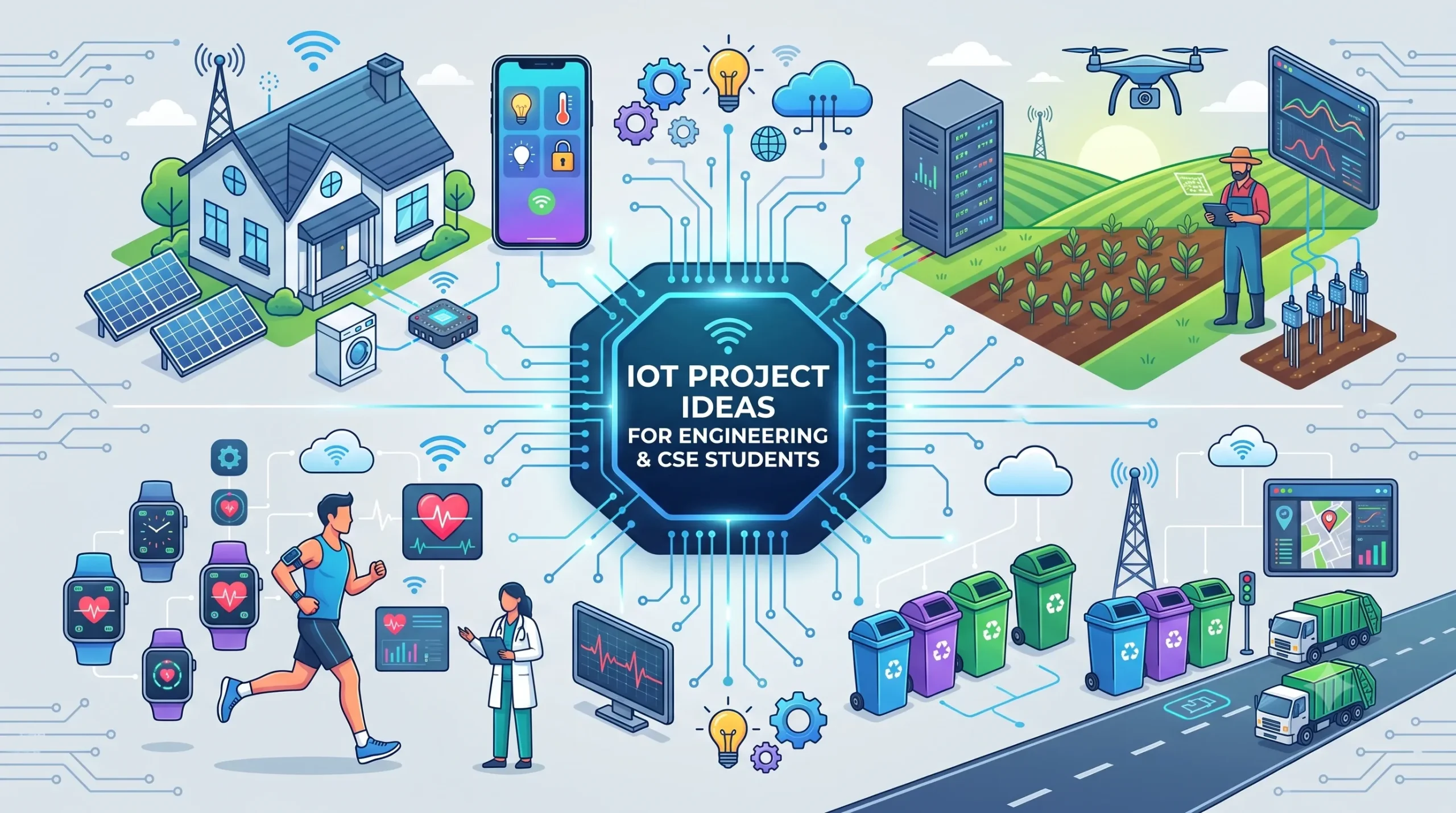









 ROI Calculator