 HOME > BLOG > IT/Software Development > IIT Delhi Healthcare for Industry 5.0 Programme 2026: The Intersection of Technology and Healthcare Leadership
IIT Delhi Healthcare for Industry 5.0 Programme 2026: The Intersection of Technology and Healthcare Leadership
 June 23, 2026
 9 min read




Table Of Content
- What Is Industry 5.0 and Why Does It Matter in Healthcare?
- The Evolution from Healthcare 4.0 to Healthcare 5.0
- Why Healthcare Leaders Need New Skills in 2026
- IIT Delhi Healthcare for Industry 5.0 Programme Overview
Healthcare is undergoing one of the biggest transformations in its history. Technologies such as Artificial Intelligence (AI), Machine Learning (ML), the Internet of Medical Things (IoMT), robotics, predictive analytics, and digital health platforms are reshaping how healthcare services are delivered and managed. At the same time, healthcare organisations are expected to improve patient outcomes, enhance operational efficiency, and provide more personalised care experiences.
This shift has given rise to the concept of Healthcare Industry 5.0—a human-centric approach that combines advanced technologies with empathy, collaboration, and patient-focused innovation. Unlike previous industrial revolutions that primarily focused on automation and efficiency, Industry 5.0 emphasizes the partnership between humans and technology to create better outcomes.
As healthcare systems become more technology-driven, professionals need new skills that extend beyond traditional healthcare management. Leaders must understand digital transformation, healthcare analytics, AI adoption, innovation management, and strategic decision-making.
Recognising this need, IIT Delhi has introduced the Executive Programme in Healthcare for Industry 5.0, designed to help healthcare professionals, administrators, and leaders navigate the future of healthcare innovation and management.
 ChatGPT
 Perplexity
 Claude
 Grok
GrokWhat Is Industry 5.0 and Why Does It Matter in Healthcare?
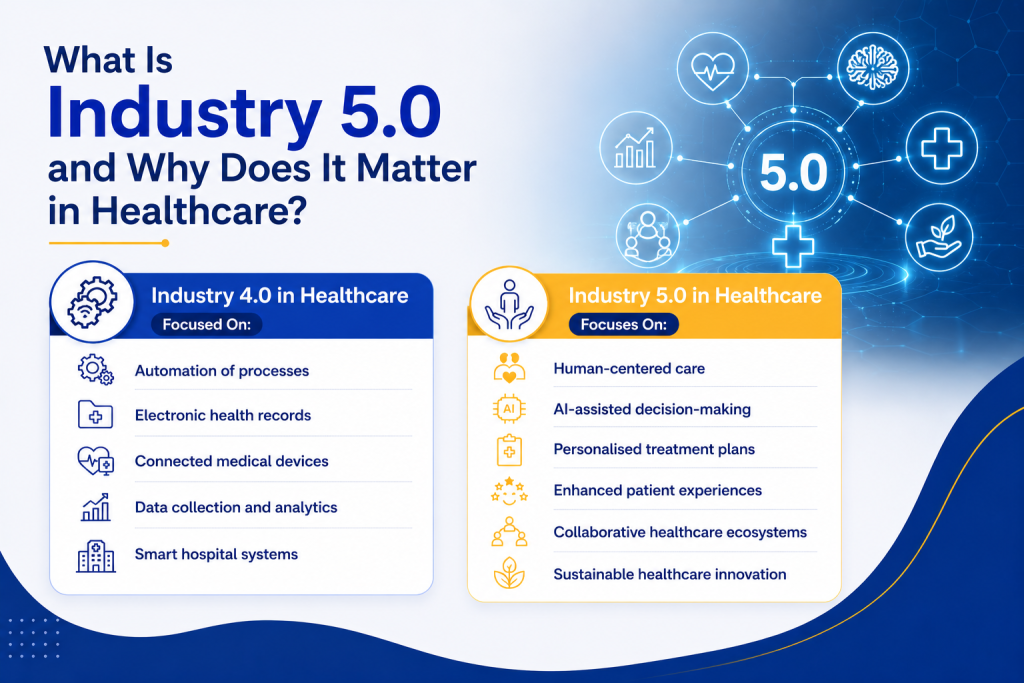
Industry 5.0 represents the next phase of industrial evolution where technology and human intelligence work together to create value. While Industry 4.0 focused heavily on automation, connectivity, and data-driven systems, Industry 5.0 places equal importance on human creativity, sustainability, and personalised experiences.
In healthcare, this shift is particularly significant because healthcare has always been a people-centric industry.
Industry 4.0 in Healthcare Focused On:
- Automation of processes
- Electronic health records
- Connected medical devices
- Data collection and analytics
- Smart hospital systems
Industry 5.0 in Healthcare Focuses On:
- Human-centered care
- AI-assisted decision-making
- Personalised treatment plans
- Enhanced patient experiences
- Collaborative healthcare ecosystems
- Sustainable healthcare innovation
The goal is not to replace healthcare professionals with technology but to empower them with tools that improve care quality, efficiency, and decision-making.
The Evolution from Healthcare 4.0 to Healthcare 5.0
Healthcare has evolved significantly over the last decade. Understanding this evolution helps explain why healthcare professionals must continuously adapt their skills.
1.Traditional Healthcare
Traditional healthcare models relied heavily on manual processes, physical records, and in-person consultations. Decision-making was often limited by access to information and technology.
2. Digital Healthcare
The introduction of electronic health records, telemedicine, mobile health applications, and digital patient management systems marked the beginning of digital healthcare transformation.
3. AI-Enabled Healthcare
Healthcare organisations are now leveraging AI and machine learning to support:
- Disease prediction
- Medical imaging analysis
- Patient monitoring
- Drug discovery
- Clinical decision support
These technologies help improve accuracy, speed, and efficiency across healthcare operations.
4. Healthcare 5.0
Healthcare 5.0 builds on these advancements by creating a more collaborative and patient-focused ecosystem where technology enhances human capabilities rather than replacing them.
Examples include:
- AI-assisted diagnostics
- Personalized treatment recommendations
- Smart healthcare facilities
- Remote patient monitoring
- Predictive healthcare analytics
- Digital health ecosystems
As this transformation accelerates, healthcare professionals must understand both healthcare management and emerging technologies.
Why Healthcare Leaders Need New Skills in 2026
The responsibilities of healthcare leaders are changing rapidly. Managing healthcare operations today requires a combination of clinical understanding, business acumen, and technological awareness.
Digital Transformation Management
Healthcare organisations are investing heavily in digital technologies. Leaders must understand how to implement and manage these initiatives effectively.
Healthcare Analytics
Data is becoming a strategic asset in healthcare. Leaders need the ability to interpret healthcare data and make evidence-based decisions.
AI and Emerging Technologies
Understanding the practical applications of AI, machine learning, and automation is becoming essential for healthcare decision-makers.
Innovation and Change Management
Healthcare organisations must continuously adapt to technological advancements, regulatory changes, and evolving patient expectations.
Risk and Compliance Management
As healthcare systems become more digital, leaders must address:
- Cybersecurity risks
- Data privacy concerns
- Regulatory compliance
- Operational resilience
Patient Experience Leadership
Modern healthcare success is increasingly linked to patient satisfaction, engagement, and personalised care delivery.
Professionals who can combine these capabilities are likely to play an important role in shaping the future of healthcare.
IIT Delhi Healthcare for Industry 5.0 Programme Overview
The Executive Programme in Healthcare for Industry 5.0 by CEP, IIT Delhi has been designed to help healthcare professionals understand the intersection of healthcare, technology, innovation, and leadership.
The programme focuses on preparing participants to lead healthcare transformation initiatives in an increasingly technology-driven environment.
Why Is This Programme Relevant in 2026?
The healthcare industry is experiencing rapid transformation driven by digital technologies, data-driven decision-making, and evolving patient expectations. As a result, healthcare organizations are increasingly seeking leaders who can manage innovation, leverage healthcare analytics, understand emerging technologies, and drive digital transformation initiatives. They also need professionals capable of improving patient outcomes while building resilient and future-ready healthcare systems. The IIT Delhi Healthcare for Industry 5.0 Programme addresses these evolving industry demands by combining academic excellence with practical, industry-focused learning, helping professionals develop the skills needed to lead healthcare transformation in a technology-driven world.
Programme Objectives
The programme aims to help participants:
- Understand Industry 5.0 principles in healthcare
- Explore emerging healthcare technologies
- Develop innovation-focused leadership skills
- Learn healthcare transformation strategies
- Improve strategic decision-making capabilities
- Build future-ready healthcare management expertise
As healthcare systems continue to evolve, these competencies are becoming increasingly valuable across hospitals, healthcare providers, pharmaceutical companies, health-tech organisations, and consulting firms.
Key Features of the Programme
The programme is designed to provide participants with practical insights into healthcare innovation and leadership.
1. Industry-Focused Curriculum
The curriculum is aligned with current healthcare trends and emerging technologies.2
2. Executive Learning Format
Designed for working professionals, the programme allows participants to continue their careers while upgrading their skills.
3. Technology and Innovation Focus
Participants gain exposure to emerging technologies that are transforming healthcare delivery and management.
4. Leadership Development
The programme emphasizes strategic thinking, innovation management, and leadership capabilities.
5. Practical Learning Approach
Real-world examples, industry insights, and applied learning methodologies help bridge the gap between theory and practice.



Technologies Driving Healthcare 5.0
Healthcare Industry 5.0 is being shaped by several advanced technologies that are transforming how healthcare organizations deliver care, manage operations, and improve patient outcomes. Artificial Intelligence (AI) is enhancing clinical decision-making, improving diagnostic accuracy, supporting predictive healthcare, and enabling better patient engagement. Machine Learning (ML) helps healthcare systems identify patterns, predict outcomes, and improve operational efficiency through data-driven insights. The Internet of Medical Things (IoMT) connects healthcare devices and systems, allowing providers to monitor patients in real time and deliver more proactive care. Meanwhile, robotics and automation are increasingly being used in surgical procedures, hospital operations, rehabilitation services, and healthcare logistics to improve precision and efficiency.
Another key driver of Healthcare 5.0 is predictive analytics, which enables healthcare organizations to forecast patient demand, optimize resource allocation, reduce risks, and improve strategic planning. Additionally, digital health platforms are creating seamless communication between patients, healthcare providers, and healthcare systems, resulting in more integrated, accessible, and patient-centric healthcare experiences. Together, these technologies are helping healthcare organizations build smarter, more efficient, and future-ready healthcare ecosystems.
Who Should Join This Programme?
As healthcare becomes increasingly driven by technology, data, and innovation, professionals across the healthcare ecosystem need skills that go beyond traditional clinical or operational expertise. The IIT Delhi Healthcare for Industry 5.0 Programme is designed for healthcare professionals, doctors, clinicians, and healthcare practitioners who want to understand emerging technologies and modern healthcare management practices. It is also highly relevant for hospital administrators and healthcare managers responsible for overseeing operations, patient services, quality management, and organizational growth.
Additionally, the programme can benefit pharmaceutical and life sciences professionals seeking insights into how technology is transforming healthcare delivery and patient outcomes. Healthcare consultants advising organizations on innovation and operational excellence, as well as HealthTech entrepreneurs developing technology-driven healthcare solutions, can gain valuable knowledge from the programme. Mid-to-senior management professionals looking to lead digital transformation initiatives and future-proof their careers in an evolving healthcare landscape will also find the programme highly beneficial.
Career Opportunities After Healthcare Industry 5.0 Education
As healthcare organizations increasingly adopt digital technologies, there is a growing demand for professionals who can combine healthcare expertise with innovation, analytics, and strategic leadership. Healthcare Industry 5.0 education prepares professionals for emerging roles such as Healthcare Innovation Manager, where they oversee the implementation and scaling of innovative healthcare solutions, and Digital Health Consultant, who helps healthcare organizations adopt and optimize digital technologies. Professionals can also pursue leadership positions as Healthcare Transformation Leaders, driving large-scale digital transformation initiatives and organizational change.
Other promising career paths include Hospital Operations Head, responsible for improving operational efficiency and patient experiences, and Healthcare Analytics Manager, who leverages healthcare data to enhance clinical outcomes and business performance. For those interested in entrepreneurship, opportunities exist in the rapidly growing HealthTech sector, where innovators develop AI-powered healthcare products and digital health solutions. Additionally, Healthcare Strategy Consultants play a crucial role in helping healthcare institutions plan long-term growth, innovation, and transformation strategies. As Healthcare 5.0 continues to evolve, these roles are expected to become increasingly important across hospitals, healthcare networks, pharmaceutical companies, and technology-driven healthcare organizations.
IIT Delhi vs Traditional Healthcare Management Programmes
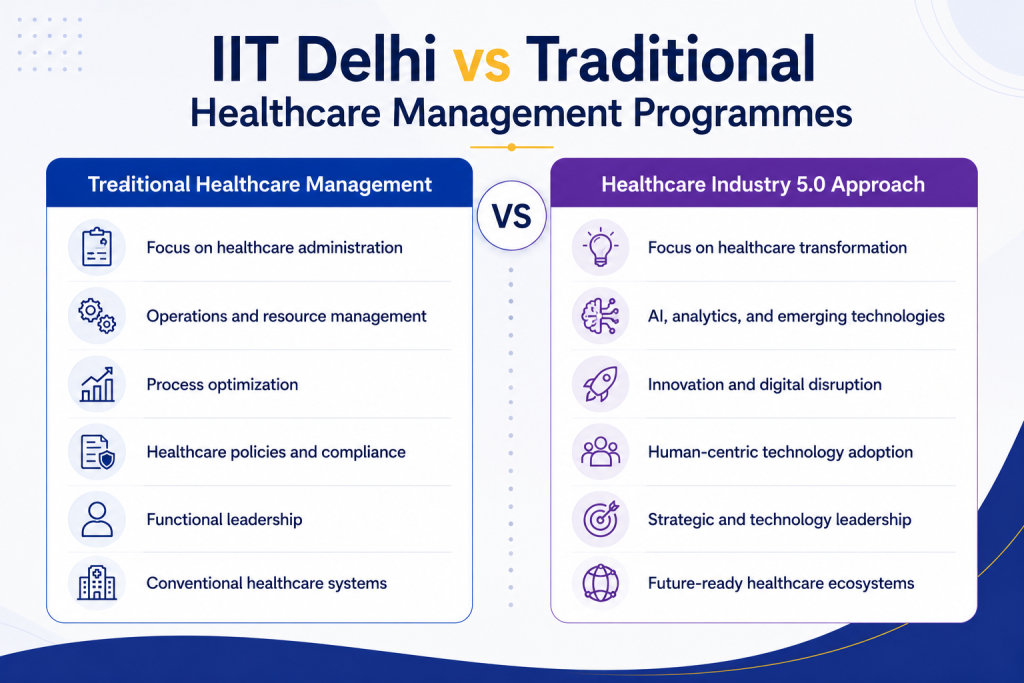
Healthcare management education has evolved significantly over the years. Traditional healthcare management programmes focus primarily on administration, operations, and healthcare policies. Industry 5.0 programmes expand this scope by integrating technology, innovation, and digital transformation.
| Traditional Healthcare Management | Healthcare Industry 5.0 Approach |
| Focus on healthcare administration | Focus on healthcare transformation |
| Operations and resource management | AI, analytics, and emerging technologies |
| Process optimization | Innovation and digital disruption |
| Healthcare policies and compliance | Human-centric technology adoption |
| Functional leadership | Strategic and technology leadership |
| Conventional healthcare systems | Future-ready healthcare ecosystems |
Both approaches are valuable, but Industry 5.0 education prepares professionals for the future challenges and opportunities emerging within healthcare.
Healthcare Leadership in the AI Era
Artificial Intelligence is becoming an integral part of healthcare systems worldwide. However, successful healthcare transformation requires more than technology implementation.
Healthcare leaders must understand how to:
Balance Technology and Human Care
Technology should enhance patient outcomes while maintaining empathy and human-centered care.
Make Data-Driven Decisions
Leaders increasingly rely on analytics and AI-generated insights to support strategic planning and operational decisions.
Manage Digital Transformation
Healthcare organizations need leaders capable of implementing technology initiatives while managing organizational change.
Address Ethical and Regulatory Challenges
AI adoption raises important questions around privacy, transparency, governance, and accountability.
Build Future-Ready Teams
Healthcare leaders must create environments where healthcare professionals and technology systems work collaboratively.
The future of healthcare leadership will be defined by an individual’s ability to combine technological awareness with strong people-management capabilities.
Related Learning Pathways for Healthcare Professionals
Healthcare professionals often pursue continuous learning to remain relevant in a rapidly changing industry.
Healthcare Management Courses in India
Professionals looking for a broader understanding of healthcare management can explore various healthcare-focused learning opportunities.
Related Reading:
https://www.jaroeducation.com/blog/healthcare-management-courses-in-india
IIM Trichy Healthcare Management Programme
Healthcare leaders seeking management-focused learning pathways may also benefit from exploring healthcare management programmes offered by leading institutions.
Related Reading:
https://www.jaroeducation.com/blog/iim-trichy-healthcare-management-programme-overview
Executive Programme in Healthcare Services Management by IIM Ahmedabad
Professionals interested in healthcare leadership, operations, and healthcare services management can explore:
https://www.jaroeducation.com/executive-programme-in-healthcare-services-management-iim-ahmedabad
Together, these programmes support the development of healthcare leaders equipped to manage modern healthcare systems.
Why Healthcare Professionals Should Upskill Now
The healthcare industry is undergoing rapid transformation due to advancements in technology, changing patient expectations, and evolving healthcare delivery models. Technologies such as Artificial Intelligence (AI), digital health platforms, telemedicine, and advanced analytics are reshaping how healthcare services are managed and delivered. At the same time, healthcare organizations face increasing regulatory requirements, growing volumes of healthcare data, and a greater need for innovation-driven decision-making. As a result, professionals who develop expertise in healthcare technology, innovation management, analytics, and leadership will be better equipped to navigate these changes and seize emerging career opportunities. Upskilling today not only helps healthcare professionals remain competitive but also enables them to play a meaningful role in building the future of healthcare.
Final Thoughts
Healthcare Industry 5.0 represents a significant shift in how healthcare organizations operate, innovate, and deliver value to patients. The future of healthcare will be shaped by technologies such as Artificial Intelligence, Machine Learning, IoMT, predictive analytics, and digital health platforms—but equally by leaders who understand how to use these technologies responsibly and effectively.
The Executive Programme in Healthcare for Industry 5.0 by CEP, IIT Delhi is designed to help professionals navigate this transformation by combining healthcare management, innovation, technology, and leadership development into a future-focused learning experience.
For healthcare professionals, hospital administrators, consultants, and health-tech leaders, the programme provides an opportunity to build capabilities that align with the evolving demands of the healthcare sector.
As Healthcare 5.0 continues to redefine patient care and healthcare operations, professionals who invest in future-ready skills today will be better equipped to lead tomorrow’s healthcare organizations.
Frequently Asked Questions

Related Courses
Explore our programs

Find a Program made just for YOU
We'll help you find the right fit for your solution. Let's get you connected with the perfect solution.
Is Your Upskilling Effort worth it?
 ROI Calculator
Are Your Skills Meeting Job Demands?
Try our Skill Gap tool
Experience Lifelong Learning and Connect with Like-minded Professionals
Explore Jaro Connect
