 HOME > BLOG > Career Development > How to Become an Entrepreneur: Skills, Steps & Career Opportunities
How to Become an Entrepreneur: Skills, Steps & Career Opportunities
 August 24, 2026
 10 min read





Table Of Content
- What Is Entrepreneurship?
- Why Choose Entrepreneurship as a Career?
- How to Become an Entrepreneur?
- Types of Entrepreneurs
 Key Insights
- Entrepreneurship involves identifying opportunities, developing ideas into ventures, organizing resources, and taking calculated risks to create value.
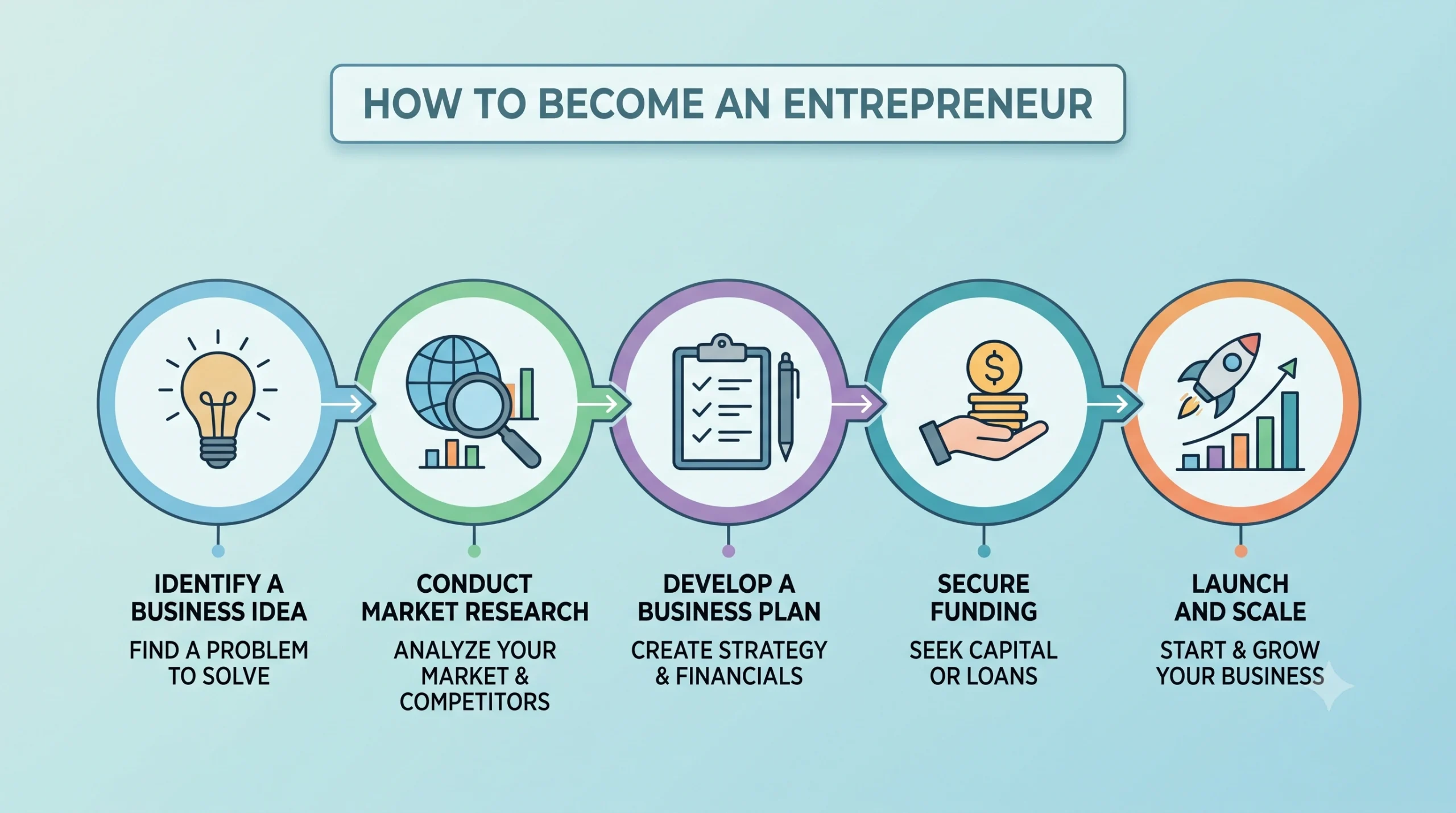
- The steps to become an entrepreneur include identifying a business opportunity, researching the market, validating the idea, creating a business plan, understanding financial basics, launching, and focusing on sustainable growth.
- Strong entrepreneur skills such as leadership, communication, decision-making, problem-solving, financial management, creativity, adaptability, negotiation, and networking can help manage the responsibilities of building a business.
- There are different types of entrepreneurs, including small business entrepreneurs, scalable startup entrepreneurs, social entrepreneurs, intrapreneurs, and innovative entrepreneurs, each with different goals and approaches.
- In this blog, you'll learn how to become an entrepreneur, what is entrepreneurship, essential entrepreneur skills, the steps to become an entrepreneur, types of entrepreneurs, and career opportunities in entrepreneurship.
Entrepreneurship has become an increasingly attractive career path for people who want to turn ideas into businesses, solve real-world problems, and create value in their communities. From launching a technology startup to running a local business, entrepreneurship offers different ways to build a career based on individual interests, skills, and goals.
However, becoming an entrepreneur is more than having a business idea. It requires the ability to identify opportunities, understand customers, manage resources, make informed decisions, and adapt when circumstances change. Entrepreneurs often have to handle multiple responsibilities, especially during the early stages of a business.
If you are wondering how to become an entrepreneur, this guide explains what is entrepreneurship, the essential entrepreneur skills you need, the key steps to become an entrepreneur, different types of entrepreneurs, and the career opportunities available in this field.
 ChatGPT
 Perplexity
 Claude
 Grok
GrokWhat Is Entrepreneurship?
So, what is entrepreneurship? Entrepreneurship is the process of identifying an opportunity, developing an idea into a business or venture, organizing resources, and taking calculated risks to create value. An entrepreneur may create a new product, introduce a service, develop a new business model, or find a better way to solve an existing problem.
Entrepreneurship is not limited to technology startups or large companies. A person running a consulting business, opening a restaurant, developing an online store, building a software company, or creating a social-impact venture can all be an entrepreneur.
At its core, entrepreneurship involves recognizing a need or opportunity and taking action. Entrepreneurs typically move through different stages, including idea development, market research, planning, launching, managing operations, and growing the venture.
It is also important to understand that entrepreneurship involves uncertainty. There is no guaranteed outcome when starting a business. Entrepreneurs must therefore learn to evaluate risks, make decisions with available information, respond to setbacks, and continuously improve their approach.
Why Choose Entrepreneurship as a Career?
Entrepreneurship as a career can provide an alternative to traditional employment. Instead of following a predefined organizational structure, entrepreneurs build and manage their own ventures and decide how they want to develop their businesses.
One of the biggest attractions is the opportunity to turn an idea into something tangible. Entrepreneurs can identify problems they care about and develop solutions that address customer needs. Building a business can also provide opportunities to develop leadership, financial, marketing, communication, and management capabilities.
Entrepreneurship can also offer flexibility. Depending on the nature of the business, entrepreneurs may have greater control over their work environment, business direction, and growth strategy.
However, entrepreneurship also comes with challenges. Income may not be consistent during the early stages, business decisions can carry financial consequences, and entrepreneurs may have to manage long working hours and uncertainty. Therefore, entrepreneurship should be viewed as a long-term career journey rather than a shortcut to financial success.





How to Become an Entrepreneur?
There is no single educational qualification or career route that guarantees entrepreneurial success. People enter entrepreneurship at different stages of their lives and from different professional backgrounds.
If you are exploring how to become an entrepreneur, the following steps can help you build a structured path.
1. Develop an Entrepreneurial Mindset
The first step is to develop the right mindset. Entrepreneurs need to be comfortable with uncertainty and willing to learn from both successes and failures.
An entrepreneurial mindset involves curiosity, initiative, resilience, adaptability, and a willingness to solve problems. Instead of seeing a challenge only as an obstacle, entrepreneurs often look for ways to turn it into an opportunity.
You should also develop a growth mindset. Your first idea may not work exactly as expected, and your initial business strategy may need to change. Being open to feedback and learning can help you make better decisions over time.
2. Identify a Problem or Business Opportunity
Successful businesses generally address a customer need, solve a problem, or offer a valuable alternative to existing solutions.
Start by observing the problems people face in your workplace, community, industry, or everyday life. Think about what customers find expensive, inconvenient, slow, complicated, or difficult to access.
Your personal interests and professional experience can also help you identify potential opportunities. However, an idea should not be pursued solely because you find it interesting. You should also determine whether there is a genuine market for the product or service.
3. Research Your Target Market
Market research helps you understand potential customers and competitors before investing heavily in a business idea.
Study your target audience, their needs, purchasing behavior, preferences, and expectations. Research existing competitors to understand what they offer and where their products or services may have limitations.
This process can help you identify your unique value proposition. Ask yourself: What makes your solution different, useful, or more relevant to your target customer?
4. Validate Your Business Idea
Before building a complete product or investing significant capital, test your idea.
You can speak with potential customers, conduct surveys, create a basic prototype, offer a small-scale service, or develop a minimum viable product. The purpose is to gather feedback and determine whether customers are genuinely interested in your solution.
Validation can help you identify weaknesses early and make changes before committing substantial resources.
5. Create a Business Plan
A business plan provides direction for your venture. It should explain what your business offers, who your customers are, how you plan to reach them, how the business will generate revenue, and what resources you require.
Your plan can also include information about competitors, pricing, marketing, operations, estimated costs, and financial goals.
A business plan does not have to remain unchanged. As you gain customer feedback and market experience, you may need to revise your assumptions and strategy.
6. Understand Business and Financial Basics
Entrepreneurs do not necessarily need to be financial experts, but they should understand the fundamentals of running a business.
Learn about budgeting, cash flow, pricing, revenue, expenses, profit margins, taxes, and basic accounting. Financial knowledge can help you understand the financial health of your business and make more informed decisions.
You should also understand the legal and regulatory requirements relevant to your business. Depending on your location and business structure, registration, licenses, contracts, taxation, and other compliance requirements may apply.
7. Build Your Product or Service
Once your idea has been validated, begin developing the product or service.
Start with a manageable version rather than trying to build everything at once. Focus on delivering the core value promised to your customers.
During this stage, pay close attention to quality and customer experience. Early customers can provide valuable feedback that helps you improve the offering before expanding.
8. Develop a Marketing Strategy
Even a strong product needs an effective way to reach customers. Entrepreneurs should therefore understand basic marketing principles.
Depending on your target market, you may use social media, content marketing, email marketing, networking, partnerships, paid advertising, referrals, or other promotional channels.
Your marketing strategy should clearly communicate the problem your business solves and why customers should choose your product or service.
9. Launch, Learn, and Adapt
Launching a business is not the final step. It is the beginning of an ongoing learning process.
Track customer feedback, sales, expenses, marketing performance, and other relevant business indicators. Identify what is working and what needs improvement.
Entrepreneurs often need to adjust their products, pricing, marketing messages, or business models as they learn more about their customers and market.
10. Focus on Sustainable Growth
Once the business begins gaining traction, focus on building sustainable systems.
This may involve hiring employees, improving processes, expanding your customer base, introducing new products, entering new markets, or using technology to improve efficiency.
Growth should be aligned with your resources and business objectives. Rapid expansion without adequate planning can create operational and financial challenges.
Types of Entrepreneurs
Entrepreneurs can be classified based on their approach to business, innovation, growth, and the markets they serve. Understanding these categories can help aspiring business owners identify the entrepreneurial path that best matches their goals, skills, and interests.
1. Small Business Entrepreneurs
They start and manage businesses such as retail stores, consulting firms, restaurants, agencies, and local service businesses, usually focusing on sustainable income and long-term stability.
2. Scalable Startup Entrepreneur
They build businesses with the intention of achieving rapid growth and expanding into larger markets. These entrepreneurs often focus on innovative ideas, technology, investment, and scalable business models.
3. Social Entrepreneurs
They create ventures that aim to address social or environmental challenges while developing financially sustainable business models. Their focus is on creating measurable social impact alongside business value.
4. Innovative Entrepreneurs
They introduce new products, services, technologies, or business models to solve existing problems in different ways. Innovation and differentiation are central to their entrepreneurial approach.
5. Serial Entrepreneurs
They continuously explore new business ideas and may launch multiple ventures throughout their careers. After establishing or exiting one venture, they often move on to developing another business opportunity.
Essential Entrepreneur Skills
Developing strong entrepreneur skills can help you manage the different responsibilities involved in building a business. These skills can be developed through education, professional experience, mentorship, practical projects, and continuous learning.
Leadership
Entrepreneurs need to set a clear direction and motivate people toward shared goals. Leadership becomes particularly important as a business grows and teams become larger.
Communication
Entrepreneurs communicate with customers, employees, investors, suppliers, partners, and other stakeholders. Strong written and verbal communication can help build relationships and present ideas effectively.
Decision-Making
Business owners regularly have to make decisions involving pricing, hiring, marketing, investments, and growth. Good decision-making involves analyzing available information, considering risks, and acting with confidence.
Problem-Solving
Problems are a regular part of running a business. Entrepreneurs need to identify the underlying issue, evaluate possible solutions, and take practical action.
Financial Management
Understanding finances is essential for managing business sustainability. Entrepreneurs should be able to track expenses, manage budgets, understand cash flow, and evaluate financial performance.
Creativity and Innovation
Creativity helps entrepreneurs develop new products, services, marketing approaches, and business models. Innovation can also help businesses respond to changing customer expectations.
Negotiation
Entrepreneurs frequently negotiate with suppliers, customers, employees, partners, and investors. Negotiation skills can help create agreements that support business objectives while maintaining professional relationships.
Adaptability
Markets, technologies, customer preferences, and competitors can change quickly. Entrepreneurs need to adapt their strategies when circumstances change rather than relying permanently on an outdated approach.
Networking
Building professional relationships can create opportunities for partnerships, mentorship, customer acquisition, hiring, and business development. Entrepreneurs should actively develop and maintain a professional network.
Career Opportunities in Entrepreneurship
Entrepreneurship does not necessarily mean immediately leaving employment to launch a company. There are several ways to develop an entrepreneurial career.
You can become a business owner by starting a company based on your skills or interests. Another option is to join a startup and work in areas such as business development, product management, marketing, operations, or strategy. This can provide practical exposure to entrepreneurial environments.
Entrepreneurial skills can also support careers such as business consultant, startup advisor, innovation manager, business development manager, product manager, franchise owner, or family-business professional.
Professionals can also become freelancers or independent consultants and gradually turn their services into larger businesses.
For students and working professionals, entrepreneurship education can provide knowledge of business planning, finance, marketing, leadership, strategy, and innovation. Practical experience, however, remains equally important because entrepreneurship requires applying knowledge to real-world situations.
Build Your Entrepreneurial Journey with IIT Bombay
Take your entrepreneurial ambitions forward with the e-Postgraduate Diploma in Innovation & Entrepreneurship from Desai Sethi School of Entrepreneurship (DSSE), IIT Bombay. Designed for aspiring entrepreneurs, startup founders, corporate intrapreneurs, R&D professionals, and innovation managers, the program covers the venture creation lifecycle, including opportunity identification, design thinking, customer discovery, entrepreneurial finance, technology venture formation, marketing, leadership, and business growth. With a practice-oriented approach featuring case studies, fieldwork, simulations, projects, prototype development, and pitch sessions, the program helps learners build practical capabilities for developing and scaling innovative ventures.
Conclusion
Learning how to become an entrepreneur requires more than developing a business idea. It involves building the right mindset, identifying meaningful opportunities, understanding customers, validating ideas, creating a business plan, managing finances, marketing effectively, and continuously adapting.
Strong entrepreneur skills such as leadership, communication, problem-solving, decision-making, financial management, creativity, and adaptability can help aspiring entrepreneurs navigate the challenges of building a business.
Whether you choose to launch a startup, operate a small business, develop a social venture, or pursue innovation within an established organization, entrepreneurship as a career offers multiple pathways. The most important step is to start learning, gain practical experience, test your ideas, and remain willing to adapt as you grow.
Frequently Asked Questions
Yes. There is no single background required to become an entrepreneur. People from different educational, professional, and industry backgrounds can pursue entrepreneurship by developing relevant skills, identifying opportunities, and gaining practical business experience.
The key steps to become an entrepreneur include developing an entrepreneurial mindset, identifying a business opportunity, researching the market, validating the idea, creating a business plan, understanding finances and legal requirements, developing the product or service, marketing the business, launching it, and adapting based on feedback.





Find a Program made just for YOU
We'll help you find the right fit for your solution. Let's get you connected with the perfect solution.
Is Your Upskilling Effort worth it?
 ROI Calculator

Are Your Skills Meeting Job Demands?
Try our Skill Gap tool
Experience Lifelong Learning and Connect with Like-minded Professionals
Explore Jaro Connect
