Best Marketing Management Courses & Certificates in 2026
Key Insights
A marketing management course can help professionals build capabilities in marketing strategy, consumer behavior, analytics, digital channels, brand management, and campaign planning.
The key features of marketing management include a customer-oriented approach, strategic decision-making, market research, integrated marketing activities, performance measurement, and adaptability.
Choosing the right marketing course requires evaluating the curriculum, faculty, learning format, duration, projects, assessment structure, certification, and alignment with career goals.
Building a career in marketing management requires a strong educational foundation, practical experience, marketing and analytical skills, leadership capabilities, and continuous learning.
In this blog, you'll learn what is marketing management, the types of marketing courses and certificates available in 2026, the key features of marketing management, how to choose a suitable course, and how to become a marketing manager.
Marketing has evolved far beyond traditional advertising and promotional campaigns. In 2026, marketing professionals are expected to understand customers, interpret data, develop digital strategies, use emerging technologies, manage brands, and connect marketing activities with broader business goals. The growing importance of AI, analytics, digital channels, and strategic decision-making is also changing the skills organizations look for in marketing professionals.
For students, working professionals, entrepreneurs, and aspiring marketing leaders, pursuing a structured marketing management course can provide a systematic way to build these capabilities. This guide explains what is marketing management, the key features of marketing management, popular types of courses and certificates to consider in 2026, and how to become a marketing manager.
Before exploring courses, it is important to understand what is marketing management. Marketing management refers to the planning, execution, analysis, and control of marketing activities designed to meet customer needs while supporting organizational objectives. It covers areas such as market research, product positioning, pricing, promotion, distribution, customer engagement, and marketing performance.
Marketing management brings together customer understanding and business strategy. Instead of treating marketing as a collection of individual campaigns, it focuses on creating a coordinated approach to reaching target audiences and delivering value.
A modern marketing manager may therefore need to work across digital marketing, branding, content, social media, analytics, advertising, customer experience, and business development. This broad scope makes marketing management education relevant for professionals who want to move from execution-focused roles into strategic positions.
The marketing profession is changing as organizations increasingly combine creativity with data, technology, and business strategy. A marketing management course can help learners understand how different marketing functions work together and how to apply marketing concepts to business situations.
One major shift is the growing importance of AI. The AMA’s 2026 career research identifies AI fluency as a baseline expectation for marketers and highlights strategic thinking, decision-making, business acumen, adaptability, and storytelling as future-oriented skills. (American Marketing Association)
A structured course can also help professionals strengthen their understanding of marketing strategy, consumer behavior, market research, brand management, digital channels, marketing analytics, and campaign planning. Depending on the program, learners may also gain exposure to case studies, projects, simulations, and industry-oriented tools.
The features of marketing management explain the broad nature of the discipline and why it is important to businesses.
Customer-Oriented Approach
Marketing management begins with understanding customer needs, preferences, expectations, and behavior. Businesses use these insights to develop appropriate products, services, positioning, and communication strategies.
Strategic Decision-Making
Marketing managers need to make decisions about target markets, positioning, pricing, promotional activities, distribution channels, and resource allocation. These decisions should support the organization’s wider objectives.
Market Research and Analysis
Research helps organizations understand customers, competitors, industry developments, and market opportunities. Marketing managers use this information to identify potential opportunities and make informed decisions.
Integrated Marketing Activities
Marketing management brings different activities together rather than treating them independently. Branding, advertising, content, digital marketing, sales support, customer engagement, and other activities can work toward common objectives.
Performance Measurement
Modern marketing requires continuous measurement. Professionals monitor campaign and business metrics to understand what is working, identify areas for improvement, and optimize marketing activities.
Adaptability
Customer behavior, technology, and marketing channels continue to change. Marketing management therefore requires professionals to adapt strategies based on new information and changing market conditions.
Best Marketing Management Courses & Certificates in 2026
There is no single marketing management program that is ideal for every learner. The right option depends on career stage, learning objectives, experience, preferred specialization, and the depth of management knowledge required.
1. Postgraduate Marketing Management Programs
Postgraduate programs are suitable for learners seeking comprehensive management education. These programs generally provide broader exposure to marketing strategy, consumer behavior, branding, sales, business analytics, and other management functions.
They can be particularly relevant for graduates who want to build a long-term career in marketing or professionals seeking broader business knowledge alongside marketing expertise.
2. Executive Marketing Management Programs
Executive programs are designed for working professionals who want to strengthen their managerial and strategic capabilities without necessarily pursuing a traditional full-time degree.
These programs can focus on advanced marketing strategy, leadership, customer insights, brand management, digital transformation, and business decision-making. For experienced professionals, an executive marketing management course can be useful when preparing for larger responsibilities.
For example, IIM Kozhikode’s Advanced Strategy for Products & Marketing and Advanced Analytics for Products & Marketing is a 14-month dual certificate programme designed for business leaders, digital analysts, marketing managers, product managers, and other professionals. It covers product and marketing strategy, analytics, consumer behavior, product innovation, positioning, pricing, digital strategy, and strategic decision-making through live classes, case studies, simulations, and capstone projects.
3. Digital Marketing Certificates
Digital marketing certificates can be useful for professionals who want to develop specialized skills in areas such as SEO, paid advertising, social media, content marketing, email marketing, and analytics.
These certificates are particularly relevant for professionals who already understand basic marketing but want to strengthen their digital capabilities.
4. Marketing Analytics Certificates
Marketing analytics programs focus on using data to understand customer behavior, campaign performance, market trends, and marketing outcomes.
These courses can help professionals become more comfortable with metrics and data-driven decision-making. Analytics is increasingly relevant because marketing teams need to demonstrate the impact of campaigns and use data to optimize future activities.
5. Brand and Strategic Marketing Programs
Professionals interested in brand leadership can explore programs focused on brand strategy, customer insights, positioning,storytelling, and strategic marketing.
These courses can be particularly relevant for professionals moving toward brand manager, marketing strategist, category manager, or marketing leadership roles.
You can explore a wide range of marketing management certificates, including programs from prestigious institutions such as IIM Calcutta, IIM Nagpur, IIM Visakhapatnam, MDI, and others, with differences in duration, delivery format, level, and specialization.
How to Choose the Right Marketing Management Course
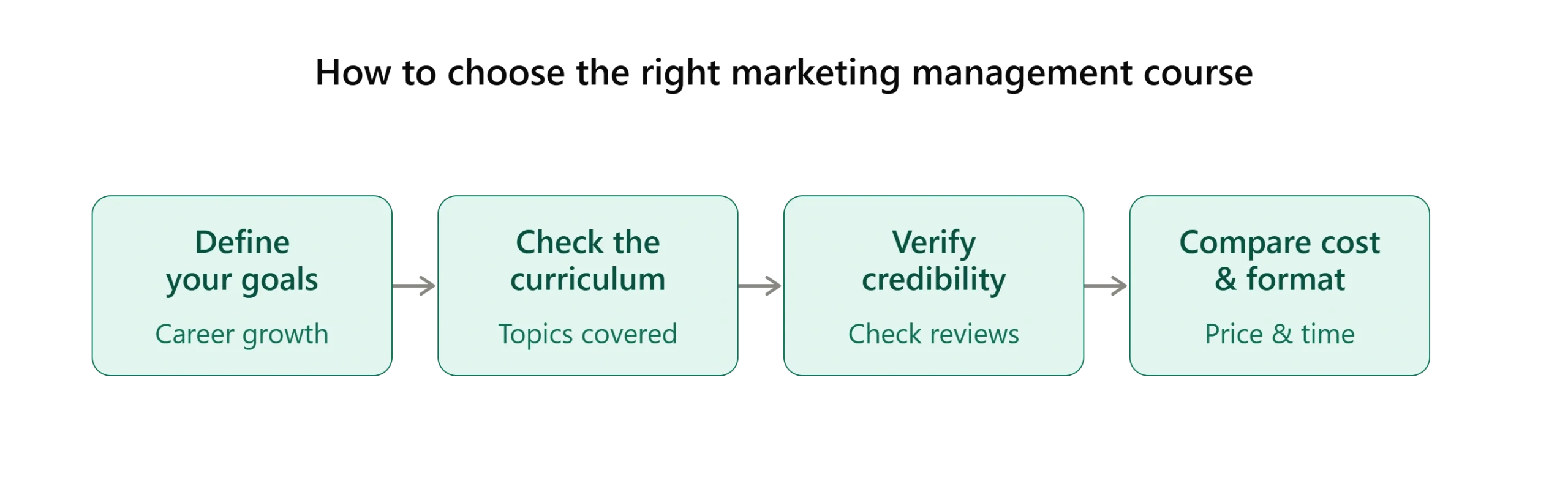
With many courses and certificates available, comparing programs based only on the course title may not be enough. Learners should examine the curriculum, faculty, learning format, duration, projects, assessment structure, certification, and relevance to their career goals.
The curriculum should ideally cover fundamental marketing concepts while also addressing contemporary areas such as digital marketing, analytics, AI, customer experience, brand strategy, and marketing technology where relevant.
Working professionals may prefer programs that provide flexible learning formats, while early-career learners may benefit from programs offering broader management foundations and practical projects.
It is also important to consider whether the credential aligns with the learner’s intended career path. Someone targeting digital marketing may need a different program from a professional preparing for a senior brand or marketing strategy role.
How to Become a Marketing Manager
If you are wondering how to become a marketing manager, there is no single route. However, education, practical experience, marketing skills, and leadership capabilities are important components of the career path.
Build a Strong Educational Foundation
A degree in marketing, business, management, communications, or a related field can provide foundational knowledge. Professionals can later strengthen their expertise through specialized certificates, postgraduate programs, or executive education.
Develop Core Marketing Skills
Marketing managers need a combination of analytical, creative, communication, leadership, and problem-solving capabilities. Current career guidance also emphasizes skills such as marketing analytics, SEO, social media, communication, leadership, teamwork, and creative thinking.
Gain Practical Experience
Experience helps professionals understand how marketing strategies work in real business environments. Entry-level positions can provide exposure to campaigns, customer research, content, digital channels, analytics, and reporting.
Career progression commonly moves through roles such as coordinator or specialist before reaching management positions, although the path varies by organization and experience.
Build Analytical and Digital Capabilities
Marketing managers increasingly need to work with data and technology. Developing knowledge of analytics, SEO, advertising platforms, social media, marketing automation, and other relevant tools can strengthen a professional profile.
Develop Leadership Skills
Moving into management requires more than technical marketing knowledge. Marketing managers need to communicate with stakeholders, coordinate teams, manage budgets, make decisions, and connect marketing initiatives with organizational goals.
Continue Learning
Marketing changes quickly. Professionals need to stay updated on customer behavior, emerging technologies, AI, digital channels, and evolving marketing practices. Continuous learning through courses, certifications, projects, and industry resources can support long-term career development.
Career Opportunities After a Marketing Management Course
A marketing management qualification can support career opportunities across different marketing functions. Depending on education, experience, and specialization, professionals may explore roles such as Marketing Manager, Brand Manager, Digital Marketing Manager, Product Marketing Manager, Marketing Analyst, Growth MarketingManager, Category Manager, or Marketing Strategist.
Professionals can work across industries because marketing is relevant to consumer products, technology, financial services, healthcare, education, retail, media, manufacturing, and other sectors.
As professionals gain experience, they may progress toward senior marketing management, head of marketing, marketing director, or other strategic leadership positions.
Conclusion
Marketing management combines customer understanding, market analysis, strategic planning, creativity, technology, and business decision-making. As the marketing profession evolves in 2026, professionals need to develop capabilities that go beyond campaign execution. AI fluency, analytics, strategic thinking, communication, business understanding, and adaptability are becoming increasingly relevant to modern marketing careers. (American Marketing Association)
Choosing the right marketing management course can help learners build a structured understanding of marketing while developing specialized capabilities aligned with their career goals. Whether you are a student starting your career, a professional looking to move into management, or an experienced marketer seeking strategic expertise, the right course or certificate can support continuous skill development. Understanding what is marketing management, its key features, and the skills required for leadership can help you make a more informed decision about your learning and career path.
Frequently Asked Questions
Marketing management is the process of planning, implementing, analyzing, and controlling marketing activities to understand customers, create value, support business objectives, and achieve marketing goals.
The best course depends on your career stage and objectives. Consider factors such as curriculum, specialization, institution, faculty, duration, delivery format, practical learning, certification, and relevance to your desired career path.
To understand how to become a marketing manager, start by building a strong educational foundation, developing marketing and analytical skills, gaining relevant work experience, strengthening leadership capabilities, and continuing to learn emerging marketing practices.
The major features of marketing management include a customer-oriented approach, strategic decision-making, market research, integrated marketing activities, performance measurement, and adaptability to changing market conditions.
Marketing certificates can help professionals develop or validate specialized knowledge. Their value depends on the course content, credibility of the institution or provider, practical learning, and how effectively the learner applies the acquired skills in real-world situations.
Priya Sahu
Sales & Digital Marketing Strategist
Sales and Marketing professional with 6+ years of experience in B2B and B2C growth, specializing in business development and digital marketing. Skilled in CRM systems, paid campaigns, and AI-driven strategies to drive revenue, optimize performance, and build lasting client relationships.
Get Free Upskilling Guidance
Fill in the details for a free consultation
Related Courses
Explore our programs
Professional Certificate Programme in AI-Powered Digital Marketing for Performance & Growth

 August 22, 2026
 8 min read





 Key Insights
 ChatGPT
 Perplexity
 Claude
 Grok
Grok









 ROI Calculator