Emerging IT Career Roles: UX Design, Product and Project Management
J
By Nuthana Reddy
September 5, 20268 min read
Published on September 5, 2026
SHARE THIS ARTICLE
Table Of Content
What Are Emerging IT Career Roles?
UX Designer vs Product Manager vs Project Manager
Classification of Information System and Its Relevance
Skills Common Across These IT Career Roles
Key Insights
UX Design, Product Management, and Project Management offer distinct career paths that connect technology with user needs, business goals, and project execution.
Aspiring UX Designers can build their careers by developing skills in user research, wireframing, prototyping, usability testing, and creating a strong portfolio.
Product Manager eligibility varies by organization, with employers considering educational background, relevant experience, product knowledge, business understanding, and communication skills.
Project Manager requirements can include relevant education, project experience, planning, leadership, communication, risk management, and knowledge of project management methods and tools.
In this blog, you'll learn about emerging IT career roles, how to become a user experience designer, product manager eligibility, project manager requirements, the classification of information systems, and how to choose the right career path.
India’s technology sector is evolving rapidly, creating career opportunities that go beyond traditional software development and technical roles. According to NITI Aayog’s 2025 Roadmap for Job Creation in the AI Economy, India’s technology sector could create up to 4 million new job opportunities by 2031, depending on how effectively the country adapts to AI-driven changes. This transformation is also increasing the importance of professionals who can connect technology with user needs, business objectives, and project execution. As a result, career paths such as UX design, product management, and project management are gaining relevance for professionals looking to build careers at the intersection of technology, creativity, strategy, and business.
Technology-driven organizations need professionals who can do more than write code or maintain IT infrastructure. They also need people who understand customer expectations, define product priorities, coordinate teams, and ensure digital solutions are easy to use.
This has increased the importance of roles such as UX Designer, Product Manager, and Project Manager. Although these professionals work closely with technology teams, their responsibilities are different.
A UX Designer focuses on the user’s experience with a product. A Product Manager determines what should be built and why, while a Project Managerfocuses on how and when the work should be completed.
Understanding these differences is important for anyone considering a career in the modern IT industry.
1. UX Designer
A UX Designer focuses on making digital products useful, accessible, and easy to navigate. Instead of simply concentrating on how an application or website looks, UX professionals study user needs and design experiences that help users accomplish their goals.
Their work may include user research, creating user journeys, developing wireframes, designing prototypes, conducting usability testing, and collaborating with developers and product teams.
UX design can be found across websites, mobile applications, software platforms, e-commerce products, financial applications, healthcare technology, and other digital services.
How to Become a User Experience Designer
If you are wondering how to become a user experience designer, the first step is to understand the fundamentals of user-centered design. You should learn concepts such as user research, information architecture, interaction design, wireframing, prototyping, and usability testing.
A typical path can include:
Learning UX design fundamentals
Understanding user research methods
Practicing wireframing and prototyping
Learning commonly used design tools
Building real-world design projects
Creating a strong UX portfolio
Developing communication and presentation skills
A degree in design, technology, psychology, or a related field can be useful, but practical skills and a portfolio are also important for demonstrating your capabilities.
Skills Required for UX Designers
UX professionals need a combination of creative, analytical, and interpersonal skills. Important skills include:
The UX field is also evolving with AI and emerging technologies. Newer specializations include AI UX design, conversation design, accessibility-focused roles, and design engineering, making continuous learning increasingly relevant.
2. Product Manager
A Product Manager is responsible for guiding a product from an idea toward development and improvement. The role sits at the intersection of customer needs, business objectives, design, and technology.
Product Managers work with designers, developers, business teams, and other stakeholders to understand problems, define priorities, create product roadmaps, and make decisions about product development.
Their responsibilities may include:
Understanding customer requirements
Conducting market and user research
Defining product goals
Prioritizing features
Creating product roadmaps
Coordinating with design and engineering teams
Monitoring product performance
Communicating with stakeholders
Unlike a UX Designer, who primarily focuses on the user experience, a Product Manager takes a broader view of the product, including its users, business objectives, market opportunity, and development priorities.
Product Manager Eligibility
There is no single universal requirement for becoming a Product Manager. Product manager eligibility can vary depending on the organization, role, and level of experience.
Many employers look for candidates with a bachelor’s degree in areas such as business, technology,engineering, design, economics, or related disciplines. However, relevant work experience and practical product knowledge can also be valuable.
Professionals from technology, business analysis, consulting, marketing, UX design, software development, and other fields may transition into product management .
To prepare for the role, candidates should develop knowledge of:
Strong communication and decision-making abilities are particularly important because Product Managers often need to coordinate different teams and make choices about competing priorities.
3. Project Manager
While Product Managers focus on what should be built and why, Project Managers focus on delivering the work successfully.
A Project Manager plans, coordinates, and monitors projects from initiation to completion. In IT organizations, project managers may work with developers, designers, testers, business teams, clients, and other stakeholders.
Their responsibilities can include:
Defining project scope
Creating project schedules
Allocating resources
Coordinating team members
Tracking project progress
Managing risks
Communicating with stakeholders
Monitoring deadlines and deliverables
Project management is particularly important when multiple teams need to work together toward a common objective.
Project Manager Requirements
The project manager requirements can differ across companies and industries. Employers may look for a relevant bachelor’s degree, project experience, industry knowledge, and familiarity with project management methods and tools.
Certifications can also support professional development, depending on the candidate’s career goals and the requirements of the organization.
For IT project management, understanding technology concepts can be particularly useful. Project Managers do not necessarily need to be expert programmers, but they should understand the development process well enough to communicate effectively with technical teams.
Although these three roles often work together, their primary responsibilities differ.
Role
Primary Focus
Key Responsibility
UX Designer
User experience
Designs useful and intuitive experiences
Product Manager
Product strategy
Defines priorities and product direction
Project Manager
Project delivery
Plans and coordinates project execution
A UX Designer asks, “How can we make this experience better for the user?”
A Product Manager asks, “What should we build, and why does it matter?”
A Project Manager asks, “How can we deliver this successfully within the planned scope and timeline?”
In practice, these roles collaborate closely. A Product Manager may define product priorities, a UX Designer may design the experience, and a Project Manager may coordinate the resources and activities required to deliver the project.
Classification of Information System and Its Relevance
Understanding the classification of information system can also be useful for professionals entering technology-oriented business roles. Information systems can support different organizational activities, including transaction processing, management reporting, decision-making, and strategic planning.
For professionals in UX, product, and project management, understanding how information systems support business processes can provide useful context.
For example, a Product Manager may work on a business application that collects and analyzes customer information. A UX Designer may focus on how users interact with that application, while a Project Manager coordinates the implementation process.
Knowledge of information systems therefore helps professionals understand how technology supports organizational activities and business decisions.
Although UX Design, Product Management, and Project Management require different expertise, several skills are valuable across all three careers.
Communication
Professionals must communicate with technical teams, business stakeholders, customers, and other departments. Clear communication helps teams understand requirements, priorities, and expectations.
Problem-Solving
Technology projects often involve changing requirements, user challenges, resource limitations, or competing priorities. The ability to analyze problems and develop practical solutions is valuable.
Collaboration
These roles rarely work in isolation. UX Designers, Product Managers, and Project Managers regularly collaborate with developers, marketers, business leaders, designers, and other professionals.
Analytical Thinking
Data can help professionals understand user behavior, evaluate product performance, identify project issues, and support better decisions.
Adaptability
Technology and customer expectations continue to change. Professionals need to learn new tools, processes, and approaches as their roles evolve.
How to Choose the Right Career Path
Choosing between UX Design, Product Management, and Project Management depends largely on your interests and strengths.
If you enjoy understanding people, solving design problems, and creating intuitive digital experiences, UX Design may be a suitable option.
If you are interested in business strategy, customer needs, technology, and deciding product priorities, Product Management could be a strong career direction.
If you enjoy planning, coordinating people, managing timelines, and ensuring that work progresses toward completion, Project Management may be a better fit.
Your existing education and professional experience can also influence the transition. For example, designers may explore product roles, developers may move toward product management, and professionals with coordination or operations experience may consider project management.
The boundaries between technology, business, and user experience are becoming increasingly interconnected. Organizations need professionals who can understand users, make informed decisions, coordinate teams, and translate business objectives into technology-driven solutions.
UX roles are also becoming more specialized as organizations adopt AI-powered products and focus on areas such as accessibility, conversational interfaces, and design systems. Product management is similarly evolving as professionals increasingly work with data, AI-enabled products, and cross-functional teams.
Project management continues to play an important role in ensuring that technology initiatives are planned and delivered effectively.
Rather than viewing these careers as completely separate, it can be useful to understand how they complement one another. Professionals who understand adjacent functions can collaborate more effectively and develop broader business and technology perspectives.
Conclusion
UX Design, Product Management, and Project Management represent three distinct career paths within the evolving IT industry. Each role addresses a different aspect of technology-driven work: UX Designers focus on user experience, Product Managers guide product direction, and Project Managers coordinate successful project delivery.
For aspiring professionals, the right choice depends on individual interests, existing skills, education, and career goals. Learning the required skills, gaining practical experience, and understanding how technology teams work together can help build a strong foundation for these careers.
As technology continues to influence how organizations operate and serve customers, professionals who can connect users, business objectives, and technology can find diverse opportunities across the IT ecosystem.
Frequently Asked Questions
To become a UX Designer, learn user research, information architecture, wireframing, prototyping, interaction design, and usability testing. Building practical projects and a strong portfolio can help demonstrate your skills to employers.
Product manager eligibility varies by organization. Employers may consider educational background, relevant work experience, product knowledge, business understanding, communication skills, and problem-solving abilities.
Project manager requirements can include relevant education, project experience, planning and communication skills, leadership abilities, and knowledge of project management methods and tools.
UX Designers focus on user experience, Product Managers focus on product strategy and priorities, and Project Managers focus on planning, coordination, and project delivery.
Nuthana Reddy
Nuthana Reddy is a Senior Manager at Procter & Gamble, specializing in operations, digitization, and cross-functional leadership. She has driven multimillion-dollar impact through innovation, process optimization, and strategic execution across global markets.
Get Free Upskilling Guidance
Fill in the details for a free consultation
Related Courses
Explore our programs
e-Postgraduate Diploma in Interaction Design (ePGD IxD)
 HOME > BLOG > Career Development > Emerging IT Career Roles: UX Design, Product and Project Management
 September 5, 2026
 8 min read




 Key Insights
 ChatGPT
 Perplexity
 Claude
 Grok
Grok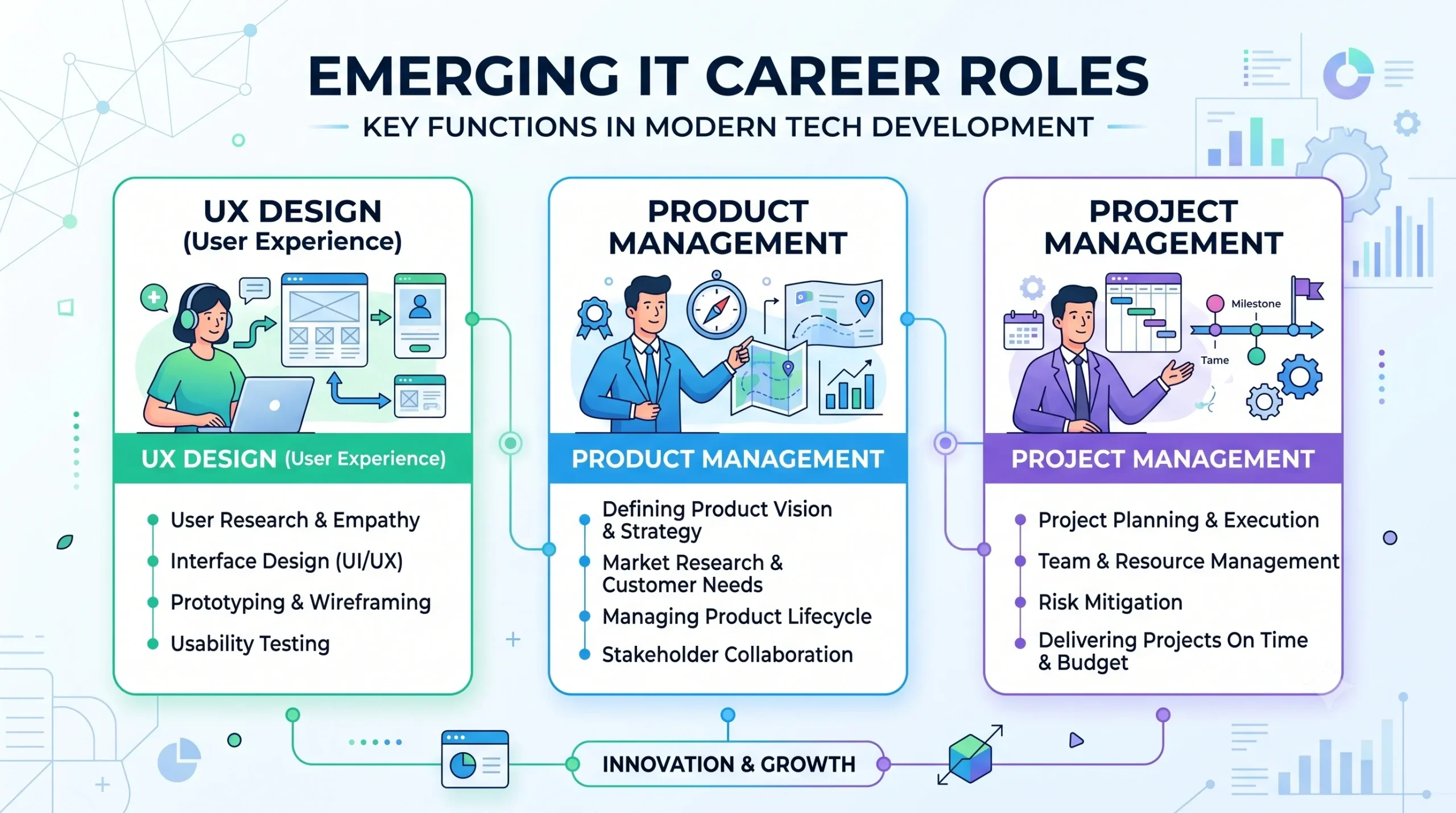











 ROI Calculator




