Eligibility for Computer Science Courses After 12th
Computer Science Courses After 12th: Complete List of Options
Computer Science Engineering Courses After 12th: Specializations to Consider
Key Insights
Computer science courses after 12th include B.Tech, BCA, B.Sc in Computer Science, B.Sc IT, diplomas, integrated programmes, and short-term certifications.
Eligibility requirements vary by course, with B.Tech generally requiring Physics, Chemistry, and Mathematics, while some BCA and diploma programmes accept students from other streams.
Popular specializations include Artificial Intelligence and Machine Learning, Data Science, Cybersecurity, Cloud Computing, Internet of Things, and Robotics and Automation.
Choosing the right course requires evaluating your interests, career goals, college quality, fees, course duration, curriculum, and placement opportunities.
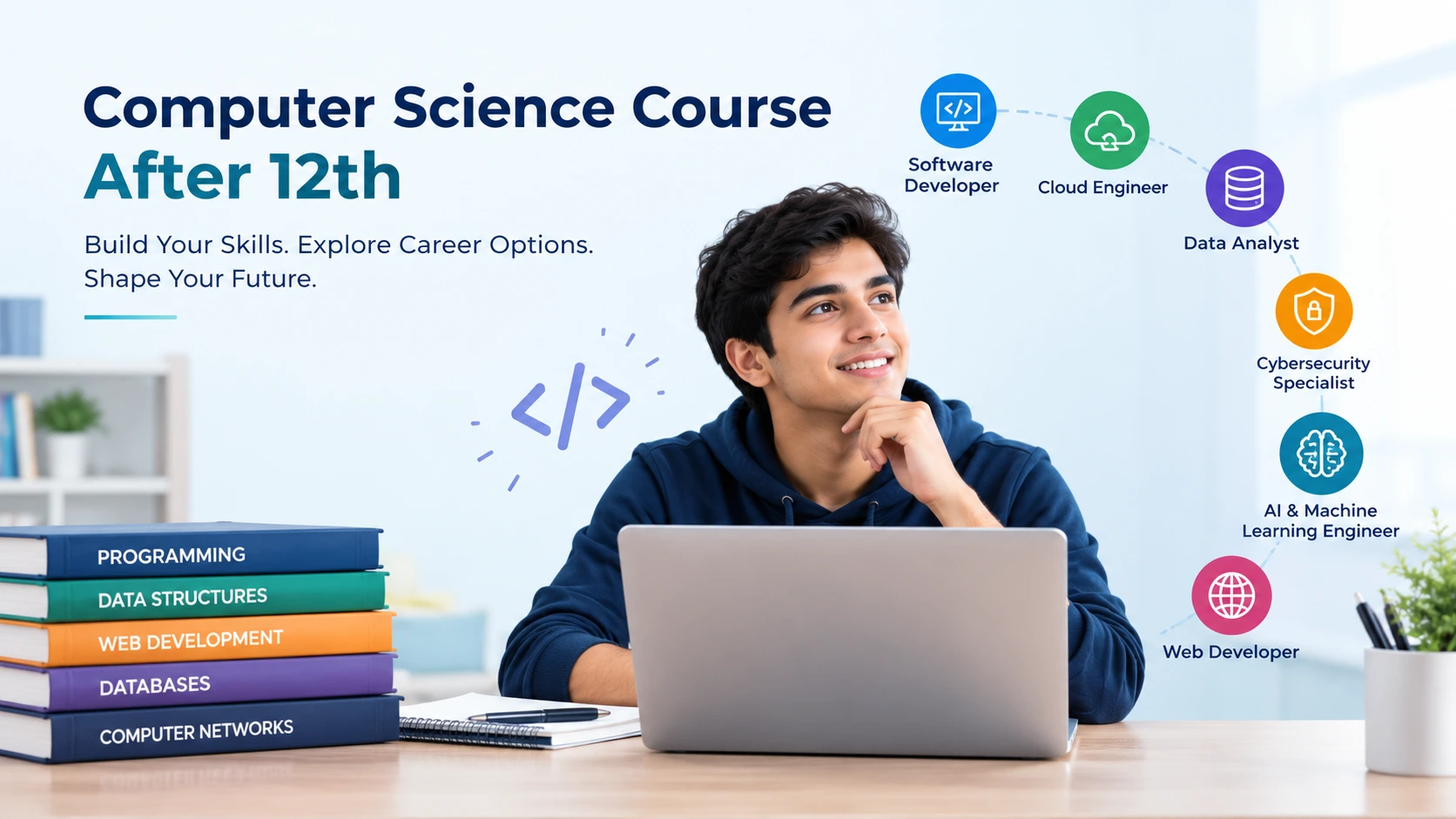
In this blog, you'll learn about computer science courses after 12th, eligibility criteria, entrance exams, specializations, essential skills, career opportunities, higher studies, and tips for selecting the right programme.
Choosing what to study after Class 12 is one of the biggest decisions a student makes. If you enjoy technology, problem-solving, or building things on a screen, a computer sciencecourse can be a rewarding path. The demand for skilled professionals in software, data, artificial intelligence, and cybersecurity continues to grow across every industry, from banking and healthcare to education and entertainment.
However, the number of options can feel overwhelming. Should you go for B.Tech, BCA, or B.Sc? Which stream is required? What is the best computer science course for your goals? This guide answers all of these questions in simple language. You will learn about computer science courses after 12th, eligibility rules, entrance exams, specializations, career options, and practical tips to help you decide with confidence.
A computer science course teaches you how computers work and how to use them to solve real-world problems. It covers programming, algorithms, data structures, databases, operating systems, computer networks, and software development. Higher-level subjects include artificial intelligence,machine learning, cloud computing, and information security.
The field is not only about writing code. It also buildslogical thinking, analytical skills, and the ability to break a large problem into smaller, manageable steps. These skills are useful in almost every profession today, which is why a computer science course remains one of the most popular choices among students after Class 12.
Depending on the level and the institution, a computer science course can be a degree program, a diploma, or a short-term certification. Each option differs in duration, cost, depth, and career outcome, and we will look at each of them below.
Eligibility for Computer Science Courses After 12th
Before choosing a program, check whether you meet the basic eligibility conditions. These vary by course and college, but the general pattern is as follows:
B.Tech / B.E. in Computer Science: You need to pass Class 12 with Physics, Chemistry, and Mathematics. Most colleges ask for a minimum of 50 to 75 percent marks, depending on the institution and category.
BCA: Students from any stream can usually apply, although some universities prefer or require Mathematics in Class 12.
B.Sc in Computer Science or IT: Most colleges require Class 12 from the science stream, and many prefer Mathematics as a subject.
Diploma in Computer Science: Many diploma programs accept students who have passed Class 10 or Class 12.
Certification courses: These are generally open to everyone, with no strict academic requirement.
Always read the official admission brochure of the college you are interested in, because eligibility rules and cutoffs can change from year to year.
Computer Science Courses After 12th: Complete List of Options
Students often assume that engineering is the only route into technology. In reality, there are several computer science courses after 12th, and each one suits a different type of learner. Here are the main options.
1. B.Tech or B.E. in Computer Science and Engineering
This is a four-year undergraduate engineering degree and the most popular choice. It combines core computer science subjects with mathematics, electronics, and engineering fundamentals. Students also complete labs, projects, and internships. This degree is well recognized by employers and is often required for roles in large technology companies, research, and government sector jobs.
2. BCA (Bachelor of Computer Applications)
BCA is a three-year undergraduate degree focused on software development, web technologies, databases, and application building. It is less math-heavy than engineering and is a good choice for students who want to enter the IT industry quickly. After BCA, many students pursue MCA or an MBA for further growth.
3. B.Sc in Computer Science
This three-year degree gives a strong theoretical base in programming, algorithms, and mathematics. It suits students who like academic learning and may want to pursue research or a master’s degree later. Some universities also offer a four-year honors version.
4. B.Sc in Information Technology
Similar to B.Sc Computer Science, this program focuses more on practical IT topics such as networking, web development, system administration, and information systems. It is a solid option for those who want technical roles in IT support and infrastructure.
5. B.Sc or B.S. in Data Science and Artificial Intelligence
Several universities and institutes now offer undergraduate degrees in data science, AI, and analytics. These programs include statistics, machine learning, anddata visualizationalongside basic programming. They are ideal for students who enjoy working with numbers and patterns.
6. Diploma in Computer Science or Computer Engineering
A diploma usually lasts three years after Class 10 or two years after Class 12. It is more affordable and practical. Many diploma holders later take lateral entry into the second year of a B.Tech program, which makes this a flexible pathway.
7. Integrated Programs
Some institutions offer five-year integrated programs, such as B.Tech with M.Tech or BBA with MBA in technology management. These save time and offer deeper specialization.
8. Short-Term Certification Courses
Courses in Python, Java, web development, ethical hacking, cloud computing, and data analytics can be done alongside your degree. They help you build job-ready skills and strengthen your resume.
Computer Science Engineering Courses After 12th: Specializations to Consider
If you decide to pursue engineering, it helps to know the different branches and specializations available. Computer science engineering courses after 12th are no longer limited to a single general degree. Many colleges now offer focused branches from the very first year, or let you choose a specialization after the first or second year.
Computer Science and Engineering (CSE): The core branch covering programming, systems, networks, and software engineering.
CSE with Artificial Intelligence and Machine Learning: Focuses on building intelligent systems, neural networks, and predictive models.
CSE with Data Science: Combines statistics, big data, and analytics to help organizations make better decisions.
CSE with Cyber Security: Prepares you to protect systems, networks, and data from digital threats.
CSE with Cloud Computing: Teaches you to design and manage applications on platforms such as AWS, Azure, and Google Cloud.
CSE with Internet of Things (IoT): Connects hardware devices with software, which is useful in smart homes, healthcare, and industry.
Information Technology (IT): A closely related branch with a stronger focus on applications and information systems.
Robotics and Automation: A blend of computer science, electronics, and mechanical engineering.
When you compare these computer science engineering courses after 12th, look at the curriculum, the faculty, lab facilities, industry tie-ups, and placement records, rather than the name of the branch alone.
Entrance Exams for Computer Science Engineering Courses After 12th
Admission to most engineering colleges depends on entrance exams. Here are the major ones students should know about:
JEE Main: The national-level exam for admission to NITs, IIITs, and other centrally funded technical institutions.
JEE Advanced: Required for admission to the Indian Institutes of Technology (IITs). Only top JEE Main performers qualify.
BITSAT: Conducted by BITS Pilani for its campuses.
VITEEE, SRMJEEE, and similar private university exams: Used by respective universities for their own B.Tech programs.
State-level exams: Examples include MHT CET, KCET, WBJEE, and other state common entrance tests for state engineering colleges.
For BCA and B.Sc programs, many universities use the CUET-UG score or conduct their own entrance tests, while others admit students based on Class 12 marks. Start preparing early, understand the syllabus, and practice previous years’ papers regularly.
Best Computer Science Course: How to Choose the Right One
Students often ask which is the best computer science course. The honest answer is that there is no single best option for everyone. The best computer science course is the one that matches your interests, your academic background, your budget, and your long-term goals. Consider the following points before deciding.
Your Interests and Strengths
If you enjoy mathematics and deep technical subjects, B.Tech in CSE is a strong fit. If you prefer practical application developmentand want to start your career early, BCA may suit you better. If research or teaching interests you, B.Sc Computer Science followed by a master’s degree can be a good route.
Career Goals
Think about where you want to be in five to ten years. Do you want to work at a large product company, join a startup, build your own business, or pursue research abroad? Product companies and research roles often prefer engineering graduates, while many service companies and startups hire BCA and B.Sc graduates as well, based on skills.
College Quality and Placements
A good college can make a major difference. Check the accreditation, faculty experience, curriculum updates, internship opportunities, and placement records. Speak with current students and alumni if possible, and avoid relying only on advertisements.
Cost and Duration
B.Tech is a four-year program and usually costs more than a three-year BCA or B.Sc. Diploma programs are the most affordable. Look at tuition, hostel costs, and the availability of scholarships or education loans before making your final decision.
Industry Relevance
The technology field changes quickly. Choose a program that teaches current tools and includes practical projects, hackathons, and internships. A course that updates its syllabus regularly will keep you competitive in the job market.
Quick Comparison of Popular Computer Science Courses
Here is a simple way to compare the main options at a glance:
B.Tech/B.E. in CSE: Four years; best for strong technical roles, research, and large tech companies; requires physics, chemistry, and mathematics in Class 12.
BCA: Three years; best for application development and quick entry into the IT sector; open to students from multiple streams.
B.Sc Computer Science/IT: Three years; best for theory, academics, and further studies; usually requires a science background.
Diploma: Two to three years; best for low-cost, practical training and lateral entry into B.Tech.
Certification courses: A few weeks to a few months; best for adding specific skills to your existing degree.
Key Skills You Need to Succeed in a Computer Science Course
You do not need to be a genius to succeed in computer science, but certain habits and skills help a great deal:
Logical and analytical thinking: The ability to break down problems and find step-by-step solutions.
Programming languages:Python, Java, C++, and JavaScript are widely used and a good starting point.
Mathematics basics: Discrete mathematics, probability, and statistics support many advanced topics.
Problem-solving practice: Regular practice on coding platforms improves speed and confidence.
Communication and teamwork: Most software projects are built by teams, so clear communication matters.
Willingness to keep learning: New tools and technologies appear all the time, so continuous learning is essential.
You can begin building these skills even before your college starts. Free online tutorials, beginner coding courses, and small personal projects are an excellent way to start.
Many students choose to continue their education after completing an undergraduate degree. Common options include:
M.Tech or M.E.: For deeper specialization and research opportunities.
MCA: A popular choice for BCA and B.Sc graduates.
MBA: Useful for those who want to move into management or technology leadership.
MS abroad: Many students apply to universities overseas, usually with GRE or English proficiency scores.
PhD: For those who are passionate about research and academia.
Higher studies can improve your expertise and open senior roles, but gaining work experience before a master’s degree is also a valid option.
Top Institutes for Computer Science Courses in India
India has a strong network of institutions that offer high-quality computer science programs. Well-known names include the Indian Institutes of Technology (IITs), National Institutes of Technology (NITs), Indian Institutes of Information Technology (IIITs), BITS Pilani, and reputed universities such as VIT, SRM, and Manipal. Many state universities and government colleges also offer strong programs at a lower cost.
Rankings and cutoffs change every year, so check the latest information on official websites and the National Institutional Ranking Framework (NIRF) before applying.
Practical Tips for Choosing Your Computer Science Course
Start early: Research courses, exams, and colleges at least a year before your admission cycle.
Try before you commit: Take a free beginner programming course to see if you enjoy it.
Do not follow the crowd blindly: Choose based on your own interests, not only on what friends or relatives suggest.
Check the curriculum: Make sure it includes current topics such as AI, cloud computing, and data science.
Build projects: Practical work matters as much as marks. Create a small portfolio on GitHub.
Apply to multiple options: Keep a backup plan in case you miss your first-choice college.
Seek guidance: Talk to teachers, seniors, and professionals working in the field.
Conclusion
A computer science course after Class 12 can be the beginning of a stable and rewarding career. Whether you choose B.Tech, BCA, B.Sc, or a diploma, success depends on your interest, consistent effort, and willingness to keep learning. Take time to compare computer science courses after 12th, understand the entrance exams, and explore specializations within computer science engineering courses after 12th before making your choice. Remember that the best computer science course is the one that fits your strengths and goals, and your skills and projects will matter just as much as the degree itself.
Frequently Asked Questions
There is no single answer, because it depends on your interests and goals. B.Tech in Computer Science and Engineering is the most popular choice for strong technical careers, while BCA and B.Sc Computer Science are good alternatives for students who want a shorter and less math-intensive route. Choose the program that matches your strengths and future plans.
Yes, in some cases. Certain BCA programs and diploma courses accept students from the arts or commerce streams without mathematics. However, B.Tech in computer science generally requires Physics, Chemistry, and Mathematics in Class 12. Always check the eligibility criteria of each college.
Artificial intelligence and machine learning, data science, cybersecurity, and cloud computing are among the fastest-growing areas. Demand changes with technology trends, so it is wise to build strong fundamentals first and then specialize.
Neither is better in every situation. A computer science engineering degree offers deeper technical training and is preferred by many large companies and research institutions. BCA is shorter, more affordable, and good for application development and IT roles. Your skills, projects, and experience will influence your career growth in both cases.
Shubham Lal
Lead Software Developer
Shubham Lal joined Microsoft in 2017 and brings 8 years of experience across Windows, Office 365, and Teams. He has mentored 5,000+ students, supported 15+ ed-techs, delivered 60+ keynotes including TEDx, and founded AI Linc, transforming learning in colleges and companies.
Get Free Upskilling Guidance
Fill in the details for a free consultation
Related Courses
Explore our programs
Online BCA Course – Bachelor of Computer Applications

 November 2, 2026
 10 min read





 Key Insights
 ChatGPT
 Perplexity
 Claude
 Grok









 ROI Calculator