
What is Logical Thinking? A Beginner’s Guide
 March 9, 2026
 8 min read





Table Of Content
- Why Logical Thinking Matters (Especially for Your Career)
- Logical Thinking Questions & Practice: What Actually Helps
- Core Components of Logical Thinking
- Importance of Logical Thinking
Have you ever walked out of an exam thinking, “I knew the answer, but I still got it wrong”? Or taken a career decision that felt right in the moment, but later didn’t quite add up?
That uncomfortable gap between knowing and thinking clearly is where logical thinking quietly enters the picture. It’s not about being brilliant or topping every test. It’s about how you process information, connect dots, and arrive at decisions that actually make sense, especially when the pressure is on.
 ChatGPT
 Perplexity
 Claude
 Grok
GrokWhy Logical Thinking Matters (Especially for Your Career)
Let’s be honest. Most students don’t wake up wanting to “improve logical thinking.” They want results. Grades. High Salaried Jobs. Growth. But here’s the uncomfortable truth: logical thinking is already influencing all of those whether you’re aware of it or not.
In academics, logical thinking helps you:
- Break down complex questions
- Avoid silly mistakes
- Manage time intelligently during exams
In careers, it shows up in less obvious but more powerful ways:
- How you prioritise tasks at work
- How you respond in interviews when answers aren’t straightforward
- How you solve problems instead of escalating them
Recruiters don’t just look for knowledge anymore. They look for how you think under uncertainty. Logical thinkers stand out because they don’t panic when instructions are unclear, they clarify, analyse, and move forward. And long term? Logical thinking is what separates professionals who follow instructions from those who make decisions.
Logical Thinking Questions & Practice: What Actually Helps
If you’re searching for logical thinking questions, here’s a quick reality check: doing 100 questions mindlessly won’t help. What does help is practising variety, not volume.
- Number and letter series
- Syllogisms
- Cause–effect questions
- Situational puzzles
After each question, ask yourself:
- Why was this answer correct?
- What assumption did I make that was wrong?
That reflection is where growth happens. You can also train logic outside “practice mode” by:
- Explaining your reasoning out loud
- Debating respectfully
- Analysing why a decision failed or succeeded
Logical thinking isn’t a shortcut. It’s a foundation. Once you build it, everything else, learning, decision-making, career growth becomes more stable. You stop guessing. You start reasoning. And slowly, you realise something important: You don’t need all the answers. You just need a better way to think through them.
Core Components of Logical Thinking
Before logical thinking becomes a skill, it exists as a process. And like any strong process, it’s built on a few non-negotiable components. Miss even one, and thinking starts to wobble quietly, but noticeably. So, what actually sits at the heart of logical thinking? Read below to know.
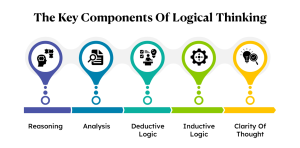
1. Reasoning Over Reaction
At its most basic level, logical thinking means resisting the urge to react instantly. Most people respond first and think later. Logical thinkers reverse that order. They pause sometimes only for a few seconds but long enough to ask, “What do I know for sure here?” That pause is not hesitation; it’s control.
2. Cause-and-Effect Awareness
Nothing happens in isolation. Logical thinking trains your mind to look beyond the event and trace the chain behind it. If this decision is taken, what follows next? And after that? This ability to link actions with outcomes is central to the logical thinking meaning, especially in academic problem-solving and workplace decisions.
3. Pattern Recognition
From aptitude tests to real-life behaviour, logic often hides in repetition. When you recognise patterns, numbers behaving a certain way, questions following a structure, situations repeating similar outcomes, you reduce complexity instantly. Logical thinking isn’t always about solving faster; it’s about seeing sooner.
4. Objective Evaluation of Information
This is where logical thinking becomes uncomfortable. It requires separating facts from assumptions and opinions from evidence. Emotions still exist, but they don’t lead. This clarity is what defines the true logical skills meaning: thinking that is structured, grounded, and fair.
Put together, these components don’t just help you answer logical thinking questions. They change how you approach problems altogether. And once that shift happens, there’s no going back.
Importance of Logical Thinking
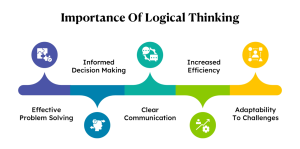
Let’s talk outcomes, because that’s what really matters, right? Logical thinking starts showing its value long before you enter an office. It’s there when you decide which subjects to focus on, how to approach an exam, or whether a career option truly aligns with your strengths. Students who think logically don’t necessarily study more; they study smarter. They understand weightage, patterns, and consequences.
Step into the professional world, and the stakes rise. Suddenly, you’re expected to:
- Make decisions with incomplete information
- Solve problems without clear instructions
- Justify your choices to people senior to you
This is where logical thinking quietly becomes a career differentiator. Employers may test technical knowledge, but they observe thinking. How you structure answers. How you explain your reasoning. How you respond when you don’t immediately know something.
Over time, logical thinking influences promotions, leadership opportunities, and trust. People who think clearly tend to be relied upon. And reliance, in any organisation, is currency.
Top Logical Thinking Skills to Boost Your Brainpower
Logical thinking isn’t one big switch you turn on. It’s a collection of smaller, trainable skills working together. Strengthen these, and you’ll feel the difference, mentally and practically.
- Analytical thinking: This is the ability to break complexity into manageable parts. Instead of feeling overwhelmed by a large problem, analytical thinkers ask, “What’s the first piece I can deal with?” That alone reduces mental load.
- Deductive reasoning: Starting from known facts and moving toward a conclusion. This skill is heavily used in exams, interviews, and structured decision-making. It’s logic in its most disciplined form.
- Inductive reasoning: Here, you move in the opposite direction, observing examples and forming general rules. This is how learning from experience works. Patterns noticed today become better judgments tomorrow.
- Decision-making under constraints: Real life rarely gives you perfect data. Logical thinkers know how to make reasonable decisions even when information is limited, time is short, or pressure is high.
Together, these skills define practical intelligence. This is the real-world logical skills meaning, not theory, but usable clarity.
How to Develop Logical Thinking Skills
Here’s the good news: logical thinking is not a talent you either have or don’t. It’s a muscle. And muscles grow with intentional use.Start simple. No grand routines. Slow down your thinking, just slightly. Before answering a question or reacting to a situation, pause and ask:
- What do I know?
- What am I assuming?
- What logically follows?
That pause is transformative. The next steps are:
- Break problems down deliberately: Big problems scare the brain. Smaller ones invite engagement. Whether it’s a question, a project, or a decision, divide it into parts. Handle one at a time.
- Learn from wrong answers: When practising logical thinking questions, the real value isn’t in getting it right, it’s in understanding why you got it wrong. That’s where thinking patterns are corrected.
Apply logic outside study hours: Explain your reasoning out loud. Analyse everyday decisions. Ask yourself why something worked, or didn’t. Logical thinking grows fastest when it’s part of daily life, not just exam prep.
Exercises & Practice Recommendations
If you’re serious about improving logical thinking, practice matters, but how you practise matters more. Instead of solving dozens of similar questions, focus on variety:
- Number and letter series
- Syllogisms and statements
- Cause-and-effect scenarios
- Real-life situational puzzles
After each question, reflect briefly:
- What was the key idea?
- Where did my logic break?
- What should I watch out for next time?
Also, don’t underestimate informal exercises:
- Debating ideas respectfully
- Explaining your thinking to someone else
- Analysing decisions you see around you
These activities sharpen logic without feeling like work.





Why Logical Thinking Feels Harder Under Pressure
Logical thinking doesn’t disappear under pressure. It just gets crowded.
When time is short or stakes feel high, the brain switches into survival mode. Speed feels safer than accuracy. That’s why people who understand concepts well still make mistakes in exams or interviews. It’s not lack of knowledge. It’s loss of thinking space.
Under pressure, we skip steps. We stop checking assumptions. We jump to what looks familiar. Logical thinking, by definition, needs structure. Pressure breaks structure first.
This is also why logical thinking questions feel harder in real tests than during practice. At home, your brain has room. In the exam hall, it’s juggling time, comparison, self-doubt, and noise. Logic has to compete.
The solution isn’t “think faster.” It’s think cleaner. Fewer mental steps. Clear checkpoints. Asking, What is being asked? What information actually matters? These anchor questions bring logical thinking back even when stress is high.
The more you practise logic deliberately, the less pressure can hijack it. Over time, structured thinking becomes automatic. And when that happens, pressure doesn’t vanish, but it stops controlling your decisions.
Common Mistakes That Block Logical Thinking (And Why They’re So Easy to Miss)
Here’s something rarely talked about: most people don’t lack logical thinking. They block it. Quietly. Repeatedly. And without realising it.
One of the biggest blockers is rushing to conclusions. The brain loves speed. It wants closure fast, especially under pressure. Exams, deadlines, interviews, even arguments. But logical thinking slows things down just enough to ask, “Am I answering the question, or just reacting to it?” That tiny difference decides outcomes.
Another common issue is overconfidence in first instincts. We trust our gut because it feels decisive. But gut feeling is often past experience speaking, not current logic. When situations change, relying only on instinct leads to errors that feel confusing later. This is where logical skills meaning becomes practical, it’s about checking instinct, not killing it.
Then there’s assumption stacking. You assume one thing, then build another assumption on top of it, and suddenly the conclusion feels solid. It isn’t. Logical thinking questions often expose this pattern because one wrong assumption collapses the entire answer.
Finally, emotional attachment. This one’s uncomfortable. When you want an answer to be right, logic bends. Objectivity slips. Logical thinking requires stepping back, even from your own opinions.
The good news? Awareness fixes half the problem. Once you notice these patterns, your thinking starts correcting itself naturally.
Conclusion
Logical thinking doesn’t give instant rewards. And that’s exactly why it’s powerful. Once developed, it quietly improves everything, how you learn, how you decide, how you grow. You stop guessing. You start reasoning. And slowly, confidence replaces confusion.
At Jaro Education, we see this shift happen every day. As an upskilling platform, we focus on helping learners strengthen logical thinking and analytical clarity through a wide range of career-focused courses developed with top institutions and industry experts. Our goal is simple: equip learners with the ability to think clearly, make better decisions, and stay relevant in a world where how you think matters just as much as what you know.
Because in the long run, success doesn’t belong to those who know the most. It belongs to those who think the best with what they know. And that’s a skill worth investing in.
Frequently Asked Questions
Logical thinking is the skill of being able to view information in a calm manner, make connections between facts, and come to conclusions that actually make sense. Rather than guessing or acting on emotions, you think your way through a situation.
Work on reasoning questions of different kinds, but more importantly, think back on your own answers. Even simple decisions become practice when you take the time to think about cause and effect.

Find a Program made just for YOU
We'll help you find the right fit for your solution. Let's get you connected with the perfect solution.

Is Your Upskilling Effort worth it?
 ROI Calculator

Are Your Skills Meeting Job Demands?
Try our Skill Gap tool
Experience Lifelong Learning and Connect with Like-minded Professionals
Explore Jaro Connect
