Step-by-Step Process for Effective Competitive Analysis
Key Insights
Competitive analysis helps businesses understand their competitors' strengths, weaknesses, strategies, and market positions to make informed business decisions.
Competitors can be classified into three types: direct, indirect, and replacement competitors, each offering different insights into market opportunities.
Effective competitive research involves gathering reliable data from competitor websites, customer reviews, social media, industry reports, and research tools such as SEMrush, Ahrefs, and SimilarWeb.
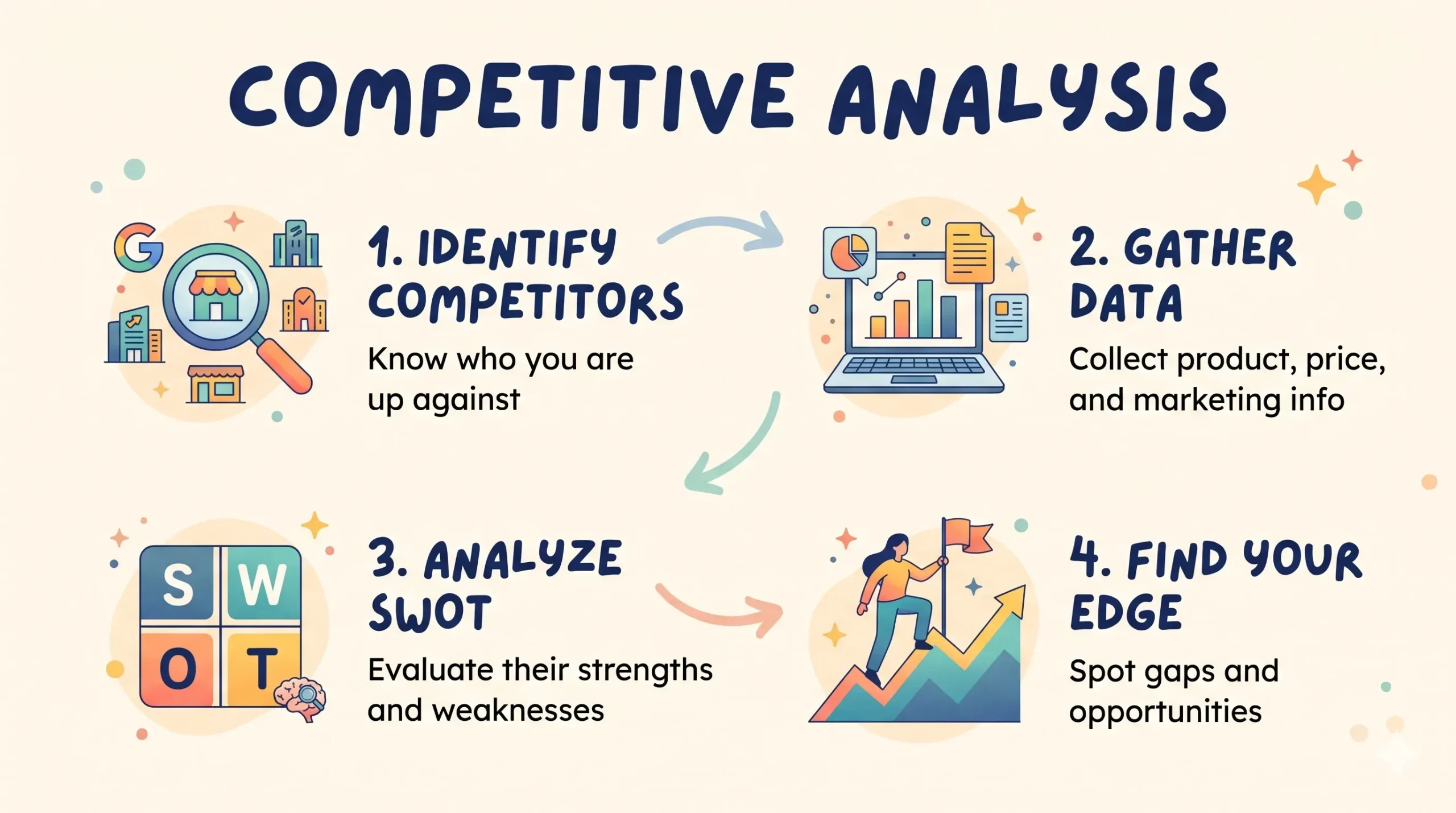
A seven-step competitive analysis process includes defining objectives, identifying competitors, collecting data, evaluating strengths and weaknesses, conducting SWOT analysis, mapping market position, and creating an action plan.
In this blog, you'll learn what competitive analysis is, why it matters, how to conduct competitive research, understand competitor insights, explore a practical competitor analysis example, and turn findings into actionable business strategies.
Every business operates in a market where others are competing for the same customers. Some competitors are well known, while others quietly grow in the background. Companies that understand these rivals make smarter decisions about pricing, marketing, and product development. Companies that ignore them often discover the gap too late.
This blog explains what competitive analysis is, why it matters, and how to carry it out step by step. You will also find a practical competitor analysis example, ways to turn findings into action, and answers to common questions. By the end, you will know how to use research to strengthen your position in the market.
Before collecting data, you need to know whom to study. Competitors generally fall into three groups.
Direct competitors sell similar products or services to the same audience. For example, two local coffee shops on the same street are direct competitors.
Indirect competitors offer different products that solve the same problem. A coffee shop, for instance, competes indirectly with a tea shop or an energy drink brand.
Replacement competitors provide an entirely different way of meeting a customer’s need. A video call platform, for example, can replace business travel. Considering all three groups gives you a complete view of the market.
Competitive Research: How to Gather Reliable Data
Good analysis depends on good competitive research. Fortunately, much of the information you need is publicly available. Start with competitor websites, product pages, pricing tables, blogs, and social media accounts. Read customer reviews on platforms such as Google, Trustpilot, and app stores, since they reveal what buyers truly think.
You can also review press releases, annual reports, job listings, and industry publications. Tools like Google Alerts, SEMrush, Ahrefs, SimilarWeb, and social listening platforms help track traffic, keywords, and engagement. Whenever possible, add primary research, such as customer surveys and interviews, to confirm what the data suggests. Always rely on ethical, publicly available sources and keep records of where each piece of information came from.
Step-by-Step Process for Effective Competitive Analysis
Following a clear process keeps your work organized and useful. These seven steps provide a simple framework.
Step 1: Define Your Objective
Decide what you want to learn. You might want to improve pricing, enter a new market, or refine your messaging. A specific objective keeps your research focused and prevents you from collecting information that you will never use.
Step 2: Identify Your Key Competitors
Create a list of five to ten businesses across direct, indirect, and replacement categories. Use search engines, customer feedback, industry directories, and social media to discover them. Prioritize those that most influence your customers’ decisions.
Step 3: Collect Relevant Information
Gather data on each competitor’s products, pricing, target audience, marketing methods, customer service, and brand voice. Organize the findings in a spreadsheet so that you can compare companies side by side using the same criteria.
Step 4: Analyze Strengths and Weaknesses
Review what each competitor does well and where they struggle. Customer reviews are especially helpful here. Repeated complaints often signal an opportunity, while repeated praise shows what the market values.
Step 5: Use a SWOT Analysis
A SWOT analysisexamines your own Strengths, Weaknesses, Opportunities, and Threats in light of what you learned. It helps you see how your business compares and where you should act first.
Step 6: Map Your Market Position
Place your business and your competitors on a simple chart using two factors that matter to customers, such as price and quality. This positioning map shows crowded areas and open spaces where your brand can stand out.
Step 7: Create an Action Plan
Translate your findings into clear tasks with owners and deadlines. Analysis only creates value when it leads to action, so decide what to change, test, or launch.
Free Courses
Free Digital Marketing Course – Marketing in New Age Digital World
Competitor Analysis Example: A Simple Illustration
A practical competitor analysis example can show how these steps work together. Imagine a small online store that sells eco-friendly water bottles. The owner wants toincrease sales and begins by studying three competitors.
Factor
Your Store
Competitor A
Competitor B
Competitor C
Average price
$28
$24
$35
$30
Shipping
$5 flat rate
Free over $50
Free over $30
$6 flat rate
Product range
12 designs
40 designs
8 designs
20 designs
Customer reviews
4.5 stars
3.9 stars
4.7 stars
4.2 stars
Main strength
Sustainable materials
Low prices
Premium quality
Wide selection
From this table, the owner notices that Competitor A has many complaints about slow delivery, while Competitor B has strong quality but limited choice. The owner decides to offer free shipping above $30, highlight fast delivery, and promote the sustainable materials that set the brand apart. This small, focused example shows how comparing a few key factors can lead to clear decisions.
Turning Competitor Insights into Action
Collecting data is only the beginning. The real value comes from using competitor insights to improve your business. Here are several practical ways to do so.
Improve your product. If customers consistently complain about a missing feature in a rival’s offering, consider adding it to yours.
Refine your pricing. Compare your prices with the value you provide. You do not need to be the cheapest, but your pricing should make sense to buyers.
Sharpen your messaging. Identify the claims competitors repeat, then highlight what makes you genuinely different.
Strengthen customer service. Fast, friendly support is often a deciding factor, and many companies neglect it.
Find content gaps. Look at topics your competitors have not covered well, and create more helpful resources for your audience.
Remember that the goal is not to copy others. It is to understand the market well enough to serve customers better than anyone else.
Advance Your Marketing Career with the IIM Ahmedabad Programme
If you want to turn competitor insights into a stronger marketing strategy, structured learning can help. TheAchieving Excellence in Marketing: Programme for Marketing Executives by IIM Ahmedabad, offered through Jaro Education, is designed for mid- to senior-level marketing professionals, entrepreneurs, and business owners. Over 6 to 7 months, in a blended format of live online sessions and campus modules, it covers topics closely linked to competitive analysis, including market segmentation, value proposition and positioning, pricing, brand management, go-to-market strategy, digital marketing, and AI in marketing. Taught by IIMA faculty through the case method, the programme helps you apply competitive research to real business decisions, and eligible participants receive a Certificate of Completion from IIM Ahmedabad.
Competitive analysis is not about fear or imitation. It is about understanding your market clearly so that you can make confident choices. By identifying your competitors, gathering reliable data, comparing strengths and weaknesses and acting on what you learn, you build a business that responds to real customer needs.
Start small. Choose three competitors, compare a few important factors, and make one improvement based on your findings. Repeat the process regularly, and you will steadily gain an advantage that others find difficult to match.
Frequently Asked Questions
A full review once or twice a year is a good starting point. In fast-moving industries, quarterly updates are wiser. You should also monitor key competitors continuously for price changes, product launches, and new campaigns.
Popular options include Google Alerts for news, SEMrush and Ahrefs for search and traffic data, SimilarWeb for website performance, and social listening tools for brand mentions. Free resources such as review sites and competitor websites are also very useful.
Yes, absolutely. Small businesses can use simple methods such as comparing websites, reading reviews, and tracking prices. Even a basic analysis can reveal ways to stand out, particularly against larger companies that may be slower to adapt.
AI tools can summarize customer reviews, track market trends, and organize large amounts of data quickly. They save time and highlight patterns, but human judgment remains essential for interpreting results and making strategic decisions.
Priya Sahu
Sales & Digital Marketing Strategist
Sales and Marketing professional with 6+ years of experience in B2B and B2C growth, specializing in business development and digital marketing. Skilled in CRM systems, paid campaigns, and AI-driven strategies to drive revenue, optimize performance, and build lasting client relationships.
Get Free Upskilling Guidance
Fill in the details for a free consultation
Related Courses
Explore our programs
Achieving Excellence in Marketing: Programme for Marketing Executives

 November 28, 2026
 6 min read





 Key Insights
 ChatGPT
 Perplexity
 Claude
 Grok











 ROI Calculator