A go-to-market (GTM) strategy is a plan for how a company will deliver a product's value to a defined set of customers, covering target market, positioning, pricing, channels and sales approach.
A GTM strategy is narrower and more time-bound than a marketing strategy. It focuses on launching a specific product or entering a specific market.
A practical GTM framework has seven steps: market, customer, value proposition, pricing, channels and sales motion, launch plan, and metrics with feedback loops.
Your sales motion, whether direct sales, partners, self-serve or a hybrid, should match your price point, customer type and product complexity.
The strongest GTM plans treat their assumptions as hypotheses and test them early, rather than committing to a full launch on guesswork.
In this blog, you'll learn the components of a GTM strategy, a step-by-step framework, a ready-to-use template, sales motions, examples and common mistakes.
Building a good product is only half the job. Plenty of strong products fail because the right customers never hear about them, find them too expensive or cannot easily buy them. A go-to-market plan exists to prevent that, by answering a simple question: how will this product reach the right customers and win their business?
This guide explains what a go-to-market strategy is, how it differs from a marketing strategy, its key components and a step-by-step framework. It also includes a template, a comparison of sales motions, real examples and mistakes to avoid.
A go-to-market strategy, often shortened to GTM strategy, is a plan that describes how a company will deliver its product or service to customers and gain a competitive advantage. It brings together target market, customer needs, value proposition, pricing, distribution channels and sales and marketing activities into one coordinated plan.
Companies usually need a GTM strategy when they are launching a new product, entering a new market or customer segment, repositioning an existing product or changing how they sell, such as moving from direct sales to online self-serve.
GTM Strategy vs Marketing Strategy
The two overlap but are not the same. A marketing strategy is an ongoing plan for brand, messaging, content and demand generation across the business. A GTM strategy is a focused, time-bound plan for launching a specific product into a specific market. Think of marketing strategy as the operating system and GTM as a specific application running on it. If you want to understand the building blocks of marketing, start with the 4Ps of marketing.
Focus: it forces choices about who you serve first and who you do not.
Alignment: product, marketing, sales and customer support work from the same plan.
Speed: clear priorities shorten launch time and help teams spot risks early.
Efficient spend: you invest in channels where your customers actually are.
Measurable goals: a plan with metrics tells you early whether the launch is working.
Key Components of a Go-to-Market Strategy
1. Target Market and Ideal Customer Profile
Define who you are selling to: industry, company size, geography and use case for businesses, or demographics, needs and behaviours for consumers. Segmenting well is the starting point, so read our guide on market segmentation for methods and benefits.
2. Value Proposition and Positioning
Explain the specific problem you solve and why you are better than alternatives. Positioning is how you want customers to think of you relative to competitors, which our article on positioning in marketing covers in depth. A SWOT analysis helps you check your strengths and gaps against the market.
3. Pricing and Packaging
Your price signals value and decides who can buy. Decide on a pricing model, such as one-time, subscription or usage-based, and how features are bundled. Competitive cost structures also matter, as explained in our guide to cost leadership and competitive pricing.
4. Distribution Channels
Channels are how customers find, evaluate and buy: your website, marketplaces, retail stores, distributors, resellers or partners. Pick where your ideal customers already spend time rather than where it is easiest for you.
5. Sales Motion
This is how you convert interest into revenue, whether through a field sales team, inside sales, partners or self-serve. We compare these options later in this guide.
Decide in advance how you will measure success, such as pipeline, conversion rate, customer acquisition cost and retention, and how you will learn from the results.
This go-to-market strategy framework works for products ranging from consumer apps to enterprise software.
Analyse the market: size the opportunity, study competitors and identify unmet needs. Our guide to marketing analytics shows how data supports these decisions.
Define the customer: build an ideal customer profile and personas based on research, not assumptions.
Craft the value proposition: state the problem, your solution and the proof that it works.
Set pricing and packaging: test willingness to pay before locking in prices.
Choose channels and the sales motion: select two or three channels where you can win, rather than spreading thin.
Plan the launch: set the timeline, messaging, assets, responsibilities and budget, with help from product marketing.
Measure and iterate: track results and adjust quickly.
According to Harvard Business School Online, a sound approach to GTM involves forming hypotheses about how customers will respond, running experiments to test them and then combining what you learn into an actionable strategy with clear success metrics. That mindset, test first and scale second, reduces the cost of being wrong.
Go-to-Market Sales Strategy: Choosing Your Sales Motion
Your go-to-market sales strategy decides how customers buy from you. The right choice depends on price, complexity and customer type.
Sales motion
How it works
Best for
Field or direct sales
Sales reps meet customers, run demos and negotiate
High-value, complex B2B deals
Inside sales
Remote reps sell by phone, email and video
Mid-value deals with shorter cycles
Channel or partner sales
Distributors, resellers or integrators sell for you
Wide geographic reach or specialised markets
Self-serve (product-led)
Customers sign up and buy through the product or website
Low-price, easy-to-adopt products
Hybrid
A self-serve entry with a sales team for larger accounts
Use this simple template to organise your plan. Copy it into a document or spreadsheet and fill each row in one or two sentences.
Section
Questions to answer
Product and goal
What are we launching, and what will success look like in 6 to 12 months?
Target market
Which segment first? How big is it?
Ideal customer profile
Who exactly buys, who decides and what triggers purchase?
Problem and value proposition
What problem do we solve, and why are we better?
Competitors and positioning
Who else solves it, and how are we different?
Pricing and packaging
What will we charge, and how will we structure plans?
Channels
Where will customers discover and buy?
Sales motion
How will we convert interest into revenue?
Marketing plan
Which messages, content and campaigns will we run?
Launch timeline
What happens before, during and after launch?
Owners and budget
Who is responsible for each task, and what is the budget?
Metrics
Which numbers will we track, and how often will we review?
Risks and assumptions
What must be true for this to work, and how will we test it?
Go-to-Market Strategy Examples
Slack: Product-Led, Team by Team
Slack is often cited as a product-led growth example. Rather than relying only on a large sales team, it let individual teams start using the product, which then spread inside organisations. The approach lowered customer acquisition costs and let usage prove value before a purchase decision reached senior buyers.
Reliance Jio: Pricing as the Launch
Jio launched commercially on 5 September 2016 with a free introductory period for voice, data and SMS. Industry coverage notes that it crossed 100 million subscribers within six months. The lesson is that pricing and distribution can themselves be the go-to-market strategy, although this approach required heavy upfront investment that few companies can match.
An Illustrative Example: A B2B Analytics Start-Up
This hypothetical example shows how the framework fits together. A start-up building inventory analytics software for mid-sized retailers chooses one segment first: retailers with 20 to 100 stores. Its value proposition is “cut stock-outs without raising inventory.” It prices by number of stores, sells through inside sales supported by webinars and case studies, and tracks pipeline, demo-to-trial conversion and retention. After the first quarter, it learns that regional chains convert better than national ones, and shifts its messaging and outreach accordingly.
Targeting everyone: a narrow first segment is easier to win and learn from.
Skipping customer research: assumptions about needs often turn out wrong.
Treating GTM as a marketing task: product, sales and support must be involved.
Launching in too many channels: focus on a few and do them well.
Ignoring pricing tests: a wrong price can sink a good product.
No feedback loop: without metrics and reviews, you cannot improve.
Conclusion
A strong go-to-market strategy turns a good product into a commercial success by defining who you serve, what value you offer, how you price it, where you sell it and how you will measure results. Start with a narrow segment, write down your assumptions, test them quickly and refine the plan as the data comes in.
For professionals who want to build these skills in depth, the Post Graduate Certificate Programme in Digital Strategy and Marketing Analytics from IIM Nagpur is a 9-month online programme for graduates with at least three years of work experience. Its curriculum covers strategic marketing and product-market fit, pricing analytics, marketing analytics, brand management and marketing technology, and it includes a strategy simulation. Please check the programme page for current batch dates and availability.
Frequently Asked Questions
A go-to-market strategy is a plan for how a company will deliver a product’s value to a target market, covering customer definition, positioning, pricing, channels and sales and marketing activities.
A marketing strategy is an ongoing plan for brand and demand across the business. A GTM strategy is a focused plan to launch a specific product or enter a specific market.
Target market and ideal customer profile, value proposition and positioning, pricing and packaging, distribution channels, sales motion, marketing plan and metrics.
Analyse the market, define your customer, craft the value proposition, set pricing, choose channels and a sales motion, plan the launch and track metrics. Test your assumptions early.
Yes. A good template covers product and goals, target market, customer profile, value proposition, competitors, pricing, channels, sales motion, marketing, timeline, owners, metrics and risks. A ready-to-use version appears above.
Slack’s product-led, team-by-team adoption and Reliance Jio’s free introductory launch in 2016 are well-known examples of different approaches.
It is the plan for how customers will buy from you, such as direct sales, inside sales, partners, self-serve or a hybrid, chosen to match price, complexity and customer type.
When launching a new product, entering a new market or segment, repositioning a product or changing your sales model.
Priya Sahu
Sales & Digital Marketing Strategist
Sales and Marketing professional with 6+ years of experience in B2B and B2C growth, specializing in business development and digital marketing. Skilled in CRM systems, paid campaigns, and AI-driven strategies to drive revenue, optimize performance, and build lasting client relationships.
Get Free Upskilling Guidance
Fill in the details for a free consultation
Related Courses
Explore our programs
Digital Marketing: Business Models, Processes and Technologies

 October 11, 2026
 7 min read





 Key Insights
 ChatGPT
 Perplexity
 Claude
 Grok
Grok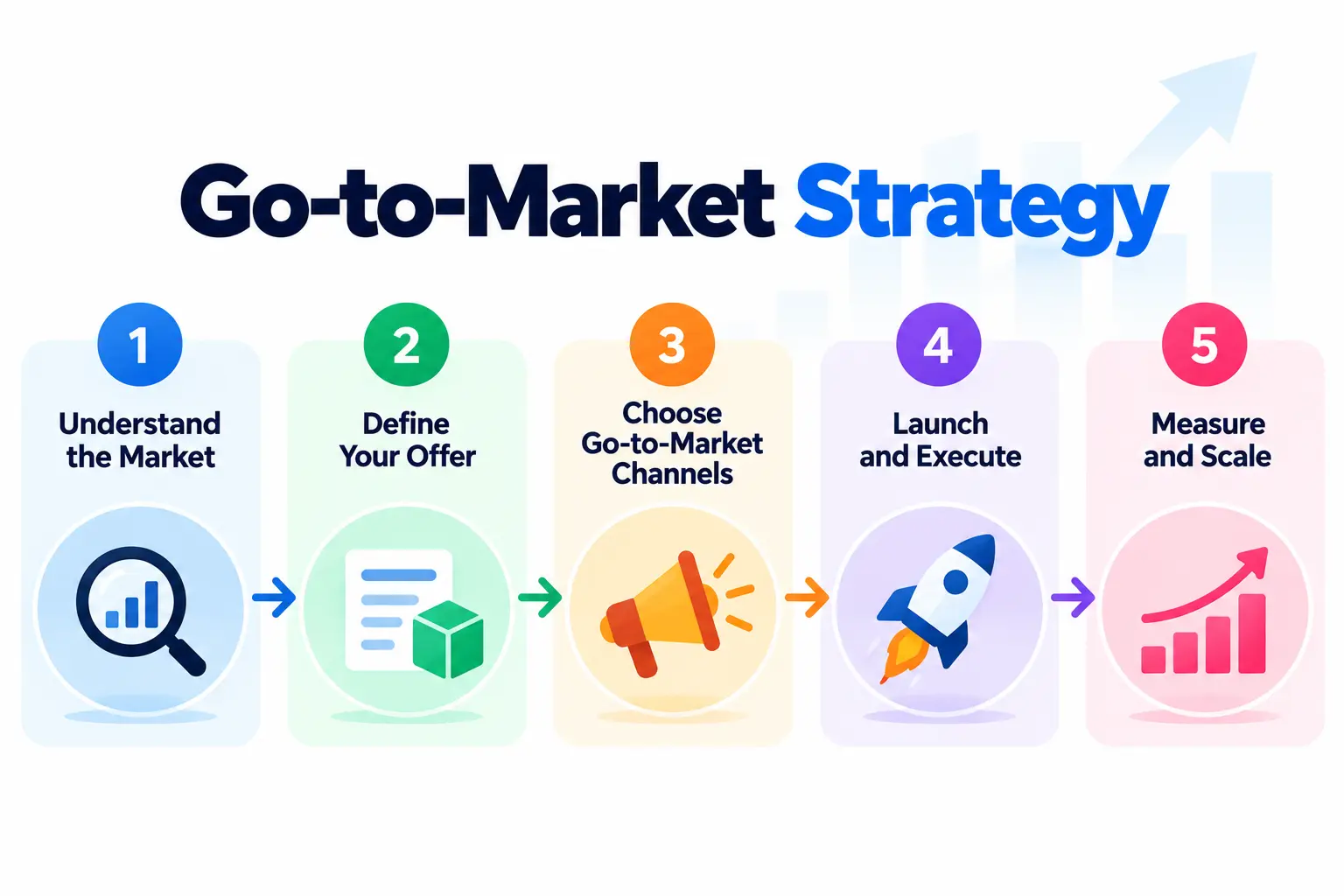











 ROI Calculator



