
BCA Course Subjects: Semester-Wise Subjects & Syllabus
 September 25, 2026
 8 min read





Table Of Content
- What Are BCA Course Subjects?
- BCA Subjects List: Semester-Wise Overview
- BCA Subjects 1st Year: Semester 1 and 2
- BCA 2nd Year Subjects: Semester 3 and 4
 Key Insights
- BCA course subjects build a foundation in programming, databases, operating systems, networking, web technologies, software engineering, and emerging technologies
- The BCA subjects progress from fundamentals in the first year to application focused learning in the second year and advanced technologies, specializations, and projects in the third year
- Practical learning becomes increasingly important through programming labs, database and web projects, mini projects, internships, and major projects. Students can explore specializations such as AI and machine learning, data science,
- and full stack development, depending on the university and its curriculum. When choosing bachelor of computer application colleges, students should consider the curriculum, practical learning, specializations, faculty, infrastructure, industry exposure, and academic details.
- In this blog, you'll learn about the BCA subjects list semester-wise, BCA subjects in the 1st year, practical subjects and projects, specializations, career areas, and factors to consider when choosing a BCA college.
What if learning to code is only one part of becoming a computer applications professional? A Bachelor of Computer Applications (BCA) introduces students to programming, databases, operating systems, web technologies, networking, software development, and emerging areas such as artificial intelligence and cloud computing.
The BCA course subjects are generally spread across six semesters over three years. However, the exact syllabus can differ from one university to another. Some institutions include subjects such as financial accounting, communication skills, or environmental studies, while others offer specialized tracks in areas such as AI, data science, cybersecurity, or full stack development.
If you are planning to pursue BCA and want to know what you will actually study, this blog covers the BCA subjects list semester by semester, along with the skills, practical components, specialization options, and career relevance of these subjects.
 ChatGPT
 Perplexity
 Claude
 Grok
GrokWhat Are BCA Course Subjects?
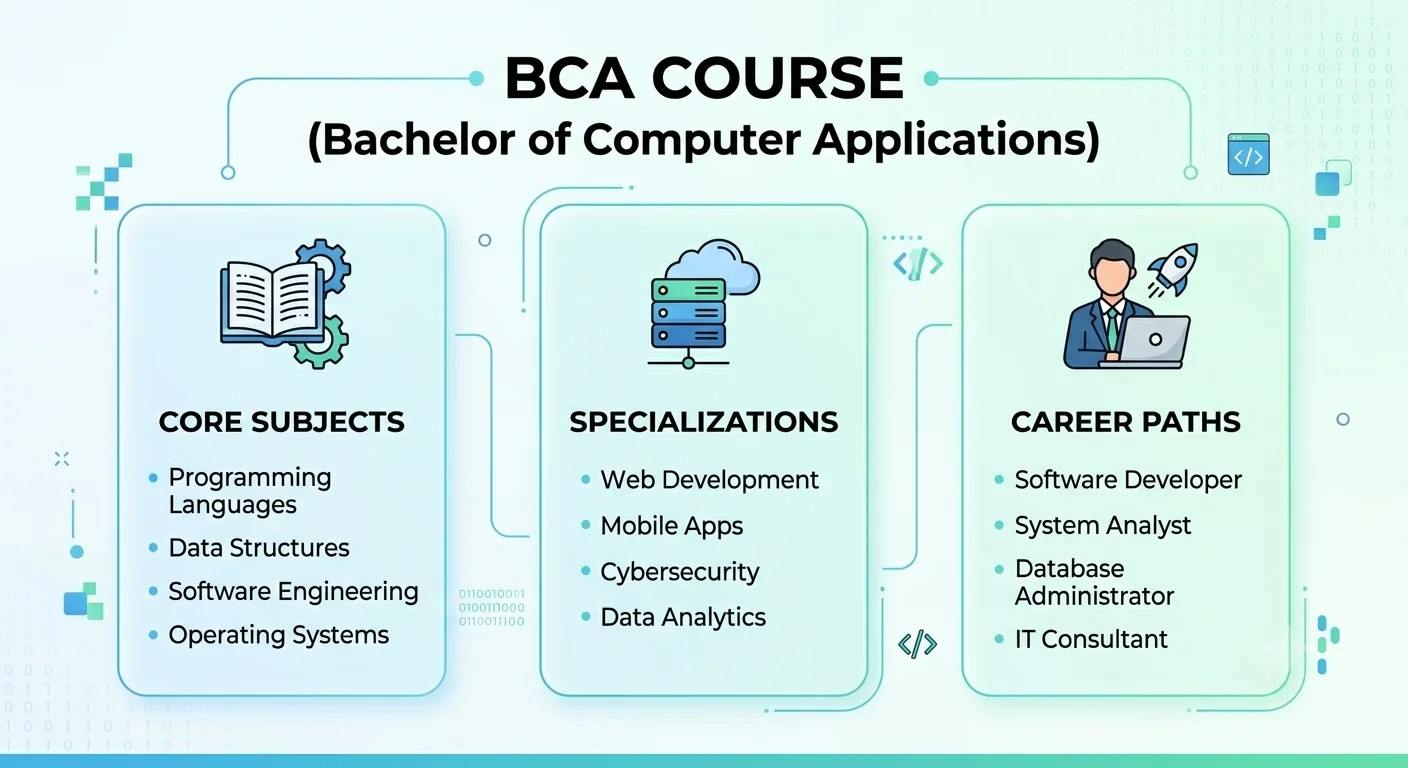
BCA course subjects are designed to build a foundation in computer applications, programming, software development, databases, networking, and related technologies.
The curriculum usually starts with fundamental subjects before moving toward more advanced programming and application development. By the final year, students may encounter subjects related to cloud computing, artificial intelligence, data analytics, cybersecurity, mobile applications, or other specialized areas.
A typical BCA curriculum may include:
- Computer fundamentals
- C, C++, Java, or Python programming
- Data structures and algorithms
- Database management systems
- Operating systems
- Computer networks
- Web technologies
- Software engineering
- Computer architecture
- Cloud computing
- Artificial intelligence and data analytics
- Practical labs and projects
The three reference syllabi show that programming, databases, operating systems, web technologies, networking, and practical learning are recurring areas, although the exact subject names and semester placement vary.
BCA Subjects List: Semester-Wise Overview
The following is a representative BCA subjects list. It should be treated as a general academic guide rather than a fixed syllabus because universities structure their BCA programs differently.
| Semester | Major BCA Subjects |
| Semester 1 | Computer Fundamentals, C Programming, Mathematics, Digital Fundamentals, Communication Skills |
| Semester 2 | Data Structures, C++ or Object-Oriented Programming, Operating Systems, Statistics, Practical Labs |
| Semester 3 | Java, DBMS, Computer Networks, Web Technologies, Software Engineering |
| Semester 4 | Python, Advanced Operating Systems, Software Engineering, Network Security, Mini Project |
| Semester 5 | Cloud Computing, Mobile Application Development, AI or Data Science, UI Design, Electives |
| Semester 6 | Advanced or Specialized Subjects, Data Analytics, Major Project, Internship or Viva |
The exact subjects can change based on the university, academic framework, and specialization.
BCA Subjects 1st Year: Semester 1 and 2
The BCA subjects in the 1st year are mainly focused on developing basic computing and programming knowledge. Students who are new to coding generally start by learning how computers work and how programming logic is developed.
Semester 1 BCA Subjects
Common Semester 1 subjects may include:
- Fundamentals of Computers
- Programming in C
- Digital Computer Fundamentals
- Mathematics or Discrete Mathematics
- Communication or Technical English
- Computer Organization
- Computer or Programming Lab
C programming is often introduced early because it helps students understand programming logic, variables, functions, memory, and basic problem-solving. Mathematics and computer fundamentals provide supporting knowledge for later technical subjects.
Some universities also include hardware labs, statistics, or software labs in the first semester.
Semester 2 BCA Subjects
The second semester generally moves from basic programming toward data organization and system-level concepts.
Common subjects may include:
- Data Structures
- Data Structures Lab
- Object-Oriented Programming using C++
- Operating Systems
- Discrete Mathematics
- Statistics and Probability
- IT or Office Automation
- Soft Skills
Data structures are particularly important because students begin learning how information can be organized and processed efficiently. Topics can include arrays, stacks, queues, linked lists, trees, searching, and sorting.
The first year therefore creates the foundation for more advanced programming, databases, networking, and software development.




BCA 2nd Year Subjects: Semester 3 and 4
The second year is where the BCA subjects generally become more application focused. Students begin working with databases, web technologies, object-oriented programming, and software development concepts.
Semester 3 BCA Subjects
The Semester 3 syllabus may include:
- Object-Oriented Programming
- Java Programming
- Database Management Systems
- Computer Networks
- Web Technologies
- Software Engineering
- C++ Programming Lab
- DBMS Lab
- Web Technology Lab
DBMS introduces students to how data is stored, organized, retrieved, and managed. SQL is an important part of this area and is useful for working with relational databases.
Web technologies introduce the building blocks of websites and web applications. Depending on the university, students may work with HTML, CSS, JavaScript, PHP, or related technologies.
Software engineering, meanwhile, introduces systematic approaches to designing, developing, testing, and maintaining software.
Semester 4 BCA Subjects
Common Semester 4 subjects can include:
- Java Programming
- Python Programming
- Computer Networks
- Advanced Operating Systems
- Software Engineering
- Network Security
- Web Technologies
- Practical Labs
- Mini Project
This stage gives students opportunities to move beyond individual programming exercises and begin thinking about complete applications.
A mini project can help students apply programming, database, web development, and problem-solving concepts together. The reference syllabi also show project and practical work becoming more prominent as students progress through the course.
BCA 3rd Year Subjects: Semester 5 and 6
The third year generally shifts the focus toward advanced technologies, specialization, and project work.
Semester 5 BCA Subjects
Depending on the university, Semester 5 may include:
- Python Programming
- Cloud Computing
- Mobile Application Development
- Artificial Intelligence
- Data Analytics
- Business Intelligence
- User Interface Design
- Computer Graphics
- Cybersecurity
- Elective Subjects
This is also the stage where some BCA programs begin offering specialization-based subjects.
For example, a student interested in data science may study data visualization and analytics, while a student interested in application development may focus more on full stack technologies or mobile development.
Semester 6 BCA Subjects
The final semester often includes advanced subjects and a substantial practical component.
Possible subjects include:
- Artificial Intelligence
- Data Analytics
- Advanced Database Management
- Cloud Computing
- Software Testing
- Client-Server Computing
- Design and Analysis of Algorithms
- Major Project
- Internship
- Seminar or Viva
Some universities use the final semester primarily for a capstone project or internship, allowing students to demonstrate what they have learned throughout the BCA program.
Practical Subjects and Projects in BCA
One important aspect of the BCA syllabus is that learning is not limited to classroom theory.
Practical sessions may accompany programming, database, networking, and other technical subjects. For example, students may write C or Java programs, create database queries, develop web pages, or work with Python during lab sessions.
Projects become increasingly important as students move through the course.
A typical progression could look like this:
First year: Basic programming exercises and lab assignments
Second year: Database, web, or application-based mini projects
Third year: Major project, internship, or capstone project
Projects can help students connect multiple BCA subjects. For example, a web application could combine HTML, CSS, JavaScript, a programming language, SQL, and database management.
BCA Specializations and Emerging Subjects
BCA programs are not always limited to a general curriculum. Some universities now offer specialized programs in areas such as AI and machine learning, data science, and full stack development.
Take a look at some of the specializations below:
BCA in Artificial Intelligence and Machine Learning
Students may encounter topics such as:
- Machine learning fundamentals
- Natural language processing
- Deep learning
- Computer vision
- AI project development
BCA in Data Science
Possible subjects include:
- Statistical modeling
- Data visualization
- Big data analytics
- Predictive modeling
- Data science projects
BCA in Full Stack Development
Students may study areas such as:
- Frontend frameworks
- Backend development
- REST APIs
- Microservices
- DevOps fundamentals
- Full stack project development
The availability of these specializations depends on the university, so students should check the latest curriculum before applying.
How BCA Subjects Build Technical Skills
The value of the BCA course subjects is not just in completing individual papers. The subjects are connected.
For example, a student may first learn programming fundamentals in C, then data structures, followed by object-oriented programming and Java or Python. Later, those programming skills can be applied to databases, web development, cloud applications, or AI projects.
Similarly, learning DBMS and SQL can support later work in data analytics or backend development, while networking and operating systems help students understand how software interacts with computer systems and networks.
This progression gives students a broader understanding of how software applications are developed and operated.
BCA Subjects and Career Areas
Different BCA subjects can support different career directions.
| BCA Subject | Related Career Area |
| C, C++, Java, Python | Software Development |
| Data Structures and Algorithms | Programming and Technical Roles |
| DBMS and SQL | Database and Data Roles |
| Web Technologies | Web and Full Stack Development |
| Computer Networks | Networking |
| Network Security | Cybersecurity |
| Cloud Computing | Cloud and DevOps |
| AI and Machine Learning | AI and ML |
| Data Analytics | Data and Business Intelligence |
| Software Engineering | Software Development and Testing |
This does not mean completing a particular subject automatically qualifies a student for a specific job. Additional practical skills, projects, internships, and relevant learning can be important when preparing for a career.
How to Choose Bachelor of Computer Application Colleges
Choosing among bachelor of computer application colleges requires more than looking at the number of subjects listed in a syllabus.
Students should compare factors such as:
Curriculum
Check whether the curriculum includes the programming languages, databases, web technologies, and emerging areas that match your interests.
Practical Learning
Look for sufficient laboratory work, projects, coding activities, and opportunities to apply theoretical concepts.
Specializations
If you already have an interest in AI, data science, cybersecurity, or full stack development, check whether the college offers relevant specialization options.
Faculty and Infrastructure
Consider the availability of qualified faculty, computer laboratories, learning resources, and technology infrastructure.
Industry Exposure
Internships, workshops, coding events, projects, and industry interactions can provide opportunities to apply classroom learning.
Academic Recognition and University Details
Students should also verify the university affiliation, recognition, admission requirements, fees, and current curriculum before applying.
Most importantly, do not choose a college only because its syllabus contains a long list of subjects. Look at how those subjects are taught and how much practical exposure students receive.
How to Prepare for BCA Subjects
BCA becomes easier to manage when students focus on understanding concepts rather than simply memorizing them.
Start coding early and practice regularly. If you are learning C, for example, write small programs instead of only reading syntax.
For subjects such as data structures and algorithms, solve problems repeatedly. For DBMS, practice SQL queries and work with sample databases. For web technologies, build simple websites and gradually add functionality.
You can also maintain a small portfolio of projects throughout the three years. By graduation, this can demonstrate how you have applied your BCA subjects to practical problems.
Final Thoughts
The BCA course subjects take students from basic computer concepts and programming to databases, networking, software engineering, web development, and emerging technologies.
The BCA subjects of the 1st year generally focus on fundamentals, programming, mathematics, and data structures. The second year introduces areas such as DBMS, Java, Python, networking, web technologies, and software engineering. The third year can move toward AI, cloud computing, data analytics, mobile development, specialization subjects, and major projects.
The exact BCA subjects list varies across universities, so students should always check the latest official syllabus before making an admission decision.
A good BCA experience is ultimately about more than completing six semesters. Combining academic subjects with coding practice, projects, internships, and continuous skill development can help students make better use of what they learn throughout the degree.
Frequently Asked Questions
The main BCA course subjects generally include programming, data structures, database management, operating systems, computer networks, web technologies, software engineering, and emerging areas such as cloud computing, AI, or data analytics.
BCA subjects in the 1st year commonly include computer fundamentals, C programming, mathematics, digital fundamentals, communication skills, data structures, operating systems, and practical laboratory work. The exact subjects vary by university.

Related Courses
Explore our programs



Find a Program made just for YOU
We'll help you find the right fit for your solution. Let's get you connected with the perfect solution.
Is Your Upskilling Effort worth it?
 ROI Calculator

Are Your Skills Meeting Job Demands?
Try our Skill Gap tool
Experience Lifelong Learning and Connect with Like-minded Professionals
Explore Jaro Connect
