 HOME > BLOG > Cloud Computing and Cyber Security > Cybersecurity Careers in India 2026: Roles, Salaries and Which IIM or IIT Programme Gets You There
Cybersecurity Careers in India 2026: Roles, Salaries and Which IIM or IIT Programme Gets You There
 August 5, 2026
 7 min read




Table Of Content
- Why Cybersecurity Is a Future-Proof Career in India
- What Does a Cybersecurity Professional Do?
- Top Cybersecurity Roles in India in 2026
- Cybersecurity Salary in India (2026)
Discover the top cybersecurity careers in India for 2026, including in-demand roles, salary trends, essential skills, and how executive programmes from IITs and IIMs can help accelerate your professional growth.
Cybersecurity has become one of the most sought-after career domains in India. As organizations continue to digitize their operations, adopt cloud computing, integrate artificial intelligence (AI), and embrace hybrid work environments, protecting digital assets has become a top business priority. From multinational corporations and financial institutions to healthcare providers and government organizations, every sector is investing heavily in cybersecurity talent.
The cybersecurity landscape in 2026 is vastly different from what it was a few years ago. Today's professionals are expected not only to defend networks against cyberattacks but also to manage enterprise risk, ensure regulatory compliance, secure AI systems, and support digital transformation initiatives. This shift has created a wide range of high-paying career opportunities for professionals with the right blend of technical expertise and strategic thinking.
If you're considering a career in cybersecurity or planning to transition into this fast-growing field, understanding the available roles, salary trends, required skills, and learning pathways can help you make an informed decision. This blog explores the cybersecurity job market in India, expected salaries, and how executive programmes from leading IIMs and IITs can help professionals accelerate their careers.
 ChatGPT
 Perplexity
 Claude
 Grok
GrokWhy Cybersecurity Is a Future-Proof Career in India
India’s digital economy is expected to continue expanding rapidly, driven by cloud adoption, digital banking, e-commerce, Industry 4.0, artificial intelligence, and smart infrastructure. However, every technological advancement also increases the number of potential entry points for cybercriminals.
Organizations today face ransomware attacks, phishing campaigns, insider threats, data breaches, supply chain attacks, and AI-powered cyber risks. As these threats become more sophisticated, businesses require skilled professionals who can proactively identify vulnerabilities, respond to incidents, and build resilient security systems.
Unlike many technology domains where automation may replace repetitive tasks, cybersecurity relies heavily on analytical thinking, decision-making, investigation, and strategic planning. As a result, demand for qualified cybersecurity professionals continues to exceed supply, making it one of the most secure long-term career options.
Another advantage of this field is its versatility. Cybersecurity professionals are required across banking, healthcare, manufacturing, consulting, IT services, telecom, e-commerce, government agencies, and even startups. This widespread demand allows professionals to explore diverse career opportunities while enjoying strong salary growth.
What Does a Cybersecurity Professional Do?
Cybersecurity is often misunderstood as simply preventing hackers from accessing systems. In reality, the field encompasses multiple responsibilities that contribute to an organization’s overall resilience.
Professionals working in cybersecurity monitor digital environments for suspicious activities, assess vulnerabilities, implement security controls, investigate cyber incidents, manage identity and access systems, secure cloud infrastructure, and ensure compliance with regulatory frameworks.
Increasingly, cybersecurity teams collaborate with business leaders, legal departments, compliance officers, and technology executives. Security decisions now influence customer trust, operational continuity, and organizational reputation, making cybersecurity a strategic business function rather than just an IT responsibility.
Top Cybersecurity Roles in India in 2026
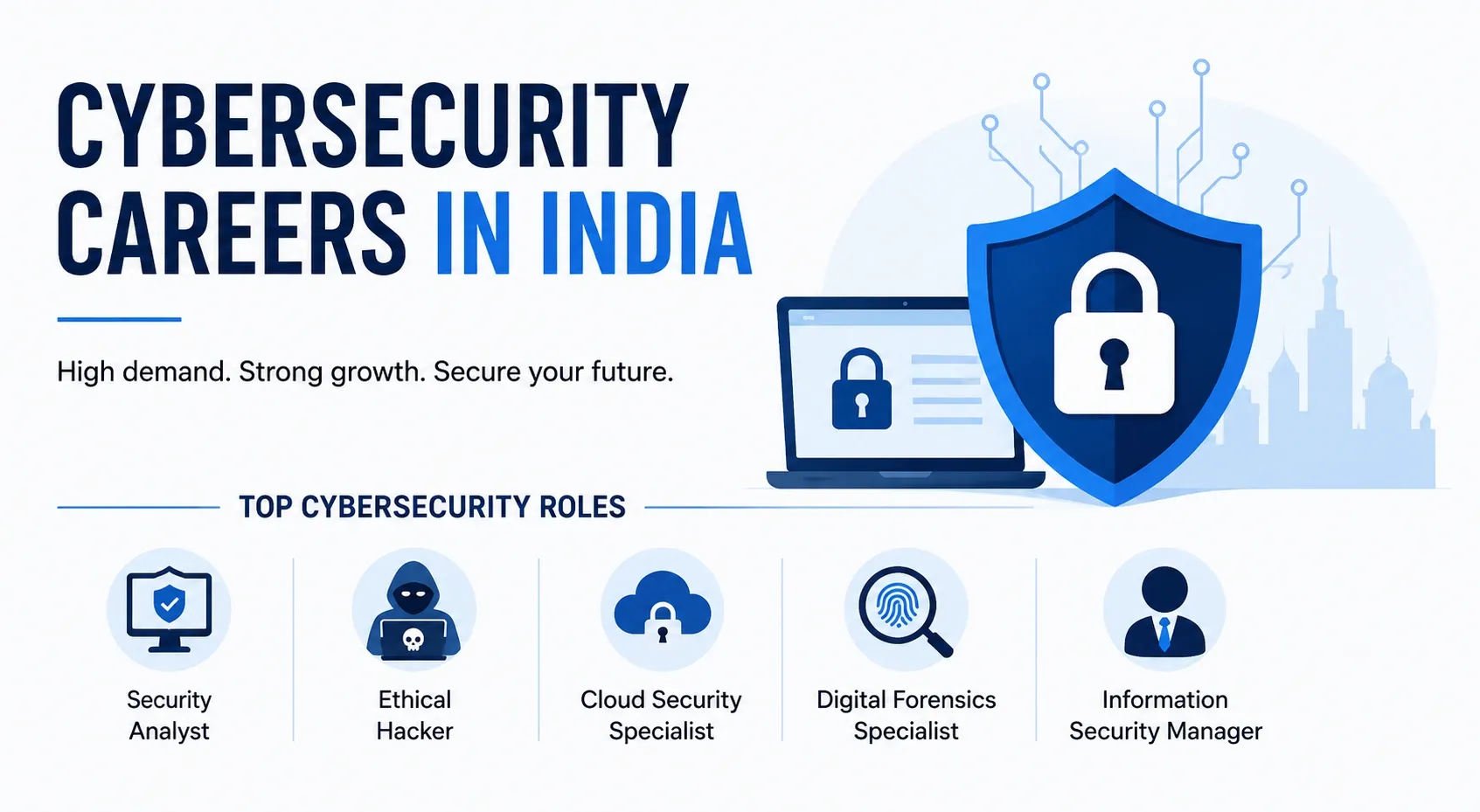
Security Analyst
A Security Analyst is often the starting point for many cybersecurity careers. These professionals monitor networks, investigate security alerts, analyze vulnerabilities, and recommend preventive measures to strengthen organizational security.
The role provides exposure to multiple cybersecurity tools and technologies, making it an excellent foundation for long-term career growth.
Cybersecurity Engineer
Cybersecurity Engineers focus on building secure digital infrastructures. Their responsibilities include configuring security solutions, implementing network protection mechanisms, securing endpoints, and managing enterprise security architecture.
With organizations increasingly adopting cloud platforms and remote work environments, Cybersecurity Engineers remain among the most sought-after professionals.
Ethical Hacker (Penetration Tester)
Ethical Hackers simulate cyberattacks to identify weaknesses before attackers can exploit them. Their work includes application testing, network assessments, cloud security testing, and vulnerability analysis.
Ethical Hacking role requires curiosity, analytical thinking, and an understanding of how attackers operate, making it one of the most exciting career paths within cybersecurity.
Cloud Security Specialist
As businesses migrate workloads to cloud platforms such as AWS, Microsoft Azure, and Google Cloud, Cloud Security Specialists help organizations secure cloud environments.
Their responsibilities include identity management, cloud governance, workload protection, compliance, and infrastructure security. Professionals with cloud security expertise continue to command premium salaries due to increasing enterprise demand.
Digital Forensics Specialist
When cyber incidents occur, organizations rely on Digital Forensics Specialists to investigate compromised systems, recover evidence, analyze attack methods, and support legal proceedings.
This role combines technical expertise with investigative skills and is particularly valuable in sectors dealing with financial fraud and cybercrime investigations.
Information Security Manager
Experienced cybersecurity professionals often move into leadership roles where they oversee security strategies, compliance programmes, enterprise risk management, and organizational governance.
Information Security Managers work closely with senior leadership to align cybersecurity initiatives with business objectives, making this one of the highest-paying roles in the industry.





Cybersecurity Salary in India (2026)
Salaries in cybersecurity vary depending on experience, specialization, certifications, and industry. Professionals with expertise in cloud security, AI security, cyber risk management, and DevSecOps generally receive higher compensation.
| Role | Average Annual Salary (India) |
| Security Analyst | ₹6–12 LPA |
| SOC Analyst | ₹6–14 LPA |
| Ethical Hacker | ₹8–18 LPA |
| Cybersecurity Engineer | ₹10–20 LPA |
| Digital Forensics Specialist | ₹10–22 LPA |
| Cloud Security Specialist | ₹12–25 LPA |
| Information Security Manager | ₹25–50+ LPA |
| Chief Information Security Officer (CISO) | ₹50 LPA–₹1 Crore+ |
While salary is an important consideration, cybersecurity also offers excellent long-term career stability. Organizations are increasingly investing in experienced professionals who can protect critical business infrastructure and ensure regulatory compliance.
Skills That Employers Want in 2026
Technical expertise remains essential, but employers now seek professionals who understand both technology and business.
A strong cybersecurity profile typically includes knowledge of networking, operating systems, cloud computing, security operations, identity and access management, vulnerability assessment, threat intelligence, and incident response. Familiarity with scripting languages such as Python, as well as emerging concepts like Zero Trust Architecture and DevSecOps, can further strengthen a candidate’s profile.
Equally important are soft skills. Cybersecurity professionals often communicate with business leaders, present risk assessments, manage cross-functional teams, and coordinate responses during security incidents. Strong communication, problem-solving, and decision-making abilities therefore play a significant role in career progression.
Emerging Trends Shaping Cybersecurity Careers
Cybersecurity continues to evolve alongside technological innovation. Artificial intelligence is now being used to detect anomalies, automate threat detection, and strengthen incident response. However, cybercriminals are also leveraging AI to launch more sophisticated attacks, increasing the need for professionals who understand AI-driven security.
Cloud-native security has become another major focus area as organizations continue migrating applications to public and hybrid cloud environments. Professionals capable of securing cloud infrastructure, APIs, containers, and microservices are in particularly high demand.
Another emerging trend is cyber risk management. Organizations increasingly expect cybersecurity teams to evaluate business risks, ensure compliance with evolving regulations, and contribute to strategic decision-making. This shift is creating opportunities for professionals who combine technical expertise with business acumen.
How IIT Executive Programmes Can Help
For professionals aiming to strengthen their technical expertise, executive programmes offered by IITs provide structured learning in emerging technologies and advanced cybersecurity concepts.
Many IIT programmes cover areas such as cloud security, artificial intelligence, machine learning, secure software development, data science, networking, and cyber defence. These programmes are particularly suitable for software engineers, cloud professionals, network engineers, DevOps specialists, and IT consultants looking to move into cybersecurity or enhance their existing technical capabilities.
The practical orientation of IIT programmes allows working professionals to apply concepts directly within enterprise environments while continuing their careers.
How IIM Executive Programmes Add Value
Technical expertise alone is often insufficient for professionals aspiring to leadership positions. Organizations increasingly expect cybersecurity leaders to understand governance, enterprise risk, business strategy, digital transformation, and technology management.
Executive programmes offered by IIMs help professionals develop these managerial capabilities while strengthening strategic decision-making. Participants gain exposure to leadership frameworks, risk management practices, digital business strategies, organizational transformation, and executive communication.
These programmes are particularly valuable for experienced professionals preparing for roles such as Information Security Manager, Technology Leader, Cyber Risk Consultant, Digital Transformation Manager, or Chief Information Security Officer.
Which One Should You Choose: IIT or IIM?
The choice depends entirely on your career aspirations.
If your goal is to strengthen technical expertise in cybersecurity, cloud computing, AI, or secure software engineering, an IIT executive programme is generally a better fit. These programmes focus on technical depth and emerging technologies that prepare professionals for specialized cybersecurity roles.
On the other hand, if you already have technical experience and wish to transition into leadership, governance, consulting, or enterprise strategy, an IIM executive programme can help you build the business and managerial skills required for senior positions.
Many professionals eventually combine technical certifications with executive education, creating a balanced profile that appeals to organizations hiring for leadership roles.
Build Leadership Skills in Cyber Security & Data Science
For working professionals looking to move beyond technical execution into strategic cybersecurity leadership, the PG Certificate Programme in Cyber Security Management & Data Science offered by IIM Nagpur through Jaro Education is a strong executive learning option. Designed for professionals with work experience, the 12-month programme combines cybersecurity management, cloud security, AI, data science, governance, risk management, and leadership into one comprehensive curriculum. Participants gain exposure to real-world case studies, hands-on tools, emerging technologies such as Generative AI and Agentic AI, and business-oriented cybersecurity practices. Along with live online learning and campus immersion, the programme also offers Executive Alumni Status from IIM Nagpur, making it suitable for professionals aspiring to roles such as Cyber Security Manager, Information Security Manager, Risk & Compliance Manager, or CISO. The programme is particularly valuable for those seeking to strengthen both their technical expertise and strategic decision-making capabilities in an increasingly AI-driven security landscape.
Final Thoughts
Cybersecurity is no longer just an IT specialization—it has become a strategic business function that directly impacts organizational success. As India accelerates its digital transformation journey, the demand for skilled cybersecurity professionals will continue to grow across industries.
Whether you aspire to become a Security Analyst, Ethical Hacker, Cloud Security Specialist, Information Security Manager, or even a Chief Information Security Officer, the opportunities are substantial. Along with gaining practical experience and industry-recognized certifications, pursuing executive education from reputed IITs or IIMs can significantly enhance your technical capabilities, strategic thinking, and leadership potential.
For professionals seeking a future-ready career with strong earning potential, continuous learning opportunities, and long-term stability, cybersecurity remains one of the smartest career choices in 2026.
Frequently Asked Questions
Yes. With increasing cyber threats, cloud adoption, AI integration, and stricter data security regulations, cybersecurity is one of the fastest-growing and highest-paying career domains in India.
Leadership roles such as Information Security Manager, Cloud Security Architect, Cybersecurity Architect, and Chief Information Security Officer (CISO) generally offer the highest salaries, often exceeding ₹50 LPA.
Yes. Professionals from networking, cloud computing, software development, risk management, and even engineering backgrounds can transition into cybersecurity through structured learning, certifications, and practical experience.
Choose an IIT programme if you want to strengthen technical expertise in cybersecurity and emerging technologies. Choose an IIM programme if your goal is leadership, governance, cyber risk management, or executive decision-making.





Find a Program made just for YOU
We'll help you find the right fit for your solution. Let's get you connected with the perfect solution.
Is Your Upskilling Effort worth it?
 ROI Calculator

Are Your Skills Meeting Job Demands?
Try our Skill Gap tool
Experience Lifelong Learning and Connect with Like-minded Professionals
Explore Jaro Connect

