Cloud computing is the backbone of modern digital ecosystems, powering applications, platforms, and services across the world. But what gives the cloud its remarkable flexibility, scalability, and efficiency? The reason behind it lies in one of the core architectural principles-resource pooling in cloud computing. This mechanism lets cloud providers efficiently allocate and manage computing resources for multiple users at the same time.In this comprehensive blog, we will explain what resource pooling is, why it matters, how it works, the technologies behind it, benefits, challenges, real-world examples, and the future of cloud resource pooling.
Understanding Cloud Computing and Resource Pooling
The best way to explain resource pooling in cloud computing is to understand cloud computing itself first. Cloud computing is all about providing services from basic resources like servers, networking, databases, analytics, and storage over the internet. It allows faster innovation, flexible resources, and economies of scale for businesses. Resource pooling is one of the key aspects of cloud computing, whereby cloud providers collocate resources such as compute power, memory, storage, and network bandwidth in a pooled manner for multiple users. In substance, the pooling of resources enables dynamic assignment of resources to users on demand.
This dynamic and shared provisioning model ensures efficiency, flexibility, and optimal utilization of the underlying resources. The end-user remains unaware of the exact physical location of his data and services. Rather, he interacts with a virtualized environment that is supported by the pooling of cloud resources.
Resource pooling means that through cloud computing, a provider creates one pool of computing resources and uses them to serve many customers simultaneously. These resources may include CPU cycles, RAM, storage space, virtual machines, and network components.The essence is that no customer gets a dedicated machine. Resources are shared in a pool, and cloud providers have to manage them dynamically. By pooling resources, the provider allocates, reassigns, or scales resources depending on user demand, which helps in efficiency and cost saving. Each of the resources in the pool operates from large data centers maintained by the cloud providers. The provider ensures that resources are equitably allocated, securely, through virtualization and orchestration technologies. This allows them to serve thousands of customers while optimizing hardware usage.
How Cloud Resource Pooling Works
Cloud resource pooling is easier to understand when breaking down the technologies and processes involved in enabling this concept.
1. Virtualization: The Core Pillar of Resource Pooling
Virtualization acts as the backbone of resource pooling in cloud computing. It allows physical servers to be divided into multiple virtual machines, each with its own isolated environment and operating system. A hypervisor manages the distribution of computing resources among these virtual machines.
Virtualization achieves the abstraction of hardware into software-defined environments so that multiple customers can share the same physical resources without interference. It furthers efficient and flexible cloud resource pooling.
2. Dynamic Resource Allocation and Multi-Tenancy
Cloud platforms are continually monitoring workloads and making dynamic adjustments in resource allocations. Applications receive more computing power when demand spikes and release those unused resources back into the pool when that demand decreases.
The dynamic provisioning here supports multi-tenancy-a model where multiple users share the same infrastructure while maintaining the isolation of data and applications. Multi-tenancy is central to resource pooling, which ensures efficient use of large-scale cloud systems.
3. Abstraction and Location Independence
One of the defining attributes of resource pooling in cloud computing is location independence. The user doesn’t need to know or control the exact physical location of resources he or she is using but interact with an abstraction of virtual resources. This not only simplifies usage but also brings in security and flexibility.
4. Automated Orchestration Systems
Present cloud systems depend on automated orchestration tools, which constantly monitor workloads and manage resource distribution. Orchestration systems ensure optimum performance, load balancing, and fault tolerance to allow pooling of cloud resources seamlessly.
Resource Pooling in Cloud: Types of Resources
Different cloud resources can be pooled for improving efficiency and performance, such as:
1. Compute Resource Pools
The compute resource pools bundle the resources of CPU power and memory. For an application to function, resources will be allocated to virtual machines or containers with defined requirements for them. Compute pooling ensures applications have the processing power required at all times, a core function of resource pooling in cloud computing.
2. Storage Resource Pools
Storage in cloud computing involves storage pools where hundreds of storage devices are aggregated into a pool, which appears as a single logical system. No need to worry about the hardware layout; one can easily store and recover data. It is a main part of resource pooling, as it provides scalability and redundancy.
3. Pools of Network Resources
Network resource pooling encompasses the pooling of bandwidth, switches, routers, and firewalls. The respective network elements will be shared among users with efficacious communication between systems. Networking pooling thus improves performance and reliability within the cloud environment.
4. CPU and Memory Pools
The data centers accomplish this through the pooling of CPU and RAM from many physical servers. Applications draw on this pool of processing power. Pooling maximizes efficiency by ensuring that applications balance load optimally across servers.
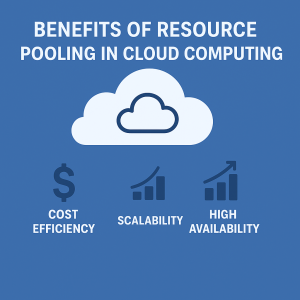
Among the biggest benefits of resource pooling is cost savings. Rather than buying and maintaining hardware, which is costly, business enterprises access shared resources provided by cloud providers. Such sharing of infrastructure reduces operation and capital expenditure considerably.
2. High Scalability and Elasticity
Moreover, because of pooling, it becomes easy to scale the business up or down due to demand. In case of a spike in an application, instantly the resources are drawn out of the pool. This elasticity ensures that applications are performing optimally during peak loads.
3. Optimal Use of Resources
Without resource pooling, many physical servers would sit underutilized in a cloud computing environment. It ensures pooling of resources such that when a resource is idle, the same would be reassigned to workloads that require them. In simple words, it makes for great efficiency and prevents resource wastage.
4. Flexibility and Fast Provisioning
In cloud platforms, users can quickly deploy new resources using automated tools for rapid provisioning. Resource pooling enables the provisioning of resources in minutes rather than days/weeks.
5. Improved Reliability and High Availability
Because resources are pooled across multiple servers and data centers, the cloud provider can offer redundancy. When one server in the pool fails, workloads are shifted to another server in the pool. This ensures near-continuous uptime-one of the strongest advantages of resource pooling in cloud computing.
6. Load Balancing and Performance Optimization
Accordingly, load balancing by cloud systems spreads workloads evenly across available machines, thus avoiding any bottle-necking and assuring a smooth operation with high performance.
Resource Pooling Challenges in Cloud Computing
While resource pooling is advantageous, it does pose the following challenges:
1. Security & Data Isolation
With multiple users on the same hardware, strong isolation becomes paramount. Cloud providers should implement strict security controls, encryption, and segregation of tenants to reduce the risk.
2. Contention in Performance
In multi-tenant environments, users might contend for use of the same pooled resources. When not appropriately managed, performance bottlenecks may result from increased workloads above expected capacity.
3. Complex Resource Management
Large dynamic resource pools require advanced orchestration tooling and experienced staff. The complexity of maintaining and optimizing cloud resource pooling can be challenging for providers.
4. Compliance and Governance
It can be demanding, especially for organizations in regulated industries who have to ensure pooled resources adhere to strict data governance rules in shared environments.
Real-World Examples of Cloud Resource Pooling
Major cloud providers rely on resource pooling in cloud computing to a very large extent:
1. Amazon Web Services (AWS)
AWS delivers its services by using huge pools of compute and storage. Resources such as EC2, S3, and RDS share these pools and support millions of users with high performance.
2. Microsoft Azure
The scale sets of Azure’s virtual machines and clusters of storage depend much on cloud pooling to provide flexible, scalable services across regions.
3. Google Cloud Platform (GCP)
GCP pools global computer resources together, enabling powerful AI training, data analytics, and hosting applications.
These examples demonstrate how crucial resource pooling is to contemporary cloud platforms.
Future Trends in Cloud Resource Pooling
1. AI-driven Resource Management
AI will play a key role in usage-pattern prediction, resource distribution optimization, and orchestration automation across very large pools of resources.
2. Edge and Distributed Cloud Computing
Resource pooling is extended even to edge devices and micro-data centers, thus reducing latency by making computing closer to the end user.
3. Hybrid and Multi-Cloud Pooling
More and more organizations are pooling resources across public, private, and hybrid clouds. Seamless resource pools across multiple platforms are trending.
4. Serverless Architectures
Automation in pooling cloud resources forms the backbone of serverless computing, wherein applications can instantly scale up or down with no user interference.
Conclusion: Why Resource Pooling in Cloud Computing Matters
Resource pooling of cloud computing is amongst those main principles that actually make the cloud services scalable, flexible, cost-effective, and high performance. Aggregating the compute, storage, and networking resources and managing them across multiple users ensure the cloud provider of optimum utilization, resulting in seamless service delivery.
Understanding resource pooling, its mechanisms, benefits, and challenges is basic for the IT professional, cloud architect, developer, and business adopting cloud-first strategies.
Frequently Asked Questions
Resources in cloud computing encompass compute power, storage, networking, memory, and virtual machines. Cloud computing carries out resource pooling for managing these resources efficiently to ensure multiple users share them securely. This shared model ensures better utilization through cloud resource pooling and dynamic allocation.
These include On-Premise ERP, Cloud ERP, Hybrid ERP, and Open-Source ERP. Resource pooling is one of the key benefits that a modern cloud-based ERP system will have. Resources can be scaled up or down as required. Because of cloud pooling, ERP applications run smoothly and efficiently without the need for dedicated hardware.
The types of cloud computing are Public Cloud, Private Cloud, Hybrid Cloud, and Community Cloud. All these models utilize resource pooling in cloud computing to deliver flexible and scalable services. With resource pooling in the cloud, users access shared computing resources on demand.
The core components of ERP include Finance, Human Resources, Supply Chain, Manufacturing, and Customer Relationship Management. These, when hosted on cloud platforms, use resource pooling for smooth performance. Resource pooling in cloud computing makes ERP modules run with efficiency and dynamic allocation for compute and storage.

 January 3, 2026
 8 min read




 ChatGPT
 Perplexity
 Claude
 Grok
Grok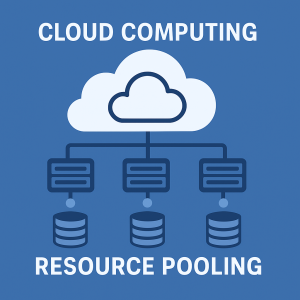











 ROI Calculator



