C Language Interview Questions: Top Questions & Answers for 2026
J
By Shubham Lal
September 22, 202611 min read
Published on September 22, 2026
SHARE THIS ARTICLE
Table Of Content
Why Prepare for C Language Interview Questions in 2026?
Basic Interview Questions for C Programming
C Programming Questions on Strings and Arrays<
C Programming Coding Questions and Answers
Key Insights
C interview preparation should cover both conceptual questions and practical coding problems, including variables, data types, functions, arrays, pointers, and memory management.
Basic C programming concepts include arrays, strings, pointers, functions, operators, and data types, which are commonly discussed in technical interviews.
C programming coding questions and answers cover practical problems such as reversing a number, checking prime numbers, finding palindromes, and calculating factorials.
Advanced preparation includes dynamic memory allocation, dangling and NULL pointers, structures, unions, storage classes, local and global variables, and function pointers.
In this blog, you'll learn basic interview questions for C programming, C programming coding questions and answers, advanced C interview questions and answers, and practical tips for preparing for C programming interviews in 2026.
Preparing for a C programming interview can feel challenging, especially when interviewers move from basic concepts tocoding problems and advanced topics. The good news is that most interviews test how well you understand core programming concepts, how you approach problems, and whether you can explain your code clearly.
If you are a fresher preparing for your first technical interview or an experienced developer looking to strengthen your fundamentals, practicing the right C language interview questions can make your preparation more focused.
This blog covers basic interview questions for C programming, commonly asked C programming questions, coding problems, and advanced C interview questions and answers to help you prepare for interviews in 2026.
Why Prepare for C Language Interview Questions in 2026?
C continues to be an important programming language for understanding how software works at a lower level. Its concepts are also useful when working with operating systems, embedded systems, compilers, and other performance-oriented applications.
During an interview, recruiters may evaluate your understanding of variables, data types, operators, functions, arrays, pointers, structures, memory management, and file handling. Coding rounds may also include problems involving strings, arrays, loops, and functions.
Therefore, your preparation should be a mix of both conceptual C programming questions and practical coding problems.
If you are a fresher, interviewers often begin with fundamental concepts. Here are some basic interview questions for C programming that you should practice.
1. What is C programming?
C is a general-purpose, procedural programming language used to develop system software, application software, embedded applications, and other performance-oriented programs.
It provides features such as functions, pointers, arrays, structures, and direct memory manipulation. C is also known for its relatively small set of keywords and efficient execution.
2. What are the main features of C?
Some important features of C include:
Procedural programming support
Pointers and direct memory access
Functions for modular programming
Arrays and structures for organizing data
Support for dynamic memory allocation
Efficient and fast execution
Portability across different systems
These features make C useful for both learning programming fundamentals and developing low-level software.
3. What is a variable in C?
A variable is a named memory location used to store a value. The value stored in a variable can generally be changed during program execution.
Example
int age = 25;
Here, age is an integer variable containing the value 25.
4. What are data types in C?
Data types specify the type of value a variable can store. Common data types include:
int for integers
char for characters
float for floating-point values
double for double-precision floating-point values
void for indicating no value
C also allows developers to create more complex data types using structures, unions, arrays, and pointers.
5. What is the difference between = and == in C?
The = operator is used for assignment, while == is used to compare two values.
Example
int x = 10; if (x == 10)
Here, 10 is assigned to x.
On the other hand, the if (x == 10) statement checks whether x is equal to 10.
Confusing these two operators is a common mistake, so be prepared to explain the difference during an interview.
6. What is a function in C?
A function is a block of code designed to perform a specific task. Functions help divide a program into smaller and more manageable parts.
A function can accept parameters and may return a value.
Example
int add(int a, int b) { return a + b; }
Here, the add() function accepts two integers and returns their sum.
7. What is an array in C?
An array stores multiple values of the same data type in contiguous memory locations.
Example
int numbers[5] = {10, 20, 30, 40, 50};
This array can store five integer values. Array indexing in C starts from 0, so the first element is numbers[0].
8. What is a pointer in C?
A pointer is a variable that stores the memory address of another variable.
Example
int x = 10; int *ptr = &x;
Here, ptr stores the address of x. Pointers are an important part of C and are frequently discussed in technical interviews.
C Programming Questions on Strings and Arrays<
Questions involving arrays and strings are common in technical interviews because they test your understanding of loops, indexing, memory, and basic problem-solving.
9. How is a string represented in C?
A string in C is represented as an array of characters ending with a null character ‘\0’.
For example:
char name[] = “Priya”;
Internally, the string contains the characters followed by the null character that indicates the end of the string.
10. What is the difference between an array and a pointer?
An array is a collection of elements of the same type stored in contiguous memory. A pointer is a variable that stores an address.
Although arrays and pointers are closely related in C, they are not identical. For example, an array name generally represents the address of its first element in many expressions, but an array itself is not a pointer variable.
11. How can you find the largest element in an array?
One simple approach is to assume the first element is the largest and then compare it with each remaining element.
For example:
#include <stdio.h>
int main() { int arr[] = {10, 25, 7, 40, 15}; int n = 5; int max = arr[0];
for (int i = 1; i < n; i++) { if (arr[i] > max) { max = arr[i]; } }
printf(“Largest element = %d”, max);
return 0; }
Output
Largest element = 40
The logic involves traversing the array once and updating the maximum value whenever a larger element is found.
Coding rounds are often used to understand how candidates approach programming problems. The following c programming coding questions and answers cover some common interview patterns.
12. Write a C program to reverse a number
A number can be reversed by repeatedly extracting its last digit and adding it to the reversed number.
Example
#include <stdio.h>
int main() { int num = 12345; int reverse = 0;
while (num != 0) { reverse = reverse * 10 + num % 10; num = num / 10; }
printf(“Reversed number = %d”, reverse);
return 0; }
Output
Reversed number = 54321
The % operator obtains the last digit, while integer division removes the last digit from the original number.
13. Write a C program to check whether a number is prime
A prime number has exactly two positive factors: 1 and itself.
Example
#include <stdio.h>
int main() { int num = 17; int isPrime = 1;
if (num <= 1) { isPrime = 0; }
for (int i = 2; i * i <= num; i++) { if (num % i == 0) { isPrime = 0; break; } }
if (isPrime) printf(“Prime number”); else printf(“Not a prime number”);
return 0; }
Output
Prime number
This type of question tests loops, conditional statements, operators, and basic optimization of the checking process.
14. Write a C program to check whether a string is a palindrome
A palindrome reads the same forward and backward.
Example
#include <stdio.h> #include <string.h>
int main() { char str[] = “madam”; int start = 0; int end = strlen(str) – 1; int palindrome = 1;
while (start < end) { if (str[start] != str[end]) { palindrome = 0; break; }
start++; end–; }
if (palindrome) printf(“Palindrome”); else printf(“Not a palindrome”);
return 0; }
Output
Palindrome
During an interview, do not just provide the code. Explain the logic behind comparing characters from both ends of the string.
15. Write a C program to calculate the factorial of a number
The factorial of a positive integer is the product of all positive integers up to that number.
Example
#include <stdio.h>
int main() { int n = 5; int factorial = 1;
for (int i = 1; i <= n; i++) { factorial = factorial * i; }
printf(“Factorial = %d”, factorial);
return 0; }
Output
Factorial = 120
Interviewers may also ask you to solve this problem using recursion.
Advanced C Interview Questions and Answers
Once the interviewer is confident about your fundamentals, the discussion may move towards pointers, memory management, storage classes, and other concepts. These advanced C interview questions and answers can help you prepare for that stage.
16. What is dynamic memory allocation in C?
Dynamic memory allocation allows memory to be allocated during program execution rather than only at compile time.
C provides functions such as:
malloc()
calloc()
realloc()
free()
Example
int *ptr;
ptr = (int *)malloc(5 * sizeof(int));
free(ptr);
Here, malloc() allocates memory, while free() releases it after use.
17. What is the difference between malloc() and calloc()?
Both functions are used for dynamic memory allocation, but they differ in their behaviour.
malloc() allocates a specified amount of memory without initializing the allocated bytes.
calloc() allocates memory for a specified number of elements and initializes the allocated memory to zero.
18. What is a dangling pointer?
A dangling pointer is a pointer that refers to a memory location that is no longer valid for the pointer to use.
For example, if dynamically allocated memory is released using free() but the pointer continues to refer to that location, using that pointer can result in undefined behaviour.
Setting a pointer to NULL after releasing the memory can help avoid accidentally using the old address.
19. What is a NULL pointer?
A NULL pointer is a pointer that does not point to a valid object or function.
Example
int *ptr = NULL;
Checking a pointer against NULL before dereferencing it can help prevent attempts to access memory through an invalid pointer.
20. What is a structure in C?
A structure is a user-defined data type that allows different types of data to be grouped under one name.
Example
struct Student { char name[50]; int age; float marks; };
A structure can therefore represent an entity containing different kinds of information.
21. What is the difference between a structure and a union?
Both structures and unions allow different data types to be grouped together. However, their memory usage differs.
In a structure, each member has its own storage within the structure. In a union, members share the same memory location.
This distinction is important when memory usage is a key consideration.
22. What are storage classes in C?
Storage classes provide information about the scope, lifetime, and storage characteristics of variables.
Common storage classes include:
auto
register
static
extern
For example, a static variable can retain its value between function calls.
23. What is the difference between a local and global variable?
A local variable is declared inside a function or block and generally has scope limited to that area.
A global variable is declared outside functions and can be accessed according to its scope and linkage.
Understanding variable scope is important because it affects how and where variables can be used.
24. What is a function pointer?
A function pointer is a pointer that stores the address of a function. It can be used to call a function indirectly.
Example
int add(int a, int b) { return a + b; }
int (*ptr)(int, int) = add;
Function pointers are useful in situations where functions need to be passed as arguments or selected dynamically.
Commonly Asked Questions on C Programming
25. What is the difference between break and continue?
break ends the loop or switch statement in which it appears.
continue skips the remaining statements in the current loop iteration and proceeds with the next iteration.
26. What is recursion in C?
Recursion occurs when a function calls itself. A recursive function needs a condition that eventually stops further recursive calls.
Factorial and Fibonacci problems are common examples used to test recursion.
Example
int factorial(int n) { if (n == 0) return 1; return n * factorial(n – 1); }
Output
factorial(5) = 120
Here, the factorial() function calls itself with a smaller value until the base condition n == 0 is reached.
27. What is a preprocessor in C?
The C preprocessor processes certain instructions before the actual compilation of the program.
Common preprocessor directives include #include and #define.
For example:
#define PI 3.14
This defines a symbolic constant that can be used in the program.
28. What is the purpose of sizeof() in C?
The sizeof operator determines the size, in bytes, of a type or object.
For example:
int x; printf(“%zu”, sizeof(x));
The result depends on the implementation and data type involved.
29. What is type casting in C?
Type casting is the process of explicitly converting a value from one data type to another.
For example:
float x = 10.5; int y = (int)x;
Here, the floating-point value is explicitly converted to an integer.
Tips to Prepare for C Language Interview Questions
Preparing for an interview is not only about memorizing answers. You should also practice explaining why a particular approach works.
Start with the fundamentals, including variables, operators, loops, functions, arrays, strings, and pointers. Once these concepts are clear, move towards dynamic memory allocation, structures, unions, recursion, and function pointers.
You should also practice writing small programs without relying heavily on an IDE. Try solving problems involving numbers, arrays, strings, sorting, searching, and basic pointer operations.
During the interview, explain your approach before writing the complete code. If you make a mistake, walk through the logic and identify where the issue occurs. This demonstrates your problem-solving process rather than only your ability to produce a final answer.
Conclusion
Preparing for C language interview questions becomes easier when you approach the process in stages. Begin with basic interview questions for C programming, strengthen your understanding of arrays, strings, functions, and pointers, and then move towards c programming coding questions and answers and advanced concepts.
For experienced candidates, practicing advanced C interview questions and answers can help refresh concepts related to memory, pointers, structures, unions, and function pointers. Most importantly, focus on understanding the logic behind each solution rather than simply memorizing answers. This approach can help you handle both conceptual C programming questions and practical coding problems more confidently in 2026.
Frequently Asked Questions
Common questions cover variables, data types, pointers, arrays, strings, functions, memory allocation, structures, unions, recursion, and storage classes. Coding rounds may also include problems involving numbers, arrays, strings, and loops.
Yes. Coding questions help interviewers understand how candidates apply programming concepts to practical problems. Freshers should practice basic programs involving loops, arrays, strings, functions, and conditional statements.
Experienced candidates should revise pointers, dynamic memory allocation, function pointers, structures, unions, storage classes, recursion, and memory-related concepts. They should also be comfortable explaining their code and approach.
Start by strengthening your fundamentals and then practice coding problems regularly. Revise important concepts, write programs yourself, understand common errors, and practice explaining your solutions clearly during mock interviews.
Shubham Lal
Lead Software Developer
Shubham Lal joined Microsoft in 2017 and brings 8 years of experience across Windows, Office 365, and Teams. He has mentored 5,000+ students, supported 15+ ed-techs, delivered 60+ keynotes including TEDx, and founded AI Linc, transforming learning in colleges and companies.
 HOME > BLOG > IT/Software Development > C Language Interview Questions: Top Questions & Answers for 2026
 September 22, 2026
 11 min read




 Key Insights
 ChatGPT
 Perplexity
 Claude
 Grok
Grok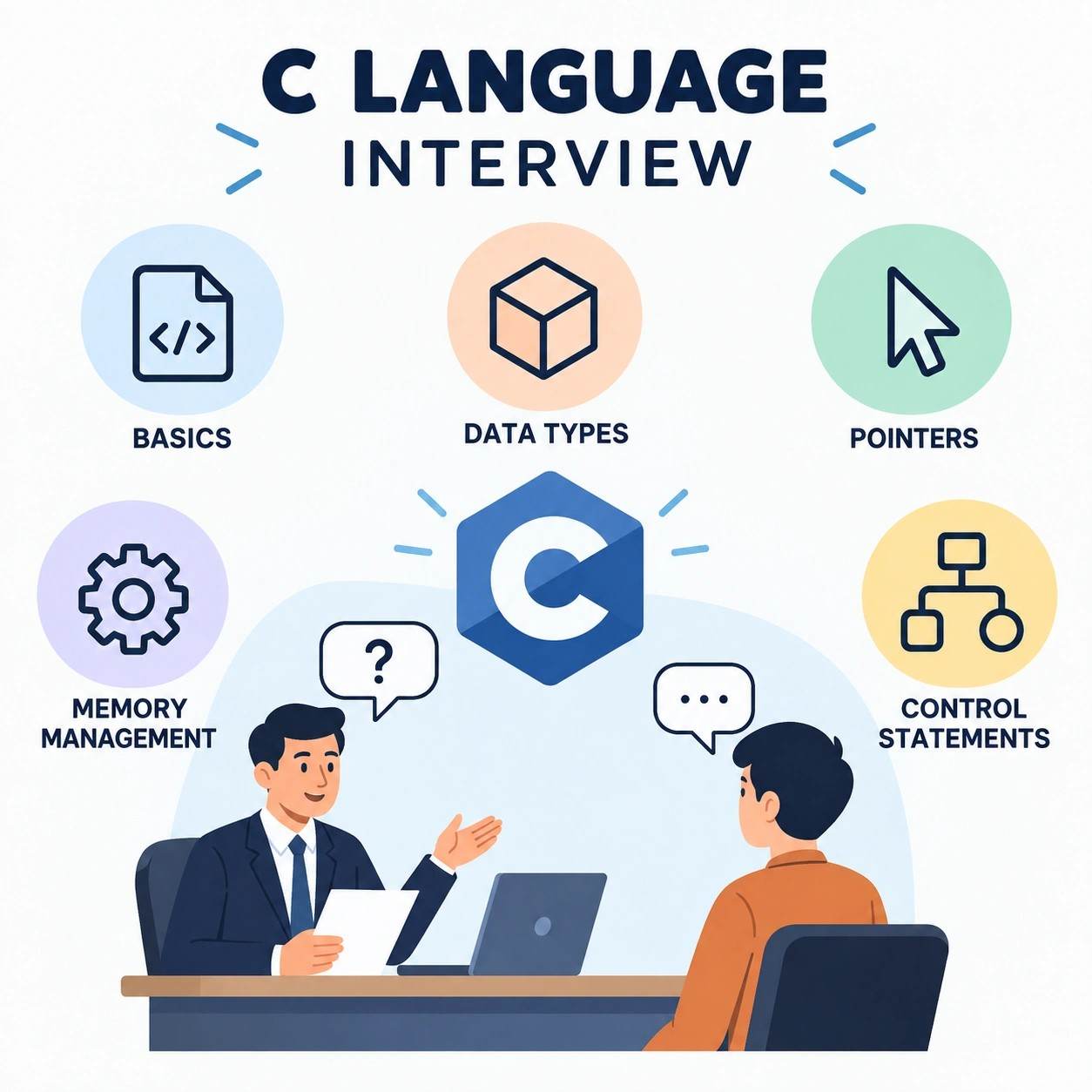









 ROI Calculator