AI Robotics: The Must-Have Skills for Tomorrow’s Careers
J
By Dr. Sanjay Kulkarni
September 13, 20267 min read
Published on September 13, 2026
SHARE THIS ARTICLE
Table Of Content
What Is AI Robotics?
What Is Physical AI and Why Does It Matter?
Must-Have Skills for AI Robotics Careers
Career Opportunities in AI Robotics
Key Insights
AI Robotics combines artificial intelligence with robotic systems to help machines understand their surroundings, make decisions, and perform tasks.
Physical AI enables robots to perceive and respond to the physical world, supporting applications such as autonomous robots, robotic arms, smart factories, healthcare robotics, and autonomous vehicles.
Key skills for AI and robotics careers include artificial intelligence, machine learning, programming, robotics, computer vision, sensor technology, simulation, and reinforcement learning.
Problem-solving, systems thinking, communication, collaboration, creativity, and adaptability are also important for working on complex robotics projects.
Hands on projects, continuous learning, and a strong foundation in AI, programming, and robotics can help students and professionals prepare for emerging career opportunities.
In this blog, you'll learn about AI Robotics, Physical AI, essential robotics AI skills, career opportunities, and how to build a career in AI and robotics.
What if the next generation of robots could not only follow instructions but also understand their surroundings, make decisions, and respond to unexpected situations? This is becoming possible with the rapid development of AI Robotics and Physical AI.
The World Economic Forum’s Future of Jobs Report 2025 estimates that 39% of workers’ core skills could change by 2030. It also identifies AI and big data as the fastest growing skills, followed by networks and cybersecurity and technological literacy. (World Economic Forum)
As the role of artificial intelligence becomes more prominent in factories, warehouses, hospitals, vehicles, and other physical environments, the relationship between AI and robotics is becoming increasingly important. For students and professionals, this means that understanding both AI and robotics can open doors to a wide range of emerging career opportunities.
But what skills will actually matter? Let us explore the key skills that can help professionals prepare for careers shaped by robotics ai, intelligent machines, and Physical AI.
AI Robotics combines artificial intelligence with robotic systems to help machines understand their surroundings, process information, make decisions, and perform tasks.
Traditional robots generally depend on predefined instructions. However, an ai robot can use technologies such as machine learning, computer vision, sensors, and intelligent decision-making to respond to changing situations.
For example, a warehouse robot can use sensors and AI to identify obstacles and change its route. A robotic arm can understand the position of an object and adjust its movement. These capabilities allow robots to perform more complex tasks with less dependence on fixed instructions.
This is where AI and robotics come together. AI provides the intelligence, while robotics provides the physical ability to act.
Physical AI refers to AI systems that can perceive, reason about, and act in the physical world. NVIDIA describes Physical AI as technology that enables autonomous systems such as robots and other machines to understand their environment and perform complex actions. (NVIDIA)
This is an important shift because AI is no longer limited to generating text, analyzing data, or creating images. AI can influence what happens in the physical world as well.
Physical AI can support applications such as autonomous mobile robots, robotic arms, smart factories, healthcare robotics, and autonomous vehicles. These systems can combine information from cameras and sensors with AI models to make decisions in real time.
For professionals, this means that future careers may require a combination of software knowledge, AI expertise, robotics knowledge, and an understanding of real-world environments.
Must-Have Skills for AI Robotics Careers
Professionals who are looking to make a career in robotics should have the following skills:
1. Artificial Intelligence and Machine Learning
A strong understanding of artificial intelligence is one of the most important skills for an AI Robotics career.
Professionals should understand concepts such as machine learning, deep learning, neural networks, model training, and data processing. These technologies allow an AI robot to identify patterns, understand inputs, and improve its performance.
You do not necessarily need to become an AI researcher to work with robotics. However, understanding how AI models work and how they can be integrated into robotic systems can give you a strong foundation.
2. Robotics and Automation
Learning the fundamentals of robotics is equally essential.
You should understand concepts such as robotic movement, actuators, sensors, robot control, navigation, and automation. Knowledge of how robotic systems are designed and operated helps professionals understand how AI can be applied to physical machines.
This combination is particularly valuable because the future of AI and robotics will depend on professionals who can connect intelligent software with physical hardware.
3. Programming Skills
Programming remains a key skill for AI Robotics professionals.
Python is widely used in AI and machine learning, while other programming languages can be useful for robotics and system development. Programmingknowledge helps professionals develop algorithms, process sensor information, train models, and control robotic systems.
You should focus not only on learning programming syntax but also on problem-solving. Robotics involves dealing with real-world situations where systems may encounter unexpected objects, movements, or environmental changes.
4. Computer Vision
How can an AI robot understand what is happening around it?
Computer vision is a major part of the answer.
Computer vision enables machines to process and interpret visual information. In robotics, it can help machines recognize objects, understand positions, identify obstacles, and navigate environments.
Professionals interested in robotics should become familiar with image processing, object detection, image classification, and visual perception.
Computer vision becomes even more important when robots need to work alongside people or operate in environments that are constantly changing.
5. Sensor and Perception Skills
Robots need more than cameras to understand the world.
They can use different sensors to collect information about distance, movement, position, pressure, temperature, and other environmental conditions. Professionals working in robotics AI need to understand how this information is collected and processed.
Sensor fusion is particularly useful because combining information from multiple sensors can help a robotic system develop a more complete understanding of its surroundings.
6. Simulation and Digital Twin Technology
Testing robots directly in the real world can be expensive, time-consuming, and risky. Simulation provides a safer way to train and test intelligent machines.
Physical AI increasingly uses digital environments to simulate real-world conditions. NVIDIA highlights simulation, digital twins, synthetic data, and robot policy training as important components of the Physical AI technology stack.
Professionals who understand simulation can help develop, test, and improve robotic systems before they are deployed in real environments.
7. Reinforcement Learning
Robots often need to learn how to perform tasks through repeated practice.
Reinforcement learning helps an AI system learn by trying different actions and learning from the results. When it makes the right decision, it receives a reward and uses that feedback to improve its future actions.
This approach can be particularly useful in Physical AI because robots need to learn physical actions such as movement, navigation, manipulation, and object handling.
8.Problem Solving and Systems Thinking
Technical skills alone are not enough.
Robotics systems involve hardware, software, sensors, AI models, networks, and physical environments. A small issue in one part of the system can affect the entire operation.
This makes systems thinking an important skill. Professionals need to understand how different components work together and identify the root cause of problems.
The World Economic Forum also highlights analytical thinking, programming, systems thinking, and technological skills as important in a labour market increasingly influenced by robotics and autonomous systems.
9. Communication and Collaboration
Technical professionals alone won’t build the future of AI Robotics.
Robotics projects often involve software developers, engineers, data scientists, product managers, designers, operations teams, and business leaders. Professionals need to explain technical concepts clearly and work effectively across different teams.
Skills such as communication, collaboration, creativity, and adaptability can therefore be just as valuable as technical knowledge.
Potential career paths include robotics engineer, AI engineer, machine learning engineer, computer vision engineer, robotics software developer, automation engineer, autonomous systems engineer, robotics researcher, and AI product manager.
These skills can also be valuable beyond traditional robotics companies. Manufacturing, logistics, healthcare, automotive, agriculture, retail, and industrial operations are exploring intelligent automation and autonomous systems.
This means professionals do not necessarily need to work for a company that builds robots. They can also work in industries that adopt and manage intelligent robotic systems.
How to Build a Career in AI Robotics
If you are planning to enter this field, start with the fundamentals.
Learn programming and build a strong understanding of AI and machine learning. Then explore robotics concepts, computer vision, sensors, simulation, and reinforcement learning.
Hands-on projects can make a major difference. You could build a simple robotic system, experiment with computer vision, create a simulation, or develop an AI model that interacts with a robotic platform.
It is also important to keep learning. The field is evolving quickly, and professionals who regularly update their technical knowledge are more likely to remain relevant.
The future of AI Robotics is moving towards machines that can understand their environment, make decisions, and perform increasingly complex tasks.
Physical AI is helping bridge the gap between digital intelligence and physical action. As this technology develops, businesses will need professionals who understand not only AI but also robotics, physical systems, data, and human collaboration.
The goal should not be to learn every technology at once. Instead, build a strong foundation and gradually develop skills that connect AI with the physical world.
For students and professionals, learning about robotics AI, Physical AI, and AI and robotics can help build the skills needed for future career opportunities.
Frequently Asked Questions
Important skills include artificial intelligence, machine learning, programming, robotics, computer vision, sensors, simulation, reinforcement learning, problem-solving, and systems thinking.
Physical AI refers to AI systems that can perceive, reason about, and act in the physical world. It enables robots and other autonomous systems to respond to their surroundings and perform complex tasks.
Yes. Programming is an important skill for developing AI models, processing sensor data, building robotic applications, and controlling intelligent systems. Python is particularly useful for AI and machine learning.
Career options include robotics engineer, AI engineer, machine learning engineer, computer vision engineer, automation engineer, autonomous systems engineer, robotics software developer, and AI product manager.
Dr. Sanjay Kulkarni
Data & AI Transformation Leader
Dr. Sanjay Kulkarni is a Data & AI Transformation Leader with over 25 years of industry experience. He helps organizations adopt data-driven and responsible AI practices through strategic guidance and education. With experience across startups and global enterprises, he bridges the gap between theory and real-world application. His work empowers teams to innovate and thrive in AI-driven environments.

 September 13, 2026
 7 min read




 Key Insights
 ChatGPT
 Perplexity
 Claude
 Grok
Grok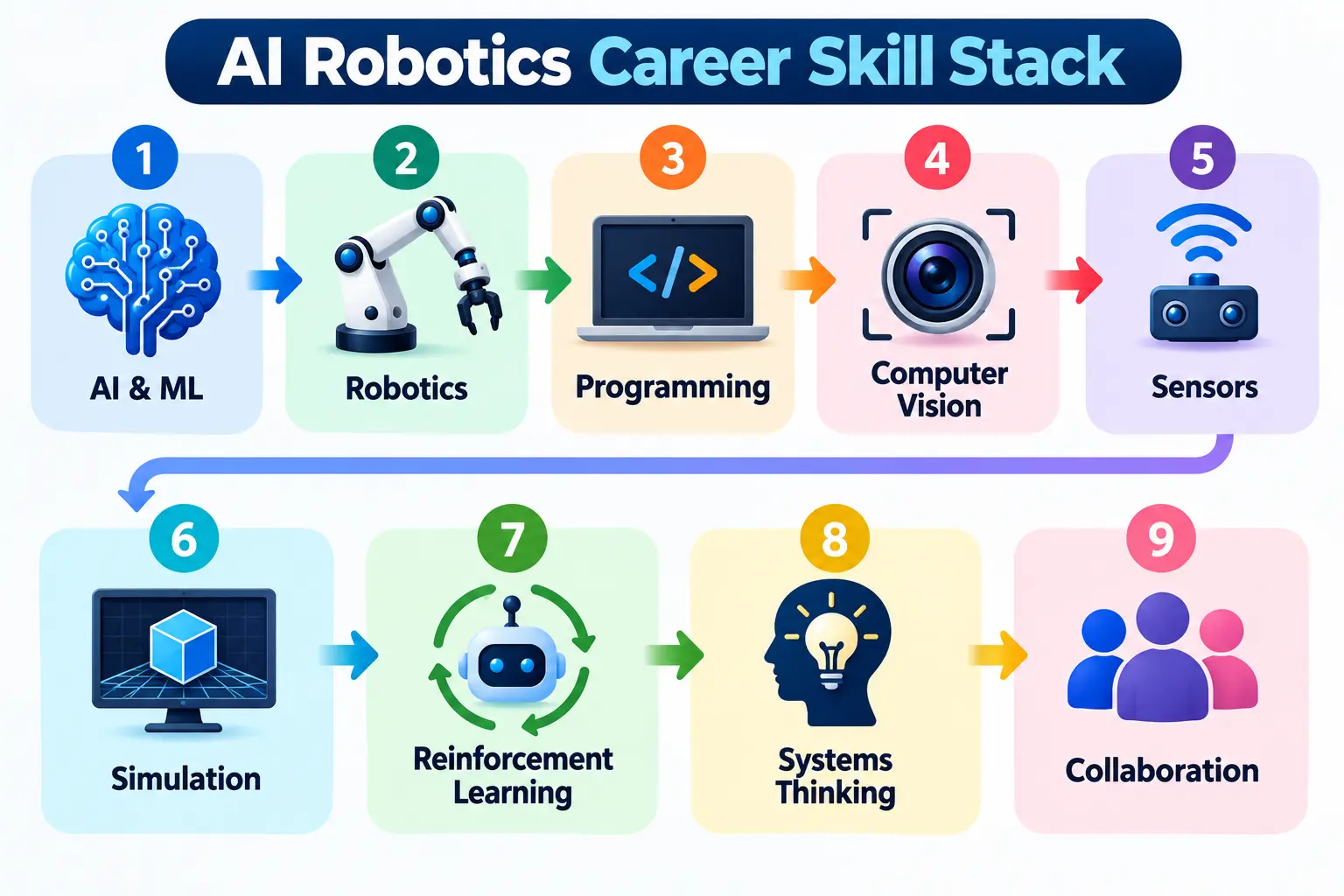







 ROI Calculator