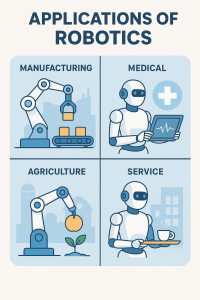
1. Manufacturing: Smart Factories Powered by Collaborative Robots
2. Healthcare & Surgery: Precision Robotics Saving Lives
3. Logistics & Warehousing: Autonomous Supply Chains
4. Agriculture & Farming: Smart Robots Boosting Crop Yield
Robotics is evolving faster than ever, and its impact will prevail in nearly all industries by 2026. Due to massive developments in AI, machine learning, sensor technology, and robotics and automation, robots today are becoming collaborative, agile, and intelligent. Businesses all over the world are implementing applications of robotics to derive productivity with a reduction in operation costs, thereby enhancing safety. The growth of collaborative robotics-that is, robots designed to work safely alongside humans-is also accelerating innovation across sectors.
In this blog, find the top 10 applications of robotics in 2026-considered, knowledgeable, and inspired by the world's leading insight into technology and robotics. You will get to know how organizations are adopting state-of-the-art robotic systems to solve actual global problems, at the same time increasing speed, precision, and efficiency.
1. Manufacturing: Smart Factories Powered by Collaborative Robots
Manufacturing remains the largest adopter of applications of robotics, and in 2026, factories are way more autonomous and connected. In addition, robots run assembly lines, material movement, welding, packaging, and more with an accuracy that is unparalleled.With the integration of AI-powered systems and robotics and automation, smart factories have become possible, which can engage in self-diagnosis, predictive maintenance, and real-time decision-making.
The standout feature is the emergence of collaborative robotics, where cobots will work closely with a human operator in order to perform repetitive, hazardous, or high-accuracy tasks, increasing productivity without sacrificing human judgment and innovation.
2. Healthcare & Surgery: Precision Robotics Saving Lives
Special applications of robotics in healthcarehave brought a revolutionary shift, especially in minimally invasive surgeries, rehabilitation, diagnostics, and care of the elderly.Robotic surgical systems, driven by robotics and automation, promise smaller incisions, faster recovery times, and greater accuracy than traditional procedures. In 2026, robots assist doctors with neurosurgery, orthopedics, and laparoscopic procedures with accuracies at the level of micrometer precision.
The rise of the use of collaborative robotics in hospitals enables safe interaction with humans, whether it’s assisting nurses or guiding patients to transportation.
3. Logistics & Warehousing: Autonomous Supply Chains
In 2026, the logistics industry will heavily rely on robotics and automation in warehouse operations, such as for picking up orders, packing, palletizing, and last-mile delivery.Robots designed for applications of robotics can navigate the most complex warehouse layouts, inventory tracking, and collaborate with people to optimize throughput. Companies are increasingly deploying collaborative robotics for tasks such as sorting and automated inventory management, reducing errors while speeding up ecommerce fulfillment.
4. Agriculture & Farming: Smart Robots Boosting Crop Yield
Agriculture is one sector that has shown rapid growth in the application of robotics in 2026. Robotic systems help farmers manage crops more efficiently, sustainably, and accurately.From planting the seed and autonomous tractors down to AI-driven crop monitoring, robotics and automation reduce the need for manual labor while improving predictability of yields.
Use of collaborative robotics allows human workers and machines together to perform various tasks, including harvesting, pruning, and packing, thereby maximizing seasonal productivity.
5. Retail & Customer Service: AI-Powered Interactive Robots
Different applications of robotics are being adopted by retail businesses to create customer experience and optimization in store operations. They help with product suggestions, shelf scanning, replenishment of inventory, and checkout automation.AI-driven humanoid robots use advanced robotics and automation, which are gaining momentum in malls, airports, and hospitality centers for visitor guidance and query response.
By 2026, collaborative robotics will be accomplished by both human staff and robots, allowing for quicker customer service, done more accurately.
6. Construction & Infrastructure: Autonomous Building Processes
Applications of robotics in construction projects have been on the increase, including such works as bricklaying, rebar tying, 3D printing of structures, and site inspection.With robotics and automation, construction companies can reduce risks to the workforce and accelerate project timelines while improving safety in hazardous environments.
The adoption of collaborative robotics supports human workers in heavy lifting, surveying, and repetitive operations requiring consistency and endurance.
7. Defense & Security: Intelligent Robotic Systems
Advanced applications of robotics are used by defense organizations around the world for surveillance, bomb disposal, perimeter security, and autonomous missions that help reduce soldiers’ exposure to danger.Robotics and automation-enabled AI-powered drones and ground robots assure rapid response, real-time data gathering, and increased precision for critical operations.
With collaborative robotics, soldiers receive tactical gains from robotic units that can operate safely around them in shared environments.
8. Space Exploration: Robots Expanding Human Reach
Space agencies continue to push the boundaries with applications of robotics to further support lunar missions, Mars exploration, asteroid mining, and satellite repair.In 2026, complex tasks involving navigation, sample collection, and maintenance of space robots using robotics and automation are done with minimal human intervention.
The emerging collaborative robotics allows astronauts and robots to work together on extraterrestrial missions, hence ensuring safety and mission success.
9. Education & Research: Learning with Robotic Innovation
The schools integrate robotics applications to develop programming, teaching concepts about STEM, engineering design, and integration of AI.Universities and R&D labs depend on robotics and automation for experiments, prototyping, and developing next-generation technologies.
Classrooms increasingly use collaborative robotics platforms that enable students to interact with the robots themselves for practical learning.
10. Home Automation & Personal Assistance: Smart Living Robots
The boom in the consumer robotics market in 2026 is contributed by rapid innovations in applications of robotics for house cleaning, elderly care, entertainment, and personal assistance.From autonomous vacuum cleaners to AI-powered humanoid companions, robotics and automation are fast becoming central to everyday living.
With the growth of collaborative robotics, home robots have been designed to work safely beside the family while providing support, reminders, and daily task assistance.
A Rapidly Evolving Field of Robotics: What 2026 Holds
With industries upgrading their technological prowess, the usage of robotics technology in 2026 has reached a point of maturity that has never been experienced before. With advancements in computing capabilities, AI models, and sensor accuracy, robots are migrating from being mere task performers to being competently intelligent decision-makers. Such a transformation in robotics and automation technology would lead to a new wave of innovations in both industries and society, a world where human and robotic abilities would complement each other in perfect harmony.One of the most prominent shifts that has occurred in this area involves a major development in the use of collaborative robots. Unlike conventional robotic systems that functioned in a cage environment, it has been seen that the latest generation of robots, also known as cobots, are designed for use in a common working area and are ideal for a setting that needs flexibility as well as efficiency.
How Robotics Is Reshaping Workforce Abilities
By 2026, the integration of robotics application in the workforce will not only be a matter of replacing human labor but also a matter of enhancing human professionals. With precision from robots and creativity from humans, productivity raises to an exponential level. Employees are now able to monitor, repair, and control sophisticated robots rather than doing mundane tasks.This development also launches new job dimensions as follows:
Robot supervisors
Robot
AI Maintenance Specialists
Automation Workflow Designers
Collaborative robots training
Sectors that were reluctant to accept automation are now warming up to robotics and automation since cobots provide scalability, affordability, and unprecedented ease of deployment.
The Economic Impact: A Global Perspective
The worldwide acceptance of advanced applications of robotics technology is expected to contribute to a substantial rise in worldwide GDP by 2026. Organizations are turning to robots to help minimize costs of operation, minimize injuries in the working environment, and speed up innovation cycles. Through technology and robotics, small businesses that couldn’t afford advanced technology are now able to implement robots.Analysts note that this robotics revolution is not just a technology trend, but rather a catalyst in a bigger picture. Developing nations in Asia, Africa, and Latin America are using collaborative robots to increase mass production, enhance agricultural production, and facilitate infrastructural development.
Human-Robot Interaction: The New Normal
The shift towards intuitive human-robot interaction represents one of the greatest breakthroughs in terms of applying robotics. Robots with natural language processing capabilities, enhanced vision, and predictive artificial intelligence are able to understand human behavior in a way that has never been done before. Such a breakthrough brings humans and robots closer together than ever before.
In working environments, cooperation between robots ensures that:
Safer working environments
Less fatigue for human employees
Increased precision in day-to-day activities
Increased division of labor
These advancements make robots feel far from being like a tool, rather like a sophisticated electronic colleague.
Sustainability and Robotics: Creating a Greener Planet
An increasing emphasis on “climate responsibility” has led to a growing use of robotics in environmentally responsible ways. Robots assume a prominent role in “waste management, energy efficiency, and a circular economy by 2026.”
Important sustainability issues that a company should consider
Self-driven robots analyzing energy usage patterns
Robots in farming, AI technology, Water conservation, Water usage
Smart garbage sorting technology using robotics and automation
Cobots involved in micro-precision tasks that provide low material wastage
Now, governments and corporations make use of collaborative robots to efficiently and effectively contribute to their sustainability agendas.
Conclusion
The future of robotics is accelerating at a pace the world has never seen before. As such, with industries still pushing the limits, the top applications of robotics in 2026 will shape how companies operate, innovate, and deliver value. Be it smart factories, autonomous logistics, or advanced healthcare solutions, the blend of robotics and automation drives unparalleled efficiency, precision, and scalability across segments.
What really makes this evolution much more consequential is the advent of collaborative robotics, where humans work with intelligent machines, side by side, creating a safer, faster, and adaptable workflow. These are advancements that are not only changing organizations but also redoing job roles, boosting productivity, and enabling completely new possibilities in engineering, service, and consumer applications.
Embracing the next wave of robotics will be central in a connected and automated world, especially for businesses that want to be forward-thinking, innovative, and competitive.
Frequently Asked Questions
The Big 4 of robotics typically include perception, mobility, manipulation, and cognition-core pillars that shape the major applications of robotics across industries. These components power modern robotics and automation by making machines understand, move, and interact with their environment. With emerging collaborative robotics, all these capabilities have also been becoming more humane and effective.
The future applications of robotics aim toward hyper-automation, intelligent manufacturing, precision healthcare, smart logistics, and autonomous mobility. With evolving robotics and automation, systems will be more adaptive, predictive, and integrated across industries. This growth in collaborative robotics will further open ways to seamless human-robot teamwork in factories, hospitals, and service environments.
Smart homes, cleaning robots, personalized assistants, and automated systems for customer service are some of the everyday uses of robotics. Robotics and automation make life quicker, safer, and easier on a daily basis. Even collaborative robotics affects our lives indirectly by making the industries easier that bring products and services to our homes and daily usage.
Key applications of robotics, embodying the 4 D’s— Dangerous, Dirty, Dull, and Difficult—are those tasks humans should not do or would rather not do. These form guiding principles for growth in robotics and automation, especially in hazardous or repetitive environments. With collaborative robotics, even some of these tasks are being safely divided between human and robot in the interest of greater efficiency.

 January 4, 2026
 8 min read





 ChatGPT
 Perplexity
 Claude
 Grok
Grok











 ROI Calculator