HOME > BLOG > Healthcare Management > Role of AI, Robotics & Cobots in Modern Healthcare: A Practical Guide for Industry 5.0
Healthcare Management
Role of AI, Robotics & Cobots in Modern Healthcare: A Practical Guide for Industry 5.0
J
By Nuthana Reddy
July 27, 20266 min read
Published on July 27, 2026
SHARE THIS ARTICLE
Table Of Content
Why This Matters for Healthcare Professionals — Not Just Technology Professionals
Artificial Intelligence in Healthcare: The Real Applications
Robotics in Healthcare: Three Distinct Categories
Collaborative Robots (Cobots): The Industry 5.0 Differentiator
In the previous article in this series, we established what Healthcare Industry 5.0 means and how it differs from Industry 4.0. The defining shift is from full automation to human-technology collaboration — machines that work with clinicians and healthcare workers, not in place of them.
This article goes one level deeper: what do AI, robotics, and collaborative robots (cobots) actually do in modern healthcare, how are they being used in India and globally, and what do healthcare professionals need to understand about them to work effectively in Industry 5.0 environments?
Why This Matters for Healthcare Professionals — Not Just Technology Professionals
A hospital administrator who cannot evaluate an AI diagnostic system is flying blind in 2026. A surgical team leader who does not understand what a cobot can and cannot do is a liability in an operating theatre that deploys them. A procurement officer who buys IoT-enabled equipment without understanding its data governance implications creates compliance risk for the institution.
Healthcare Industry 5.0 does not require every healthcare professional to become a technology specialist. It requires them to be technology-informed — able to evaluate, govern, deploy, and work alongside these systems intelligently. That is exactly the capability the IIT Delhi Executive Programme in Healthcare for Industry 5.0 develops.
Artificial Intelligence in Healthcare: The Real Applications
AI in healthcare is not a single technology — it is a family of tools applied across different clinical and operational contexts. Here is a structured overview of where AI is being deployed:
1. Diagnostic AI
AI systems trained on large medical imaging datasets can identify patterns in X-rays, CT scans, MRIs, and pathology slides with accuracy that, in specific narrow tasks, matches or exceeds radiologists. Key examples:
Radiology AI: Systems like Qure.ai (Indian company) screen chest X-rays for tuberculosis, pneumonia, and COVID-19 at scale — critical for India’s public health infrastructure where radiologist density is low
Ophthalmology AI: Diabetic retinopathy screening through AI-powered fundus image analysis — enabling optometrists and primary care physicians to screen for a condition that previously required a specialist
Pathology AI: Digital pathology systems analyse biopsy slides to identify cancer cells, grade tumours, and flag areas for pathologist review
ECG interpretation: AI analysis of electrocardiograms to detect arrhythmias, with alerting systems integrated into remote monitoring platforms
The common thread: AI handles the high-volume, pattern-recognition tasks. The clinician makes the diagnosis and treatment decision.
2. Predictive Analytics and Clinical Decision Support
Sepsis prediction: AI models that analyse vital signs, lab values, and nursing notes in real time to identify patients at risk of sepsis 6–12 hours before clinical deterioration
Readmission risk: Predicting which patients are at high risk of hospital readmission within 30 days, enabling targeted discharge support
Drug interaction alerts: AI-driven pharmacy systems that flag dangerous drug combinations in real time at the point of prescribing
Bed management optimisation: Predictive models that forecast patient admission volumes and help hospital administrators plan bed allocation and staffing
3. Natural Language Processing (NLP) in Clinical Documentation
Clinical documentation:NLP systems that transcribe physician-patient conversations and generate structured clinical notes — reducing administrative burden significantly
Medical coding: Automated ICD-10 coding from clinical notes — reducing billing errors and coder workload
Evidence synthesis: AI systems that scan medical literature and synthesise evidence for clinical decision support
4. Operational and Administrative AI
Appointment scheduling optimisation: AI that reduces no-show rates and optimises appointment slot allocation based on historical patterns
Supply chain management:Predictive inventory management for pharmaceuticals and medical supplies — reducing stockouts and wastage
Revenue cycle management: AI-driven claims processing and denial management in hospital billing
Robotics in healthcare falls into three functionally distinct categories, each with different clinical applications and different implications for healthcare professionals:
1. Surgical Robots
The most visible category. Surgical robots like the da Vinci system enable minimally invasive procedures with greater precision, smaller incisions, and reduced patient recovery time. The robot does not operate autonomously — it is a precision extension of the surgeon’s hands, controlled in real time.
In India, surgical robot adoption is growing in tertiary care hospitals — Apollo, Fortis, Medanta, AIIMS — particularly for urology, gynaecology, and oncology procedures.
2. Service and Logistics Robots
Autonomous mobile robots (AMRs) that move medications, laboratory specimens, linen, and food within hospital facilities. They navigate hospital corridors using AI-powered mapping and obstacle avoidance.
The operational value: reducing the time nursing and support staff spend on transport tasks, freeing them for patient care.
3. Rehabilitation and Assistive Robots
Exoskeletons for stroke rehabilitation, robotic prosthetics, and assistive devices for patients with mobility impairments. India’s rehabilitation robotics market is nascent but growing — driven by increasing stroke burden and road traffic accident rates.
Collaborative Robots (Cobots): The Industry 5.0 Differentiator
Cobots are the technology that most clearly embodies the Industry 5.0 principle of human-technology collaboration. Unlike traditional industrial robots — caged, fast, dangerous near humans — cobots are designed to work safely in close physical proximity to people.
In healthcare specifically:
Operating theatre cobots: Hold instruments steady during microsurgery, reducing tremor effects; position endoscopes consistently without requiring a human assistant to maintain position throughout a procedure
Pharmacy cobots: Dispensing cobots that work alongside pharmacists — the cobot retrieves and counts medications, the pharmacist verifies and counsels the patient
Laboratory cobots: Sample handling, pipetting, and slide preparation alongside laboratory technicians — reducing repetitive strain injuries and improving throughput
Patient handling cobots: Assist nurses in repositioning patients, reducing musculoskeletal injuries — one of the most significant occupational health risks for nursing staff
Technology
What it does
Human role in Industry 5.0
Key India application
Diagnostic AI
Identifies patterns in images, data, text
Reviews, confirms, and acts on AI outputs
TB/COVID screening, diabetic retinopathy
Predictive Analytics
Forecasts clinical and operational events
Responds to predictions, adjusts protocols
Sepsis early warning, bed management
NLP / Documentation AI
Transcribes, codes, synthesises information
Verifies outputs, maintains accuracy
Clinical documentation, medical coding
Surgical Robots
Enables precision minimally invasive surgery
Operates the robot, makes all surgical decisions
Urology, oncology, gynaecology at tertiary hospitals
Service Robots (AMRs)
Transports items within hospital facilities
Manages workflows, handles exceptions
Medication delivery, specimen transport
Cobots
Works alongside humans on shared tasks
Collaborates in real time, retains decision authority
Challenges: What Healthcare Professionals Must Understand
Deploying AI and robotics in healthcare is not just a technology challenge — it is a governance, safety, and change management challenge:
Algorithm bias: AI systems trained on datasets that underrepresent certain populations can produce systematically worse outcomes for those populations. Healthcare professionals must be able to ask the right questions about training data and model validation.
Explainability: In clinical settings, ‘the AI said so’ is not an acceptable basis for a treatment decision. Healthcare professionals need AI systems that can explain their outputs — and the ability to evaluate those explanations critically.
DPDP Act compliance: India’s Digital Personal Data Protection Act 2023 applies directly to patient health data. Healthcare organisations deploying AI systems that process personal health information have explicit compliance obligations.
Change management: The technology implementation is often easier than human adoption. Healthcare professionals leading cobot or AI deployments need structured change management capabilities.
Failure modes: What happens when the AI is wrong? When the cobot malfunctions? Healthcare Industry 5.0 requires professionals who understand failure mode analysis and can design clinical protocols that account for technology failure.
Building These Capabilities: The IIT Delhi Approach
For healthcare professionals who want to work at the intersection of technology and clinical care — as hospital administrators, medical technology managers, health policy professionals, or clinical informaticists — this programme provides the IIT Delhi credential and the applied knowledge to lead in Industry 5.0 environments.
Admissions close June 30, 2026. Apply at Jaro Education.
No — Healthcare Industry 5.0 is explicitly built around the principle that AI augments clinical professionals, not replaces them. India’s clinical workforce shortage actually makes augmentation more valuable — one specialist with AI support can serve more patients. The roles that AI replaces are narrow, repetitive tasks within clinical workflows.
Traditional robots in healthcare (like surgical robots) are operated remotely by the clinician. Cobots are designed to work safely in the same physical space as healthcare workers — side by side in a pharmacy, in a laboratory, in an operating theatre. The cobot works with the human, not separately.
India’s regulatory framework for AI in medical devices is evolving. The Medical Devices Rules 2017 cover software as a medical device (SaMD) — AI diagnostic tools require regulatory approval from CDSCO. The Digital Personal Data Protection Act 2023 governs health data processed by AI systems.
Radiology is most significantly affected — AI-powered image analysis is already operational at scale in India. Pathology, cardiology (ECG analysis), ophthalmology (diabetic retinopathy), and hospital operations (bed management, supply chain, scheduling) are also significantly impacted.
The IIT Delhi Executive Programme in Healthcare for Industry 5.0 covers all the technologies discussed in this article — AI, robotics, cobots, digital health — within a healthcare management and governance framework. Admissions close June 30, 2026.
Nuthana Reddy
Nuthana Reddy is a Senior Manager at Procter & Gamble, specializing in operations, digitization, and cross-functional leadership. She has driven multimillion-dollar impact through innovation, process optimization, and strategic execution across global markets.
Get Free Upskilling Guidance
Fill in the details for a free consultation
Related Courses
Explore our programs
Executive Programme in Healthcare for Industry 5.0
 HOME > BLOG > Healthcare Management > Role of AI, Robotics & Cobots in Modern Healthcare: A Practical Guide for Industry 5.0
 July 27, 2026
 6 min read




 ChatGPT
 Perplexity
 Claude
 Grok
Grok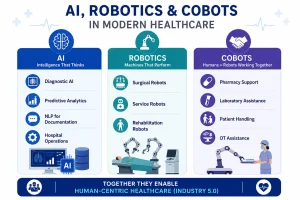










 ROI Calculator