Benefits of an AI Certification for HR Professionals
Key Insights
AI is already reshaping recruiting, learning, performance management and employee experience, and SHRM's 2026 research found that 39% of organisations had adopted AI in HR, with recruiting the most common use.
AI courses for HR professionals fall into six broad types, from short AI literacy certificates to people analytics programmes and strategic programmes for HR leaders.
The most useful skills combine AI literacy and prompting, people analytics, ethics and bias awareness, privacy and regulation, and change leadership.
Hiring and worker-management AI is classed as high-risk under the EU AI Act, with the main obligations applying from 2 December 2027, so responsible-AI knowledge matters even for India-based HR teams serving global employers.
The right course depends on your seniority and goal, so check the curriculum, how learning is assessed, how much governance and ethics it covers and what the certificate actually represents.
In this blog, you'll learn where AI is used in HR, the types of AI training for HR managers and teams, the skills to learn, a selection checklist, career scope and a 90-day starter plan.
A few years ago, HR conversations about AI were mostly about whether to try a chatbot. Today, HR teams are asked harder questions. Which AI screening tool is safe to use? How do we avoid bias in algorithmic decisions? How should roles change as AI takes over routine work? Answering these requires more than curiosity. It requires structured learning.
This guide explains where artificial intelligence in human resources is being used, the main types of AI courses for HR professionals, the skills worth learning and how to choose a programme that fits your career stage. It also covers responsible AI, regulation and a simple 90-day plan to get started.
AI adoption in HR is growing but uneven. According to SHRM’s State of AI in HR 2026, 62% of organisations use AI somewhere in the business, yet HR use is more concentrated: recruiting leads at 27%, followed by HR technology at 21% and learning and development at 17%. Among organisations using AI, 39% reported shifts in job responsibilities, 24% reported new roles and 57% saw more upskilling and reskilling.
The message for HR is two-fold. People teams will be asked to evaluate and govern AI tools, and they will manage the workforce changes AI creates. Professionals who understand both sides are better placed to lead. Our article on whether AI will replace HR or reinvent it explores that shift.
These are short, beginner-friendly programmes that explain what AI and generative AI can and cannot do, with hands-on practice using AI assistants. They suit HR executives and generalists who want a quick, practical start.
2. HR Analytics and People Analytics Programmes
These teach data handling, dashboards, predictive models and storytelling with workforce data. They suit HR professionals who want to move into analytics roles. See our guide to HR analytics and AI courses in India.
3. AI Programmes for HR Leaders
Aimed at senior professionals, these focus on strategy: redesigning HR processes, governing AI, managing the workforce impact and leading change. They rely on cases, simulations and discussion more than coding. This is the category that AI training for HR managers and heads of HR most often falls into.
4. Technical AI and Data Science Certificates
These cover Python, machine learning and model building. They suit people moving into HR technology or people science roles who need to understand how models work.
5. Tool-Specific Training
Many HRIS and applicant tracking vendors offer training on their AI features. These are useful for operations, but they teach one platform, not general principles.
6. Free and Self-Paced Courses
Open courses and webinars are a good way to test your interest, but they usually lack feedback, assessment and a recognised credential. Our guide to prompt engineering for business professionals is a useful free starting point.
Quick Comparison
Type
Best for
Coding needed?
Main output
AI literacy certificate
HR executives and generalists
No
Practical AI fluency
HR analytics programme
Analytics-minded HR professionals
Light to moderate
Data and dashboard skills
AI for HR leaders
Senior HR managers and heads
No
Strategy and governance judgement
Technical AI certificate
HR tech and people science roles
Yes
Model-building skills
Tool-specific training
HR operations teams
No
Platform proficiency
Free self-paced
Exploring the field
No
Awareness
Benefits of an AI Certification for HR Professionals
Confidence with tools: you can evaluate vendors and use AI safely instead of relying on demos.
Better decisions: you understand the limits of AI scores and predictions.
Credibility with leadership: you can discuss AI strategy with the CEO, CFO and CIO in their language.
Career mobility: AI-literate HR professionals can move into analytics, HR technology and transformation roles.
Stronger governance: you can set rules for fair, transparent and compliant AI use.
Future relevance: you can guide employees through reskilling rather than react to disruption.
A certificate alone does not guarantee a promotion or job change, but the skills behind it can improve your effectiveness and your options.
Skills to Learn from AI Courses for HR Managers and Teams
AI Literacy and Prompting
Understand how generative AI works, where it fails and how to write clear prompts for drafting policies, job descriptions and communications. Always verify outputs.
Data Literacy and People Analytics
Learn to read dashboards, question data quality, understand correlation and causation and present workforce insights simply.
AI in HR Processes
Know how AI is used in recruitment, learning, performance and workforce planning, and how to evaluate tools for fit, accuracy and explainability.
Ethics, Bias and Fairness
Learn how bias enters data and models, how to test for it and why human oversight is essential. Our overview of AI ethics is a helpful primer.
Privacy, Compliance and Regulation
Understand data protection principles, consent, retention and legal exposure. Our guide to HR compliance and legal issues covers the basics.
Change Management and Leadership
Guide teams through fear, resistance and new ways of working. This is often the hardest part of AI adoption, and it sits squarely with HR.
Human Skills That Matter More
Empathy, judgement, communication and ethical reasoning remain core HR strengths, and good programmes reinforce them instead of replacing them.
Responsible AI in HR: Bias, Privacy and Regulation
HR decisions affect people’s livelihoods, which is why regulators treat hiring AI carefully. Under the EU AI Act, AI used for recruitment, selection, promotion, termination and worker monitoring is classified as high-risk, with obligations such as risk assessment, bias testing, human oversight and transparency. Reports on the 2026 Digital Omnibus say the main high-risk obligations now apply from 2 December 2027, while the ban on emotion recognition in the workplace has applied since February 2025.
Even if you work only in India, this matters when you serve global employers or use vendors that operate internationally. India’s own data protection law, the Digital Personal Data Protection Act, 2023, also affects how personal data is handled, so check how it applies to your organisation. Our guide to ethical issues in HRM shows how these concerns arise in practice.
Good practice for any HR team using AI includes:
Keeping a human responsible for every significant decision about a person.
Asking vendors how their tools are tested for bias and how decisions are explained.
Telling candidates and employees when AI is used in decisions that affect them.
Limiting the personal data you feed into AI tools.
Documenting how tools are used and reviewed.
How to Choose the Right AI Course for HR
Use this checklist when comparing options. For general advice on evaluating AI programmes, read how to choose the best AI course.
Your goal: are you building AI fluency, moving into analytics or leading AI strategy? Choose the type that matches.
Your seniority: leadership programmes assume decision-making experience, while beginner courses assume none.
Curriculum depth: look for applied topics such as AI in recruitment, performance and workforce decisions, not only definitions.
Ethics and governance coverage: responsible AI should be a core module, not an afterthought.
Learning method: cases, simulations, workshops and a capstone beat passive videos.
Faculty and institution: check credentials and the reputation of the awarding body.
Assessment and certificate: find out what you must do to earn a completion certificate, and whether it differs from a participation certificate.
Time and format: make sure the schedule fits your work, including any campus sessions.
Cost versus outcomes: compare fees with what you will concretely learn and apply.
Honest claims: be cautious of programmes that promise jobs or promotions.
Your profile
Likely best fit
HR executive or recruiter
AI literacy or generative AI certificate
HR business partner
AI literacy plus people analytics
L&D or talent specialist
People analytics or AI in learning programmes
HR manager or senior manager
AI programme for HR leaders
HR head or CHRO aspirant
Strategic AI and transformation programme
Moving into HR tech
Technical AI or data science certificate
Career Scope After AI Training in HR
AI skills can open or strengthen roles such as people analytics specialist, HR technology lead, talent intelligence analyst, HR transformation manager and, at senior levels, CHRO. Salaries vary widely by organisation and experience, so treat any figure as a rough guide. To explore this path, read about the HR analytics career in India and our overview of strategic HRM in modern business.
A 90-Day Plan to Start Learning AI in HR
Days 1 to 30: Build fluency. Learn the basics of generative AI, try an AI assistant on low-risk tasks such as drafting job descriptions and summarising feedback, and always review the output.
Days 31 to 60: Learn the data and the risks. Study basic people analytics, read your organisation’s data and privacy policies and learn how to test AI tools for bias.
Days 61 to 90: Apply and decide. Pilot one small use case with a clear success measure, document what you learn and then choose a structured programme to deepen the skills that mattered most.
AI is changing HR from a function that administers processes to one that shapes how people and technology work together. The right AI course helps you move from curiosity to capability: understanding the tools, questioning their outputs, protecting employees and leading change. Match the course to your goal and seniority, favour applied learning and responsible AI, and be wary of promises that sound too good to be true.
If you are a senior HR professional, the Strategic Applied AI for HR Leaders programme from Educational Outreach, IIT Bombay is one option to consider. It is a five-month programme with live online sessions on Sundays and two mandatory campus immersions at IIT Bombay, with the first batch starting in February 2027. It is designed for HR leaders with strategic or managerial responsibility, with 10 years of experience preferred, and no coding background is required. The curriculum covers AI and the future of work, behavioural responses to AI, algorithmic management, competencies for the AI era, AI in HR processes, leadership and culture, and wellbeing and responsible AI, ending with a capstone. Participants who pass the assessment receive a Certificate of Completion, and others a Certificate of Participation, both from Educational Outreach, IIT Bombay. Please check the programme page for current fees, dates and eligibility, and compare it with the XLRI digital HR transformation programme before deciding.
Frequently Asked Questions
They are programmes that teach HR professionals how AI works, where it is used in HR, how to evaluate and govern AI tools and how to lead workforce change. They range from short literacy courses to strategic leadership programmes.
There is no single best option. Choose by your goal and seniority: AI literacy for beginners, analytics programmes for data-focused roles and strategic programmes for HR leaders. Check curriculum, assessment and the awarding institution.
Not for most. Many programmes for HR managers and leaders are designed for non-technical learners. Coding matters mainly for technical certificates and HR technology roles.
Typically AI in recruitment, talent and performance systems, workforce analytics, change management, ethics and bias, privacy and AI governance, often through cases and simulations.
Short certificates can take a few weeks, while programmes for leaders commonly run several months with weekly live sessions. Check the schedule against your workload.
It is the use of AI tools in HR work, such as screening candidates, answering employee questions, personalising learning, analysing workforce data and forecasting attrition, with human oversight.
AI is more likely to change HR tasks than to remove the function. Routine work is being automated, while judgement, empathy, ethics and change leadership become more important.
Yes. Free webinars, open courses and tool tutorials can build basic awareness. They usually do not provide assessment, feedback or a recognised certificate, so many professionals use them as a first step.
Prerna Singh
Talent Acquisition Manager - India
Prerna Singh is a results-driven Talent Acquisition Manager with expertise in end-to-end HR management. She has a strong background in recruitment, employee engagement, and HR operations across IT domains. Skilled in ATS/HRIS platforms and vendor management, she is passionate about building productive workplaces. She is committed to aligning talent strategies with business growth.
 HOME > BLOG > HR Management > AI Courses for HR Professionals: Types, Benefits, Skills to Learn and How to Choose the Right Programme
 October 14, 2026
 8 min read




 Key Insights
 ChatGPT
 Perplexity
 Claude
 Grok
Grok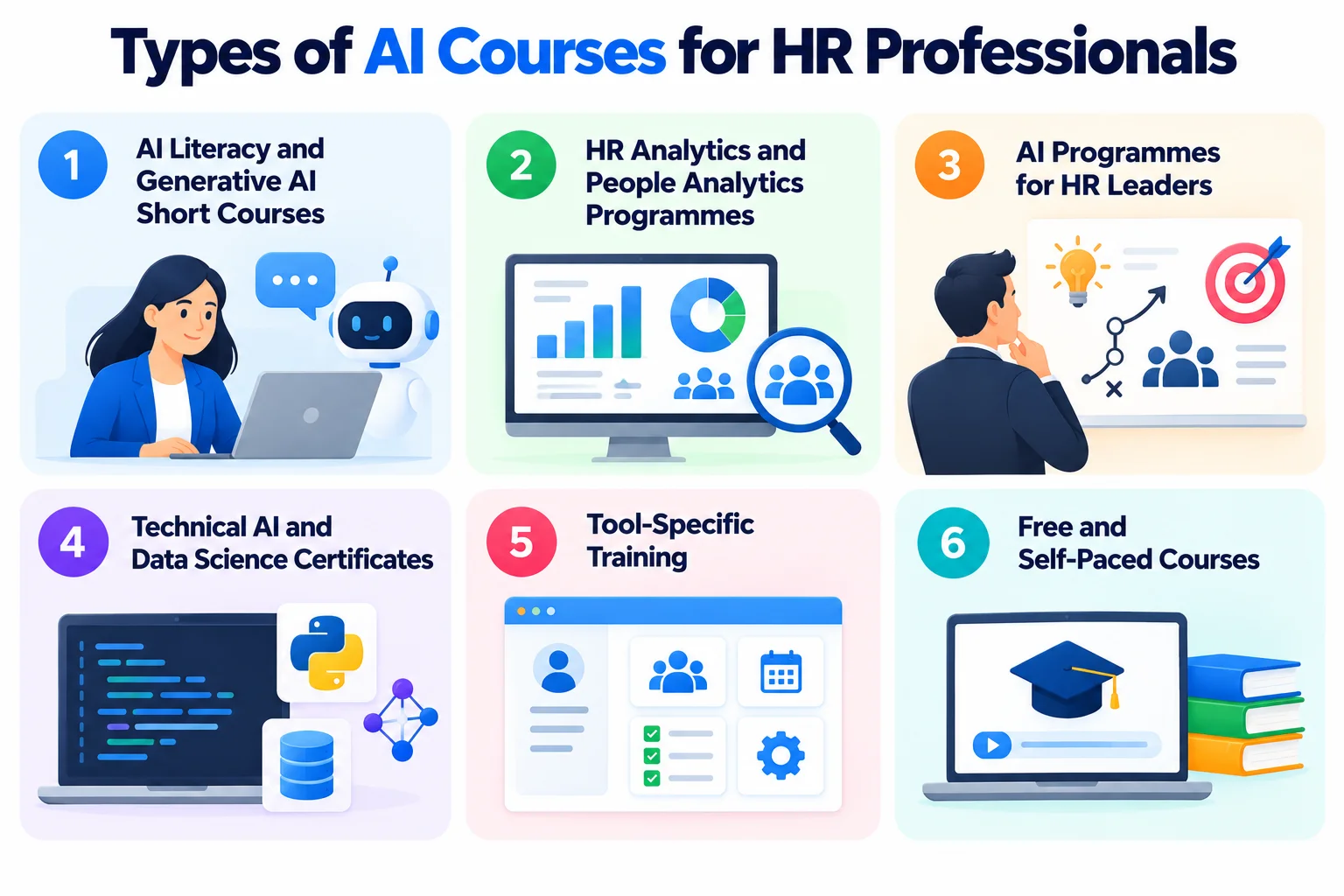










 ROI Calculator



