
Strategic Applied AI for HR Leaders
Educational Outreach, IIT Bombay

- Batch
01
- Duration
05 Months
- Commencement Date
05th February, 2027
(Academic Orientation &
Opening Campus Immersion) - Admission Closure Date
25th January, 2027
Overview
AI is reshaping how organisations work, decide and lead, but its most significant impact will be felt through people. For HR leaders, the imperative is not merely to adopt new technologies, but to guide organisations through the behavioural, ethical and strategic shifts they create.
The Strategic Applied AI for HR Leaders programme from Educational Outreach, IIT Bombay is a strategic, application-oriented programme for senior HR leaders. It is built for those who want to understand how AI is transforming HR processes, organisational architecture, workforce decisions and the future role of the HR function.
Through faculty-led learning, applied simulations and industry perspectives, participants develop the strategic judgement to lead responsible, human-centred AI transformation within their organisations. The programme is delivered as live online sessions with two campus immersions at IIT Bombay, and it is facilitated by Prof. Soumya Rajan of SJM School of Management, IIT Bombay.
Deloitte’s 2026 Global Human Capital Trends report found that 66% of C-suite leaders say functions like HR, finance and IT must fundamentally change because of AI, yet only 7% report making meaningful progress. This programme prepares HR leaders to lead that change from the centre of the organisation, not the sidelines.
Admission Criteria

Eligibility Criteria
- Preferred: Minimum 10 years of work experience
- Candidates with 8 to 9 years of experience may be considered selectively, based on:
1. Seniority of role
2. Scope of responsibility
3. Demonstrated exposure to strategic HR or organisational decisions
- Primary requirement: Strategic, managerial or decision-making responsibility within HR
- Technical background, coding knowledge and engineering/technology education: Not required
Who Should Attend?
- Senior HR managers and HR leaders
- HR Heads and functional HR leaders
- HR Business Partners
- Learning and Development Heads
- GCC HR leaders
- Talent, culture, performance and people-function leaders
- HR transformation and organisation-design professionals
- Senior professionals aspiring to CHRO roles
- HR leaders in startups and mid-sized organisations who may operate as de facto CHROs
Attendance:
- A minimum attendance of 80% is mandatory.
Assessment:
- Case Analysis 1: Weightage – 30%
- Case Analysis 2: Weightage – 30%
- Individual Strategic Recommendation: Weightage – 25%
- Online Knowledge Checks: Weightage – 15%
- Individual Capstone Project (Optional): Participants apply programme learning to an HR or organisational context. Outputs may include an AI-in-HR transformation roadmap, organisational readiness assessment, HR process redesign proposal, governance framework or strategic recommendation.
- Additional assessment factors include proctored quizzes and knowledge checks, short puzzles or application-based exercises, theme-based assignments and optional participant presentations.
- Capstone presentations at the closing campus immersion will not be considered for the assessment.
Key Insights
Mode of Engagement
- Live online sessions with 2 campus immersions, one at the beginning and one at the end of the programme
- Total learning of 55.5 hours (39 hours online and 16.5 hours campus immersion), across approximately 12 to 13 instructional sessions
Class Schedule
- Sundays: One 3-hour session, from 3:00 PM to 6:00 PM
- Weekly Commitment: 3 Hours
- Programme Duration: 5 Months
Campus Immersion (Mandatory)
- Opening Campus Immersion: 5th & 6th February 2027 (1½ Days). Programme orientation, foundational strategic frameworks, faculty interaction and cohort building. Participants arrive on campus on Friday in the second half of the day.
- Closing Campus Immersion & Valediction: 16th & 17th July 2027 (1½ Days). Capstone presentations, group case presentations, synthesis sessions, networking and valedictory activities.
- Both campus immersions are mandatory. Session recordings are provided only at the discretion of the faculty.
Programme Timeline
- End January (30th January 2027), Technical Orientation: Familiarise yourself with the learning platform, programme processes and virtual-session protocols.
- First Week of February (5th & 6th February 2027), Academic Orientation & First Campus Immersion: Meet faculty and cohort, and understand the academic framework, learning expectations, assessments and the strategic context of AI-enabled HR transformation.
- 14th February 2027, First Platform Class: Live online sessions begin on the Jaro platform.
- Third Week of February to Mid-May, Regular Online Academic Delivery: Core faculty-led sessions on AI and the future of work, behavioural responses, algorithmic management, human capabilities, AI in HR processes, leadership, culture, wellbeing and responsible AI integration.
- March to Mid-May, Applied Learning & Strategic Integration: Workshops, simulations, peer discussion and capstone-related work alongside academic sessions.
- May to June, Industry Masterclasses & Alternative Learning Engagements: Three industry masterclasses with senior practitioners, along with limited alternative sessions, peer exchanges, capstone guidance and synthesis activities.
- June to Early July, Capstone Submission & Assessment Preparation: Submit your individual strategic integration assignment or AI transformation roadmap, and prepare for final presentations.
- Mid-July (16th & 17th July 2027), Final Campus Immersion: Capstone presentations, academic synthesis, industry interaction, peer networking, valedictory and certificate distribution, subject to attendance and assessment requirements.
About IIT Bombay
Indian Institute of Technology Bombay (IIT Bombay) is a globally renowned institution of higher education and research. Established in 1958, IIT Bombay has consistently been at the forefront of innovation, academic rigour and intellectual leadership, producing world-class graduates who have made significant contributions to various fields.
With a diverse and distinguished faculty, cutting-edge research facilities and a vibrant academic environment, the institute fosters an ethos of creativity, critical thinking and entrepreneurship. Its commitment to academic excellence and deep engagement with industry and society have solidified its reputation as a leader in shaping the future of technology and education.
IIT Bombay Rankings
- #2 Rank Asian University Rankings, Southern Asia (Top Universities), 2026
- #3 Rank NIRF India Rankings, 2025 (Engineering Category)
- #19 Rank Pitchbook Top 100 Global Universities Ranked for Entrepreneurs, Sept 2025
- #129 Rank QS World University Rankings, 2025
About Educational Outreach, IIT Bombay
Educational Outreach (EO) at IIT Bombay is dedicated to meeting the knowledge enhancement and upskilling needs of professionals in industry, academia and government, empowering them to excel and adapt in a changing world. Participants also gain access to IIT Bombay’s cutting-edge research and resources across a wide range of domains.
EO has upskilled 35,000+ professionals, delivered 800+ programmes, covered 100+ learning disciplines, and partnered with 300+ corporate and government organisations, reflecting its continued commitment to lifelong learning and professional development.
Pedagogical Methodology
The programme adopts a senior-leader-oriented learning approach, combining:
Key Learning Outcomes
Student Privileges
Participants of the programme receive the following
Enrolment Process
- 1
Eligibility of Applicant
- 2
Application Submission
- 3
Screening & Shortlisting
- 4
Admission & Fee Payment
- 5
Book your Seat
Unleash the benefits that await you with Jaro Value adds.
%
higher employee retention rate
%
increase in employee productivity
%
businesses achieved measurable growth
Companies that already trust us!
















Course Structure
| Module | Course Name | Session(s) | Duration |
|---|---|---|---|
| Module 1 | AI, Organizations and the Future of Work | Session 1 | 3 Hours |
| Module 2 | Behavioural Responses to AI and Technological Change | Session 2 | 3 Hours |
| Module 3 | Algorithmic Management, Surveillance and Workplace Behaviour | Session 3 | 3 Hours |
| Module 4 | Competencies and Human Capabilities for the AI Era | Session 4 | 3 Hours |
| Module 5 | AI in HR Processes: Strategy, Talent Management, HR Decision Systems | Sessions 5, 6 and 7 | 9 Hours |
| Module 6 | Leadership, Culture and Organizational Transformation | Session 8 | 3 Hours |
| Module 7 | Stress Management, Wellbeing and Responsible AI Integration | Session 9 | 3 Hours |
| Module 8 | Strategic Integration Lab: Executive Capstone with Individual Assignments | Session 10 | 3 Hours |
| Module 9 | Evaluations: Group Capstone Projects and Individual Assignments | 3 Industry Mentor Led Masterclasses and Capstone Project | As scheduled |
| Learning Component | Hours |
|---|---|
| Online Sessions | 39 Hours |
| Campus Immersion | 16.5 Hours |
| Total Learning Hours | 55.5 Hours |
Curriculum
AI, Organizations and the Future of Work
- Foundations of Artificial Intelligence, Generative AI, Machine Learning and Automation
- AI as a socio-technical transformation affecting work systems, communication, managerial decision-making and organizational coordination
- Automation versus augmentation
- Evolution from digital transformation to AI-enabled organizational transformation
- Impact of AI on organizational structures, workflows and knowledge work
- Organization theory perspectives on technology and organizational adaptation
Workshops / Simulations: AI Familiarity Mapping Exercise | Guided experimentation with Generative AI tools for HR | Human vs Machine decision-mapping workshop | Task decomposition activity: automation vs augmentation | Organizational workflow redesign exercise
Behavioural Responses to AI and Technological Change
- Employee reactions to technological disruption, including fear, uncertainty, trust, resistance and adaptation
- Psychological responses to AI-enabled workplaces
- Identity disruption and the changing meaning of work
- Trust in algorithmic systems and AI-assisted decisions
- Psychological safety during digital transformation
- Self-determination theory, social exchange and sensemaking during change
Workshops / Simulations: Behavioural response diagnostic | Emotional journey mapping during AI transitions | Reflection exercise on technological disruption and workplace identity | Group discussion on trust and transparency in AI systems | Psychological safety assessment workshop
Algorithmic Management, Surveillance and Workplace Behaviour
- Algorithmic management and behavioural control systems
- Workplace surveillance and employee autonomy
- Technostress, digital fatigue and cognitive overload
- Hyperconnectivity and “always-on” organizational cultures
- Employee dignity, autonomy and fairness in AI-enabled workplaces
- Ethical and behavioural implications of monitoring systems
Workshops / Simulations: Roleplay simulation on employee resistance to AI-enabled monitoring | Technostress self-assessment exercise | Group debate on workplace surveillance and autonomy | Behavioural mapping workshop on digital overload | Organizational intervention design activity
Competencies and Human Capabilities for the AI Era
- Technical and behavioural competencies required in AI-enabled organizations
- AI literacy, prompting, analytics interpretation and AI-assisted decision-making
- Human capabilities that remain strategically important: empathy, creativity, ethical reasoning, systems thinking, resilience and adaptability
- Tacit knowledge and human judgment in AI-supported systems
- Reskilling, upskilling and workforce capability development
Workshops / Simulations: AI competency audit | Prompt engineering lab for HR leaders | Skills adjacency mapping workshop | Human vs AI judgment simulation | Designing future competency architectures exercise
AI in HR Processes: Strategy, Talent Management, HR Decision Systems
- AI-enabled recruitment, workforce analytics and performance management systems
- Predictive analytics and workforce intelligence
- AI-supported learning and development systems
- Human oversight in algorithmic HR decisions
- Bias, fairness and accountability in talent systems
- Strategic implications of AI-enabled HR systems
Workshops / Simulations: AI recruitment tool evaluation workshop | HR analytics dashboard interpretation exercise | AI-supported talent decision simulation | Debate: “Should AI decide promotions?” | Workshop on redesigning performance management systems
Leadership, Culture and Organizational Transformation
- Leadership during technological uncertainty and disruption
- Building adaptive and learning-oriented organizational cultures
- Human-centred AI transformation
- Organizational learning, adaptability and change management
- Resistance to technological transformation and organizational politics
- Communication and sensemaking during disruption
- Organizational theory perspectives on adaptive organizations and dynamic capabilities
Workshops / Simulations: AI transformation readiness assessment | Leadership reflection lab | Organizational culture mapping workshop | Scenario simulation: managing workforce anxiety during AI implementation | Designing transformation communication strategies
Stress Management, Wellbeing and Responsible AI Integration
- Neuroscience and physiology of stress, including cortisol, burnout, cognitive overload, fatigue and emotional exhaustion
- Technostress and digitally intensive work environments
- Stress contagion within teams and managerial behaviour under stress
- Psychological safety and emotional resilience
- Ethics, fairness, transparency, privacy and responsible AI governance
- Building humane and sustainable workplaces during AI transformation
Workshops / Simulations: Burnout risk assessment | Technostress diagnostic workshop | Reflection exercise on digital work and behavioural exhaustion | Ethical dilemma simulation | AI bias identification exercise | Responsible AI governance charter workshop
Strategic Integration Lab: Executive Capstone with Individual Assignments
- Integration of behavioural, technological, strategic and ethical dimensions of AI transformation
- Building future-ready HR systems and organizational capability frameworks
- Designing humane AI transformation roadmaps
- Long-term organizational adaptability and workforce transition planning
- Strategic role of HR leadership in AI-enabled organizations
Workshops / Simulations: AI-HR transformation roadmap development | Behavioural risk assessment workshop | Executive panel simulation | Peer consulting and feedback sessions | Presentation of organizational transformation blueprints
Evaluations
- Group capstone projects and individual assignments
- 3 Industry Mentor Led Masterclasses
- Capstone Project
Fee Details

- Easy EMI Options Available*

Application Fee
(Non-refundable)
(To be made part of the programme fee)
Programme Fee
INR 2,00,000 + GSTCertification
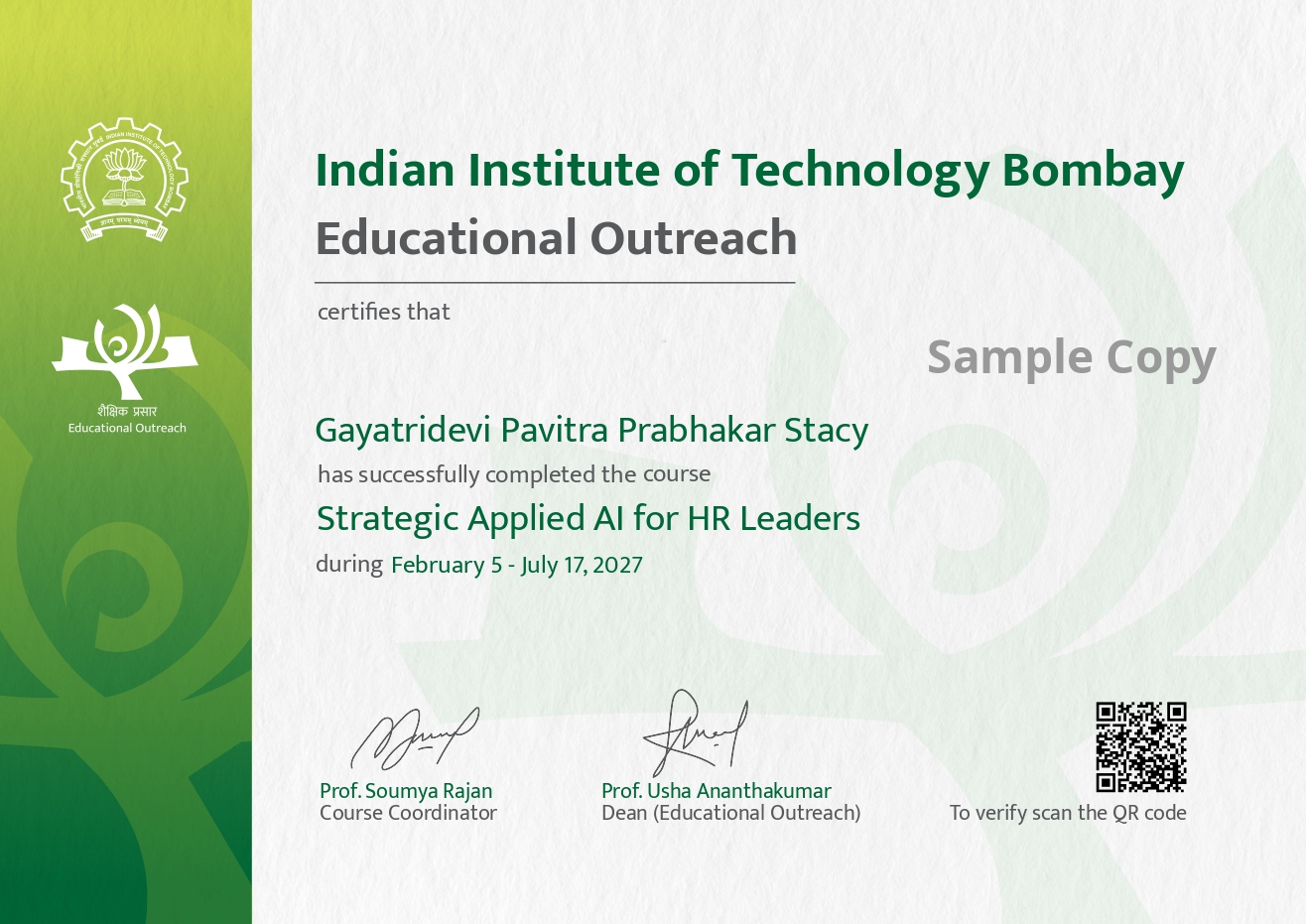
- A Certificate of Completion will be awarded to participants who pass the individual-level assessment/evaluation.
- Otherwise, a Certificate of Participation will be awarded.
- Both will be awarded by Educational Outreach, IIT Bombay.
Know the Facilitator

The Jaro Advantage
Personalized Learning Support
- Career Acceleration: Get unmatched career guidance, resume-building workshops, and 1:1 mentorship to fast-track your professional growth.
- 24/7 Student Support: Dedicated assistance at every step—from enrollment to graduation.
- Future-Ready Learning: Engage in immersive, industry-aligned programs designed for lifelong career relevance.

Expert-Led Doubt Resolution
- Learn from the Best: Access mentorship from top-tier faculty and industry leaders.
- Collaborative Learning: Join dynamic discussion forums and peer-to-peer networks for deeper insights.
- Real-World Problem Solving: Apply knowledge through case studies and interactive sessions.

Powerful Global Networking
- Elite Alumni Community: Connect with 350,000+ professionals worldwide for career opportunities and collaborations.
- Exclusive Events: Attend global webinars, networking meetups, and industry talks.
- Lifelong Access: Stay updated with cutting-edge trends and alumni benefits long after graduation.
Unlock Your Path to Success
Unsure about which course to choose? We understand—selecting the right programme can feel overwhelming. That’s why our intuitive Course Finder is here to help you discover the perfect match based on your skills, goals, and interests. Let us guide you toward your next career milestone with confidence.
Find My Ideal Course Find My Ideal Course

Refer & Earn – Amazing Rewards Await!
Share the gift of education—refer your friends and colleagues now! Earn fantastic rewards for every successful referral and empower others to advance their careers while you benefit.
Start Referring Today! Start Referring Today!Frequently Asked Questions
The programme follows a blended format, with live online sessions and two mandatory campus immersions at IIT Bombay on 5th & 6th February 2027 and 16th & 17th July 2027.
You will learn how AI is reshaping organisations and HR operating models, how employees respond to technological change, the implications of algorithmic management and surveillance, the competencies needed in an AI-enabled workplace, and how AI is influencing talent acquisition, performance management and HR decision systems. You will also learn how to lead culture change, support wellbeing and build responsible AI governance.
Yes. Participants who pass the individual-level assessment receive a Certificate of Completion. Otherwise, a Certificate of Participation is awarded. Both are issued by Educational Outreach, IIT Bombay.
Yes. The programme includes case analyses, workshops, simulations, peer consulting, three industry mentor-led masterclasses and an optional individual capstone focused on an AI-enabled HR transformation roadmap.
A minimum of 80% attendance is mandatory.