Human Resource Management Meaning: What Does HRM Actually Do?
Human Resource Development Meaning: What Does HRD Focus On?
Human Resource Management vs Human Resource Development: The Big Picture
Difference Between HRM and HRD: A Detailed Comparison
Key Insights
Human Resource Management (HRM) focuses on recruitment, payroll, employee relations, and compliance to ensure smooth and organized workplace operations.
Human Resource Development (HRD) emphasizes employee growth through training, mentoring, career planning, upskilling, and leadership development.
The key difference between HRM and HRD lies in their purpose and time frame. HRM manages present workforce needs, while HRD prepares employees for future responsibilities and career growth.
HRM promotes operational efficiency, fair treatment, and legal compliance, while HRD improves employee performance, motivation, adaptability, and leadership capabilities. Both functions work together to build a stronger workforce.
In this blog, you'll learn the meaning of HRM and HRD, their key differences, roles, benefits, real-life examples, how they complement each other, and the career paths available in both fields.
If you have ever worked in an office, you have probably heard people say, "Talk to HR." But HR is not just one thing. Behind that simple label sit two different ideas that often get mixed up: managing people and developing people. That is exactly where the debate of human resource management vs human resource development begins.
Both matter for a healthy workplace, but they solve different problems. One keeps the organization running smoothly today. The other prepares people and the business for tomorrow. In this blog, we will break down HRM vs HRD in plain language, look at the human resource management meaning and human resource development meaning, compare their roles, benefits, and examples, and help you understand how they work together.
Human Resource Management Meaning: What Does HRM Actually Do?
Let’s start with the basics. The human resource management meaning is simple: it is the process of hiring, managing, paying, and supporting employees so the organization can run efficiently and meet its goals. Think of HRM as the engine room of people operations.
HRM looks after the full employee journey on the administrative and operational side. That includes:
Recruitment and selection: Finding the right people and bringing them on board.
Onboarding: Helping new joiners settle in with paperwork, orientation, and introductions.
Payroll and benefits: Making sure everyone is paid correctly and on time, along with leave, insurance, and other perks.
Compliance: Following labour laws, safety rules, and company policies.
Employee relations: Handling conflicts, grievances, and workplace discipline.
Performance records: Tracking attendance, appraisals, and employee data.
In short, HRM is about managing the workforce as a vital resource. It is structured, policy-driven, and focused on keeping things fair, legal, and organized.
Human Resource Development Meaning: What Does HRD Focus On?
Now for the other half of the story. The human resource development meaning is quite different: it is the continuous process of helping employees grow their skills, knowledge, abilities, and careers so they can perform better now and in the future.
Where HRM asks, “How do we manage our people?”, HRD asks, “How do we help our people grow?” It treats employees as long-term assets who become more valuable with learning and support.
Typical HRD activities include:
Training programs: Technical, soft skills, and leadership workshops.
Career development: Mapping growth paths and promotion tracks.
Mentoring and coaching: Pairing people with experienced guides.
Learning and development (L&D): E-learning, certifications, and upskilling.
Succession planning: Preparing future leaders from within.
Organizational development: Improving culture, teamwork, and change readiness.
HRD is all about potential. It is forward-looking, people-centered, and built around learning.
Human Resource Management vs Human Resource Development: The Big Picture
Here is an easy way to remember the difference. Imagine a football club. The HRM side signs the players, handles contracts, pays salaries, and manages the rules. The HRD side runs training sessions, improves fitness, sharpens tactics, and grooms young talent into stars. A club needs both to win.
The same applies in a business. Without HRM, even talented people will face chaos in pay, policies, and processes. Without HRD, those same people may stop growing, lose motivation, and eventually leave. When you compare human resource management vs human resource development, you are really comparing stability with growth.
Difference Between HRM and HRD: A Detailed Comparison
Let’s look at the difference between HRM and HRD across the areas that matter most.
1. Purpose
HRM aims to manage employees effectively and keep the organization running smoothly. HRD aims to improve employee skills, performance, and career growth over time.
2. Focus
HRM focuses on the present: staffing, pay, compliance, and daily operations. HRD focuses on the future: learning, potential, and long-term development.
3. Nature of Work
HRM is largely administrative and policy-based, with clear rules and routines. HRD is more creative and developmental, designed around learning needs and goals.
4. Approach to Employees
In HRM, employees are seen as resources to be managed fairly and efficiently. In HRD, employees are seen as individuals with potential who can be nurtured.
5. Time Frame
HRM tasks are often ongoing and short-term, like monthly payroll or hiring cycles. HRD works across a longer horizon. Skill-building andleadership growth can take months or years to show results.
6. Key Activities
HRM covers recruitment, payroll, benefits, attendance, discipline, and legal compliance. HRD covers training, coaching, career planning, skill assessments, and leadership programs.
7. Outcome
HRM results in an organized, compliant, and well-staffed workplace. HRD results in a skilled, motivated, and adaptable workforce.
8. Quick Comparison Table
Aspect
HRM
HRD
Core idea
Managing people
Developing people
Focus
Present operations
Future growth
Nature
Administrative, policy-driven
Developmental, learning-driven
Key tasks
Hiring, payroll, compliance
Training, coaching, careers
Time frame
Short to medium term
Medium to long term
Result
Stability and order
Skills and potential
HRM vs HRD: Roles and Responsibilities
Because the work is different, the people doing it often have different job titles too.
Common HRM Roles
HR Manager: Oversees overall people strategy and policies.
Recruiter or Talent Acquisition Specialist: Finds and hires candidates.
Payroll and Benefits Executive: Handles salaries, taxes, and perks.
Employee Relations Officer: Manages workplace concerns and conflict resolution.
HR Compliance Officer: Ensures the company follows labor regulations.
Common HRD Roles
Learning and Development Manager: Designs and runs training programs.
Training Coordinator: Schedules and delivers workshops.
Career Development Specialist: Helps employees plan their growth.
Organizational Development Consultant: Improves culture and change management.
Leadership Development Lead: Builds the next generation of managers.
In small companies, one person might handle both sets of duties. In larger organizations, there are often separate teams for each.
Both functions bring real, measurable value. Here is what each contributes.
Benefits of HRM
Smooth operations: Clear policies and processes reduce confusion.
Legal protection: Compliance lowers the risk of fines and disputes.
Fair treatment: Consistent pay and rules build trust.
Right people in the right roles: Good hiring saves time and money.
Better employee relations: Problems are addressed before they grow.
Benefits of HRD
Higher performance: Skilled employees do better work.
Improved motivation and loyalty: People stay where they can grow.
Stronger leadership pipeline: Future managers come from within.
Adaptability: Teams learn new tools and handle change with confidence.
Competitive advantage: A learning culture helps businesses outpace rivals.
When you combine them, you get what every company wants: a workforce that is well managed and constantly improving.
HRM vs HRD Examples in Real Life
Theory is useful, but examples make it stick. Here are a few everyday scenarios.
Example 1: A growing startup. A fast-growing tech startup hires 30 new engineers. HRM handles job postings, interviews, offer letters, payroll setup, and onboarding. Six months later, HRD steps in with coding bootcamps, mentorship, and leadership workshops for senior engineers ready to lead teams.
Example 2: A retail chain. A retail brand uses HRM to schedule shifts, manage attendance, and process salaries for hundreds of store staff. Its HRD team runs customer service training and builds a path for sales associates to become store managers.
Example 3: A hospital. HRM ensures nurses and doctors are properly licensed, paid, and scheduled. HRD organizes ongoing medical training, emergency-response simulations, and leadership courses for senior staff.
Example 4: A manufacturing company. HRM manages safety compliance, contracts, and wages for factory workers. HRD introduces apprenticeships and upskilling programs so workers can move into technician and supervisor roles.
Notice the pattern. HRM sets up and maintains the system. HRD makes the people inside that system stronger.
It would be a mistake to see HRM vs HRD as a competition. They are partners, and each makes the other more effective.
For example, HRM data from performance reviews can show where employees struggle, which helps HRD design the right training. In turn, HRD programs can raise performance, which makes HRM tasks like appraisals and promotions smoother. Good hiring by HRM brings in people who are open to learning. Good development by HRD helps retain those people, reducing the cost of constant recruitment.
In modern organizations, the line between the two is blurring. Many companies now use the broader term “human capital management” or “people operations” to describe a combined approach where managing and developing people go hand in hand.
Which One Is More Important?
Honestly, neither wins on its own. A company with strong HRM but no HRD may run smoothly yet struggle to innovate, since employees stagnate. A company with great HRD but weak HRM may train people well but suffer from payroll errors, unclear policies, and legal trouble.
The smartest approach is balance. Build solid HRM foundations first, then layer HRD on top to unlock growth. Think of HRM as the roof and walls of a house, and HRD as the renovations that keep it modern and comfortable.
Career Paths: HRM or HRD?
If you are considering a career in HR, here is a quick guide. Choose HRM if you enjoy structure, processes, problem-solving, and working with policies and people data. Choose HRD if you love teaching, coaching, designing learning experiences, and watching people grow. Many professionals start in HRM and later move into HRD, or the other way around, because both build a deep understanding of how organizations work.
Final Thoughts
Understanding human resource management vs human resource development helps you see HR in a new light. HRM keeps the business stable, fair, and compliant. HRD keeps people learning, motivated and ready for what comes next. The difference between HRM and HRD is not about which is better. It is about timing and purpose: one manages today, the other builds tomorrow.
Whether you are an HR student, a manager, or someone planning a career, remember this simple line: HRM manages people; HRD grows people. Companies that get both right end up with happier teams and stronger results.
Frequently Asked Questions
The main difference is focus. HRM deals with managing employees through hiring, payroll, policies, and compliance, while HRD focuses on developing employees through training, coaching, and career growth.
In many organizations, yes. HRD is often treated as a sub-function of the wider HR department. However, it has its own goals and methods, which is why it is discussed separately in the HRM vs HRD debate.
It depends on your interests. HRM suits people who like organizing, policy, and operations, while HRD suits those who enjoy training and mentoring. Both offer strong growth, and with rising demand for upskilling, learning and development roles are becoming especially popular.
Because jobs and technology change quickly, companies need employees who can keep learning. HRD helps organizations upskill their teams, retain talent, and stay competitive, especially as trends like AI, remote work, and skill-based hiring reshape the workplace.
Prerna Singh
Talent Acquisition Manager - India
Prerna Singh is a results-driven Talent Acquisition Manager with expertise in end-to-end HR management. She has a strong background in recruitment, employee engagement, and HR operations across IT domains. Skilled in ATS/HRIS platforms and vendor management, she is passionate about building productive workplaces. She is committed to aligning talent strategies with business growth.
Get Free Upskilling Guidance
Fill in the details for a free consultation
Related Courses
Explore our programs
Post Graduate Certificate Programme in Strategic Human Resource Management with AI & Analytics
 HOME > BLOG > HR Management > Human Resource Management vs Human Resource Development: Key Differences, Roles, Benefits & Examples
 October 13, 2026
 7 min read




 Key Insights
 ChatGPT
 Perplexity
 Claude
 Grok
Grok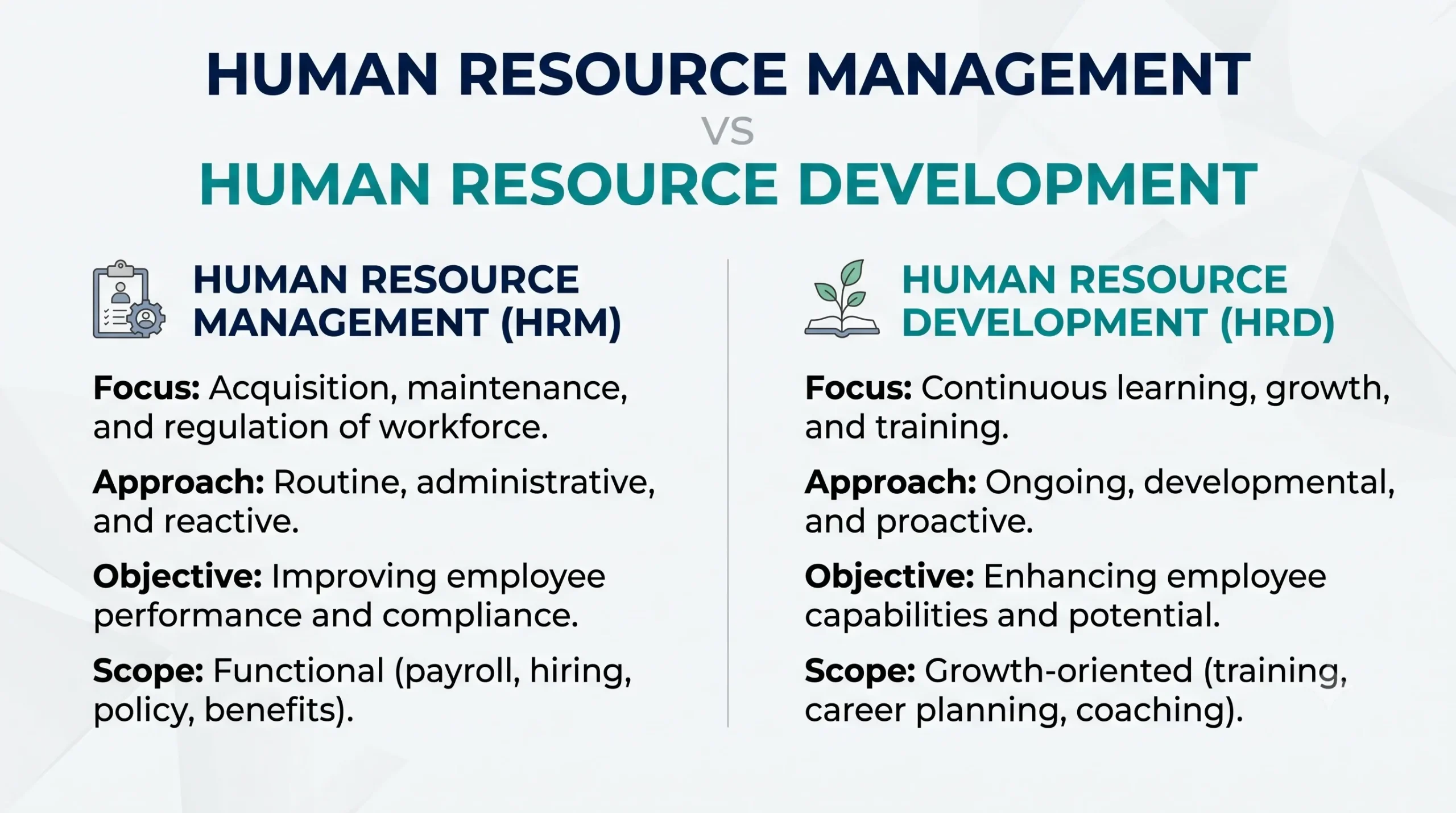









 ROI Calculator



