Why Agentic AI Is Becoming the Biggest AI Trend in 2026
Agentic AI vs Generative AI
How Agentic AI Is Transforming Businesses
Artificial Intelligence has evolved rapidly over the past few years. What started as automation tools and predictive analytics systems quickly progressed into Generative AI platforms capable of creating text, images, videos, code, and business content. However, in 2026, the conversation has shifted toward a new frontier: Agentic AI.
Unlike traditional AI systems that wait for instructions or Generative AI tools that create outputs based on prompts, Agentic AI systems can independently plan tasks, make decisions, execute actions, and continuously work toward achieving specific objectives.
This capability is attracting significant attention from businesses across India and globally. Organisations are exploring how AI agents can improve productivity, automate complex workflows, support decision-making, and enhance customer experiences.
For business professionals, managers, MBA aspirants, and technology leaders, understanding Agentic AI is becoming increasingly important. As companies integrate AI agents into daily operations, professionals who understand both business strategy and AI technologies will be better positioned to lead the next wave of digital transformation.
In this article, we explore what Agentic AI is, why it is emerging as one of the biggest technology trends of 2026, and how it is transforming businesses across industries.
Agentic AI refers to artificial intelligence systems that can autonomously perform tasks, make decisions, and pursue goals with minimal human intervention.
Unlike traditional software that follows predefined instructions, Agentic AI systems can:
Understand objectives
Break tasks into smaller actions
Gather information
Make decisions
Execute workflows
Adapt based on outcomes
In simple terms, Agentic AI acts more like a digital assistant that can independently complete tasks rather than merely responding to commands.
Traditional AI vs Generative AI vs Agentic AI
To understand Agentic AI, it is helpful to compare it with earlier generations of AI technology.
Traditional AI
Traditional AI systems are designed to analyse data and generate predictions.
Examples include:
Recommendation engines
Fraud detection systems
Predictive analytics tools
These systems typically require predefined workflows and human oversight.
Generative AI
Generative AI introduced the ability to create content.
Examples include:
Text generation
Image creation
Video generation
Code generation
Popular AI tools can answer questions, draft content, and assist with problem-solving.
Agentic AI
Agentic AI goes a step further.
Instead of simply generating content, it can:
Plan actions
Execute tasks
Coordinate multiple systems
Make contextual decisions
Work toward predefined goals
A Simple Example
Imagine a manager needs a monthly business performance report.
Generative AI
You ask:
“Create a report using this data.”
The AI generates the report.
Agentic AI
You ask:
“Prepare and share the monthly performance report.”
Technology firms and consulting organisations are among the earliest adopters of Agentic AI, using it to enhance productivity, automate workflows, and deliver more efficient client services.
What Agentic AI Means for Business Professionals
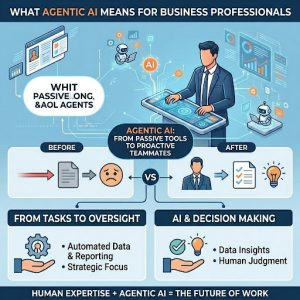
One of the biggest misconceptions surrounding Agentic AI is that it will replace business professionals. In reality, the technology is more likely to transform how professionals work rather than eliminate the need for human expertise.
As organisations adopt AI agents, the role of professionals will evolve from performing repetitive tasks to managing outcomes, making strategic decisions, and overseeing AI-driven processes.
From Task Execution to Strategic Oversight
Traditionally, managers spent significant time on:
Data collection
Reporting
Workflow monitoring
Administrative coordination
Agentic AI can automate many of these activities, allowing professionals to focus on:
Strategic planning
Leadership
Innovation
Stakeholder management
Business growth
AI Literacy Will Become Essential
Just as digital literacy became a core business skill over the last two decades, AI literacy is becoming a necessity.
Future business leaders will need to understand:
AI capabilities
AI limitations
AI governance
Risk management
Ethical AI usage
Professionals who can effectively collaborate with AI systems will be better positioned for leadership roles.
Decision-Making Will Become More Data-Driven
Agentic AI can analyse large volumes of information and provide recommendations in real time.
However, organisations will still rely on human judgment to:
Evaluate risks
Consider broader business implications
Manage uncertainty
Make final strategic decisions
The future belongs to professionals who can combine AI-powered insights with business expertise.
Emerging Career Opportunities in the Agentic AI Era
As Agentic AI adoption grows, new career opportunities are emerging across industries.
AI Product Manager
AI Product Managers help organisations develop and launch AI-powered products and services.
Organisations need leaders who can align AI initiatives with strategic objectives.
AI Governance and Responsible AI
As regulations evolve, professionals will need to understand:
AI ethics
Governance frameworks
Compliance requirements
Risk management practices
Which Courses Can Prepare You for Agentic AI?
The rise of Agentic AI is increasing demand for structured learning programs that help professionals understand both the technical and business dimensions of artificial intelligence.
The most valuable learning pathways typically include:
Generative AI
Understanding how AI creates content and interacts with users.
Machine Learning
Learning how AI systems identify patterns, generate predictions, and improve performance.
Business Applications of AI
Exploring how AI can be used to solve real-world business challenges.
AI Strategy and Transformation
Developing the ability to lead AI initiatives within organisations.
For professionals seeking to build future-ready skills, programs that combine Generative AI, Machine Learning, and practical business applications are particularly valuable.
Program Spotlight: Advanced Generative AI & Machine Learning by IITM Pravartak
As Agentic AI becomes more mainstream, professionals need a strong foundation in both Generative AI and Machine Learning.
The Advanced Generative AI & Machine Learning programme by IITM Pravartak is designed to help learners understand the technologies driving the next generation of AI systems.
Why This Program Matters
Agentic AI is built on advancements in:
Large Language Models
Machine Learning
AI Decision-Making Systems
Intelligent Automation
Understanding these technologies can help professionals remain relevant in an increasingly AI-driven workplace.
Key Learning Areas
The programme helps participants build expertise in:
Generative AI Concepts
Machine Learning Applications
AI Tools and Technologies
Data-Driven Decision Making
Real-World AI Use Cases
Who Should Consider This Program?
The programme is suitable for:
Working Professionals
MBA Aspirants
Business Managers
Technology Professionals
Data Enthusiasts
Digital Transformation Leaders
Career Benefits
Participants can strengthen their readiness for emerging opportunities in:
AI Strategy
Business Analytics
Product Management
Digital Transformation
AI-Powered Leadership Roles
Why Professionals Should Start Learning AI Now
The adoption of Agentic AI is expected to accelerate significantly over the next few years.
Professionals who start building AI capabilities today can gain several advantages:
Competitive Differentiation
AI literacy is becoming a highly valued skill across industries.
Better Career Opportunities
Employers increasingly seek professionals who understand how to leverage AI for business outcomes.
Stronger Leadership Potential
Future leaders will need to manage teams that include both human talent and AI systems.
Long-Term Career Resilience
As technology continues to evolve, professionals who continuously learn and adapt are more likely to thrive.
The goal is not to compete with AI but to learn how to work alongside it effectively
Final Thoughts
Agentic AI represents the next major evolution in artificial intelligence. Unlike traditional AI systems or Generative AI tools that primarily respond to user requests, Agentic AI can independently plan, execute, and optimise workflows to achieve business objectives.
For organisations, this promises significant improvements in productivity, efficiency, and decision-making. For professionals, it signals the beginning of a new era where AI literacy, strategic thinking, and technology awareness become essential career skills.
The rise of Agentic AI is not just a technology story—it is a business transformation story. Managers, consultants, analysts, and business leaders who understand how AI systems operate will be better positioned to lead organisations through this change.
Investing in AI education today can help professionals stay relevant, unlock new career opportunities, and build the capabilities needed to thrive in an increasingly AI-powered future.
Frequently Asked Questions
Agentic AI refers to artificial intelligence systems that can perform tasks independently and collaborate with other AI tools. This type of AI is expected to play a significant role in automating processes within organizations.
Generative AI focuses on creating content such as text, images, and code, while Agentic AI focuses on achieving outcomes by planning and executing tasks autonomously.
Agentic AI is expected to transform many job roles, but it is more likely to augment human capabilities rather than completely replace professionals. New career opportunities are also emerging as organisations adopt AI technologies.
Industries such as banking, financial services, healthcare, retail, manufacturing, technology, and consulting are among the early adopters of Agentic AI solutions.
Important skills include AI fundamentals, machine learning awareness, data literacy, business strategy, prompt engineering, and AI governance knowledge.
Programs covering Generative AI, Machine Learning, intelligent automation, and business applications of AI can provide a strong foundation for understanding Agentic AI.
Yes. MBA professionals increasingly need to understand AI technologies because they influence business strategy, operations, decision-making, and leadership responsibilities.
Dr. Sanjay Kulkarni
Data & AI Transformation Leader
Dr. Sanjay Kulkarni is a Data & AI Transformation Leader with over 25 years of industry experience. He helps organizations adopt data-driven and responsible AI practices through strategic guidance and education. With experience across startups and global enterprises, he bridges the gap between theory and real-world application. His work empowers teams to innovate and thrive in AI-driven environments.
Get Free Upskilling Guidance
Fill in the details for a free consultation
Related Courses
Explore our programs
Admission Open
Advanced Certificate Programme in Machine Learning, Gen AI & LLMs for Business Applications
 HOME > BLOG > AI and Machine Learning > Agentic AI in India 2026: What It Means for Business Professionals and Which Courses Prepare You
 June 26, 2026
 8 min read





 ChatGPT
 Perplexity
 Claude
 Grok
Grok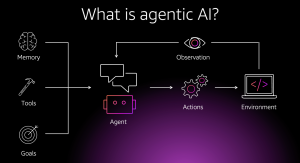




 Admission Open
 Admission Closed
 Admission Open
 Admission Open
 ROI Calculator