
What is Price Elasticity of Demand? Formula & Types
 November 14, 2026
 9 min read





Table Of Content
- What Is Price Elasticity of Demand?
- Economics Supply Demand: Where Elasticity Fits
- Demand Elasticity Formula
- Types of Price Elasticity of Demand
 Key Insights
- Price elasticity of demand measures how sensitive consumers are to changes in a product's price and helps businesses understand how pricing affects sales and revenue.
- The demand elasticity formula compares the percentage change in quantity demanded with the percentage change in price. The midpoint method provides a more consistent calculation when prices and quantities change.
- The five types of price elasticity of demand are perfectly elastic, elastic, unit elastic, inelastic and perfectly inelastic, each representing a different level of consumer sensitivity to price changes.
- Factors such as product substitutes, necessity versus luxury, share of income, time horizon and brand loyalty influence how consumers respond to price changes.
- In this blog, you'll learn what price elasticity of demand means, its formula and calculation methods, the five types, factors affecting elasticity, its relationship with total revenue and its real-world applications in business and policymaking.
Every business owner asks the same question before changing a price: how will customers react? If a coffee shop raises the price of a latte by 10%, will people keep buying it, or will they walk to the cafe next door? Economists answer this question with a concept called price elasticity of demand. It measures how sensitive buyers are to a change in price, and it helps companies, governments, and students make better decisions. In this blog, we explain the idea in simple, formal language, walk through the demand elasticity formula with examples, and cover each of the main types of price elasticity of demand.
 ChatGPT
 Perplexity
 Claude
 Grok
What Is Price Elasticity of Demand?
Price elasticity of demand (often written as PED or E_d) measures the percentage change in the quantity demanded of a good when its price changes by 1%. In plain words, it tells us how strongly buyers respond when the price moves up or down.
The law of demand tells us that when the price of a product rises, people usually buy less of it. Elasticity goes one step further. It tells us how much less. Some products see a small drop in sales after a price increase, while others see sales fall sharply.
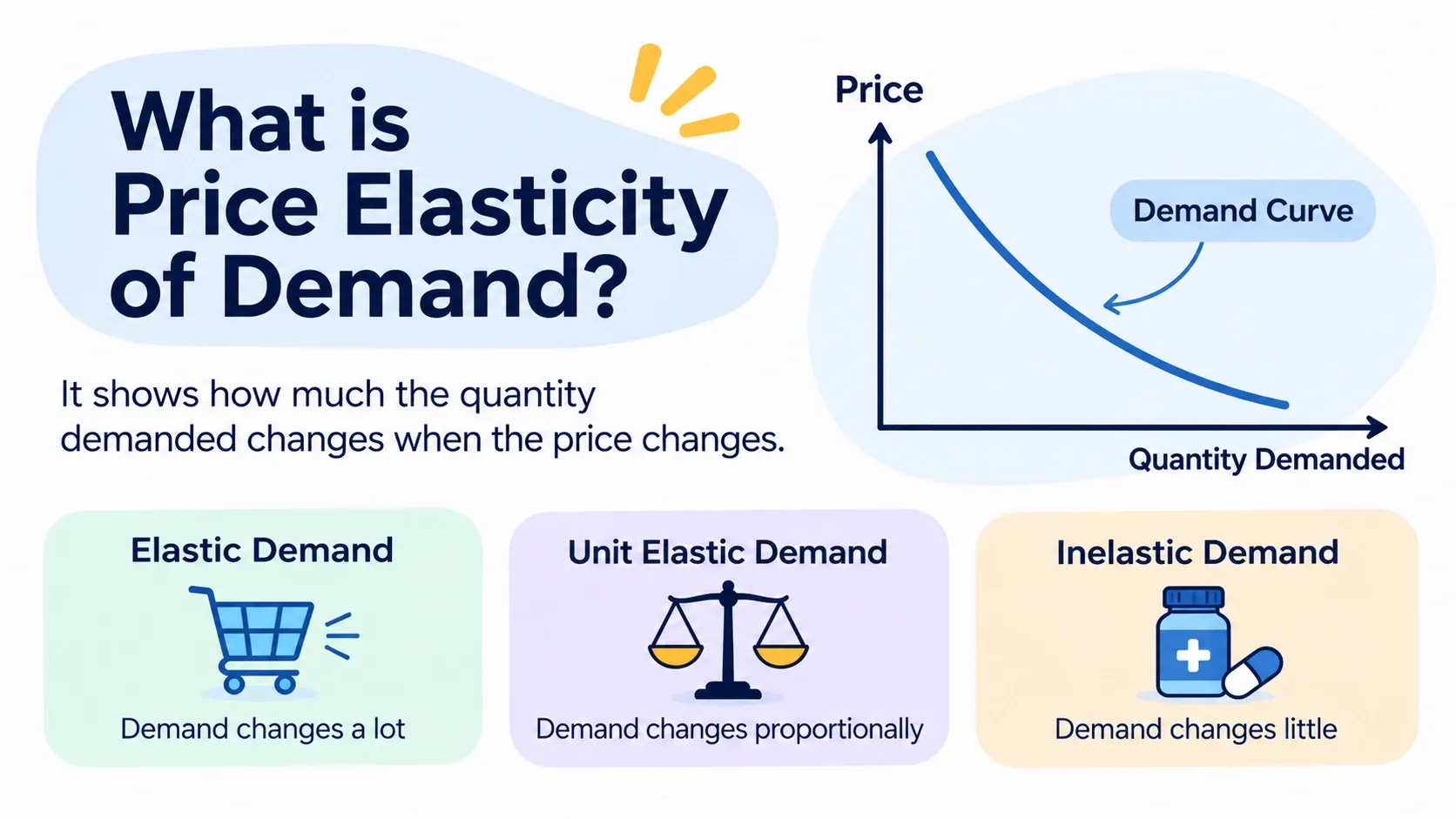
Consider two examples. If the price of salt doubles, most households will still buy about the same amount, because salt is cheap and has no real substitute. If the price of one brand of cola rises by 20%, many shoppers will switch to another brand or simply buy something else. Salt has low price elasticity of demand, and the cola has high price elasticity of demand.
Understanding this difference helps a business decide whether a price change will raise or lower its total revenue.
Economics Supply Demand: Where Elasticity Fits
To see why elasticity matters, we need a quick refresher on economics supply demand. A market has two sides. Buyers form the demand side, and their willingness to purchase falls as prices rise. Sellers form the supply side, and their willingness to produce rises as prices rise. The point where the two meet is the market equilibrium, which sets the price and the quantity traded.
The demand curve shows the relationship between price and quantity demanded. Its slope gives a rough idea of how buyers react, but slope alone can be misleading because it depends on the units we use. Elasticity solves this problem. Because it is expressed in percentage terms, it is a unit-free measure that can be compared across products, whether we are talking about dollars per gallon of gas or dollars per smartphone.
Elasticity also helps us predict what happens when something shifts the market. If a tax raises the price of a good, the quantity sold will fall by a larger or smaller amount depending on how elastic demand is. That is why elasticity is central to pricing strategy, tax policy, and market analysis.
Demand Elasticity Formula
The basic demand elasticity formula compares two percentage changes:
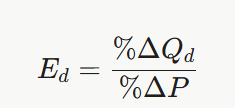
Here, %ΔQ_d is the percentage change in quantity demanded, and %ΔP is the percentage change in price. Each percentage change is calculated as the change in the value divided by the original value.
Because price and quantity move in opposite directions, the result is normally negative. Most economists ignore the sign and use the absolute value, which keeps the comparison simple.
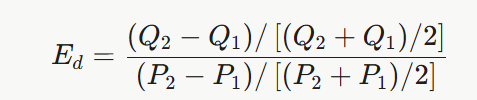
The Midpoint Method
The simple percentage method has one flaw: the answer changes depending on whether you calculate an increase or a decrease. To avoid this, many textbooks use the midpoint (or arc) method, which uses the average of the starting and ending values as the base:
Worked Example 1: Unit Elastic Demand
Suppose a bookstore raises the price of a notebook from $10 to $12, and weekly sales fall from 100 to 80 units.
- Percentage change in price = (12 − 10) ÷ 10 = 20%
- Percentage change in quantity = (80 − 100) ÷ 100 = −20%
- Elasticity = 20% ÷ 20% = 1 (in absolute value)
The elasticity is exactly 1, so demand is unit elastic in this range.
Worked Example 2: Elastic Demand
A streaming service cuts its monthly price from $50 to $45 for a premium bundle, and subscribers rise from 200 to 260.
- Percentage change in price = (45 − 50) ÷ 50 = −10%
- Percentage change in quantity = (260 − 200) ÷ 200 = 30%
- Elasticity = 30% ÷ 10% = 3
With an elasticity of 3, demand is elastic. A small price cut produced a much larger jump in sales.
Types of Price Elasticity of Demand
There are five main types of price elasticity of demand. Each is defined by the value of the elasticity coefficient.
| Type | Elasticity value | What it means | Typical example |
| Perfectly elastic | Infinity | Any price rise drops demand to zero | Wheat sold by one farmer in a competitive market |
| Elastic | Greater than 1 | Quantity changes by a larger percentage than price | Restaurant meals, branded clothing |
| Unit elastic | Equal to 1 | Quantity changes by the same percentage as price | Some mid-priced consumer goods |
| Inelastic | Between 0 and 1 | Quantity changes by a smaller percentage than price | Gasoline, groceries, electricity |
| Perfectly inelastic | 0 | Quantity does not change at all with price | Life-saving medicine with no substitute |
1. Perfectly Elastic Demand
With perfectly elastic demand, the elasticity is infinite. Buyers will purchase any amount at one specific price, but they will stop buying completely if the price rises even slightly. The demand curve is a flat, horizontal line.
2. Elastic Demand
Demand is elastic when the elasticity is greater than 1. Buyers are quite sensitive to price, so a small price change causes a larger percentage change in quantity. This is common for luxury items and for products with many close substitutes.
3. Unit Elastic Demand
Demand is unit elastic when the elasticity equals exactly 1. The percentage change in quantity matches the percentage change in price, so total revenue stays the same when the price changes. It is mostly a theoretical benchmark, though real markets can pass through this point.
4. Inelastic Demand
Demand is inelastic when the elasticity is between 0 and 1. Buyers do not react strongly to price changes. Necessities, addictive products, and goods with few substitutes usually fall in this group.
5. Perfectly Inelastic Demand
Here the elasticity is 0. The quantity demanded stays fixed no matter what the price is, and the demand curve is a vertical line. Real examples are rare, but essential medicines, such as insulin for a patient who depends on it, come close.
Perfectly Elastic Demand in Detail
Perfectly elastic demand is the most extreme case on the sensitive end of the scale. The curve is horizontal at a single price. If the seller charges even one cent more, the quantity demanded falls to zero. If the seller charges less, there is no reason to do so, because buyers are already willing to purchase everything the seller can supply at the going price.
This situation appears in perfectly competitive markets. Imagine a wheat farmer selling to a large commodity market. Thousands of other farmers sell identical wheat at the market price. The individual farmer is a price taker, and any attempt to charge more would send buyers elsewhere instantly. For the farmer, demand is perfectly elastic, even though the market as a whole has a normal downward-sloping demand curve.
It is important to remember that perfectly elastic demand is a theoretical model. Real markets rarely match it exactly, but some come close, especially for identical products that are easy to compare and switch between, such as agricultural commodities or certain online goods.
Factors That Affect Price Elasticity of Demand
Several factors decide whether demand for a product is elastic or inelastic.
- Availability of substitutes. The more alternatives that exist, the more elastic the demand. If one airline raises fares, travelers can switch to another carrier or choose a different route.
- Necessity versus luxury. Necessities such as basic food, utilities, and medicine tend to have inelastic demand. Luxuries such as designer handbags or vacations tend to have elastic demand.
- Share of income. When a product takes a large portion of a household’s budget, such as rent or a car, buyers watch price changes closely. Items that cost very little, such as matches, attract little attention.
- Time horizon. Demand is usually more inelastic in the short run. When gasoline prices rise, most people still drive the same distance this month, but over several years they may buy fuel-efficient cars or move closer to work.
- How the market is defined. Demand for “food” is inelastic, but demand for a specific brand of cereal is far more elastic because rivals offer similar products.
- Habit and brand loyalty. Strong loyalty or habit, as with coffee or tobacco, reduces sensitivity to price.
These factors rarely work alone. A good can be a necessity yet have many substitutes, which pushes elasticity in two directions. Analysts therefore look at the whole situation before drawing conclusions.
Price Elasticity of Demand and Total Revenue
One of the most practical uses of price elasticity of demand is predicting what a price change does to a firm’s total revenue, which equals price multiplied by quantity sold.
- If demand is elastic (greater than 1): a price decrease raises total revenue, and a price increase lowers it. The gain in quantity outweighs the lower price.
- If demand is inelastic (less than 1): a price increase raises total revenue, and a price decrease lowers it. Buyers stay loyal, so the higher price brings in more money.
- If demand is unit elastic (equal to 1): total revenue stays the same when the price changes.
This explains why a movie theater may offer discounted tickets on slow weekdays, since lower prices bring in many more viewers, while a utility company can raise rates with little fall in usage. It also explains why governments often tax products with inelastic demand, such as fuel and tobacco, since the tax raises revenue without drastically cutting purchases.
Real-World Uses of Price Elasticity of Demand
Elasticity is not only a classroom topic. It supports many real decisions:
- Pricing strategy. Retailers use it to decide when to run sales and when to hold prices steady.
- Taxation. Policymakers estimate how a new tax will affect consumption and government revenue.
- Forecasting. Companies predict demand under different pricing scenarios before launching a product.
- Public policy. Health agencies use elasticity to study how higher prices on sugary drinks or cigarettes may reduce consumption.
- Business planning. Managers compare elasticity across products to decide where to invest and where to cut.
Like any model, elasticity has limits. It assumes other factors, such as income, tastes, and competitor prices, stay constant. In reality, these also change, so estimates work best as guides rather than exact predictions.
Conclusion
Price elasticity of demand explains how strongly buyers respond when prices change. By using the demand elasticity formula, we can measure that response and classify demand as perfectly elastic, elastic, unit elastic, inelastic, or perfectly inelastic. These ideas sit at the center of economics supply demand, and they guide everything from a shop owner’s discount to a government’s tax policy. Once you understand the formula, the types, and the factors behind them, you can read market behavior with far more confidence.
Frequently Asked Questions
The formula is the percentage change in quantity demanded divided by the percentage change in price. For a more accurate result over larger changes, economists use the midpoint method, which calculates each percentage change using the average of the starting and ending values.
The law of demand says that price and quantity demanded move in opposite directions. When the price rises, the quantity demanded falls, which produces a negative number. Most economists report the absolute value to make comparisons easier.
A wheat farmer in a perfectly competitive market is the classic example. Because many farmers sell identical wheat at the market price, any attempt to charge even slightly more would cause buyers to purchase from someone else, so the farmer’s demand falls to zero.
It is neither good nor bad by itself, but it shapes strategy. When demand is elastic, lowering prices can increase total revenue, while raising prices can hurt sales. Businesses facing elastic demand often compete on price, promotions, or product differences that make their offer stand out.

Related Courses
Explore our programs







Find a Program made just for YOU
We'll help you find the right fit for your solution. Let's get you connected with the perfect solution.

Is Your Upskilling Effort worth it?
 ROI Calculator


Are Your Skills Meeting Job Demands?
Try our Skill Gap tool
Experience Lifelong Learning and Connect with Like-minded Professionals
Explore Jaro Connect
