
What is a Global Capability Centre? Complete Guide
 November 11, 2026
 7 min read





Table Of Content
- What Is a Global Capability Centre? Understanding What Is GCC
- How GCCs Have Evolved Over Time
- The GCC Role in a Modern Enterprise
- Types of GCCs
 Key Insights
- A Global Capability Centre (GCC) is a company-owned offshore or nearshore unit that delivers services, develops products, and supports the parent company's global operations.
- GCCs have evolved from cost-saving support units into strategic hubs that drive technology development, research, product innovation, and digital transformation.
- GCCs perform several functions, including technology and engineering, finance, HR, data analytics, artificial intelligence, cybersecurity, and customer experience.
- Global capability centres in India benefit from a skilled talent pool, strong technology ecosystem, cost-efficient operations, and supportive government policies. They also create employment opportunities and contribute to economic growth.
- In this blog, you'll learn what a Global Capability Centre is, its evolution, types, key roles, benefits, major sectors, setup process, growth in India, and future trends.
Over the past two decades, many multinational companies have changed how they organize work across borders. Instead of treating overseas offices as simple back-office units, they now build dedicated hubs that drive innovation, technology, and strategy. These hubs are known as Global Capability Centres. If you have ever wondered what a GCC is and why it features so often in business news and job listings, this guide explains it in simple terms. We cover the definition, evolution, services, benefits, and the growing importance of global capability centres in India.
 ChatGPT
 Perplexity
 Claude
 Grok
What Is a Global Capability Centre? Understanding What Is GCC
A global capability centre is an offshore or nearshore unit set up by a multinational corporation to deliver services, build products, and support business operations for the parent company. Unlike a traditional outsourcing arrangement, the company owns and operates the centre itself. The employees work directly for the organization, follow its culture, and contribute to its long-term goals.
So, what is GCC in practical terms? It is an in-house extension of a company, located in a country that offers strong talent, cost advantages, and a supportive business environment. A bank headquartered in the United States, for example, may run a GCC in India that handles technology development, data analytics, risk management, and customer experience design for its worldwide operations.
You may also hear these units called Global In-house Centres (GICs), captive centres, or offshore development centres. The terminology varies, but the idea remains the same: a company-owned center that serves the global organization.
How GCCs Have Evolved Over Time
The journey of GCCs can be understood in three broad stages.
The cost-saving phase. In the 1990s and early 2000s, companies set up captive units mainly to reduce costs. These centres handled routine tasks such as data entry, payroll processing, IT support, and customer service. The goal was efficiency and savings.
The capability-building phase. As the units matured, companies began assigning more complex work. Software development, quality assurance, financial analysis, and engineering support moved to these centres. The focus shifted from cost to quality and scale.
The value-creation phase. Today, many GCCs act as strategic partners. They lead product development, run research and development, and shape digital transformation. This is why the word “capability” has replaced the older focus on “support.” A modern global capability centre is expected to create value, not just reduce expenses.




The GCC Role in a Modern Enterprise
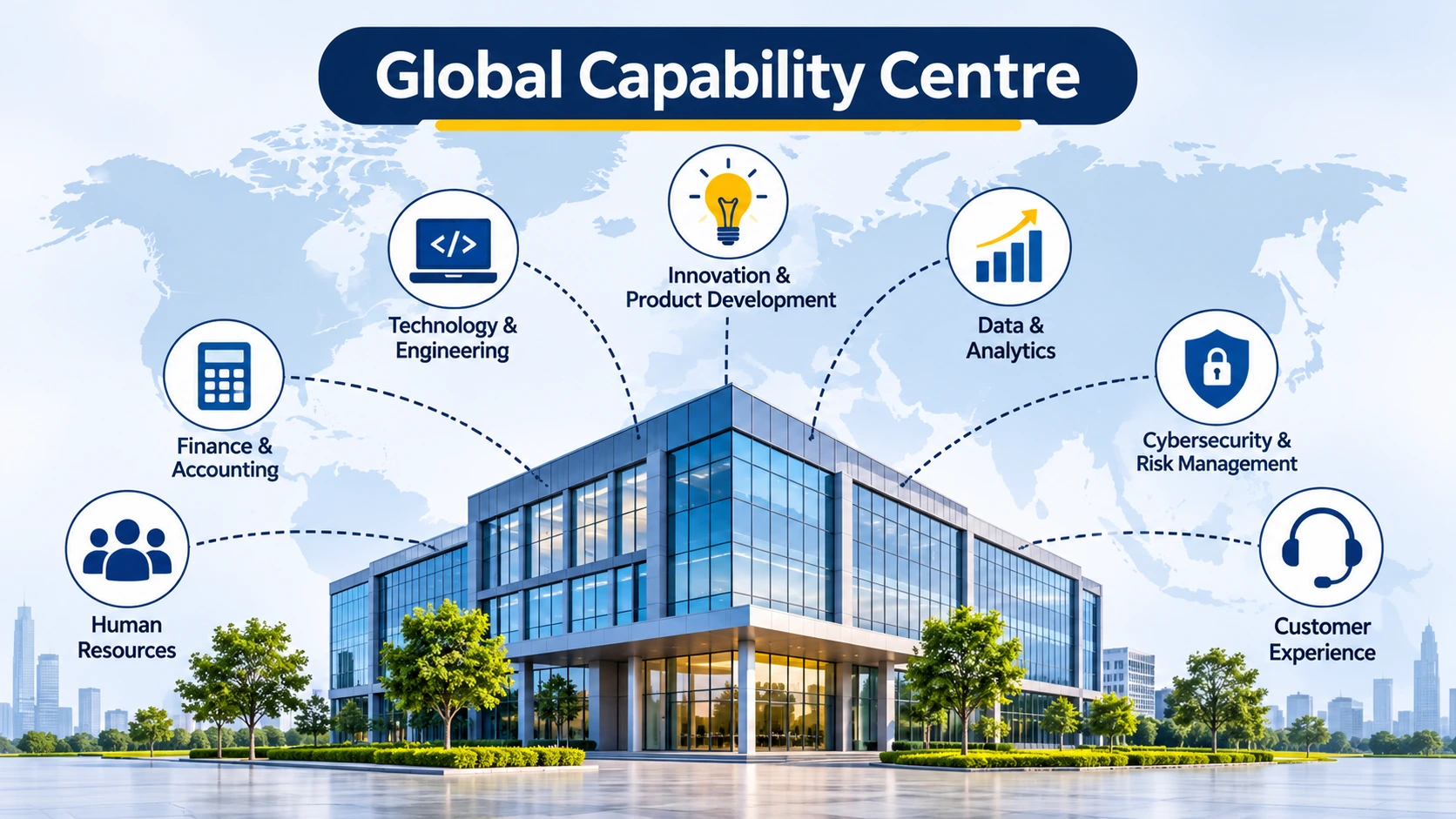
To understand the GCC role, it helps to see how these centres contribute to the parent organization. Their responsibilities have expanded well beyond the basics.
- Technology and engineering: Building and maintaining software platforms, cloud infrastructure, and enterprise applications.
- Data, analytics, and artificial intelligence: Developing machine learning models, dashboards, and decision-support tools.
- Finance and accounting: Managing reporting, audits, treasury support, and compliance activities.
- Human resources: Handling talent operations, payroll, and workforce analytics.
- Research and product development: Designing new products, testing prototypes, and filing patents.
- Cybersecurity and risk management: Monitoring threats, protecting data, and meeting regulatory requirements.
- Customer experience: Improving digital journeys, support models, and service design.
In many companies, the GCC role has become central to competitiveness. Leadership teams now look to these centres for innovation, speed, and operational resilience.
Types of GCCs
Not every centre looks the same. GCCs are commonly grouped in the following ways.
- Captive GCCs: Fully owned and managed by the parent company. This is the most common model.
- Build-Operate-Transfer (BOT) GCCs: A partner sets up and runs the centre for a period, after which ownership transfers to the parent company.
- Hybrid GCCs: A mix of in-house teams and external partners who support specific functions.
- Shared service centres: Focused mainly on repeatable processes such as finance, HR, and procurement.
- Centres of excellence: Specialized hubs built around one domain, such as artificial intelligence, cybersecurity, or product design.
Choosing the right model depends on the company’s goals, budget, speed requirements, and appetite for control.
Why Companies Set Up Global Capability Centres
There are several strong reasons behind the rise of GCCs.
Access to Skilled Talent
Talent is the biggest driver. Countries with large pools of engineers, analysts, and finance professionals allow companies to hire at scale and find rare skills, such as data science or cloud architecture, more easily.
Cost Efficiency
Lower operating costs remain a benefit, although they are no longer the main reason. Companies can maintain quality while managing expenses more effectively.
Business Continuity and Round-the-Clock Operations
Teams in different time zones can pass work across regions, allowing continuous progress. A distributed model also reduces the risk of disruption in any single location.
Control and Intellectual Property
Because the company owns its centre, it retains tighter control over data, processes, and intellectual property than it would in a typical outsourcing contract.
Faster Innovation
GCCs help companies test ideas, build prototypes, and launch products quickly by combining local talent with global strategy.
Global Capability Centres in India: A Growing Hub
India has become the world’s leading destination for GCCs. Industry estimates suggest that the country hosts well over 1,700 centres, employing close to two million professionals, and these numbers continue to rise. Analysts expect further growth through the end of this decade as more multinationals expand their operations.
Several factors explain why global capability centres in India are so successful:
- Large talent pool: India produces millions of graduates every year, including a high number in engineering, technology, and commerce.
- Strong technology ecosystem: Cities such as Bengaluru, Hyderabad, Pune, Chennai, Mumbai, and the National Capital Region offer mature infrastructure and a thriving startup culture.
- Cost-competitive operations: Operating costs remain attractive compared with many developed markets.
- English-speaking workforce: Fluency in English eases communication with global teams.
- Government support: Policies promoting digital infrastructure, special economic zones, and state-level incentives have encouraged investment.
- Track record of delivery: Decades of experience in the IT and business process industries have built trust among global leaders.
GCCs in India are also expanding beyond the largest metros. Cities such as Coimbatore, Kochi, Ahmedabad, Jaipur, and Indore are emerging as attractive locations because they offer lower costs, growing talent, and improving infrastructure.
Key Sectors Driving GCCs
GCCs in India serve many industries. The most active include:
- Banking, financial services, and insurance (BFSI): Technology, risk, compliance, and digital banking.
- Technology and software: Product engineering, cloud services, and platform development.
- Healthcare and life sciences: Clinical data management, pharmaceutical research, and medical technology.
- Retail and consumer goods: Supply chain analytics, e-commerce platforms, and customer insights.
- Automotive and manufacturing: Engineering design, connected vehicles, and industrial automation.
- Telecom and media: Network engineering, content platforms, and digital services.
Benefits of GCCs for Employees and the Economy
The growth of global capability centres creates advantages beyond the companies that run them.
For professionals, GCCs offer exposure to global projects, structured career growth, competitive compensation, and the chance to work on advanced technologies. Many employees also gain opportunities to move into leadership positions that influence worldwide strategy.
For the economy, GCCs generate jobs, attract foreign investment, support local suppliers, and strengthen the country’s reputation as a center for innovation. They also help raise the skill level of the workforce by encouraging training and continuous learning
How to Set Up a Global Capability Centre
The process of building a GCC generally follows these steps.
- Define the purpose. Decide what the centre should achieve, whether that is cost savings, technology capability, innovation, or all three.
- Select the location. Evaluate talent availability, infrastructure, costs, regulations, and quality of life.
- Choose the operating model. Decide between a captive setup, a BOT arrangement, or a hybrid structure.
- Handle legal and regulatory requirements. Register the entity, address tax matters, and ensure compliance with local laws.
- Build the leadership team. Strong local leaders are essential for hiring, culture, and execution.
- Hire and train talent. Develop a recruitment plan and invest in skill development from the start.
- Scale gradually. Begin with a few core functions, measure results, and add responsibilities over time.
The Future of GCCs
The future of the global capability centre looks promising. Several trends are shaping the next phase of growth.
- Artificial intelligence and automation: GCCs are becoming hubs for generative AI, machine learning, and intelligent process automation.
- Shift to innovation: More centres are being given ownership of end-to-end products and global mandates.
- Expansion to smaller cities: Tier 2 and Tier 3 locations are gaining attention.
- Focus on sustainability and ESG: Many centres now support environmental and governance reporting.
- Skill-first hiring: Companies increasingly prioritize practical skills, certifications, and learning agility over traditional credentials.
As these trends strengthen, the GCC role will keep expanding from execution toward leadership in strategy and innovation.
Conclusion
A global capability centre is far more than an overseas office. It is a strategic, company-owned unit that brings together talent, technology, and business knowledge to support an organization worldwide. From its early days as a cost-saving tool, the GCC has grown into a driver of innovation and long-term competitiveness.
India stands at the center of this shift, with GCCs in India shaping the country’s economic and professional landscape. For students and professionals, understanding what a GCC is and how it works offers valuable insight into one of the most dynamic areas of the modern job market. For businesses, it shows a proven path to building capability, resilience, and growth.
Frequently Asked Questions
A GCC is a company-owned unit located in another country that performs technology, finance, analytics, engineering, and other work for the parent organization. It is not an outside vendor. It is a part of the company itself.
India offers a large pool of skilled professionals, a mature technology ecosystem, competitive costs, and supportive government policies. Many multinationals also have positive experience with existing Indian operations, which encourages further investment.
In outsourcing, a third-party vendor delivers services under a contract. In a GCC, the company owns and operates the unit directly. This gives it greater control over quality, data security, intellectual property, and culture.
GCCs offer roles in software engineering, data science, artificial intelligence, cybersecurity, finance, human resources, product management, and research. Many positions involve working directly with global teams on projects that influence the parent company’s strategy.

Related Courses
Explore our programs





Find a Program made just for YOU
We'll help you find the right fit for your solution. Let's get you connected with the perfect solution.
Is Your Upskilling Effort worth it?
 ROI Calculator


Are Your Skills Meeting Job Demands?
Try our Skill Gap tool
Experience Lifelong Learning and Connect with Like-minded Professionals
Explore Jaro Connect
