HOME > BLOG > Finance > AI in Finance 2026: How Artificial Intelligence Is Changing the CFO, Analyst and Risk Manager Role in India
Finance
AI in Finance 2026: How Artificial Intelligence Is Changing the CFO, Analyst and Risk Manager Role in India
J
By Dr. Sanjay Kulkarni
August 2, 20266 min read
Published on August 2, 2026
SHARE THIS ARTICLE
Table Of Content
Why AI Adoption in Finance Is Accelerating
How AI Is Transforming Finance Functions
The Evolving Role of the CFO
AI and the Financial Analyst's Role
Blog Summary: Explore how Artificial Intelligence is revolutionizing the finance industry in India by transforming the roles of CFOs, financial analysts, and risk managers. Learn about emerging AI applications, in-demand skills, salary trends, and the career opportunities shaping the future of finance in 2026.
Artificial Intelligence (AI) has evolved from being a futuristic concept to becoming a business necessity, especially in the financial sector. In 2026, AI is no longer limited to automating repetitive tasks—it is transforming how finance professionals analyze data, forecast revenue, manage risks, detect fraud, and make strategic decisions. Across India, organizations ranging from startups to multinational corporations are integrating AI into their finance functions to improve efficiency, accuracy, and decision-making.
The role of finance professionals is changing rapidly. Traditional responsibilities such as bookkeeping, financial reporting, and manual analysis are increasingly being handled by AI-powered tools. This shift is allowing finance leaders to focus more on business strategy, value creation, and long-term planning. As a result, professionals such as Chief Financial Officers (CFOs), Financial Analysts, and Risk Managers are expected to possess not only financial expertise but also an understanding of AI technologies, data analytics, and digital transformation.
This blog explores how AI is reshaping finance careers in India, the emerging skills professionals need, and the educational pathways that can prepare them for the future.
The financial industry generates enormous volumes of structured and unstructured data every day. Processing this information manually is time-consuming and often prone to errors. AI helps organizations analyze large datasets in real time, identify patterns, predict future trends, and automate routine financial processes.
Several factors are driving AI adoption in India’s financial sector:
Increasing digital transactions and fintech growth
Rising demand for real-time financial insights
Enhanced regulatory compliance requirements
Need for faster and more accurate forecasting
Growing focus on fraud prevention and cybersecurity
Advances in cloud computing and machine learning
With India’s digital economy expanding rapidly, finance departments are becoming more technology-driven than ever before.
Artificial Intelligenceis not replacing finance professionals—it is enhancing their capabilities. Instead of spending hours on data entry or spreadsheet analysis, professionals can now leverage AI to generate insights within minutes.
Some of the most significant applications include:
Automated financial reporting
Intelligent budgeting and forecasting
Predictive cash flow analysis
Expense management automation
Invoice processing
Fraud detection
Tax compliance monitoring
Investment portfolio analysis
Credit risk assessment
By automating repetitive tasks, AI allows finance teams to dedicate more time to strategic planning and business growth.
Free Courses
Finance for All – Free Finance Certification Course
The role of the Chief Financial Officer has changed significantly over the past decade. Today’s CFO is no longer responsible only for financial reporting and compliance. They are strategic advisors who influence business decisions, digital transformation initiatives, and organizational growth.
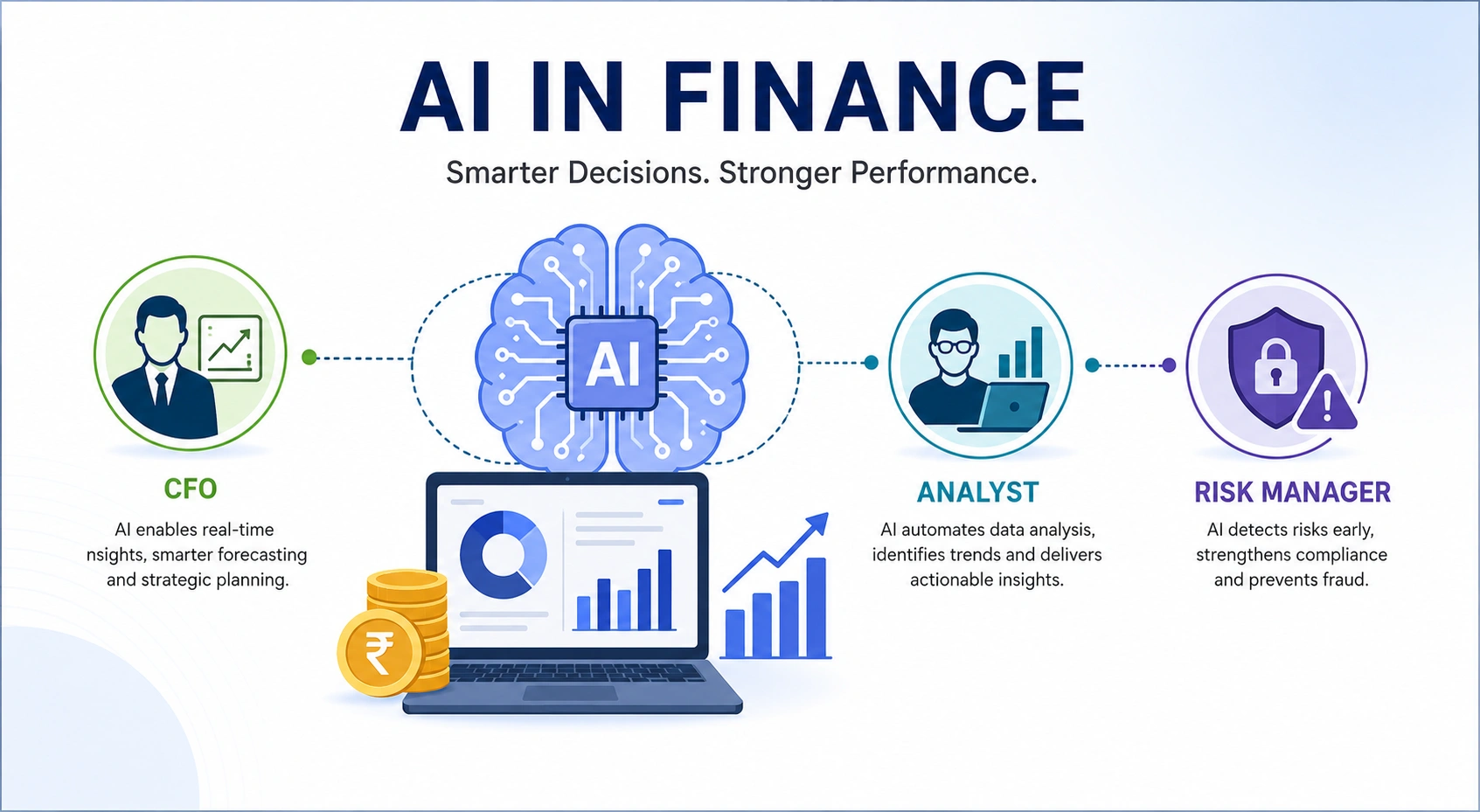
AI enables CFOs to make faster and more informed decisions by providing real-time financial intelligence.
Better Strategic Planning
AI-powered forecasting tools analyze historical financial data, market trends, consumer behavior, and economic indicators to predict future business performance with greater accuracy.
Instead of relying solely on quarterly reports, CFOs now receive continuous financial insights that support proactive decision-making.
Improved Financial Forecasting
Traditional forecasting methods often require extensive manual effort. AI automates this process by continuously updating forecasts as new information becomes available.
This helps organizations respond quickly to changing market conditions.
Smarter Cash Flow Management
AI systems monitor receivables, payables, and spending patterns to optimize working capital and improve liquidity management.
Faster Decision-Making
Modern AI dashboards provide CFOs with real-time performance metrics, allowing them to identify potential financial risks and opportunities immediately.
AI and the Financial Analyst's Role
Financial analysts have traditionally spent significant time collecting data, building spreadsheets, and preparing reports. AI is dramatically reducing these manual tasks.
Instead of focusing on data preparation, analysts are increasingly expected to interpret AI-generated insights and provide strategic recommendations.
Automated Data Analysis
AI platforms process thousands of financial records within seconds.
This improves both the speed and quality of financial analysis.
Predictive Analytics
Machine learning models can forecast future sales, operating expenses, market demand, and investment performance more accurately than traditional statistical methods.
AI allows analysts to simulate multiple business scenarios.
For example, organizations can evaluate how inflation, interest rate changes, supply chain disruptions, or new regulations might impact financial performance.
This capability significantly improves business resilience.
AI Is Revolutionizing Risk Management
Risk management has become increasingly complex due to cyber threats, economic uncertainty, regulatory changes, and global market volatility.
AI helps organizations identify potential risks before they become major problems.
Rather than reacting to issues after they occur, businesses can proactively monitor and mitigate risks using intelligent algorithms.
Fraud Detection
Financial institutions use AI to detect suspicious transactions in real time.
Machine learning algorithms continuously monitor transaction behavior and immediately flag unusual activities that may indicate fraud.
This improves security while reducing financial losses.
Credit Risk Assessment
Banks and financial institutions increasingly rely on AI to evaluate loan applicants.
Instead of depending only on traditional credit scores, AI analyzes multiple variables such as transaction history, repayment behavior, spending habits, and business performance.
This results in faster and more accurate lending decisions.
Regulatory Compliance
Keeping up with changing financial regulations can be challenging.
AI-powered compliance systems automatically monitor regulatory updates, review financial transactions, and identify potential compliance issues before audits occur.
This reduces operational risk and improves governance.
Essential AI Skills for Finance Professionals
As AI becomes integrated into finance operations, professionals need to expand their skill sets beyond traditional accountingand financial management.
Professionals who combine financial expertise with technological capabilities will have a significant advantage in the evolving job market.
AI Tools Finance Professionals Should Know
Several AI-powered platforms are becoming standard across finance departments.
Popular tools include Microsoft Copilot for Finance, ChatGPT Enterprise, Power BI with AI capabilities, Tableau AI, SAP Analytics Cloud, Oracle Fusion Cloud ERP, IBM Watson, and Anaplan.
These solutions assist with budgeting, forecasting, reporting, financial planning, and business intelligence.
However, organizations continue to emphasize that AI should support—not replace—human judgment. Finance professionals remain responsible for validating outputs, interpreting insights, and ensuring ethical and compliant decision-making.
Industries Leading AI Adoption in Finance
AI adoption is expanding across nearly every industry in India.
Such programmes help professionals understand AI applications in financial planning, investment analysis, risk management, and strategic decision-making while strengthening digital competencies.
Salary Trends for AI Finance Professionals in India (2026)
As AI adoption accelerates across finance functions, professionals who combine financial expertise with AI, analytics, and digital transformation skills are commanding higher salaries than traditional finance roles. Organizations are willing to pay a premium for talent that can leverage AI to improve forecasting, automate financial processes, and strengthen risk management.
Experience Level
Average Annual Salary (INR)
Entry Level (0–2 years)
₹6–10 LPA
Mid-Level (3–6 years)
₹10–18 LPA
Experienced (7–10 years)
₹18–30 LPA
Senior Leadership (10+ years)
₹35–70+ LPA
Professionals working in investment banking, fintech, consulting, global capability centers (GCCs), and multinational corporations often earn salaries at the higher end of these ranges. Leadership roles such as AI Finance Lead, Head of Financial Planning & Analytics (FP&A), Chief Data Officer, and Chief Financial Officer (CFO) with strong AI capabilities can command compensation exceeding ₹1 crore annually in large enterprises.
Conclusion
Artificial Intelligence is redefining the finance profession in India. Rather than replacing finance experts, AI is enabling them to work smarter by automating repetitive tasks, improving forecasting accuracy, enhancing fraud detection, and delivering real-time business insights.
For CFOs, AI supports strategic planning and financial decision-making. Financial analystscan leverage predictive analytics to generate actionable insights, while risk managers benefit from intelligent systems that identify and mitigate risks proactively.
As organizations continue investing in AI-driven finance transformation, professionals who combine financial expertise with digital skills will remain in high demand. Pursuing anMBA in Finance, Business Analytics, FinTech, or AI-focused executive programmes can help build the capabilities required to thrive in this evolving landscape.
The future of finance is not about humans versus AI—it is about humans empowered by AI to create greater business value.
Frequently Asked Questions
AI is automating routine tasks such as financial reporting, reconciliation, forecasting, and fraud detection, allowing finance professionals to focus on strategic planning, business analysis, and decision-making.
No. AI is designed to augment rather than replace finance professionals. While automation reduces manual work, CFOs and analysts remain essential for interpreting insights, managing business strategy, and making complex financial decisions.
Professionals working as CFOs, Financial Analysts, FP&A Managers, Risk Managers, Investment Analysts, Internal Auditors, Finance Controllers, and FinTech professionals benefit significantly from AI and data analytics skills.
Some of the most relevant options include MBA in Finance, MBA in Business Analytics, Executive Programmes in Artificial Intelligence, Financial Analytics Certifications, FinTech courses, and AI for Business programmes.
Employers increasingly seek professionals with expertise in financial analytics, predictive modeling, AI fundamentals, machine learning basics, data visualization, Power BI, Tableau, Python for finance, cloud-based ERP systems, and business intelligence tools.
Dr. Sanjay Kulkarni
Data & AI Transformation Leader
Dr. Sanjay Kulkarni is a Data & AI Transformation Leader with over 25 years of industry experience. He helps organizations adopt data-driven and responsible AI practices through strategic guidance and education. With experience across startups and global enterprises, he bridges the gap between theory and real-world application. His work empowers teams to innovate and thrive in AI-driven environments.

 August 2, 2026
 6 min read




 ChatGPT
 Perplexity
 Claude
 Grok
Grok








 ROI Calculator