What Is a Cloud Engineer? Roles, Skills, Salary & Career Scope in 2026
J
By Shubham Lal
September 26, 20269 min read
Published on September 26, 2026
SHARE THIS ARTICLE
Table Of Content
What Is a Cloud Engineer?
What Does a Cloud Engineer Do?
Types of Cloud Engineer Roles
Cloud Engineer Skills Required in 2026
Key Insights
A cloud engineer designs, manages, secures, monitors, and improves cloud based infrastructure, working across areas such as networking, storage, databases, automation, and application deployment.
Cloud engineering offers several career paths, including cloud development, cloud architecture, cloud DevOps, cloud data engineering, cloud security, and cloud support.
Key skills for cloud engineers include cloud platforms, networking, Linux, programming, infrastructure as code, containers, Kubernetes, cloud security, databases, monitoring, and AI cloud workloads.
A cloud engineer degree can provide a strong foundation, but certifications, practical projects, and relevant IT experience can also provide pathways into cloud engineering.
In this blog, you'll learn what a cloud engineer does, the skills and degree pathways required, AWS cloud engineer roles, salary expectations, career opportunities, cloud data engineering, and how to choose a cloud engineer program.
Think about every time you stream a video, save a file online, use a banking app, or collaborate on a document without storing everything on your laptop. Behind many of these experiences is cloud infrastructure. And behind that infrastructure are professionals who design, manage, secure, and optimize cloud environments.
A cloud engineer is an IT professional who works with cloud based infrastructure and services. They help organizations move applications and data to the cloud, configure cloud resources, monitor performance, improve security, automate processes, and troubleshoot technical issues. Cloud engineers can work with platforms such as Amazon Web Services (AWS), Microsoft Azure, and Google Cloud.
As organizations increasingly combine cloud computing with data, automation, DevOps, and artificial intelligence, the role is also becoming broader. In 2026, professionals entering this field need more than basic knowledge of a cloud platform. Skills in automation, containers, security, infrastructure as code, data engineering, and AI workloads can also add value.
This blog explains what a cloud engineer does, the skills required, the cloud engineer degree pathway, salary expectations, career options, and how to start a career through a cloud engineer program.
A cloud engineer designs, implements, maintains, and improves cloud based systems and infrastructure. Their work can involve cloud storage, computing resources, networking, databases, security, monitoring, and application deployment.
In simple terms, a cloud engineer makes sure that an organization’s cloud environment works reliably and efficiently.
For example, when a company moves an application from its own physical servers to AWS, a cloud engineer may help plan the migration, configure the required services, establish network connections, set up security controls, automate deployments, and monitor the application after migration.
The exact responsibilities depend on the organization and the engineer’s specialization.
The day-to-day responsibilities of a cloud engineer can vary significantly. Some professionals focus on infrastructure, while others specialize in cloud development, security, data, DevOps, or architecture.
Common responsibilities include:
Responsibility
What It Involves
Cloud infrastructure
Setting up and managing computing, storage, networking, and other cloud resources
Cloud migration
Helping organizations move applications, databases, and workloads to cloud platforms
Security
Managing access controls, permissions, encryption, firewalls, and security practices
Monitoring
Tracking application and infrastructure performance and identifying issues
Automation
Automating repetitive infrastructure and deployment activities
Troubleshooting
Identifying and resolving cloud performance, availability, and configuration problems
Cost optimization
Monitoring cloud usage and identifying opportunities to manage unnecessary spending
Collaboration
Working with developers, DevOps teams, security professionals, data teams, and business stakeholders
Cloud engineering therefore sits at the intersection of infrastructure, software, networking, security, and operations.
Types of Cloud Engineer Roles
The term cloud engineer can cover several specialized career paths.
1. Cloud Development Engineer
A cloud development engineer builds and deploys applications that operate on cloud platforms. Programming and knowledge of cloud services are important for this role.
2. Cloud Architect
A cloud architect focuses on designing cloud environments and deciding how applications, databases, networking, security, and other services should work together.
3. Cloud Support Engineer
Cloud support engineers troubleshoot cloud environments, investigate technical problems, manage configurations, and help maintain cloud services.
4. Cloud DevOps Engineer
A cloud DevOps engineer combines cloud infrastructure with automation and software delivery practices. The role commonly involves CI/CD, containers, monitoring, infrastructure as code, and deployment automation.
5. Cloud Data Engineer
A cloud data engineer focuses on building and maintaining systems that collect, process, store, and move data in cloud environments.
This is an important distinction. A general cloud engineer may manage the infrastructure that supports applications and data, while a cloud data engineer is more focused on data pipelines, data platforms, storage architecture, and data processing.
6. Cloud Security Engineer
Cloud security engineers focus on protecting cloud infrastructure, applications, identities, networks, and data from security threats and unauthorised access.
Cloud Engineer Skills Required in 2026
Cloud technology changes quickly, so the skill set required for cloud engineering continues to expand. The three reference resources commonly highlight cloud platforms, programming, operating systems, networking, security, databases, certifications, and practical experience.
In 2026, aspiring professionals should consider developing the following skills.
1. Cloud Platforms
Start by developing a strong understanding of at least one major cloud platform.
Networking is one of the foundations of cloud engineering. Learn concepts such as IP addresses, DNS, virtual networks, routing, load balancing, firewalls, and network security.
Without networking knowledge, it can be difficult to understand how cloud resources communicate with one another.
3. Linux and Operating Systems
Cloud environments frequently require professionals to work with Linux. Understanding command line operations, processes, permissions, filesystems, networking commands, and system administration can be valuable.
Knowledge of Windows environments can also be useful depending on the organization and technology stack.
4. Programming and Scripting
You do not necessarily need to become a full time software developer, but programming and scripting skills can make cloud engineers more effective.
Python is particularly useful for automation and cloud related tasks. Other languages used in cloud environments include Java, Go, and Ruby.
5. Infrastructure as Code
Infrastructure as code, commonly called IaC, allows infrastructure configurations to be managed through code instead of relying entirely on manual configuration.
Tools such as Terraform can be useful for professionals working with cloud infrastructure and automation.
6. Containers and Kubernetes
Containers help package applications and their dependencies so that they can run consistently across environments.
Docker and Kubernetes are therefore useful technologies for cloud and DevOps professionals.
7. Cloud Security
Security should be part of cloud engineering from the beginning rather than treated as an afterthought.
Important concepts include identity and access management, permissions, encryption, network security, secrets management, logging, and security monitoring.
8. Databases and Data Engineering
Cloud engineers increasingly work alongside data teams. Understanding relational databases, NoSQL systems, data storage, data pipelines, and cloud data services can help professionals move towards specialized roles such as cloud data engineer.
9. Monitoring and Observability
Cloud environments generate large amounts of operational information. Engineers need to understand logs, metrics, alerts, application performance, and system health.
Observability skills can help engineers identify problems before they significantly affect users.
10. AI and Cloud Workloads
One of the important areas to watch in 2026 is the intersection of cloud and AI.
AI applications require computing resources, data storage, networking, model deployment, monitoring, and scalable infrastructure. As a result, cloud professionals can benefit from understanding how AI and machine learning workloads are deployed and managed in cloud environments.
Cloud Engineer Degree: Is a Degree Required?
One of the most common questions is whether you need a cloud engineer degree to enter this field.
The answer depends on the employer and your career pathway.
A bachelor’s degree in computer science, information technology, information systems, or a related field can provide a strong foundation in programming, operating systems, networking, databases, and computer architecture.
For someone without a traditional technical degree, an alternative pathway can include:
A practical roadmap can make the transition easier. One can follow the steps below to become a cloud engineer.
Step 1: Learn IT Fundamentals
Start with operating systems, networking, databases, programming, and basic security.
Step 2: Choose a Cloud Platform
Pick AWS, Azure, or Google Cloud and learn its core services.
Step 3: Build Practical Projects
Do not rely only on video lessons or theoretical knowledge. Build projects such as deploying a web application, creating a cloud database, setting up a virtual network, or automating infrastructure.
Step 4: Learn Automation
Learn tools and concepts related to scripting, CI/CD, infrastructure as code, containers, and configuration management.
Step 5: Consider Certifications
Cloud certifications can help demonstrate knowledge of a particular platform.
Examples include entry level and associate certifications from AWS, Microsoft Azure, and Google Cloud.
Step 6: Gain Work Experience
You can enter cloud engineering through related roles such as system administration, network engineering, database administration, software development, or DevOps.
Cloud Engineer Program: What Should You Look For?
If you are considering a cloud engineer program, do not evaluate it only by its course title.
Look at the actual curriculum and practical components.
A program that includes practical projects can help you demonstrate what you can actually build rather than simply listing completed courses on your resume.
AWS Cloud Engineer: What Does the Role Involve?
An AWS cloud engineer works with Amazon Web Services to build, manage, automate, and maintain cloud infrastructure and applications.
Depending on the job, an AWS cloud engineer may work with services related to computing, storage, databases, networking, security, monitoring, and application deployment.
Professionals interested in AWS can build their skills progressively, starting with foundational concepts and then moving towards more specialized areas such as architecture, DevOps, security, data engineering, or machine learning infrastructure.
Cloud Engineer Salary in India in 2026
The cloud engineer salary in India can vary considerably depending on experience, location, company, cloud platform, specialization, and technical skills.
More recent 2026 salary sources show a wide range. Instahyre reports cloud engineer salaries ranging from approximately ₹4 lakh to ₹9 lakh for freshers and significantly higher ranges for experienced and senior roles, while its figures vary by role, platform, and company type.
Another2026 salary source, OwnYourCareer, reports indicative Indian ranges of ₹6 lakh to ₹12 lakh for entry level cloud engineers, ₹14 lakh to ₹24 lakh for mid level professionals, and ₹26 lakh to ₹42 lakh for senior professionals.
Experience Level
Indicative Salary Range in India
Entry level
₹4 lakh to ₹12 lakh per year
Mid level
₹12 lakh to ₹24 lakh per year
Senior level
₹24 lakh to ₹42 lakh+ per year
Advanced architecture and specialist roles
Can be significantly higher
These figures should be treated as market indications rather than guaranteed salaries. Different sources use different datasets and methodologies, and compensation can change significantly between companies and roles.
Career Scope of Cloud Engineers in 2026
Cloud engineering offers multiple directions for career growth.
After gaining experience as a cloud engineer, professionals can move towards roles such as:
Cloud Architect
Senior Cloud Engineer
Cloud DevOps Engineer
Cloud Security Engineer
Cloud Data Engineer
Cloud Solutions Architect
Cloud Infrastructure Engineer
Site Reliability Engineer
Cloud Consultant
Cloud Platform Engineer
The career can therefore develop horizontally through specialization or vertically through senior engineering and architecture roles.
The growing connection between cloud, data, DevOps, cybersecurity,and AI is also creating opportunities for professionals who combine cloud knowledge with another technical specialty.
Cloud Engineer vs Cloud Data Engineer
Although the roles overlap, their primary areas of focus are different.
Cloud Engineer
Cloud Data Engineer
Focuses broadly on cloud infrastructure
Focuses primarily on data infrastructure
Works with networking, compute, storage, security, and infrastructure
Works with data pipelines, processing, storage, and data platforms
May support applications and databases
Primarily supports data collection, movement, processing, and analytics
Can specialize in DevOps, security, architecture, or infrastructure
Can specialize in data platforms, analyticsengineering, or cloud data architecture
Both roles can work together. A cloud engineer may build the environment in which a data platform operates, while a cloud data engineer builds and manages the systems that process organizational data.
Cloud engineering is becoming less about simply moving servers to the cloud and more about building automated, secure, scalable, and cost aware technology environments.
In 2026, professionals may increasingly encounter cloud projects involving AI workloads, data platforms, containers, automation, multi cloud environments, and advanced security.
This makes continuous learning particularly important. For aspiring professionals, the most useful approach is to build strong fundamentals first and then develop a specialization.
Conclusion
A cloud engineer is responsible for building, managing, securing, monitoring, and improving cloud based technology environments. The role combines knowledge of cloud platforms with networking, operating systems, programming, databases, security, automation, and infrastructure.
A cloud engineer degree can provide a useful foundation, but professionals can also enter the field through certifications, practical projects, and experience in related IT roles. An AWS cloud engineer can specialize in AWS based infrastructure, while a cloud data engineer focuses more specifically on cloud based data systems.
For those considering a cloud engineer program, practical exposure should be an important consideration. Learning cloud concepts is useful, but applying them through projects, automation, infrastructure as code, containers, security, and monitoring can make the learning journey more relevant to real world cloud environments.
Frequently Asked Questions
A cloud engineer designs, deploys, manages, monitors, secures, and troubleshoots cloud infrastructure and services. Their responsibilities can include cloud migration, networking, automation, security, storage, and application deployment.
A degree in computer science, IT, or a related field can provide a strong foundation, but it is not always mandatory. Skills, certifications, hands on projects, and relevant IT experience can also provide pathways into cloud engineering.
Cloud engineer salaries vary based on experience, skills, company, location, and specialization. Current 2026 salary sources show entry level ranges of roughly ₹4 lakh to ₹12 lakh, while experienced professionals can earn considerably more.
Start by learning cloud and networking fundamentals, then develop hands on knowledge of AWS services. Build practical projects, learn automation and infrastructure as code, consider an AWS certification, and gain relevant IT or cloud experience.
Shubham Lal
Lead Software Developer
Shubham Lal joined Microsoft in 2017 and brings 8 years of experience across Windows, Office 365, and Teams. He has mentored 5,000+ students, supported 15+ ed-techs, delivered 60+ keynotes including TEDx, and founded AI Linc, transforming learning in colleges and companies.
 HOME > BLOG > Cloud Computing and Cyber Security > What Is a Cloud Engineer? Roles, Skills, Salary & Career Scope in 2026
 September 26, 2026
 9 min read





 Key Insights
 ChatGPT
 Perplexity
 Claude
 Grok
Grok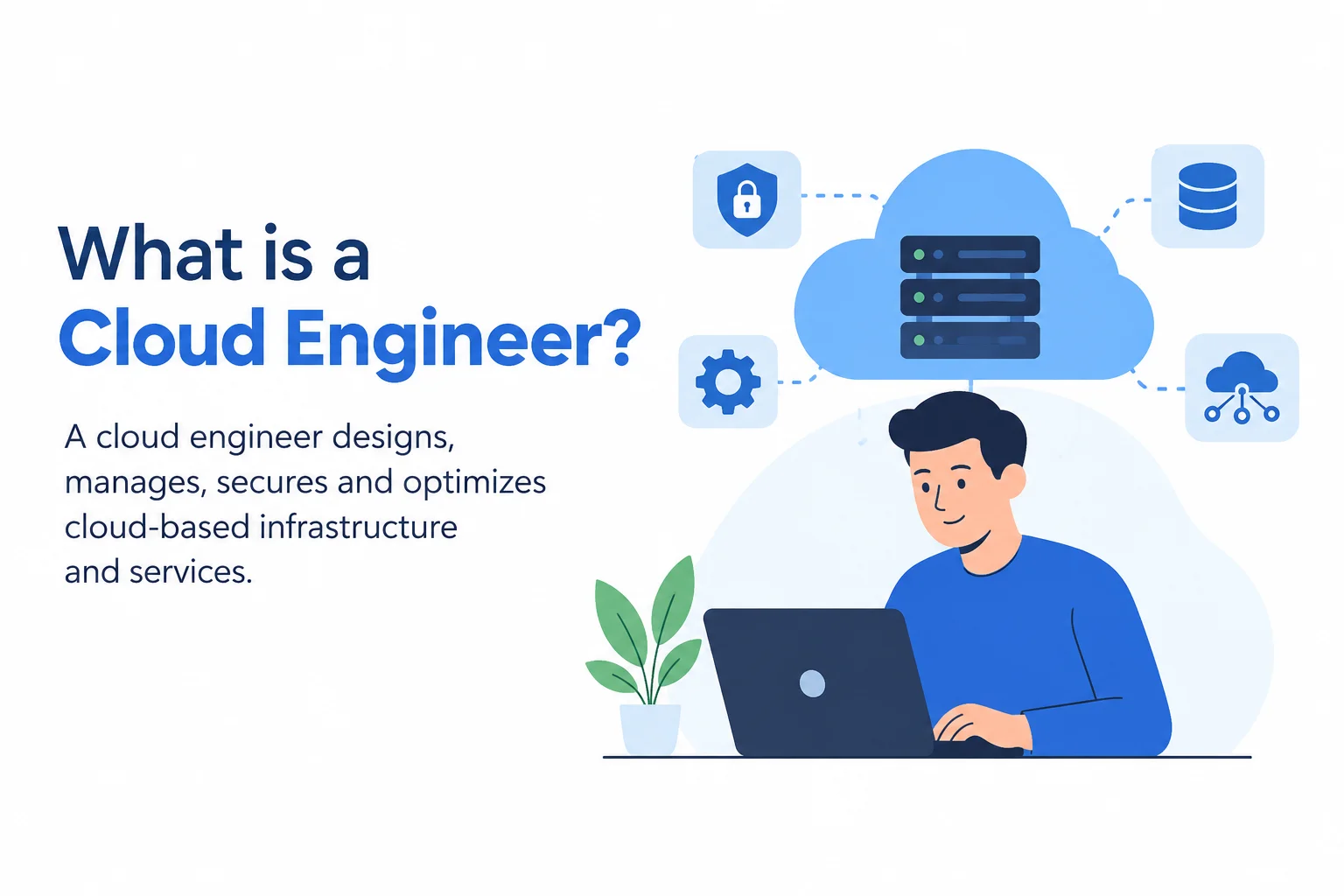










 ROI Calculator