Types of Business Analytics Courses Available Today
Take the Next Step in Your Business Analytics Career with IIM Tiruchirappalli
Core Skills You Should Expect to Learn
Key Insights
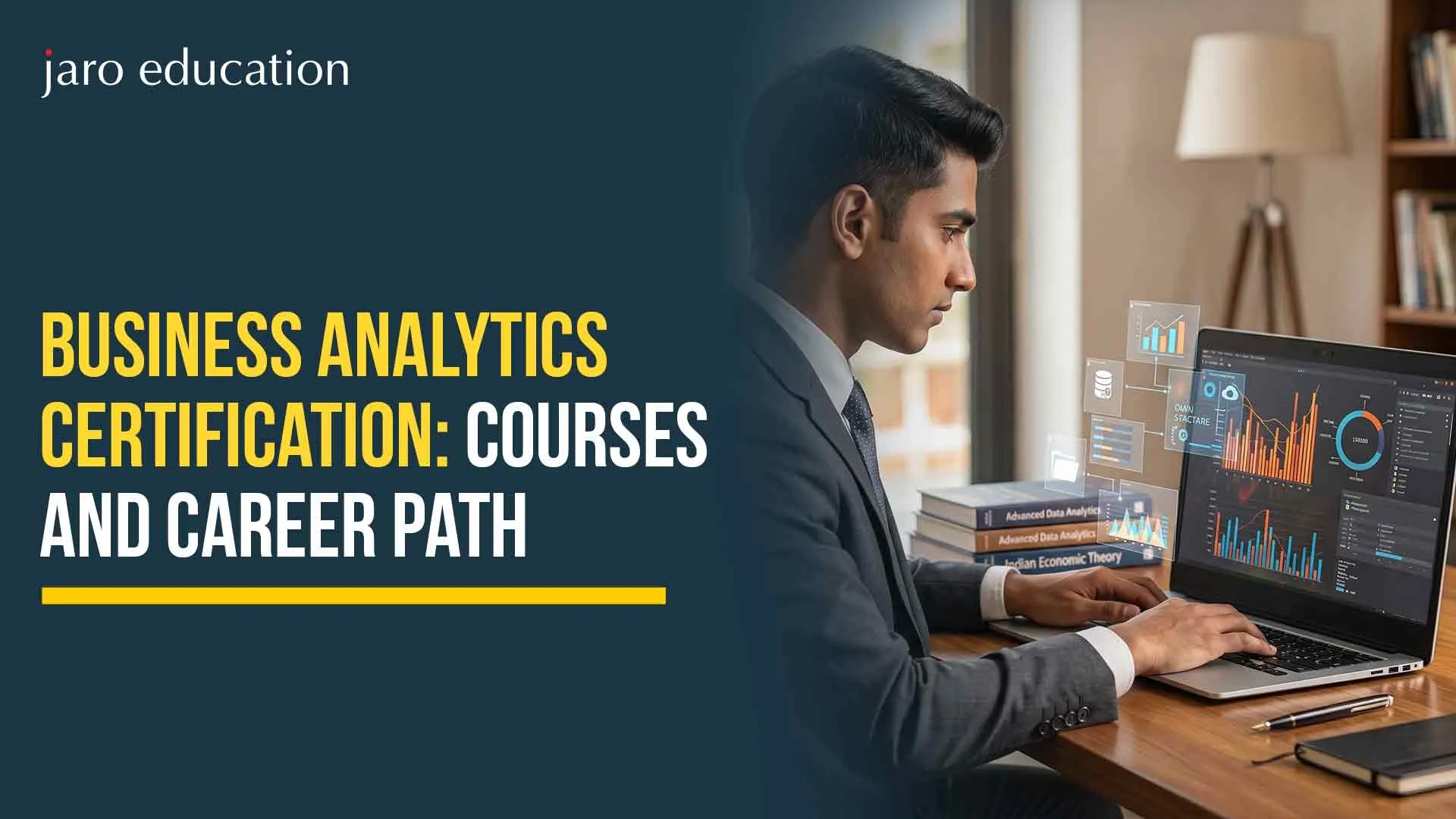
Business analytics combines data, statistical methods, technology, and business knowledge to understand performance, predict outcomes, and support better business decisions.
Learners can choose from free introductory courses, short-term certificates, business analyst degrees, and postgraduate certificate programmes, depending on their career stage, time, and goals.
A strong business analytics course should develop skills in statistics, data visualisation, Python, R, SQL, predictive analytics, machine learning, AI, and business communication, along with practical business applications.
Career opportunities can progress from Junior Business Analyst and Data Analyst roles to Analytics Consultant, Senior Analytics Manager, Head of Business Intelligence, and Director of Data Strategy, with opportunities to specialise in areas such as finance, marketing, HR, supply chain, and AI-driven analytics.
In this blog, you'll learn about business analytics certification options, essential skills, career paths, specialised roles, course selection, placement support, and how to choose a programme based on your experience and career goals.
Companies across multiple domains, such as banking, retail,healthcare, and beyond, are actively seeking professionals who can interpret data and translate it into sound business decisions. This is where business analytics comes into the picture. Additionally, the growing demand for skilled business analysts has made it important to pursue a business analytics certification. This certificate makes a great addition to an individual’s resume as well as helps them grow further in their career.
However, it is important to know that business analytics in general is quite broad. Under it sits everything from a free two-week introductory course to a full postgraduate certificate in business analyticsfrom a top-tier B-school. Choosing the right path depends on where you are in your career, how much time and money you can invest, and where you eventually want to land. This blog walks you through the landscape of courses, what a realistic career path looks like, and how to pick a programme that actually moves the needle for you.
Business analytics is the practice of using data, statistical methods, and technology to understand past performance and predict future outcomes. It sits at the intersection of business strategy and data science, requiring enough technical expertise to work with numbers and tools such as Excel, SQL, Python, R, Tableau, or Power BI, while also having the business acumen to identify the right questions, interpret insights, and turn data into meaningful business decisions.
Organizations have tons and tons of data today, such as transaction records, customer behaviour logs, supply chain metrics, and HR data. However, such huge amounts of data is useless untill and unless it can be converted into insights. This is where the role of a trained business analyst is needed. Companies today are willing to pay a premium for people who can do this. This growing demand is precisely why so many professionals are actively searching for the right certification, degree, or course to break into or grow within this field.
Types of Business Analytics Courses Available Today
Not every learner needs the same course. Broadly, the options fall into the following four categories.
1. Free Introductory Courses
If you are just starting out or want to explore the field in general, a free business analyst course with certificate is a low-risk way to start. Platforms like Coursera, edX, Google, IBM, and various university extension programmes offer free or audit-based courses covering the basics such as descriptive statistics, spreadsheet modelling, data visualization fundamentals, and an introduction to tools like Excel or Power BI.
These free courses are excellent for:
College students exploring whether analytics interests them
Professionals from non-technical backgrounds who want a taste before committing time and money
Anyone who wants a certificate to add a first analytics-related line to their LinkedIn profile
That said, free courses are usually shallow by design. They rarely include mentorship, capstone projects, placement support, or the kind of rigorous curriculum that employers associate with serious analytics roles. Think of them as a kickstarter but not the one that will give you an in-depth understanding.
2. Short-Term Certificate Programmes
These are typically 2–6 month programmes offered by ed-tech platforms or university continuing education departments. They go deeper than free courses, often including hands-on projects in SQL, Python, and visualization tools, along with some business case studies. They suit working professionals who want a targeted skill upgrade without committing to a year-long programme.
3. Business Analyst Degree Programmes
A full business analyst degree, whether an undergraduate degree in business analytics, statistics, or data science, or an MBA with an analytics specialization, remains the most comprehensive route. Degree programmes build a strong theoretical foundation across statistics, economics, operations research, and increasingly, machine learning and AI. They are ideal for students starting their careers or for professionals willing to invest two or more years into a structural career pivot.
The trade-off is time and cost. A degree demands a much bigger commitment than a certificate, and for professionals already several years into their careers, going back to a full-time degree is often impractical.
4. Postgraduate Certificate Programmes from Premier Institutes
This is generally the preferred route for working professionals: a postgraduate certificate in business analytics offered by a reputed IIM, IIT, or global university, usually delivered in a hybrid or online format over 10–12 months. These programmes combine the academic credibility of a top institute with a schedule designed around a working professional’s life — weekend or evening live sessions, a short campus immersion, and a real-world capstone project.
What makes these programmes particularly attractive is the presence of a business analytics course with placement support, dedicated career services, resume workshops, mock interviews, and access to a strong alumni and corporate network. For someone who already has a few years of work experience and wants a credible, resume-boosting credential without quitting their job, this format tends to offer the best return on investment.
Take the Next Step in Your Business Analytics Career with IIM Tiruchirappalli
If you are a working professional ready to move beyond the basics, thePost Graduate Certificate Programme in Business Analytics & AI Applications by IIM Tiruchirappalli, offered in collaboration with Jaro Education, is worth exploring. Spread across one year in a hybrid format (weekly live sessions plus a short campus immersion), the programme covers business statistics, Python and R, machine learning, Power BI and Tableau, SQL, and dedicated modules on generative AI, prompt engineering, and AI deployment, alongside functional applications in finance, marketing, operations, and people analytics. Participants work on a real-world capstone project, gain access to IIM Trichy’s faculty and executive alumni network, and receive career support through profile building, resume reviews, and career enhancement sessions. If you are looking to convert your analytics ambitions into a credible, industry-recognized postgraduate certificate in business analytics, this programme is a strong place to start.
Core Skills You Should Expect to Learn
Whatever learning path you choose, a strong business analytics course should help you develop a balanced mix of technical, analytical, and business skills, including:
Statistical Analysis & Probability – Build a strong foundation for interpreting data and making evidence-based decisions.
Data Visualization & Business Intelligence – Use tools such as Tableau, Power BI, and Excel to convert complex data into actionable insights.
Programming & Data Analysis – Learn Python and R for data cleaning, analysis, modelling, and process automation.
SQL & Data Management – Query, organize, and extract meaningful information from business databases.
Predictive Analytics & Forecasting – Apply regression, time-series analysis, and classification to identify trends and anticipate outcomes.
Machine Learning & AI for Business – Understand how AI and machine learning can support automation, prediction, and smarter business decisions.
Business & Functional Analytics – Apply analytics across marketing, finance, operations, supply chain, and human resources.
Data Storytelling & Communication – Present analytical findings clearly and translate insights into recommendations that decision-makers can act upon.
Programmes that only teach tools without connecting them to business context tend to produce analysts who can run a model but cannot explain why it matters. Look for a curriculum that pairs technical training with case studies and a capstone project based on real business problems.
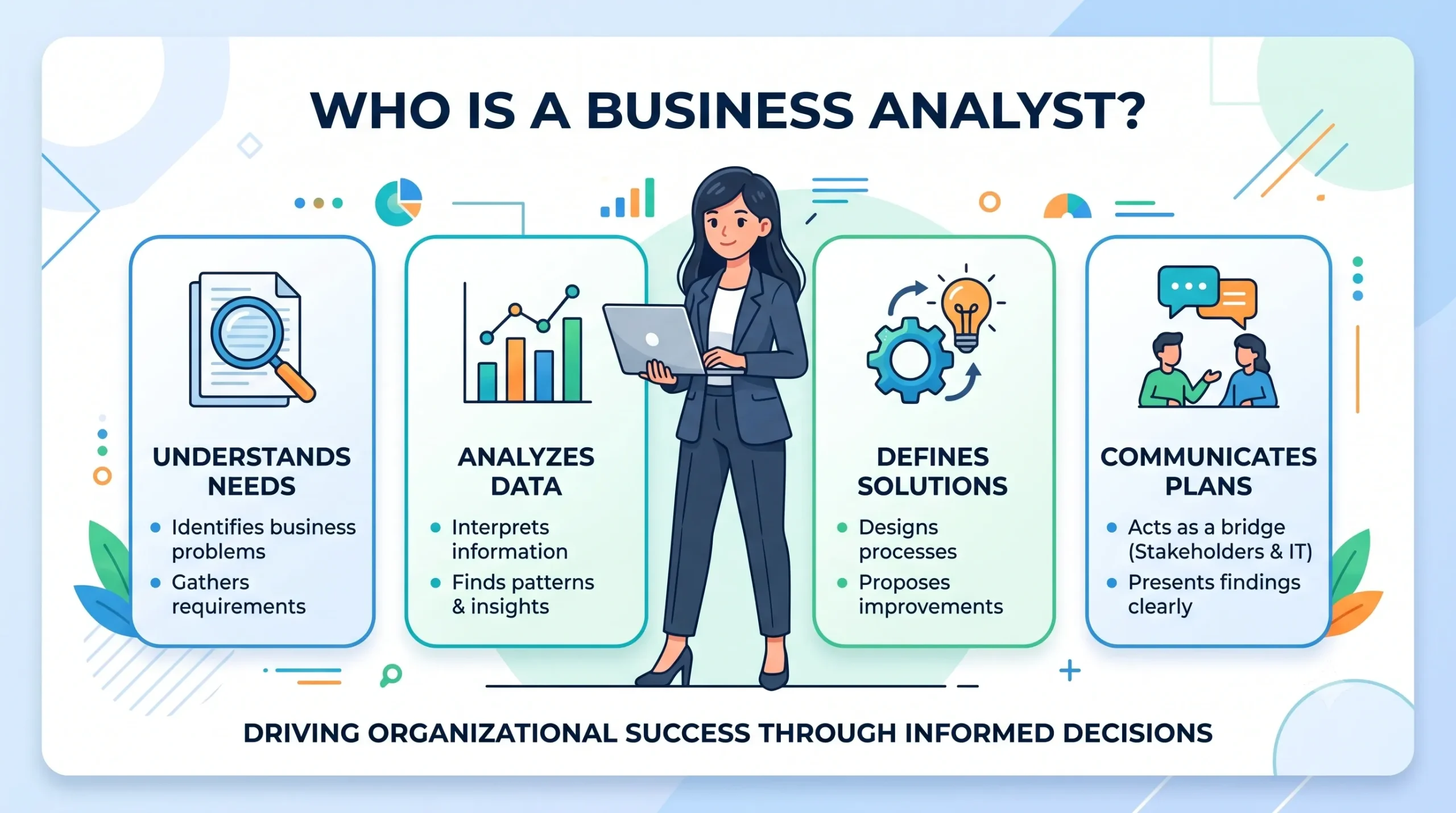
Business analytics offers diverse career opportunities, allowing professionals to enter the field through different roles and progress into more advanced positions as they gain experience and expertise.
Entry-Level Roles (0–2 years)
Most people start as a Junior Business Analyst, Data Analyst, or Reporting Analyst. The work here typically involves cleaning data, building dashboards, generating recurring reports, and supporting senior analysts with ad hoc analysis. A certificate course, whether free or paid, along with good knowledge of Excel, SQL, and a data visualization tool, can help you get started in the field.
Mid-Level Roles (2–6 years)
With a few years of experience, professionals move into roles like Business Analyst, Analytics Consultant, or Data Scientist (if the technical depth is strong enough). At this stage, employers expect you to independently frame business problems, choose the right analytical approach, and present recommendations to stakeholders. This is usually the point where professionals invest in a structured, more advanced credential, i.e., a postgraduate certificate in business analytics is particularly effective here because it covers both technical depth and business maturity to employers.
Senior and Leadership Roles (6+ years)
Experienced professionals move into positions such as Senior Analytics Manager, Head of Business Intelligence, Director of Data Strategy, or even Chief Analytics Officer in larger organizations. At this level, the job is less about running the models yourself and more about building analytics strategy, managing teams, and aligning data initiatives with business goals. A strong academic credential from a recognized institute, paired with years of demonstrated business impact, is usually what distinguishes candidates competing for these roles.
Specialized Tracks
Beyond general business analytics, professionals can specialize in areas such as marketing, finance, supply chain, HR, or AI-driven analytics. Specializing can also lead to better career opportunities as companies increasingly seek professionals with both business knowledge and technical skills.
How to Choose the Right Course for Your Stage
To choose the right course, a few questions can help you narrow down your choice:
Are you exploring the field for the first time? Start with a free or low-cost introductory course to confirm your interest before committing bigger resources.
Do you have zero prior exposure and a lot of time? A full business analyst degree may serve you better in the long run, especially if you are early in your career.
Are you a working professional with 2+ years of experience looking for a credible upgrade? A postgraduate certificate in business analytics from a reputed institute, delivered in a flexible format, is usually the most efficient path. It adds a recognizable brand name to your resume, deepens your technical and strategic skill set, and often comes bundled with placement and career support.
Do you need placement assistance? Check what the course actually offers, such as resume support, mock interviews, and access to job opportunities. These services are often more useful than general promises of guaranteed placement.
Final Thoughts
Business analytics is becoming an important skill across industries and job roles, as businesses increasingly rely on data to make better decisions. Whether you choose a free introductory course, a business analytics degree, or a postgraduate certificate, it is important to select a programme that matches your experience, learning needs, and career goals. Focus on developing practical skills in areas such as data analysis, visualization, and business intelligence, and try to apply what you learn through real-world projects. Building a strong portfolio of projects and continuously improving your skills can help you stand out to employers and create better opportunities for career growth in business analytics.
Frequently Asked Questions
Yes. A Business Analytics certification can help professionals develop skills in data analysis, business intelligence, predictive analytics, and data-driven decision-making, making it relevant across industries.
The best certification depends on your experience, career goals, budget, and preferred learning format. Executive programmes from reputed B-schools and technical institutes can be suitable for professionals looking to advance their analytics careers.
Yes. Many Business Analytics courses are designed for learners from management, commerce, finance, marketing, operations, and other backgrounds. Basic knowledge of mathematics, statistics, and spreadsheets can be helpful.
Graduates can explore roles such as Business Analyst, Data Analyst, Business Intelligence Analyst, Analytics Consultant, Marketing Analyst, and Operations Analyst, depending on their skills and experience.
A comprehensive course may cover data analysis, statistics, data visualization, Excel, SQL, Power BI, predictive analytics, business intelligence, and AI-enabled analytics, along with practical business applications.
Shubham Lal
Lead Software Developer
Shubham Lal joined Microsoft in 2017 and brings 8 years of experience across Windows, Office 365, and Teams. He has mentored 5,000+ students, supported 15+ ed-techs, delivered 60+ keynotes including TEDx, and founded AI Linc, transforming learning in colleges and companies.
Get Free Upskilling Guidance
Fill in the details for a free consultation
Related Courses
Explore our programs
Post Graduate Certification Programme in Business Analytics & Artificial Intelligence (AI) Applications

 September 9, 2026
 8 min read




 Key Insights
 ChatGPT
 Perplexity
 Claude
 Grok
Grok








 ROI Calculator