 HOME > BLOG > Career Development > Upskilling with 8-10 Years of Experience: What Actually Makes Sense in 2026
Upskilling with 8-10 Years of Experience: What Actually Makes Sense in 2026
 August 9, 2026
 6 min read




Table Of Content
- Why Mid-Career Professionals Need to Upskill in 2026
- Why Experience Alone Is No Longer Enough
- What to Study with 10 Years Experience?
- Leadership Skills Are Becoming More Valuable Than Functional Expertise
Eight to ten years into your career is often considered a defining phase. You have moved beyond entry-level responsibilities, gained domain expertise, and likely progressed into a managerial or specialist role. However, this is also the stage where many professionals begin to feel their career growth slowing down. Promotions become more competitive, leadership expectations increase, and technology continues to reshape industries at an unprecedented pace.
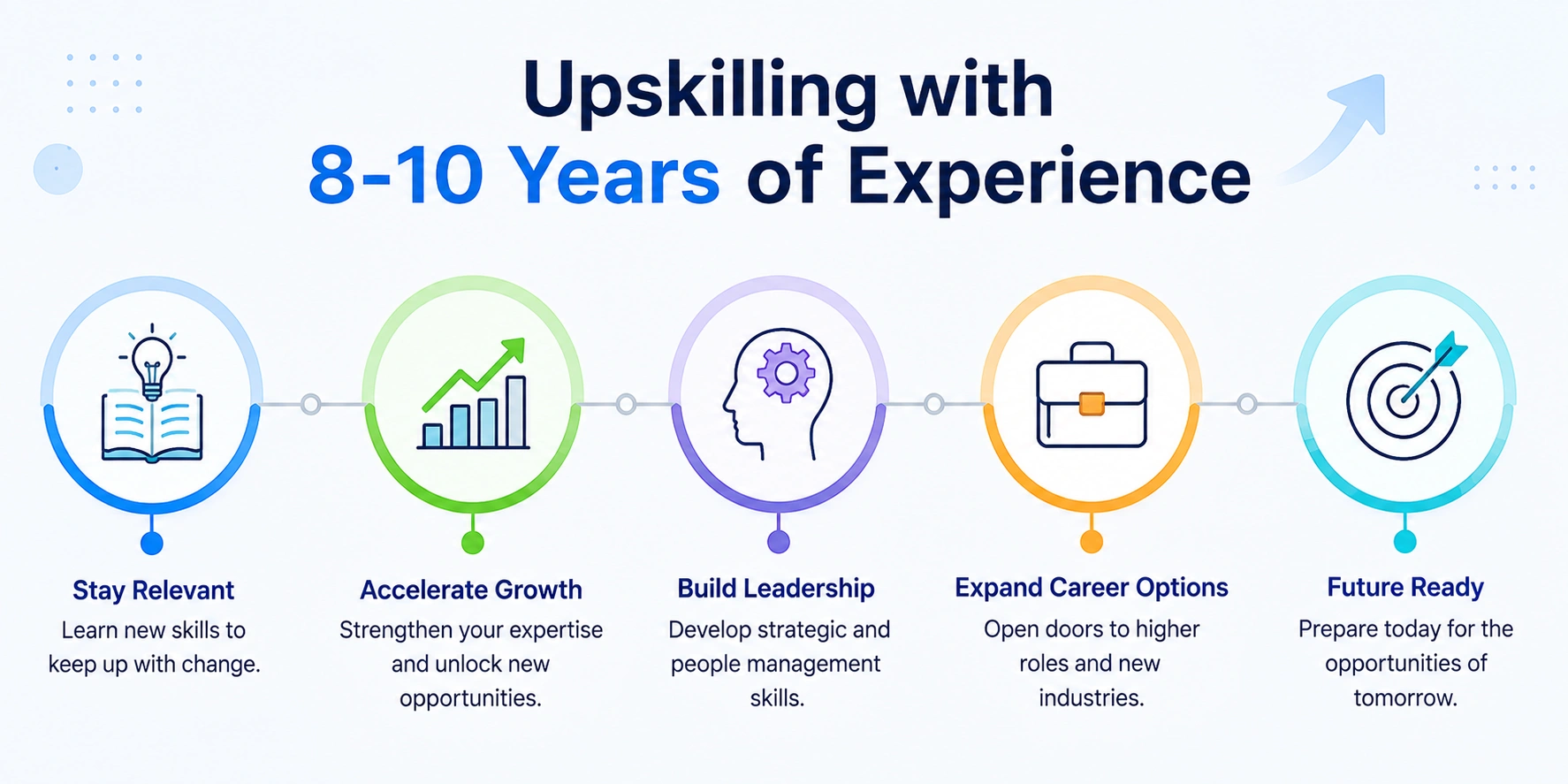
In 2026, simply relying on years of experience is no longer enough to secure senior roles or salary growth. Employers are looking for professionals who can combine experience with modern business, technology, and leadership skills. This has made upskilling after 10 years one of the smartest investments for long-term career success.
Whether you work in finance, marketing, operations, IT, HR, sales, or consulting, strategic learning can help you transition into leadership roles, switch industries, or remain relevant in a rapidly evolving workplace. But the real question is not whether you should upskill—it is what actually makes sense to study after 8–10 years of experience.
This guide explores the most valuable learning paths, emerging skills, and programmes that support upskilling mid career India while helping professionals make informed career decisions.
 ChatGPT
 Perplexity
 Claude
 Grok
GrokWhy Mid-Career Professionals Need to Upskill in 2026
The workplace today is vastly different from what it was a decade ago. Artificial intelligence, automation, digital transformation, sustainability initiatives, and data-driven decision-making have become central to business strategy. Roles that once relied solely on technical expertise now require cross-functional thinking, digital fluency, and leadership capabilities.
Professionals with nearly a decade of experience are expected to manage teams, influence business outcomes, and contribute to organisational strategy rather than simply execute tasks.
This shift has made professional development senior professional India a business necessity rather than an optional career move.
Organisations increasingly prefer leaders who understand technology, analytics, customer experience, innovation, and business strategy. As a result, professionals who continuously learn often enjoy faster promotions, greater responsibilities, and stronger job security.
Why Experience Alone Is No Longer Enough
Many professionals assume that years of experience automatically translate into career progression. While experience remains valuable, employers now prioritise professionals who can demonstrate measurable impact and adapt to changing business environments.
For example, a marketing manager is now expected to understand AI-powered marketing tools and customer analytics. A finance professional must be comfortable with automation and business intelligence platforms. HR leaders need expertise in workforce analytics and digital talent management.
This changing landscape explains why upskilling after 10 years has become increasingly important across industries.
Learning new skills signals adaptability, curiosity, and leadership potential—qualities that organisations actively seek in senior professionals.
What to Study with 10 Years Experience?
One of the most common questions professionals ask is, what to study with 10 years experience without starting their careers from scratch.
The answer depends on your long-term career goals rather than your current designation.
If you aspire to become a business leader, strategic management and leadership programmes can provide broader business exposure. Professionals aiming for technology-driven leadership may benefit from learning Artificial Intelligence, Data Analytics, or Digital Transformation. Those interested in innovation can explore Product Management, while finance professionals may consider Financial Strategy or Corporate Governance programmes.
Similarly, professionals in HR, operations, marketing, and supply chain can choose executive programmes that strengthen leadership and strategic decision-making instead of purely technical skills.
The objective is to build complementary capabilities that expand your career opportunities rather than duplicate existing expertise.
Leadership Skills Are Becoming More Valuable Than Functional Expertise
One noticeable trend in 2026 is that organisations increasingly promote professionals who can lead people, manage change, and drive business outcomes.
Technical expertise may help you reach middle management, but leadership skills often determine whether you move into senior management or executive positions.
Leadership programmes help professionals develop capabilities such as strategic thinking, stakeholder management, business communication, conflict resolution, negotiation, financial decision-making, and organisational leadership.
These competencies prepare professionals to handle larger teams, manage cross-functional projects, and influence organisational strategy.
For many professionals, leadership development represents one of the smartest investments in upskilling mid career India.
Digital Skills Are No Longer Limited to Technology Professionals
One of the biggest misconceptions is that AI, analytics, and automation are relevant only for IT professionals.
In reality, every business function now relies on technology.
Finance teams use predictive analytics. Marketing teams leverage AI for campaign optimisation. HR departments use workforce analytics. Sales teams depend on CRM automation. Supply chain professionals rely on digital planning tools.
Understanding these technologies allows professionals to collaborate more effectively across departments and make informed business decisions.
Rather than becoming programmers, senior professionals need enough digital knowledge to lead technology-enabled business initiatives.
Best Courses After 8–10 Years of Experience
Choosing the right programme depends on your career aspirations, industry, and existing expertise. However, several learning paths continue to deliver strong career outcomes for experienced professionals.
Executive MBA or Online MBA
An Executive MBA or Online MBA remains one of the most popular choices for professionals seeking leadership roles. These programmes strengthen business strategy, finance, marketing, operations, and people management skills while allowing learners to continue working.
For professionals planning to move into general management, this remains one of the best courses 10 years experience.
Artificial Intelligence for Business Leaders
AI is no longer restricted to engineers. Business leaders who understand AI adoption, automation, and intelligent decision-making are becoming increasingly valuable.
Executive programmes designed specifically for managers help professionals leverage AI without requiring coding expertise.
Product Management
Product Management has emerged as one of the fastest-growing career paths across technology, healthcare, fintech, manufacturing, and consumer businesses.
Professionals with experience in engineering, operations, sales, or marketing often transition successfully into product leadership roles after specialised training.
Data Analytics for Managers
Modern organisations depend heavily on data-driven decisions.
Learning analytics enables professionals to interpret business data, measure performance, and make strategic recommendations with greater confidence.
Digital Transformation
Companies continue investing heavily in digital transformation initiatives.
Professionals who understand digital business models, innovation frameworks, automation, and change management often become key contributors to organisational growth.



Should You Reskill Mid Career or Deepen Existing Expertise?
Another common dilemma is whether to specialise further or completely change career directions.
The answer depends on your long-term goals.
If you enjoy your current industry but want faster career growth, deepening your expertise through leadership programmes, certifications, or specialised executive education may be the better option.
However, if your industry has limited growth prospects or your interests have evolved significantly, it may be worthwhile to reskill mid career.
Reskilling involves acquiring entirely new capabilities that prepare you for different roles or industries. Examples include moving from operations into product management, finance into analytics, or traditional marketing into digital marketing.
Fortunately, today’s executive education ecosystem makes career transitions more achievable than ever.
How to Choose the Right Upskilling Programme
Selecting the right programme requires more than following industry trends.
Start by identifying where you want your career to be in the next five years. Are you aiming for leadership? A higher salary? Industry transition? Entrepreneurship? Global opportunities?
Once your objective is clear, evaluate programmes based on curriculum relevance, industry recognition, faculty expertise, flexibility, networking opportunities, and practical learning.
Mid-career professionals should prioritise programmes that offer real-world case studies, live projects, peer learning, and exposure to experienced industry leaders.
The strongest learning experiences help professionals immediately apply new knowledge within their current organisations.
Building a Long-Term Learning Mindset
Upskilling should not be viewed as a one-time activity completed every decade.
The most successful professionals treat learning as an ongoing process.
They regularly read industry reports, attend webinars, participate in executive education, engage with professional networks, and stay informed about emerging technologies.
This continuous approach allows professionals to remain adaptable as industries evolve.
In 2026, organisations increasingly reward professionals who demonstrate curiosity, innovation, and a willingness to embrace change.
Final Thoughts
Reaching eight to ten years of experience is a significant career milestone—but it is also a critical decision point.
The skills that helped you succeed during the first decade of your career may not be enough to secure leadership positions over the next decade. Organisations increasingly expect professionals to combine domain expertise with business strategy, digital capabilities, leadership, and innovation.
That is why upskilling after 10 years is no longer optional. Whether your goal is to earn a promotion, switch industries, increase your salary, or prepare for executive leadership, choosing the right learning path can significantly influence your future career trajectory.
Instead of asking whether you should continue learning, ask yourself what to study with 10 years experience that aligns with your ambitions. Focus on programmes that strengthen leadership, enhance strategic thinking, build digital fluency, and prepare you for the changing workplace.
Ultimately, successful upskilling mid career India is about making purposeful learning decisions that create long-term career value. If approached strategically, there has never been a better time to reskill mid career and unlock new opportunities.
Frequently Asked Questions
The best option depends on your career goals. Executive MBAs, leadership programmes, AI for business, data analytics, product management, and digital transformation courses are among the most popular choices for upskilling after 10 years.
If you’re wondering what to study with 10 years experience, choose programmes that complement your existing expertise, such as strategic leadership, business analytics, AI, digital transformation, or specialised executive education.
Yes. Many professionals successfully reskill mid career to transition into high-growth fields like product management, analytics, AI, consulting, and digital business, leading to better career opportunities.
Some of the best courses 10 years experience include Executive MBA programmes, AI for Business, Product Management, Data Analytics, Digital Transformation, Leadership Development, and Financial Strategy.
Professional development senior professional India helps experienced professionals stay relevant, adapt to changing business needs, strengthen leadership capabilities, and improve their chances of securing senior management and executive roles.

Related Courses
Explore our programs


Find a Program made just for YOU
We'll help you find the right fit for your solution. Let's get you connected with the perfect solution.

Is Your Upskilling Effort worth it?
 ROI Calculator

Are Your Skills Meeting Job Demands?
Try our Skill Gap tool
Experience Lifelong Learning and Connect with Like-minded Professionals
Explore Jaro Connect
