Emerging MBA specialisations with strong career potential
MBA courses subjects: What will you study?
Which field is best in MBA?
A Master of Business Administration (MBA) can help professionals build business knowledge, leadership capabilities, and specialised expertise for a wide range of career paths. While an MBA provides a broad understanding of management, choosing the right specialisation can help you develop skills aligned with your career goals and the demands of your preferred industry.
Today, students can choose from traditional areas such as Finance, Marketing, Human Resources, and Operations, as well as newer fields such as Business Analytics, Digital Marketing, Healthcare Management, and Artificial Intelligence.
With so many options available, understanding the MBA specialisations and the career opportunities associated with each can make the decision easier.
In this guide, we explore the different domains in MBA, popular MBA specialization courses, career opportunities, and factors to consider when deciding which field is best in MBA.
Most MBA programmes begin with core subjects that introduce students to fundamental areas of management. These may include accounting, finance, marketing, operations, economics, organisational behaviour, and business strategy. Students can then select electives or a specialisation based on their interests and career plans.
Here are some of the most popular types of MBA specializations to consider:
MBA specialisation
What you learn
Potential career areas
MBA in Marketing
Brand management, consumer behaviour, market research, sales, advertising, and digital marketing
Global markets, international trade, cross-border operations, and global strategy
International Business Manager, Export Manager, Global Strategy Consultant
The right option ultimately depends on your academic background, strengths, interests, and long-term career plans rather than simply choosing the specialisation with the highest salary.
Emerging MBA specialisations with strong career potential
The MBA landscape is evolving alongside changes in technology, consumer behaviour, healthcare, sustainability, and global business. As a result, several newer MBA specialization courses are gaining attention.
1. MBA in Entrepreneurship
An MBA in Entrepreneurship is designed for students who want to build, manage, or scale a business. Along with traditional management knowledge, the programme can cover opportunity identification, business planning, innovation, funding, marketing, and entrepreneurial strategy.
This specialisation can be particularly useful for aspiring entrepreneurs and professionals who want to work with startups or innovation-focused organisations.
General Management is among the more flexible MBA options because it provides exposure to several areas of business rather than concentrating heavily on one function.
Students may study subjects related to finance, marketing, operations, strategy, leadership, and people management. This broad exposure can be useful for professionals who want to move into cross-functional management roles.
An MBA in General Management can lead to roles such as:
Business Manager
Management Consultant
Strategy Manager
Operations Manager
Business Development Manager
3. MBA in Healthcare Management
Healthcare is a complex sector that requires professionals who understand both management principles and the operational realities of healthcare organisations.
An MBA in Healthcare Management can cover areas such as healthcare operations, hospital administration, healthcare strategy, finance, quality management, and healthcare policy.
It can be relevant for professionals looking to work with hospitals, pharmaceutical companies, health-tech organisations, healthcare consulting firms, and other healthcare businesses.
4. MBA in Business Analytics
Businesses increasingly use data to understand customers, improve operations, manage resources, and make strategic decisions. An MBA in Business Analytics combines management education with analytical and data interpretation skills.
The curriculum may include statistics, data visualisation, business intelligence, predictive analytics, and decision-making.
Students can develop the ability to:
Understand and interpret business data
Identify patterns and trends
Support data-driven decisions
Evaluate business performance
Translate analytical findings into business strategies
Potential career opportunities include Business Analyst, Data Analyst, Business Intelligence Manager, Analytics Consultant, and Strategy Analyst.
5. MBA in International Business
An MBA in International Business is suitable for students interested in the global business environment. It combines core management concepts with subjects related to international markets, global strategy, international trade, cross-border operations, and cultural differences in business.
The specialisation can be particularly relevant for professionals who aspire to work with multinational companies or businesses involved in international markets.
Potential roles include:
International Business Manager
Global Business Development Manager
Export Manager
International Marketing Manager
Global Strategy Consultant
6. MBA in Artificial Intelligence and Machine Learning
Artificial Intelligence and Machine Learning are transforming how organisations approach products, customer experiences, automation, analytics, and decision-making.
An MBA focused on AI and Machine Learning can help management professionals understand the business implications of these technologies while developing knowledge of AI-led business transformation.
The combination of management and technology can be useful for professionals who want to:
Support technology-led business strategies
Understand AI-driven products and services
Identify opportunities for automation
Participate in digital transformation initiatives
Make informed technology investment decisions
This can be an emerging option for professionals who want to work at the intersection of business and technology.
7. MBA in Digital Marketing
Digital Marketing focuses on how businesses use digital channels to reach, engage, and retain customers. An MBA in Digital Marketing can combine management fundamentals with areas such as search engine optimization, social media marketing, content strategy, paid advertising, customer analytics, and digital brand management.
The specialisation can be particularly relevant as businesses continue to invest in their online presence and digital customer journeys.
Career opportunities may include:
Digital Marketing Manager
Performance Marketing Manager
Brand Manager
SEO Manager
Social Media Manager
Content Marketing Manager
MBA courses subjects: What will you study?
The exact curriculum differs across universities and programmes, but most MBA courses cover a combination of core management subjects and specialised electives.
Common MBA courses subjects include:
Financial Management
Marketing Management
Human Resource Management
Operations Management
Business Economics
Accounting for Managers
Organisational Behaviour
Business Communication
Business Research Methods
Strategic Management
Entrepreneurship
Business Law
Supply Chain Management
Business Analytics
Specialised programmes then build on these fundamentals. For example, an MBA in Finance may include investment management and financial modelling, while an MBA in Marketing may focus on consumer behaviour, brand strategy, and digital marketing.
Understanding the curriculum is therefore important when comparing different MBA programmes.
Which field is best in MBA?
There is no single answer to which field is best in MBA because the ideal specialisation depends on your interests, existing skills, educational background, and career goals.
For example:
Finance may suit students interested in financial markets, investment, accounting, and analysis.
Marketing can be suitable for those interested in consumers, branding, communication, sales, and market strategy.
HR may appeal to students who enjoy working with people, organisational development, and talent management.
Operations can be a good fit for those interested in processes, efficiency, project management, and business operations.
Business Analytics may suit students who enjoy working with data and solving business problems.
IT Management can be relevant for professionals interested in technology and business strategy.
Entrepreneurship may be suitable for aspiring founders and professionals interested in building new ventures.
Healthcare Management can be relevant to those interested in the business side of healthcare.
Rather than asking which specialisation is universally the best, consider which one fits your career direction most closely.
Which field is best in MBA after BCom?
BCom graduates already have an academic foundation in accounting, finance, economics, taxation, and business. This can make certain MBA specialisations particularly familiar, although BCom graduates are not limited to these options.
MBA in Finance can be a natural choice for students who enjoyed financial management, accounting, investment, and economics during their BCom.
However, other specialisations can also offer strong career pathways. Students interested in consumer behaviour and business communication can explore Marketing, while those interested in data and decision-making can consider Business Analytics.
If you are wondering which field is best in MBA after BCom, consider these broad options:
BCom interest or strength
MBA specialisation to explore
Accounting and financial analysis
Finance
Business communication and consumer behaviour
Marketing
Data and analytical thinking
Business Analytics
People and organisational behaviour
Human Resources
Business processes and efficiency
Operations
Technology and business systems
IT Management
Global trade and markets
International Business
Starting or managing a business
Entrepreneurship
Your BCom background can provide a useful foundation, but your career objective should remain the primary factor when selecting a specialisation.
Free Courses
Finance for All – Free Finance Certification Course
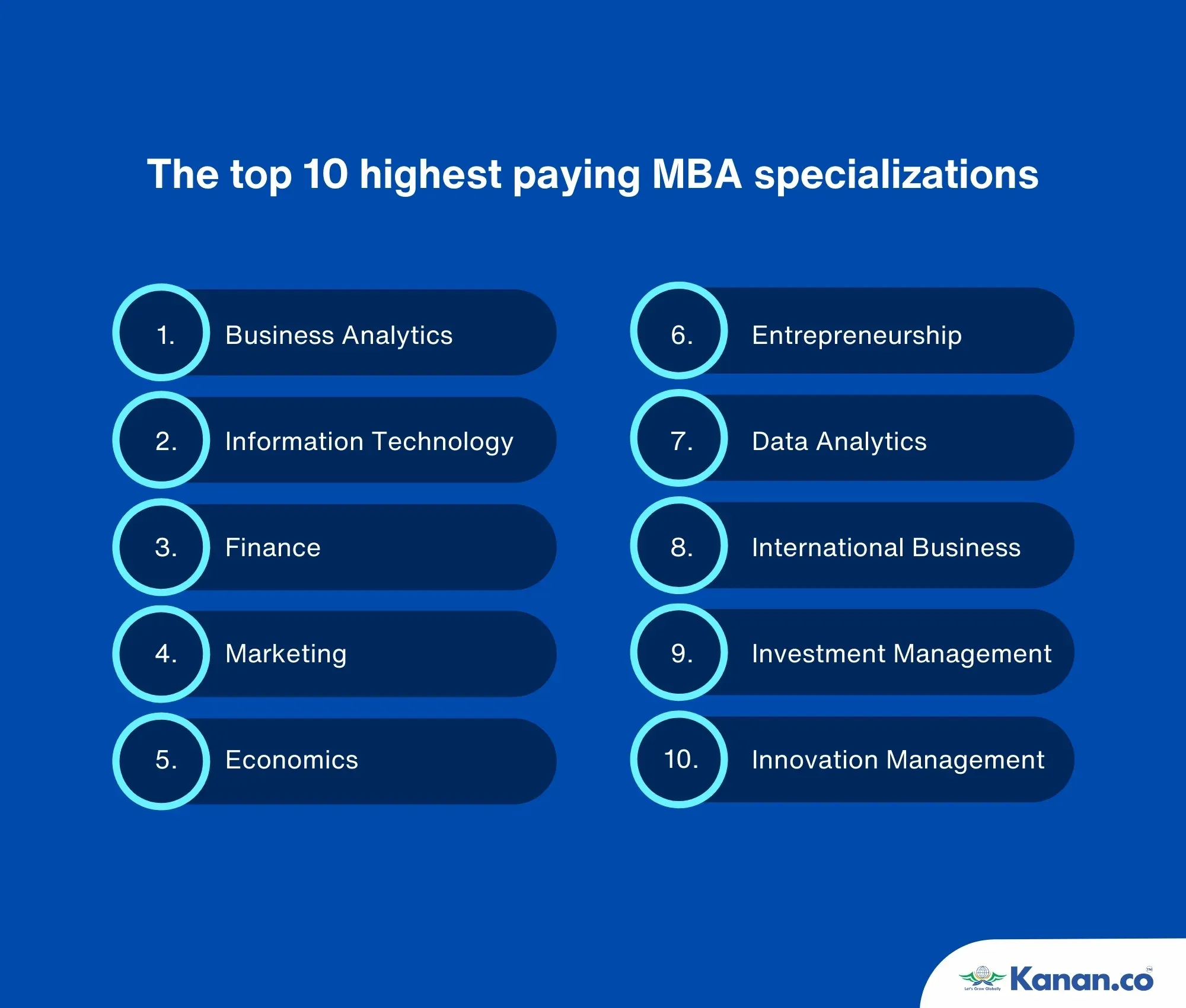
Salary after an MBA depends on several factors, including the specialisation, job role, industry, organisation, work experience, location, and institute from which the MBA is completed. Therefore, there is no single specialisation that guarantees the highest salary for every graduate.
Credits: www.kanan.co
Finance, consulting, technology, product management, business analytics, and strategy can offer strong earning potential in the right roles and organisations. However, compensation should not be the only factor in your decision.
For example, someone with strong analytical skills may progress faster in Business Analytics or Finance, while someone with strong communication and commercial skills may perform better in Marketing or Sales.
When evaluating which field in MBA has the highest salary, consider both earning potential and your ability to build expertise and progress within that field.
How to choose the right MBA specialisation?
Choosing among the different MBA specialisations can feel overwhelming. A structured approach can make the decision easier.
Consider your career goals
Start by identifying the type of role or industry you want to enter. If you have a clear career objective, shortlist specialisations that directly support it.
Evaluate your existing skills
Think about the subjects and activities you naturally perform well in. Analytical thinkers may prefer Finance or Business Analytics, while strong communicators may enjoy Marketing or HR.
Review the curriculum
Do not select a specialisation based only on its name. Review the subjects, electives, projects, and learning outcomes. Compare the curriculum of different MBA specialization courses before making a decision.
Consider your academic background
Your previous education can provide a useful starting point. For example, BCom graduates may find Finance familiar, while graduates from technology backgrounds may consider IT Management or Business Analytics. However, you can choose an MBA specialisation outside your undergraduate field if it aligns with your goals.
Research career opportunities
Look at the job roles associated with each specialisation and assess whether they match your expectations. Consider the industry demand, required skills, career progression, and work profile rather than focusing only on starting salary.
Think about long-term relevance
Technology and business models continue to evolve. Specialisations such as Business Analytics, AI and Machine Learning, and Digital Marketing can provide exposure to areas undergoing rapid change. At the same time, established fields such as Finance, Marketing, HR, and Operations continue to play important roles across industries.
How Jaro Education can help you choose the right MBA course
Jaro Education provides learners with access to a range of management and professional education opportunities. Choosing an MBA programme involves more than selecting a specialisation. Factors such as programme structure, curriculum, learning format, university, career goals, and professional experience also need to be considered.
Jaro Education can help learners explore programmes across areas such as Finance, Marketing, HR, Business Analytics, and other emerging management domains. Through its education platform and guidance, learners can compare options and identify programmes that align with their professional aspirations.
Whether you are a BCom graduate exploring an MBA for the first time or a working professional looking to strengthen your management skills, understanding your goals can help you make a more informed course decision.
The best MBA specialisation is ultimately the one that aligns with your interests, strengths, career goals, and preferred industry. Finance, Marketing, HR, Operations, Business Analytics, IT Management, and newer fields such as AI and Digital Marketing each offer different career pathways.
Instead of choosing a specialisation solely because it is considered popular or highly paid, evaluate the curriculum, skills required, career opportunities, and long-term relevance. With the right choice of MBA specialisations, an MBA can become a valuable step towards building a focused and sustainable management career.
Frequently Asked Questions
Common MBA specialisations include Finance, Marketing, Human Resources, Operations, Supply Chain Management, IT Management, International Business, Entrepreneurship, Healthcare Management, and Business Analytics. Emerging areas include Digital Marketing, Artificial Intelligence, Machine Learning, and Sustainability.
BCom graduates can explore Finance, Marketing, Business Analytics, HR, Operations, International Business, and other specialisations. Finance can be a natural fit for students interested in accounting, investments, and financial management, but the best choice depends on individual career goals.
There is no single MBA specialisation that guarantees the highest salary. Finance, consulting, technology, analytics, strategy, and product-related roles can offer strong earning potential depending on the candidate’s skills, experience, organisation, role, and institute.
The difficulty depends on the specialisation and your existing knowledge and skills. Finance and Business Analytics may involve more quantitative concepts, while Marketing and HR may involve greater emphasis on communication, strategy, and people management.
Common MBA courses include Financial Management, Marketing Management, Human Resource Management, Operations Management, Business Economics, Accounting, Organisational Behaviour, Business Communication, Business Research Methods, and Strategic Management. Specialised programmes include additional subjects related to the chosen domain.
Yes. An MBA is a multidisciplinary management degree, and students can generally choose a specialisation that differs from their undergraduate background, subject to the eligibility requirements of the specific programme.
Consider your career goals, interests, strengths, academic background, preferred industry, curriculum, and potential career opportunities. Comparing different MBA specialization courses can help you identify the option that best matches your professional plans.
Manya Tohani
Personal Growth Mentor
Manya Tohani is a Personal Growth Mentor and content strategist, helping individuals build strong personal brands and accelerate career growth. With 8M+ impressions and experience mentoring students, she empowers others through actionable guidance, resilience, and real-world insights.

 April 19, 2024
 9 min read





 ChatGPT
 Perplexity
 Claude
 Grok
Grok









 ROI Calculator