The ROI of an MBA: Salary Surges and Long-Term Gains
MBA vs. Masters: Understanding the Critical Differences
A Master of Business Administration (MBA) is more than a credential hanging on a wall — it's one of the most strategically powerful moves a professional can make. At its core, an MBA is a postgraduate degree designed to develop holistic business competency, covering everything from finance and operations to organizational behavior and global strategy.
The standard definition is straightforward: an MBA equips graduates with the analytical frameworks, leadership skills, and business acumen needed to manage complex organizations across industries. But what's changed dramatically in recent years is how that education is delivered — and why people pursue it.
The degree has evolved. The old model of a generalist management education — broad exposure, little depth — is giving way to something more purposeful. Today's top programs blend core business fundamentals with specialized strategic concentrations, from data analytics to sustainability leadership, responding directly to employer demand.
More importantly, the MBA has emerged as the premier career pivot tool for ambitious professionals. According to find-mba.com, career pivots tied to MBA programs are happening earlier than ever before, with candidates using the degree to engineer deliberate transitions rather than simply accelerate existing paths.
“An MBA isn't just an academic milestone — it's a structured mechanism for reinventing your professional identity.”
For anyone researching Master of Business Administration (MBA) jobs, career outcomes, or return on investment, understanding what this degree actually does — not just what it is — makes all the difference. The program format you choose shapes everything that follows.
Not every MBA looks the same — and that’s by design. Programs have evolved significantly to match the diverse needs of working professionals, career changers, and global leaders. Choosing the right format is just as strategic as choosing the right school, since it directly shapes your Master of Business Administration (MBA) salary potential, career trajectory, and work-life balance during the program.
Here’s how the main formats break down:
Full-time MBA — Typically two years on campus, ideal for career pivoters who want full immersion and recruiting access
Part-time MBA — Evening or weekend classes, designed for professionals who want to advance without leaving their current role
Executive MBA (EMBA) — Built for senior leaders with significant experience, often employer-sponsored
Online MBA — Flexible, increasingly respected, and expanding rapidly in quality and employer acceptance
MBA Type
Learning Format
Eligibility
Duration
Full-Time MBA
On-campus, regular classes
Bachelor’s degree + entrance exams (CAT/XAT/GMAT)
1–2 years
Part-Time MBA
Evening/weekend classes (on-campus or hybrid)
Bachelor’s degree + work experience (preferred)
2–3 years
Executive MBA (EMBA)
Weekend/short modules for working professionals
Bachelor’s degree + 3–10 years of work experience
1–2 years
Online MBA
Fully online (live + recorded sessions)
Bachelor’s degree (some programs may require work experience)
1–2 years (flexible)
Each format carries different cost structures, networking opportunities, and time commitments. According toYoungstown State University’s MBA resource guide, specializations layered onto any format — from finance to global leadership — further shape earning outcomes.
The right program type sets the foundation for everything that follows, including the application requirements you’ll need to navigate next.
What Do You Need to Apply for an MBA?
Understanding the types of MBA programs available is only half the equation — knowing whether you qualify is the other. Admission requirements vary by program format and prestige, but certain core criteria appear consistently across institutions worldwide, from regional universities to globally recognized schools like those offering a Blended (MBA) Master of Business Administration at IIM Nagpur track.
Most programs look for:
Bachelor’s degree from an accredited institution
GMAT or GRE scores (some programs are now test-optional)
2–5 years of professional work experience (Executive MBAs typically require 8–10 years)
Letters of recommendation, usually from professional supervisors
Personal essays or statement of purpose
Interview (by invitation at competitive programs)
In practice, admissions committees evaluate the full picture — not just scores. Leadership potential, career clarity, and cultural fit often carry as much weight as GPA. Strong candidates don’t just meet requirements; they demonstrate why an MBA is their logical next move.
With the admission checklist clear, the natural next question becomes: is the investment actually worth it? The financial case for an MBA deserves a close, honest look.
The ROI of an MBA: Salary Surges and Long-Term Gains
Understanding the application process is essential — but knowing what you’ll get in return is what makes the decision real. The financial case for an MBA is compelling, and for most graduates, it’s not just about the immediate paycheck.
The Post-MBA Salary Jump
The salary increase following an MBA is one of the most well-documented outcomes in graduate education. Insights fromIMD Business School indicate that MBA graduates often see salary growth of 50% to over 100%, influenced by factors such as industry and program tier. Consulting, finance, and technology tend to deliver the steepest jumps, particularly for those pursuing a Master of Business Administration (MBA) in finance, where six-figure starting salaries are routine at top programs.
Top-Tier vs. Mid-Tier: The 10-Year ROI Breakdown
Not all programs deliver equal returns, and it’s worth being clear-eyed about that. Top-tier programs — think elite business schools with global brand recognition — typically recoup their investment within four to six years when factoring in salary premiums and network access. Mid-tier programs can still deliver strong ROI, often with lower tuition costs and faster payback windows, making them a smart choice for professionals with targeted regional or industry goals.
What typically drives ROI differences:
Recruiter access and on-campus hiring pipelines
Alumni network density in target industries
Geographic reach of the program’s brand
Program specialization alignment with career goals
The long-term gains extend well beyond salary. Promotions, equity compensation, and leadership opportunities compound over a decade in ways that are difficult to quantify upfront but consistently favor MBA holders.
The Bachelor’s Degree Gap
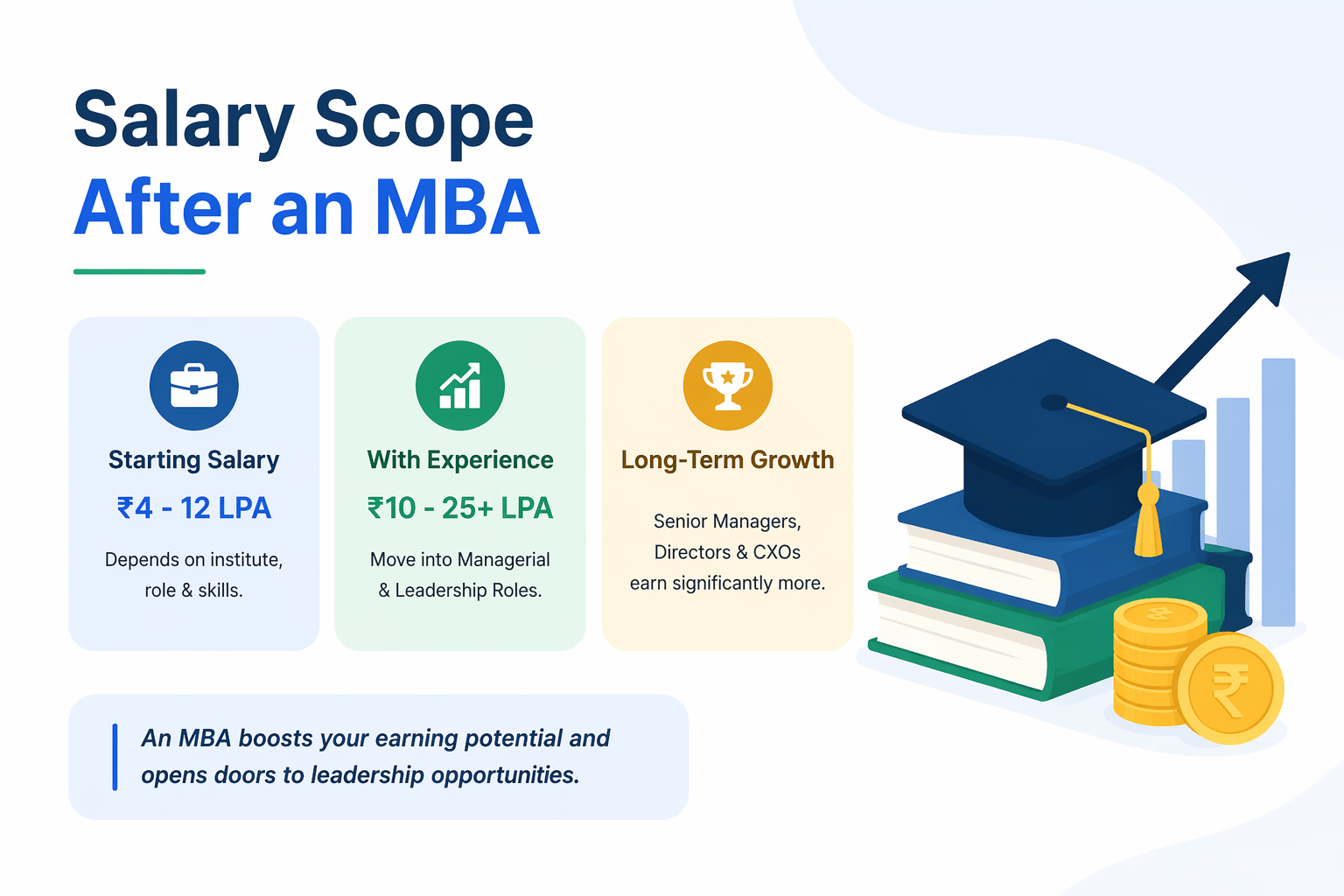
An MBA’s salary premium over a standard bachelor’s degree widens significantly over time. Mid-career MBA professionals in India typically earn ₹10–25 LPA more than their bachelor’s-only peers, with the gap widening further as they move into senior management and leadership roles.
EMBA Candidates: A Different Kind of Return
Executive MBA graduates operate in a unique category. Because most EMBA candidates are already mid-to-senior-level professionals, their ROI is often measured in promotions and expanded scope rather than raw salary entry points. The credential validates leadership capability and frequently unlocks C-suite pathways.
Of course, the MBA isn’t the only advanced business degree worth considering. Understanding how it compares to a specialized master’s degree is a critical next step — and the differences may shape your decision more than you’d expect.
MBA vs. Masters: Understanding the Critical Differences
With a clear picture of what an MBA can deliver financially, the next logical question is: Is an MBA even the right degree for you? For many professionals, the choice comes down to an MBA versus a specialized Master’s degree — and they’re fundamentally different animals.
Experience First vs. Academic First
The most defining distinction is what each program is built around. An MBA is experience-first — it’s designed for professionals who already have real-world business exposure and want to leverage it. Most programs expect two to five years of work experience precisely because peer learning is baked into the curriculum. Your classmates’ career histories are part of the education.
A specialized MSc (Master of Science), by contrast, is academic-first. Programs in finance, data analytics, or supply chain management go deep on technical theory and are typically aimed at recent graduates. The emphasis is disciplinary expertise over cross-functional breadth.
Career Switchers vs. Deep Specialists
An MBA is broadly superior for career pivots. Its generalist framework — covering strategy, operations, finance, and leadership together — equips you to move across industries or functions. An MSc, on the other hand, is the smarter investment when you want to deepen expertise within an existing field rather than redirect it entirely.
In practice, a marketing professional targeting a CFO track benefits more from an MBA’s financial and leadership exposure than from a standalone finance MSc.
Networking and Peer Learning
MBA classrooms in India are intentionally diverse — bringing together professionals from different industries, cities, and functional backgrounds. This diversity creates a powerful peer-learning environment where students gain real-world insights beyond textbooks.
Unlike specialized master’s programs, which often have more uniform academic backgrounds, MBA cohorts include engineers, marketers, consultants, entrepreneurs, and finance professionals — making discussions richer and more practical.
Leading institutions like IIM Ahmedabad and top B-schools such as Symbiosis emphasize this cross-industry exposure as a core advantage. Their cohort diversity and strong alumni networks help students build meaningful connections, gain multiple business perspectives, and unlock long-term career opportunities.
Choosing Based on Career Stage
A practical framework:
Early-career (0–3 years): An MBA can help you build a strong foundation in business, leadership, and strategic thinking early on, giving you a competitive edge across industries.
Mid-career (4–10+ years): An MBA becomes a powerful accelerator — enhancing leadership skills, expanding professional networks, and unlocking high-growth managerial and executive opportunities.
The degree that wins isn’t the most prestigious — it’s the one that matches where you are and where you’re headed. And where you’re headed often depends heavily on what you choose to specialize in — which is exactly where the real strategic decisions begin.
Specializations That Drive Career Growth: Finance, Tech, and Beyond
One of the most compelling features of a Business Administration Master’s Degree MBA program is its built-in flexibility. Unlike a narrowly focused graduate degree, the MBA allows students to layer deep, tailored expertise on top of a broad management foundation — essentially getting the best of both worlds.
1. Finance: The Gateway to Investment Banking and the C-Suite
The MBA in Finance remains one of the most sought-after specializations on Wall Street and beyond. Students who concentrate in finance develop advanced skills in financial modeling, capital markets, and corporate valuation — the exact toolkit that investment banks and private equity firms demand. According to Youngstown State University’s MBA program guide, finance-focused MBA graduates frequently move into roles like Chief Financial Officer (CFO), financial analyst, and portfolio manager, all of which command some of the highest compensation packages available to business professionals.
A finance specialization doesn’t just open doors — it builds the fluency that decision-makers at the highest levels need to operate confidently.
2. The Tech MBA: Built for the Digital Economy
The rise of the Tech MBA reflects a genuine market shift. As companies increasingly operate at the intersection of business strategy and software, demand for graduates who can bridge both worlds has surged. Product management, in particular, has become a flagship destination for Tech MBA graduates. These roles — which blend market analysis, user research, and cross-functional leadership — are a natural fit for someone trained in both technical systems and organizational dynamics. Companies across Silicon Valley and beyond now actively recruit MBA candidates specifically for product management tracks.
3. Matching Specializations to High-Paying Roles
Beyond finance and technology, specializations map directly to specific, high-compensation titles:
Healthcare Management → Hospital Administrator, VP of Operations
Supply Chain & Operations → Operations Manager, Director of Logistics
Entrepreneurship → Founder, Venture Development Lead
Each specialization essentially functions as a career signal — telling employers precisely which domain you’re prepared to lead from day one.
With specializations providing a roadmap for career trajectory, the finance track deserves a closer look at the specific roles and earning potential it unlocks.
4. Finance
Building on the specializations covered earlier, finance stands out as one of the most enduring and high-demand MBA tracks available. When weighing the MBA vs Masters question — specifically an MBA against a specialized Master of Finance — the distinction often comes down to breadth versus depth. An MBA finance concentration delivers quantitative rigor alongside leadership, strategy, and cross-functional business acumen that a narrowly focused master’s degree typically won’t provide.
Finance-track MBA graduates pursue roles in:
Investment banking and capital markets
Corporate finance and financial planning
Private equity and venture capital
Risk management and treasury operations
A finance MBA doesn’t just teach you to read a balance sheet — it trains you to make decisions that move entire organizations forward. In India, finance continues to be among the top-earning MBA specializations, driven by strong demand across banking, consulting, and corporate sectors.
Of course, the right choice depends on your goals. Aspiring CFOs benefit from MBA breadth; those targeting highly technical analyst roles may prefer a specialist master’s. Understanding that nuance is key — and it connects directly to how you position yourself in the market, which is exactly what the next section explores.
5. Marketing
While finance commands attention for its salary ceiling, marketing has emerged as one of the most dynamic MBA specializations in the modern business landscape — and one of the most strategically versatile.
An MBA marketing track goes well beyond brand campaigns. Students develop capabilities in consumer behavior analysis, data-driven decision-making, digital strategy, and market positioning. These skills translate directly into high-visibility roles like Chief Marketing Officer, brand strategist, or product marketing director.
A marketing MBA specialization is arguably the bridge between analytical rigor and human psychology — a combination that’s increasingly rare and valuable.
What makes this track particularly compelling is its cross-functional relevance. Marketing expertise informs product development, pricing strategy, and even investor communications. Insights from leading Indian business schools also indicate that marketing remains one of the most popular MBA specializations.
As you consider where marketing strategy ultimately gets executed, the natural next question becomes: who manages the systems that deliver those strategies at scale? That’s where operations come in.
6. Operations
Often overlooked in favor of flashier tracks, operations management is one of the most strategically valuable MBA specializations — and one of the most consistently in demand across industries. Where finance and marketing drive growth, operations iarewhat keeps an organization functioning at scale.
An MBA with an operations focus equips students with frameworks for supply chain optimization, process improvement, logistics strategy, and resource allocation. These skills translate directly across sectors — from manufacturing and healthcare to retail and tech.
Operations professionals are the architects of efficiency: their decisions directly impact margins, customer satisfaction, and competitive positioning. Top Indian institutes highlight operations as a core MBA specialization, preparing graduates for leadership roles such as operations director, supply chain manager, and COO.
One caveat worth noting — operations roles can vary significantly in scope and compensation depending on industry, so researching sector-specific salary benchmarks before committing is worthwhile.
As organizations increasingly rely on data to streamline workflows and reduce waste, operations and business analytics are converging rapidly — which sets up the next specialization as a natural evolution of operational thinking.
7. Business Analytics
After exploring the strategic value of operations management, it’s worth turning to a specialization that’s rapidly becoming the backbone of every business function: business analytics.
In today’s data-saturated environment, organizations don’t just want managers who can read reports — they want leaders who can build models, interpret patterns, and drive decisions from evidence. An MBA with a business analytics concentration delivers exactly that skillset.
Business analytics combines statistical methods, data visualization, and predictive modeling to solve real-world business problems. Graduates typically move into roles like data strategy manager, business intelligence director, or analytics consultant — positions commanding strong six-figure salaries across industries.
What makes this track particularly compelling is its cross-functional reach. Analytics expertise amplifies every other MBA discipline, from supply chain optimization to marketing attribution.
As companies continue investing heavily in data infrastructure, professionals who speak both business and data fluently are exceptionally well-positioned. That blend of quantitative rigor and strategic thinking also feeds directly into one of the MBA’s most underrated specializations — the people side of business, which we’ll explore next.
8. Human Resources
Building on the data-driven and process-oriented specializations covered earlier, Human Resources (HR) represents the deeply human side of business strategy — and it’s far more analytical than its reputation suggests.
An MBA with an HR concentration moves well beyond traditional personnel management. The curriculum typically covers organizational behavior, talent acquisition strategy, compensation design, labor law, and workforce analytics. The goal is to develop leaders who can align people’s strategy with business objectives — not just administrators who process paperwork.
The most effective HR leaders aren’t just empathetic — they’re organizational architects who design systems that attract, retain, and develop competitive talent.
In practice, HR specialization positions graduates for roles like Chief People Officer, HR Business Partner, or Organizational Development Director — roles that sit directly at the executive table. These career trajectories connect naturally to the broader leadership transitions explored in the next section.
Online MBA Syllabus
The syllabus for an online MBA program is specially curated by leading B Schools, universities, academicians and industry practitioners to offer an in-depth opportunity to today’s age professionals. The syllabus for the intakes may vary depending on the institution providing the program and the specific specialization chosen. However, here is an overview of the common subjects and topics that are covered in an online MBA:
Core Business Courses
Accounting and Financial Management
Business Economics
Marketing Management
Operations Management
Organizational Behaviour
Strategic Management
Business Communication
Business Ethics and Corporate Social Responsibility
Specialization Courses
Finance: Advanced topics in financial management, investment analysis, risk management, and corporate finance.
Marketing: Strategic marketing, consumer behaviour, brand management, digital marketing, and marketing analytics.
Human Resources Management: Talent management, employee development, compensation and benefits, labor relations, and HR analytics.
Entrepreneurship: New venture creation, innovation management, entrepreneurial finance, and business planning.
International Business: Global business environment, international marketing, cross-cultural management, and global strategy.
Elective Courses
Online MBA programs often provide a range of elective courses that allow students to further customize their education based on their interests and career goals. These elective courses may cover areas such as leadership, business analysis, data analytics, business law, negotiation, healthcare management, or information technology.
Capstone Project
Many online MBA programs require students/professionals to complete a capstone project or a comprehensive business project. This project allows students/professionals to apply the knowledge and skills they have acquired throughout the program to solve a real-world business problem or develop a business plan.
Experiential Learning
Some online MBA programs incorporate experiential learning components, such as case studies, simulations, or group projects, to provide practical application of theoretical concepts.
The above overview provides a general outline of the subjects and topics covered in the online MBA curriculum. Prospective participants should review the syllabus and curriculum of the specific online MBA program they are considering to get a detailed understanding of the courses and structure.
The Career Pivot: MBA Jobs and the Transition to Leadership
The specializations covered in earlier sections — analytics, HR, operations — all feed into a broader truth: the MBA’s most powerful function is often career transformation. Whether you’re a software engineer eyeing the C-suite or a finance analyst moving into strategy, the degree exists to bridge the gap between deep expertise and broad leadership capability.
High-Demand MBA Jobs in 2026
Three roles consistently dominate MBA hiring boards right now:
Strategy Consulting — Firms recruit MBA graduates for their ability to synthesize ambiguous data into actionable recommendations. It remains one of the most sought-after post-MBA paths.
Product Management — Tech companies increasingly require PMs with both technical fluency and business acumen, making MBA graduates ideal candidates.
Investment Banking — For those pivoting into finance, the MBA provides both the credential and the network to break into analyst and associate-level roles.
Industry observations indicate that graduates consistently transition into these fields at significantly higher compensation levels compared to their pre-MBA roles.
The Soft Skills Multiplier
The technical skills that earn you a seat at the table rarely keep you there — leadership, negotiation, and strategic thinking are what move careers forward. MBA programs are purpose-built to develop exactly these capabilities. Coursework in organizational behavior, stakeholder communication, and decision-making under uncertainty translates directly into managerial effectiveness. AsIMD notes, these competencies compound over time, often yielding the greatest long-term career dividends.
Closing the Technical-to-Leadership Gap
The most common reason specialists enroll in an MBA is frustration with the Technical-to-Leadership Gap — the invisible ceiling where strong individual contributors stall because they lack cross-functional business literacy. The MBA dismantles that ceiling systematically.
Career services offices play a critical supporting role here. Most top programs offer dedicated coaching, alumni mentorship pipelines, and employer partnerships specifically designed to facilitate mid-career pivots. As noted byLSBF, structured career support is often cited as a key differentiator when choosing between programs.
Choosing the right program matters enormously — which is exactly why institutional rankings and reputation deserve a close look next.
The salary scope after an MBA is generally strong and continues to grow with experience, specialization, and industry demand.
Job Role
After MBA Salary (INR)
Top Employers
Management Consultant
₹12 – 25 LPA
McKinsey, BCG, Bain, Deloitte
Investment Banker
₹15 – 30+ LPA
Goldman Sachs, JP Morgan, Morgan Stanley
Product Manager
₹10 – 25 LPA
Google, Amazon, Microsoft
Marketing Manager
₹8 – 20 LPA
Unilever, P&G, Coca-Cola
Financial Analyst
₹6 – 15 LPA
KPMG, EY, PwC
Operations Manager
₹7 – 18 LPA
Amazon, Flipkart, Tata Group
HR Manager
₹6 – 15 LPA
Infosys, TCS, Accenture
Business Analyst
₹7 – 18 LPA
Accenture, Capgemini, IBM
MBA Programs from Top-Ranking IIMs, IITs, and B-Schools
While much of this guide has focused on the Indian market, it’s worth acknowledging the global landscape — particularly India’s prestigious institutions, which have gained significant international recognition. The Indian Institutes of Management (IIMs) and Indian Institutes of Technology (IITs) consistently rank among Asia’s most competitive business programs, producing graduates who lead multinational corporations worldwide.
Top programs worth noting include:
IIM Ahmedabad – Widely regarded as India’s gold standard for MBA education
IIM Bangalore and IIM Calcutta – Strong finance and consulting pipelines
IIT Delhi and IIT Bombay – Tech-forward MBA programs bridging engineering and business leadership
In practice, these institutions offer rigorous curriculum comparable to top Western programs, often at significantly lower tuition costs — making ROI calculations particularly compelling. The right program isn’t always the most expensive one; it’s the one aligned with your specific career trajectory.
Understanding which institution fits your ambitions ultimately circles back to one foundational question that shapes every smart MBA decision.
Jaro Education offers a diverse range of MBA programs in collaboration with top universities.
No. of Universities Associated
Programme Duration
Eligibility Criteria
35+ including IITs and IIMs
2 Years
Graduation from a recognized university
Minimum 1 year of work experience (in some cases)
Explore Online MBA programs from Top Universities:
Connect with the experts at Jaro Education to get personalized guidance and explore the best MBA options for your career:
What Is Your Goal for Doing an MBA?
Before comparing programs, rankings, or tuition costs, the single most important question is deceptively simple: why do you actually want an MBA?
Clarity of purpose is the strongest predictor of MBA success. Applicants who articulate a specific goal — a career pivot, a leadership promotion, launching a venture — consistently extract more value from the degree than those pursuing it out of inertia or vague ambition.
Common goals typically fall into a few distinct categories:
Career acceleration — moving faster within your current industry
Career pivot — switching sectors or functions entirely
Entrepreneurship — building the frameworks and network to launch something new
Each goal points toward a different program type, format, and timeline. Someone accelerating in finance needs a different MBA than someone pivoting from engineering into consulting.
Honest self-assessment here also prevents costly misalignment. A full-time two-year program makes sense for deep career pivots; a part-time or accelerated format suits those building on an existing trajectory.
That format decision — one year versus two — deserves its own careful analysis.
Explore Online MBA Videos:
Decide Between One-Year vs. Two-Year Programs
Now that you’ve clarified your MBA goals, one of the most practical structural decisions you’ll face is program length. Both formats deliver an MBA credential — but they serve very different needs.
Two-year programs offer deeper immersion: summer internships, broader elective choices, and more robust recruiting cycles. They’re ideal if you’re making a significant career pivot or want maximum networking time. One-year programs compress the curriculum and suit candidates who already have strong functional expertise and simply want to accelerate into a senior role without an extended career break.
The right choice comes down to a few key factors:
Career stage — Are you redirecting entirely, or building on an existing track?
Cost tolerance — One-year programs reduce both tuition and lost income
Recruiting needs — Some industries favor the two-year internship pipeline
The program format you choose shapes your entire MBA experience — not just the timeline, but the depth of relationships, recruiting access, and skill development you’ll gain.
With format, goals, global options, and ROI all now in view, the final step is pulling everything together into clear, actionable conclusions.
Key Takeaways About MBA Programs
Choosing to pursue a Master of Business Administration is one of the most consequential professional decisions you’ll make. Here’s what the evidence consistently shows:
Clarify your “why” first. Program format, cost, and ranking matter far less than alignment with your specific career goals.
ROI is real but variable. IMD research confirms that outcomes depend heavily on industry, specialization, and how proactively you leverage the network.
Career pivots are accelerating. Professionals are using MBA programs earlier and more strategically than previous generations.
Global leadership skills are non-negotiable. Cross-cultural fluency and strategic thinking now define executive readiness.
The right MBA doesn’t just open doors — it fundamentally reshapes how you think, lead, and compete. Use the frameworks in this guide to evaluate programs with intention, not prestige alone. Your next step: revisit your core goals, shortlist two or three programs that genuinely match them, and begin building your application narrative today.
Frequently Asked Questions
An MBA (Master of Business Administration) is a postgraduate degree that develops skills in management, leadership, finance, marketing, and strategy. It prepares professionals to manage businesses, lead teams, and make strategic decisions across industries.
Yes, an MBA is highly valuable for career growth. It helps professionals secure better job roles, higher salaries, and leadership positions. Many MBA graduates transition into high-demand roles like consulting, product management, and finance.
Typically:
2 years – Standard full-time MBA (most common in India)
1 year – Accelerated MBA programs
3 years – Not common for MBA (more typical for other degrees)
The duration depends on the program format and country.
Top MBA programs in India include:
IIM Ahmedabad
IIM Bangalore
IIM Mumbai
IIM Calcutta
IIT Delhi & IIT Bombay (for tech-focused MBA)
The “best” MBA depends on your career goals, specialization, and budget.
Common types include:
Full-time MBA
Part-time MBA
Executive MBA (EMBA)
Online MBA
Each differs in flexibility, cost, and career impact.
Typical requirements include:
Bachelor’s degree
Entrance exams (CAT, GMAT, GRE)
Work experience (optional but preferred)
Personal interview and essays
MBA graduates often see a 50% to 100% salary increase, especially in fields like consulting, finance, and technology.
Yes, an MBA remains one of the best degrees for career growth, especially for:
Career switchers
Mid-level professionals aiming for leadership
Entrepreneurs
ROI depends on the institute, specialization, and career goals.
Manya Tohani
Personal Growth Mentor
Manya Tohani is a Personal Growth Mentor and content strategist, helping individuals build strong personal brands and accelerate career growth. With 8M+ impressions and experience mentoring students, she empowers others through actionable guidance, resilience, and real-world insights.
 HOME > BLOG > Online MBA > What is a Master of Business Administration (MBA)? Defining the 2026 Standard
 April 20, 2026
 20 min read





 ChatGPT
 Perplexity
 Claude
 Grok
Grok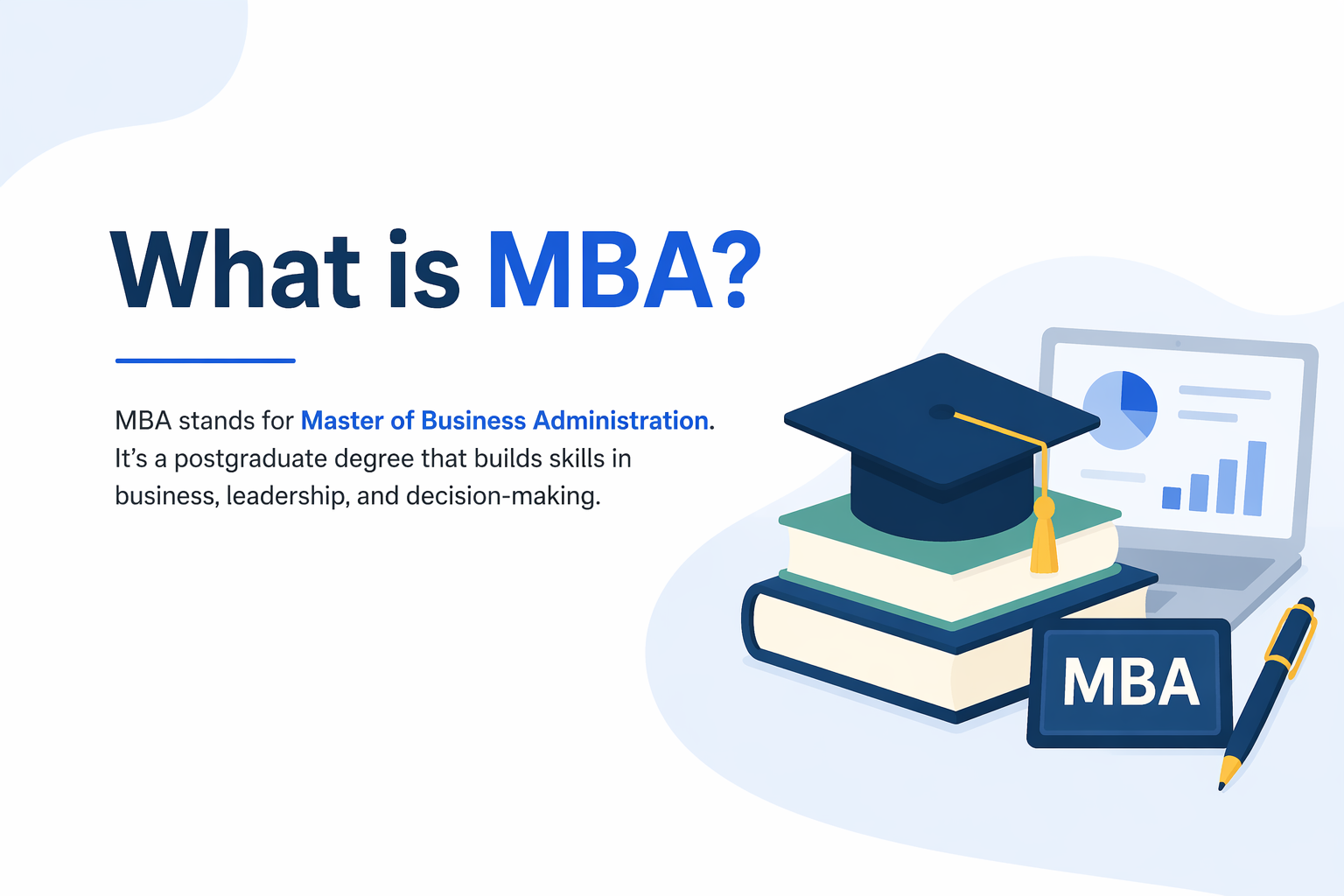





 Admission Open
 Admission Open
 Admission Open
 Admission Open
 Admission Open
 Admission Open
 Admission Open
 ROI Calculator