
Retail Analytics: Meaning, Types, Careers & Applications
 October 21, 2026
 7 min read




Table Of Content
- What Is Retail Analytics?
- Why Retail Analytics Matters Today
- Types of Retail Analytics
- Key Applications of Retail Analytics
 Key Insights
- Retail analytics involves collecting and analyzing sales, customer, inventory, and supplier data to make smarter business decisions, improve pricing, and reduce waste.
- The four main types of retail analytics are descriptive, diagnostic, predictive, and prescriptive analytics, which help retailers understand past performance, identify causes, forecast trends, and recommend actions.
- Retail analytics is used for demand forecasting, inventory management, pricing, promotions, customer personalization, store merchandising, supply chain optimization, and fraud prevention.
- Retail analytics software helps businesses combine data, monitor real time performance, and generate insights. Reliance Retail uses AI, machine learning, and IoT for product recommendations, inventory management, demand forecasting, personalized offers, and supply chain optimization.
- In this blog, you'll learn what retail analytics means, its types and applications, the software and tools used, how Reliance Retail applies data, and the career opportunities and skills needed to enter the field.
Ever wondered how your favorite store always seems to have your size in stock? Or why an app suggests exactly the thing you were about to search for? That's not luck, and it's not magic. It's data doing its job quietly in the background.
Retail analytics is the reason shelves stay full, prices feel right, and offers land at the perfect moment. In this blog, we'll break it down in simple words: what it means, the main types, the tools behind it, how big players use it, and how you can build a career in it.
 ChatGPT
 Perplexity
 Claude
 Grok
What Is Retail Analytics?
Retail analytics is the process of collecting and studying data from a retail business to make smarter decisions. That data can come from anywhere: sales counters, online carts, loyalty cards, website clicks, inventory records, supplier deliveries, and even customer feedback.
Think of it like a shopkeeper who has watched customers for thirty years. They just know that umbrellas sell fast before the monsoon and sweets fly off the shelf before Diwali. Retail analytics does the same thing, only with far more data and far more accuracy.
Instead of guessing, a retailer can answer questions like:
- Which products are selling and which are gathering dust?
- Who are our best customers, and what do they love?
- How much stock should we order for next month?
- What price will attract buyers without hurting profit?
It works for everyone, from a small neighborhood boutique to a giant chain with thousands of stores.
Why Retail Analytics Matters Today
Shopping has changed. People browse on their phones, compare prices in seconds, and expect fast delivery. Competition is fierce, and margins are thin. In this environment, even small mistakes, like overstocking one item or missing a trend, can cost a lot.
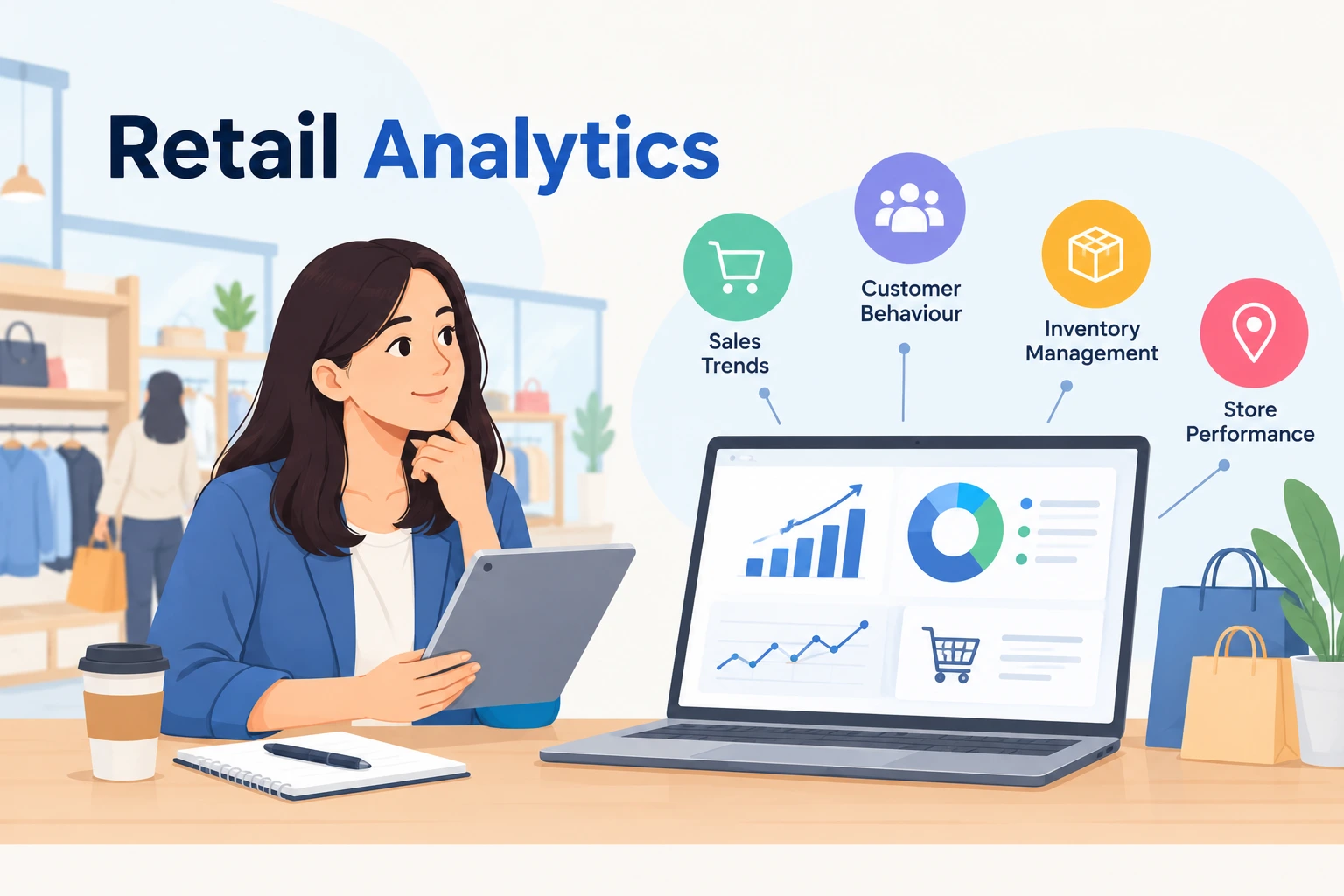
Analytics helps retailers:
- Cut waste by ordering the right amount of stock
- Boost sales through better pricing and promotions
- Understand customers on a personal level
- Save time by automating decisions that used to take days
- Stay ahead of trends instead of chasing them
In short, the retailers who understand their data usually win.
Types of Retail Analytics
Not all analytics answers the same question. There are four main types, and each one builds on the one before.
- Descriptive analytics: What happened? This is the starting point. It looks at past data and summarizes it, such as last month’s sales, top-selling products, or footfall by store. Think reports and dashboards.
- Diagnostic analytics: Why did it happen? Here, you dig deeper. Why did sales drop in one city? Why did a product suddenly spike? You compare data points to find the cause, like a weather change, a competitor’s sale, or a stock-out.
- Predictive analytics: What will happen? This type uses patterns and machine learning to forecast the future. It can predict demand for next festive season, identify customers likely to stop shopping with you, or estimate how many items might be returned.
- Prescriptive analytics: What should we do? The most advanced type doesn’t just predict, it recommends action. It might suggest the best price for a product, the ideal stock to send to each store, or the right discount for each customer segment.
Most retailers start with descriptive reports and slowly move toward prescriptive decisions as their data and skills grow.
Key Applications of Retail Analytics
So where does all this actually show up in a store? Here are the most common ways retail analytics is used every day.
Demand forecasting: Predicting what customers will buy, and when, so shelves are neither empty nor overflowing.
Inventory management: Tracking stock in real time and triggering automatic reorders before an item runs out.
Pricing and promotions: Finding the sweet spot where a price attracts shoppers but still earns a healthy profit. It also helps decide which discounts actually work.
Personalization: Recommending products based on what someone has bought or browsed. If an app has ever suggested the perfect add-on to your cart, that’s analytics at work.
Customer segmentation: Grouping shoppers by habits, spending, or interests so each group gets messages that matter to them.
Store layout and merchandising: Using footfall and sales data to decide where products should sit, so popular items are easy to find, and new ones get attention.
Supply chain optimization: Making sure products move smoothly from supplier to warehouse to store, with fewer delays and lower costs.
Fraud and loss prevention: Spotting unusual returns, billing errors, or suspicious patterns that could signal theft or fraud.
Retail Analytics Software: Tools That Make It Happen
You don’t need to crunch numbers by hand. Modern retail analytics software does the heavy lifting by pulling data from different sources and turning it into easy visuals and insights.
When choosing a tool, here’s what to look for:
- Data integration: It should connect with your billing system, e-commerce platform, inventory, and CRM.
- Real-time dashboards: You want to see what’s happening today, not just last month.
- Forecasting features: Built-in prediction for demand and sales is a big plus.
- Customer insights: Segmentation, loyalty tracking, and purchase behavior analysis.
- Ease of use: If only a data scientist can operate it, your store managers won’t use it.
- Scalability: The software should grow along with your business.
Small retailers often start with simple tools like spreadsheets, Power BI, or Google Looker Studio, or with the analytics built into their point-of-sale or e-commerce platform. Larger businesses typically use dedicated enterprise platforms, along with programming languages like Python and SQL for custom analysis.
A friendly tip: don’t buy the fanciest software first. Start with the questions you most need answered, then pick the tool that answers them.



Reliance Retail Analytics: How a Retail Giant Uses Data
India offers a great real-world example. Reliance Retail, one of the country’s largest retailers, has openly talked about leaning on data and AI across its business. Understanding Reliance retail analytics helps show how analytics works at scale.
According to the company’s technology leadership, Reliance Retail uses AI and machine learning for product recommendations, inventory management, demand forecasting, automated replenishment, supply chain optimization, and customer support through chatbots and sentiment analysis. It also applies the technology to merchandising, trend analysis, assortment planning, pricing, and fraud detection.
There are some interesting specifics, too. The company has talked about using IoT for real-time stock counts and timely replenishment. Its beauty platform, Tira, launched in 2023, uses a customer data platform to bring customer data together and use predictive AI to spot high-value customer groups, improve advertising, and personalize offers. Back in 2020, leaders in its fashion business also spoke about using data and AI to stock store-specific assortments, so that a store in a smaller city carries what its shoppers want rather than a one-size-fits-all range.
What can smaller businesses learn from this? Start with one clear goal, such as better stock planning, bring your data into one place, and let the numbers guide your decisions. You don’t need Reliance-sized resources to benefit from the same thinking.
Careers in Retail Analytics
Good news for job seekers: retail analytics is a growing field with roles for different skills and backgrounds. Here are some popular career paths:
- Retail data analyst: Cleans and studies sales and customer data, then builds reports and dashboards.
- Business intelligence (BI) analyst: Turns data into visual stories that managers can act on.
- Demand planner or forecaster: Predicts future sales to guide purchasing and inventory.
- Pricing analyst: Works out the best prices and discount strategies.
- Customer insights analyst: Studies shopper behavior and loyalty data.
- Supply chain analyst: Improves how products move from suppliers to stores.
- Data scientist: Builds machine learning models for forecasting, recommendations, and personalization.
- Category or merchandising analyst: Uses data to decide which products to stock and promote.
Skills You’ll Need
- Excel and SQL: The foundation for almost every analytics role.
- A BI tool: Power BI, Tableau, or Looker Studio are common choices.
- Python or R: Helpful for advanced analysis and forecasting.
- Basic statistics: Understanding averages, trends, and probability.
- Retail know-how: Knowing how stores, margins, and customers behave makes your analysis far more useful.
- Communication: Being able to explain your findings in simple words is just as important as the analysis itself.
You can begin with a degree in statistics, business, engineering, or economics, but plenty of people also break in through online courses, certifications, and personal projects. Try analyzing a public sales dataset and building a small dashboard. It makes a great portfolio piece.
Final Thoughts
Retail analytics is really just the art of listening to what your data is trying to tell you. It helps stores stock smarter, price better, and treat customers like individuals instead of numbers. Whether you run a small shop, work at a big chain, or are planning to build a career in the field, learning to read retail data is a skill that will keep paying off.
Start small, stay curious, and let the numbers guide you. Your next big retail win might already be sitting in your sales data.
Frequently Asked Questions
Retail analytics means using data from sales, customers, and inventory to make better business decisions. It helps retailers understand what sells, why it sells, and what to do next.
There’s no single best choice. Small retailers often start with the analytics built into their POS or e-commerce platform, along with affordable tools like Google Looker Studio, Power BI, or Excel. Pick software that is easy to use, connects with your existing systems, and answers your most important questions first.






Find a Program made just for YOU
We'll help you find the right fit for your solution. Let's get you connected with the perfect solution.
Is Your Upskilling Effort worth it?
 ROI Calculator

Are Your Skills Meeting Job Demands?
Try our Skill Gap tool
Experience Lifelong Learning and Connect with Like-minded Professionals
Explore Jaro Connect
