How Is Stock Market Prediction Done Using Machine Learning?
Why Do We Need Machine Learning for Stock Market Forecasting?
Key Data Sources for Stock Market Prediction
Types of Machine Learning Used in Stock Market Prediction
The stock market has been a matter of curiosity, excitement, and risk for the global investment community. The recent development towards the availability of data and computational power, the use of machine learning techniques for the prediction of the stock market has been proven to be one the best analytical techniques to interpret the trends and predict the behavior for the days to come.
Machine learning models for stock forecasting have recently become a favorite among traders, analysts, and financial institutions. This is attributed to their ability to process large amounts of data and make predictions that continue to improve over time. With increasingly dynamic financial systems, machine learning models can now become a necessary part of financial forecasting rather than a luxury.
Predicting Stock Market using Machine Learning blog post describes concepts and models for predicting stock markets using machine learning and provides step-by-step details and future trends on predicting the stock market using machine learning techniques.
How Is Stock Market Prediction Done Using Machine Learning?
Stock market predictions by machine learning are a process involving the use of computer algorithms with learning capabilities to make predictions using historical market information for future market stock prices or trends. The technology involves analyzing market information such as market trends and even opinions for improved accuracy in predicting stock market trends.Conventional stock market analysis relies either on fundamental analysis and technical analysis. These, however, do not involve stock prediction using machine learning, as they only rely on patterns in the market and cannot identify unknown patterns in stock market data, as machine learning can.
With a tremendous amount of data being generated daily by financial markets, stock market predictions via machine learning approach enable investors to take decisions swifter and emotionally unbiased.
Why Do We Need Machine Learning for Stock Market Forecasting?
The complexity associated with the stock market has made traditional techniques for prediction inefficient. There are pros associated with machine learning stock prediction, which improves the accuracy of stock market prediction.Machine learning algorithms can process a vast amount of historical data in a matter of seconds. Machine learning algorithms can assess a huge number of variables side by side. This makes stock market predictions via machine learning considerably more inclusive than before. Machine learning algorithms become more accurate with time as they can fine-tune their predictions regarding a new trend or anomaly that arises over time.
Moreover, machine learning models are competent of dealing with non-linear relationships of stock prices, especially in volatile markets. This feature makes stock prediction based on machine learning more reliable than rule-based methods.
Key Data Sources for Stock Market Prediction
Stock market prediction with higher accuracy using machine learning is solely dependent on the quality of data. A variety of data sources contributes towards making an effective machine learning stock prediction model.The foundation of stock market prediction includes historical stock prices: open, close, high, and low. Trading volume data makes it possible to get an idea about the activity of the market and investor interest. Financial statements, earnings reports, and macroeconomic indicators also play an important role.
The news sentiment, social media trend, or a world event is one of the alternative data sources that have been increasingly used in modern stock market prediction using machine learning. These kinds of datasets help the model capture market psychology and external influences.
Types of Machine Learning Used in Stock Market Prediction
Various machine learning techniques are put in place for the prediction of the stock market using machine learning, depending on the aim and type of data.In machine learning stock prediction, supervised learning is widely used. It involves training the models with labeled historical data to do a prediction of future stock prices. The algorithms like Regression and Classification come under this category.
Unsupervised learning enables finding patterns, clusters, or anomalies in the stock market data when no predefined labels are assigned to them. The performance of unsupervised learning will thus uncover hidden structures and improve stock market prediction.
Reinforcement learning is another advanced technique that is applied in the stock market to predict, while machine learning algorithms learn optimal trading strategies by interacting with the market environment in order to maximize returns.
Popular Machine Learning Algorithms for Stock Market Prediction
Efficiency and adaptability make several algorithms normally used in machine learning stock prediction.Linear regression is one of the simple yet effective algorithms for stock market prediction, which finds its major application in identifying long-term trends. Decision trees and random forests are some of the popular ones when the Machine Learning approach is required to handle intricate relationships and reduce overfitting associated with the stock market.
SVM performs well in classification-based machine learning stock prediction and is especially effective in stock price direction forecasting. Nowadays, neural networks, deep learning among them, are increasingly tried for high-accuracy stock market prediction.
Among different Machine Learning approaches, particularly powerful performance for LSTMs is awaited in stock market predictions because of their ability to grasp dependencies between time series and market trends within long spans.
Step-by-Step Process of Stock Market Prediction Using Machine Learning
The prediction of stock markets using machine learning comprises a few steps in a structured pipeline that makes the outcome reliable.First, data collection scrapes historical and real-time stock data. It then cleans and pre-processes the data to remove noise and inconsistencies. Feature engineering transforms raw data into meaningful indicators for machine learning stock prediction.
The next step is the partitioning of this data into training and testing. The training of machine learning models is based on the historical data, and then these models need to be evaluated by performance metrics. Much work in model optimization and tuning needs to be done for improving the accuracy of stock market predictions.
It is used finally to deploy the trained model for real-time stock market prediction using machine learning, where it is continuously learning from new data to refine forecasts.
Role of Technical Indicators in Machine Learning Stock Prediction
Technical indicators are highly crucial in machine learning stock predictions. Indicators of moving averages, RSI, and Bollinger Bands present substantial entries within stock market prediction models.By integrating the indicators, stock market prediction through machine learning becomes efficient in identifying entry and exit points more effectively. Machine learning models can analyze multiple indicators at a time, which enhances the accuracy of predictions.
Technical indicators coupled with machine learning will in one way or another help traders make informed decisions based on facts rather than mere guesses, hence increasing the overall reliability of the stock market forecast.
Fundamental Analysis in Stock Market Prediction Using Machine Learning
Therefore, the fundamental analysis of a company’s financial state is critical for long-term prediction using a machine learning algorithm.It can evaluate the value of stocks by analyzing financial ratios, earnings growth, and balance sheets. This makes the machine learning stock prediction stronger by embedding real business performance measures.
Merging these fundamental data with technical indicators results in hybrid models, which greatly improve stock market prediction outcomes for various investment horizons.
Sentiment Analysis and Stock Market Prediction
Sentiment analysis has become a crucial part of predicting stock market trends using machine learning. Market sentiment often drives short-term price changes.Machine learning models examine news articles, financial reports, and social media posts to assess investor sentiment. Positive or negative sentiment signals improve the accuracy of stock predictions, especially in volatile markets.
Adding sentiment data gives stock market prediction models a better understanding of market psychology and behavioral trends.
Benefits of Machine Learning Stock Prediction
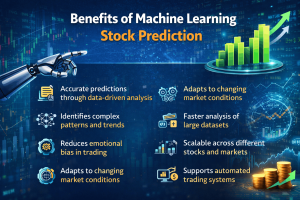
There are multiple benefits of machine learning stock prediction, which are as follows:
Machine learning stock predictions allow for informed decision-making through the evaluation of massive amounts of data from both past and current market trends, thereby increasing levels of accuracy when predicting the stock market.
One of the main advantages of using machine learning for predicting the stock market is the capability to recognize complex patterns and trends that cannot be easily observed through human eyes and observation.
Using machine learning algorithms in stock predictions helps minimize biased investments that may result from emotions since machine learning relies on algorithms rather than intuition.
The stock market prediction via machine learning model is one that is constantly updated through the use of new data.
Machine learning-based stock prediction has another advantage of fast analysis since a computer algorithm can run through several years of stock market data in seconds.
Stock market prediction also becomes scalable with machine learning as the same model can be used for different stocks, sectors, and markets.
The stock market prediction conducted through machine learning techniques enhances risk management by predicting possible stock price volatility in advance.
Stock prediction based on machine learning uses both technology indicators and sentiment information to provide more accurate results.
Machine learning stock prediction helps automated stock trading systems by allowing for the immediate execution of ‘buy’ or ‘sell’ commands.
In general, the use of machine learning technology for stock market prediction helps investors maximize profits, minimize losses, and make informed investment choices.
Challenges in Stock Market Prediction Using Machine Learning
Despite its advantages, predicting the stock market with machine learning has its challenges.Financial markets are highly unpredictable and can be influenced by unexpected events. Overfitting is a common problem in machine learning stock prediction. Models may perform well on historical data but fail in real-world situations.
Data quality, market noise, and regulatory issues also impact the accuracy of stock market predictions. Tackling these challenges requires ongoing model validation and risk management strategies.
Risk Management in Machine Learning Stock Prediction
Risk management is vital when applying stock market prediction using machine learning in real trading situations.Machine learning models should be combined with stop-loss strategies and portfolio diversification. This approach makes sure that machine learning stock predictions support sustainable investment choices instead of speculative risks.
Effective risk management increases the reliability of stock market predictions while protecting investors from large losses.
Real-World Applications of Stock Market Prediction Using Machine Learning
Many hedge funds, banks, and fintech firms use machine learning for stock market prediction to gain a competitive advantage.Algorithmic trading platforms depend on machine learning models for stock prediction to execute trades at the right time. Robo-advisors also use these algorithms to suggest personalized investment strategies.
These real-world applications show the growing significance of machine learning in stock market prediction within the global financial landscape.
Future of Stock Market Prediction Using Machine Learning
The future of stock market prediction using machine learning appears bright as technology keeps advancing. Improvements in deep learning, big data analysis, and quantum computing will further boost the accuracy of machine learning stock predictions. Combining these models with real-time data sources and automated trading systems will change stock market prediction strategies.
As artificial intelligence becomes more sophisticated, machine learning in stock market prediction will be central to the future of investing.
Conclusion
Predicting the stock market has always been a challenging task, but machine learning has changed how investors analyze and predict market behavior. By using data, algorithms, and detailed analytics, machine learning offers more accurate and scalable insights than traditional methods.
While there are challenges, the advantages of machine learning-powered stock market prediction outweigh the downsides. As technology progresses, machine learning will continue to change financial forecasting, enabling smarter, quicker, and more informed investment choices.
For investors open to innovation, using machine learning for stock market prediction is not just a trend; it is the future of smart investing.
Frequently Asked Questions
Stock Market Prediction Using Machine Learning applies historical prices, technical indicators, and market sentiment to spot patterns and trends. Using machine learning stock prediction algorithms will enable investors to make data-driven decisions and enhance the general accuracy of the stock market prediction.
It is a risk management strategy whereby investors in the stock market sell a stock the moment it falls 7% below the purchase price. It contributes to limiting losses while supporting disciplined strategies in stock market prediction using machine learning, particularly machine learning stock prediction.
Yes, it is possible for machine learning stock predictions models to forecast stock price movements by learning from historical and real-time data. Though not perfect, stock market prediction using machine learning improves through adapting to market trends and minimizing human bias.
The AI can choose stocks using stock market prediction with the help of machine learning, based on various financial data, technical indicators, and sentiment analysis. These machine learning stock prediction systems enhance stock market prediction by identifying high-potential investment opportunities.
Dr. Sanjay Kulkarni
Data & AI Transformation Leader
Dr. Sanjay Kulkarni is a Data & AI Transformation Leader with over 25 years of industry experience. He helps organizations adopt data-driven and responsible AI practices through strategic guidance and education. With experience across startups and global enterprises, he bridges the gap between theory and real-world application. His work empowers teams to innovate and thrive in AI-driven environments.
Get Free Upskilling Guidance
Fill in the details for a free consultation
Related Courses
Explore our programs
Advanced Certification Programme in Generative AI & Large Language Models

 January 10, 2026
 9 min read




 ChatGPT
 Perplexity
 Claude
 Grok
Grok










 ROI Calculator