Other Major Companies Announcing Layoffs Amid AI and Business Restructuring
Layoffs vs. Voluntary Buyouts: What Is the Difference?
Why Is the Company Restructuring Its Workforce Amid AI Growth?
Key Insights
Microsoft’s Voluntary Exit Offer covers about 60,000 employees, roughly a quarter of its workforce, across the U.S., Canada, the U.K. and India.
It follows a voluntary retirement programme earlier in 2026, which more than 30% of eligible employees accepted.
Microsoft says AI isn’t driving the buyouts, but coverage links the move to its heavy AI infrastructure spending.
Buyouts let employees choose whether to leave, while layoffs are decided by the employer.
AI is changing the mix of tasks inside jobs, so skills like AI literacy, data skills and critical thinking matter more.
Upskill if your role is evolving, and reskill if it is shrinking or you want a new path.
Jaro Education offers AI programmes with IITs, IIMs and universities that fit both paths.
On October 26, 2026, Microsoft told employees it is offering a Voluntary Exit Offer to about 60,000 people, roughly a quarter of its global workforce. The announcement landed in a year already crowded with job-cut headlines, and it raised a question many professionals are now asking quietly: if a company this large is reshaping its workforce while pouring money into artificial intelligence, what does that mean for my own career?
This blog looks at what Microsoft actually announced, how other companies are restructuring, and why the difference between a layoff and a buyout matters. It also covers how AI is changing the workplace heading into 2027, which skills are worth building, and how to choose between upskilling and reskilling. Throughout, the aim is practical: helping you respond to change with a plan rather than worry.
Here are the key facts, as reported by major outlets:
Who is eligible: About 60,000 employees in participating teams across the United States, Canada, the United Kingdom and India, atlevel 70 and below in Microsoft’s internal ranking.Reports saydivisions such as Xbox, Windows, Copilot and Finance are included, while some groups, including data centre, sales and marketing staff, are excluded.
What is on offer: Terms are similar to Microsoft’s standard severance, along with career planning support.
Timeline: Eligible employees reportedly have until early December to decide, and those who accept would leave by the end of the year.
What came before: Earlier in 2026, Microsoft ran its first-ever voluntary retirement programme for longtime U.S. employees, and more than 30% of those eligible accepted. Microsoft also cut about 4,800 jobs in July and roughly 15,000 in 2025.
Microsoft expects fewer employees to accept this buyout offer than its earlier retirement programme, which offered better benefits to long-serving staff. The company says AI is not the reason behind the buyouts, although reports link them to rising costs from its AI infrastructure investments. Reports also suggest that further layoffs could still happen despite the voluntary exit programme
Other Major Companies Announcing Layoffs Amid AI and Business Restructuring
Netflix: About 1,000 roles, roughly 7% of its workforce, announced October 6.
HubSpot: About 660 roles, or 7%, as it reorganises around an AI-focused strategy. Its CEO said the cuts were not driven by AI efficiencies.
eBay: About 1,000 roles, around 9% of staff.
Barclays: About 5,000 jobs by the end of 2026, which the bank tied to AI investment, mainly affecting developer and support roles.
Electronic Arts: About 400 roles as part of a studio restructuring.
Meta: Around 8,000 roles, about 10% of its workforce, in May.
Amazon: A new round of layoffs, mainly in its Stores division, in October.
One important caveat: companies cite different reasons. One analysis found that only about a quarter of 2026 layoff announcements in its dataset explicitly referenced AI. Restructuring, cost cutting and post-acquisition overhauls are also common drivers, so it is worth reading each announcement on its own terms.
Layoffs vs. Voluntary Buyouts: What Is the Difference?
Aspect
Layoffs
Voluntary buyouts
Who decides
The employer selects who leaves
The employee chooses whether to accept
Employee control
Little to none
Full control over timing and the decision
Typical package
Severance, often set by policy or law
Severance or an enhanced package, sometimes with career support
Employer outcome
Predictable headcount reduction
Uncertain, since uptake depends on who accepts
Morale impact
Often high disruption and anxiety
Generally gentler, though uncertainty remains
For employers, buyouts are a less disruptive way to trim headcount, but they can lead to losing people the company would rather keep. For employees, the question is not just “what is the payout?” but “what is my next move, and do I have the skills to make it?”
Why Is the Company Restructuring Its Workforce Amid AI Growth?
There are several factors at play, and it is important to separate facts from interpretations.
Confirmed: Microsoft is investing heavily in AI data centres and chips, adding pressure to its spending. The company says the new buyout offer gives employees more flexibility and builds on lessons from its earlier retirement programme.
Interpretation: Analysts view the buyouts as a way to reduce costs and shift teams toward AI priorities without relying solely on large-scale layoffs. Microsoft, however, says AI is not driving the programme.
What this means for professionals: Companies are reassessing the roles, skills and team structures they need as AI investments grow.
How AI Is Changing the Workplace and Career Opportunities in 2027
As 2027 approaches, AI’s impact is showing up in three ways:
Task automation. Routine work in support, reporting, basic coding and content drafting is increasingly handled or accelerated by AI tools. This is changing what junior roles look like.
New and evolving roles. Demand is growing for people who can build, deploy, evaluate and govern AI systems, such as data analysts, machine learning engineers, AI product managers, and prompt and workflow specialists.
Changing expectations in every role. Marketing, finance, HR and operations professionals are increasingly expected to use AI tools fluently, not just understand them in theory.
The takeaway is not that jobs are disappearing across the board. It is that the mix of tasks inside jobs is shifting, and professionals who adapt early have more options.
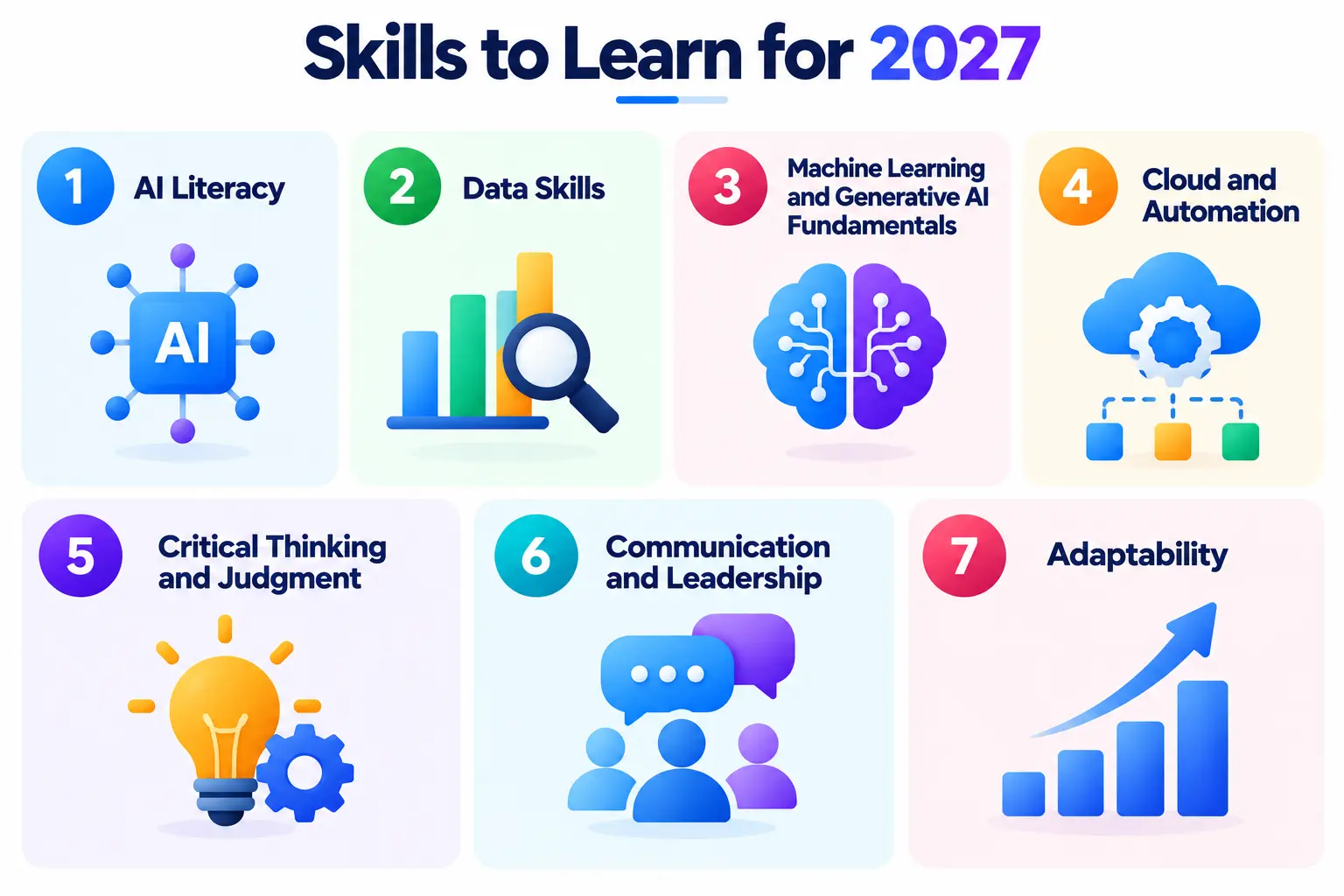
Essential Skills Professionals Should Focus on in 2027
AI literacy: Understanding what AI can and cannot do, and how to use tools responsibly at work.
Data skills: Python, SQL, analytics and the ability to interpret data and question AI outputs.
Machine learning and generative AI fundamentals: Enough depth to work with technical teams or build simple solutions.
Cloud and automation: Familiarity with cloud platforms and workflow automation.
Critical thinking and judgment: Verifying AI outputs, spotting errors and making decisions in ambiguous situations.
Communication and leadership: Explaining technical ideas to non-technical audiences and leading mixed human and AI teams.
Adaptability: The habit of learning continuously, which tends to outlast any single tool.
Upskilling vs. Reskilling: Which Is Right for Your Career?
Upskilling means deepening or extending your skills within your current field, for example, a finance professional learning data analyticsand AI-assisted forecasting. Reskilling means learning a new skill set to move into a different role or field, for example, a support specialist moving into data science.
Aspect
Upskilling
Reskilling
Goal
Grow in your current path
Move to a new path
Best when
Your role is evolving but still relevant
Your role is shrinking or you want a change
Typical time
Shorter
Longer
Example
Marketing manager learns AI analytics
Operations executive moves into data science
A simple test: if the core of your job is changing but still needed, upskill. If the core is being automated or you want a different career, consider reskilling. Many people do a mix of both.
AI Upskilling Opportunities Through Jaro Education Programmes
For working professionals looking for structured learning, Jaro Education is one option to consider. It offers 150+ programmes, including certifications, diplomas, and degrees, in collaboration with institutions such as IITs, IIMs, and other universities. Here are five AI-focused programmes offered through Jaro Education.
6 months, hybrid with live online Saturday sessions and on-campus immersions
Generative AI fundamentals, prompt engineering, responsible AI and governance, AI use cases across business functions, AI project execution and ROI (not a coding programme)
Mid-to-senior managers and business leaders with 5-15 years of experience
Those who want a postgraduate degree rather than a short certificate
What else is relevant for AI-focused learners:
Growing AI portfolio:Jaro’s FY 2025-26 report says its AI-focused programmes grew 150% and now make up about 18% of its portfolio, with a stated target of 30%.
Free starting points:Free introductory courses, such as Python for Data Analysis, can help you test your interest before committing to a longer programme.
Flexibility: Programmes are designed for working professionals who cannot pause their careers.
Whichever university or degree programme you choose, compare the curriculum, institutional recognition, time commitment and cost, and focus on practical projects and career outcomes rather than certificates alone.
Microsoft’s buyout offer is one more sign that large employers are reshaping their workforces as AI investment grows, even when they say AI is not the direct cause. For professionals, the useful response is not alarm but preparation: understand how your role is changing, build skills that complement AI, and choose between upskilling and reskilling deliberately.
Careers in 2027 will reward people who keep learning. Whether you are in a company going through restructuring or simply want to stay ahead of the curve, now is a good time to map your skill gaps and start closing them.
Frequently Asked Questions
About 60,000, roughly a quarter of the global workforce, across the U.S., Canada, the U.K. and India.
Microsoft says AI is not driving the programme. Coverage links the move to the cost of its heavy AI infrastructure spending and its broader workforce reshaping.
In a layoff, the employer decides who leaves. In a buyout, employees choose whether to accept an exit package.
Recent examples include Netflix, HubSpot, eBay, Barclays, Electronic Arts, Meta and Amazon, though their stated reasons differ.
AI literacy, data skills, generative AI fundamentals, cloud and automation, critical thinking, and communication, plus the habit of continuous learning.
Upskill if your role is evolving but still needed. Reskill if your role is shrinking or you want a new direction.
Jaro Education offers university-partnered AI and data programmes, such as the Post Graduate Certificate Programme in Applied Data Science & AI with IIT Roorkee, plus free introductory courses and planning tools like a Skill Gap Calculator.
Dr. Sanjay Kulkarni
Data & AI Transformation Leader
Dr. Sanjay Kulkarni is a Data & AI Transformation Leader with over 25 years of industry experience. He helps organizations adopt data-driven and responsible AI practices through strategic guidance and education. With experience across startups and global enterprises, he bridges the gap between theory and real-world application. His work empowers teams to innovate and thrive in AI-driven environments.
 HOME > BLOG > AI and Machine Learning > Microsoft’s 60,000 Employee Voluntary Buyouts: How AI Is Reshaping Careers and Why Upskilling Matters
 October 29, 2026
 7 min read




 Key Insights
 ChatGPT
 Perplexity
 Claude
 Grok









 ROI Calculator