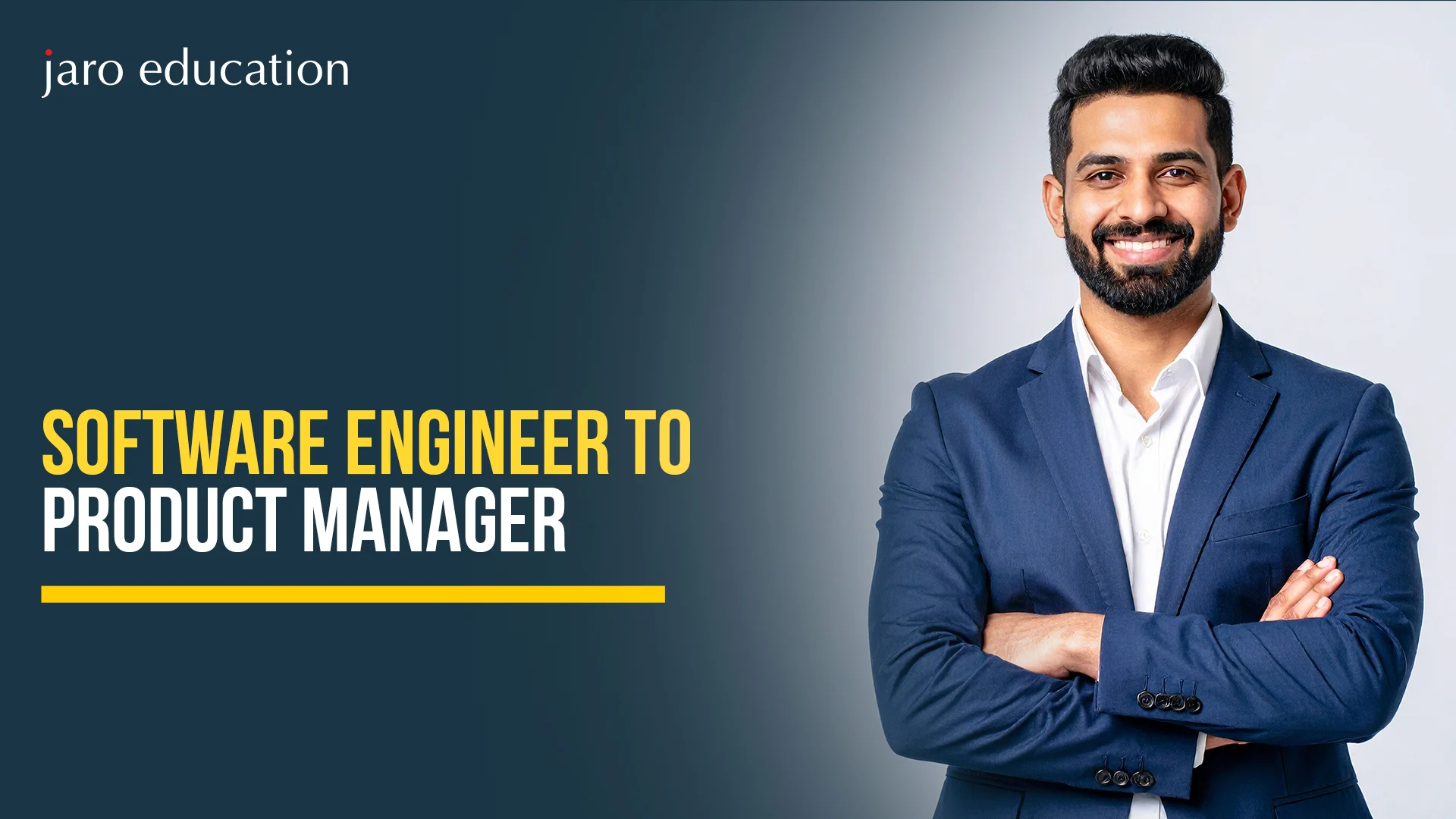
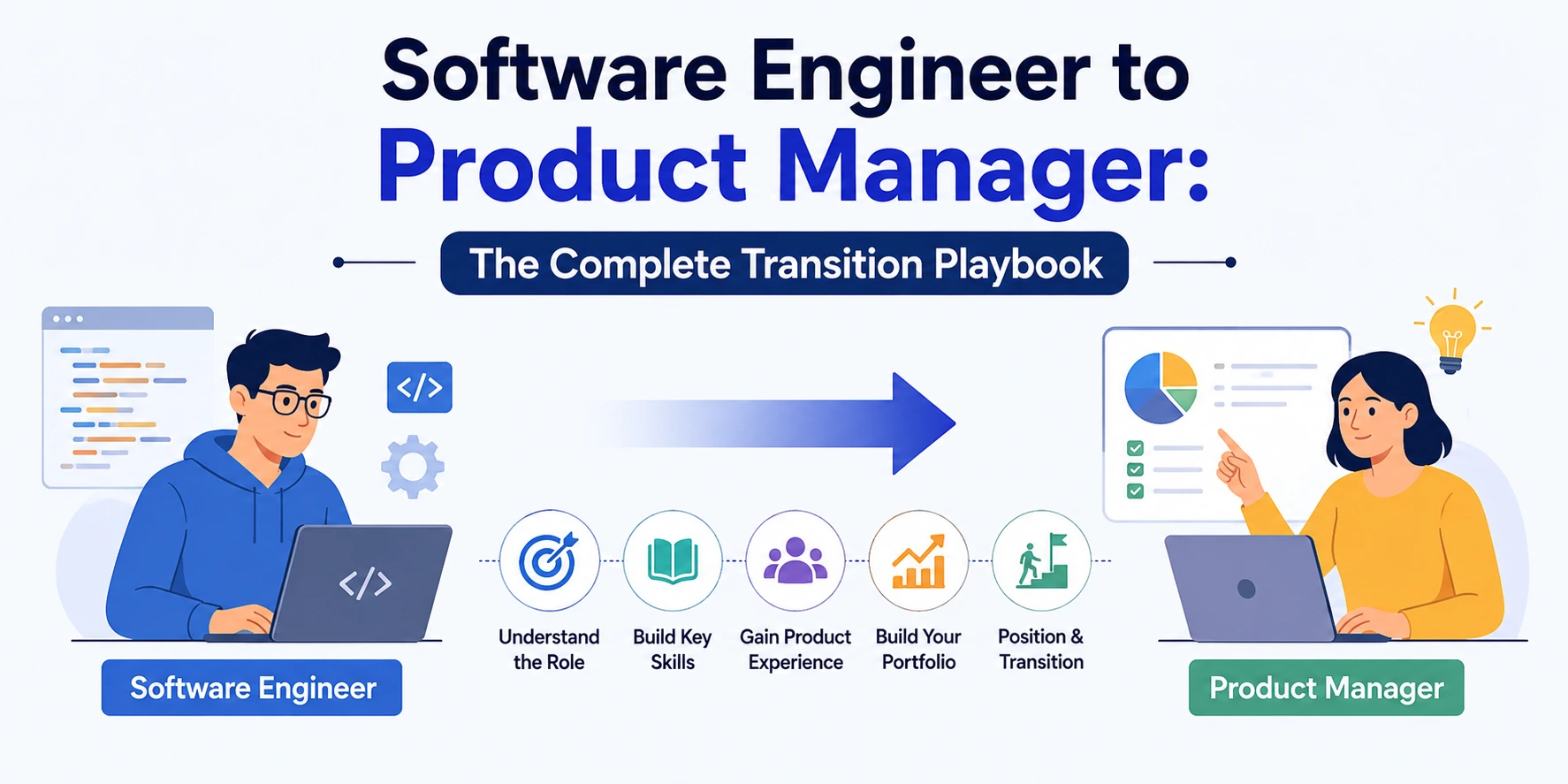
Software Engineer to Product Manager: The Complete Transition Playbook
J
By Nuthana Reddy
August 11, 20269 min read
Published on August 11, 2026
SHARE THIS ARTICLE
Table Of Content
Why Are Software Engineers Moving Into Product Management?
Software Engineer vs Product Manager: What Changes?
The Skills You Already Have as a Software Engineer
The Product Management Skills You Need to Build
Key Insights
Software engineers already have transferable strengths such as technical knowledge, analytical thinking, problem-solving, and cross-functional collaboration that can support a move into Product Management.
The transition requires building product-specific skills in customer research, product strategy, analytics, prioritisation, business understanding, and go-to-market planning.
Practical product exposure can be developed without immediately changing job titles by participating in feature planning, customer feedback analysis, product analytics, roadmap projects, and product discussions.
A product portfolio, a product-focused resume, and a structured 90-day plan can help demonstrate product capabilities and gradually build credibility for the transition.
In this blog, you'll learn how to transition from Software Engineer to Product Manager, including the required skills, practical transition steps, learning pathways, MBA options, product exposure, and career development strategies.
The technology industry is evolving rapidly, and professionals are increasingly looking beyond traditional technical roles to explore careers that combine technology, business, strategy, and customer understanding. One of the most attractive transitions today is moving from Software Engineer to Product Manager.
Software engineers already possess several skills that can provide a strong foundation for product management. They understand technology, development processes, APIs, software architecture, debugging, and the practical challenges involved in building digital products. However,product management requires a broader perspective. A Product Manager must understand users, business objectives, market opportunities, product strategy, prioritisation, analytics, and go-to-market planning.
The transition, therefore, is not about leaving technology behind. It is about building on your technical expertise and developing the strategic and business skills required to take ownership of a product.
For professionals considering this career move, this guide explains the skills required, the transition process, common challenges, learning options, and how management education can support the journey.
Why Are Software Engineers Moving Into Product Management?
Software engineers often work closely with Product Managers, designers, business teams, and customers. Over time, many developers become interested in understanding why a particular feature is being built rather than simply how it should be built.
This curiosity can become a natural entry point into product management.
A Product Manager is responsible for identifying customer problems, defining product requirements, prioritising features, coordinating with cross-functional teams, analysing product performance, and contributing to the product’s overall business direction.
For a software engineer, the technical understanding can be a significant advantage. You already know what is technically feasible, how development teams operate, and what challenges can arise during implementation. What you need to develop is the ability to connect technology with customer needs and business outcomes.
Software Engineer vs Product Manager: What Changes?
The biggest difference between the two roles is the nature of ownership.
A software engineer primarily focuses on building and improving technical solutions. Product Managers, on the other hand, focus on deciding what should be built, why it should be built, who it is for, and how its success should be measured.
This means the transition involves moving from execution-focused thinking to broader problem-solving and decision-making.
For example, an engineer may be responsible for developing a new feature. A Product Manager needs to determine whether the feature solves a meaningful customer problem, how important it is compared with other opportunities, what success metrics should be tracked, and how the feature fits into the larger product roadmap.
The engineer asks, “How can we build this?”
The Product Manager also asks, “Should we build this, why now, and what business or customer outcome will it create?”
Free Courses
Stakeholder Communication & Negotiation Skill Sets
The Skills You Already Have as a Software Engineer
The transition is easier when you recognise that you already possess many transferable skills.
Technical knowledge is particularly valuable in technology product management. A software engineer can communicate effectively with developers, understand technical constraints, evaluate proposed solutions, and participate meaningfully in architecture and implementation discussions.
Analytical thinking is another major advantage. Engineers are accustomed to breaking complex problems into smaller components, identifying root causes, interpreting data, and finding logical solutions. These capabilities are highly relevant to product analytics and decision-making.
Project collaboration is also transferable. Engineers frequently work with designers, QA professionals, business analysts, and other stakeholders. Product management expands this collaboration to include customers, sales teams, marketing teams, senior leadership, and external stakeholders.
The key is to complement these existing strengths with product-specific capabilities.
The Product Management Skills You Need to Build
The first major skill gap is product thinking. Product Managers need to look at problems from the customer’s perspective rather than starting with a technical solution.
User research is therefore essential. You should learn how to understand customer pain points, develop user personas, conduct interviews, identify jobs-to-be-done, and validate assumptions before investing resources in development.
The second important area is product strategy. This includes understanding market opportunities, defining product vision, identifying competitive advantages, creating product roadmaps, and connecting product decisions with business objectives.
Product analytics is another critical capability. Product Managers need to understand metrics, identify patterns in user behaviour, measure product performance, and use data to make decisions.
Finally, you need to understand commercial aspects such as business models, pricing, branding, product launches, and go-to-market strategies.
Step-by-Step Transition Playbook
Step 1: Understand the Product Manager Role
Before changing careers, understand what Product Managers actually do.
Read product case studies, follow product leaders, study successful products, and examine how companies identify customer problems and launch solutions. Understanding the role will help you determine whether product management genuinely matches your interests.
Step 2: Start Taking Product Responsibilities
You do not necessarily have to change your job title immediately.
Look for opportunities within your current organisation to participate in product discussions. Volunteer for feature planning, customer feedback analysis, requirement discussions, product analytics, or roadmap-related projects.
You can also collaborate more closely with Product Managers and ask to participate in product discovery or planning meetings where appropriate.
This allows you to build practical experience while remaining in your engineering role.
Step 3: Develop Business and Customer Understanding
This is often the biggest learning curve for engineers.
Start learning about market research, customer segmentation, competitive analysis, pricing, business models, and go-to-market strategies. Try to understand how the product contributes to revenue, customer retention, market share, or other business objectives.
The goal is to move beyond technical feasibility and start evaluating business impact.
Step 4: Learn Product Management Frameworks and Tools
Product Managers use various frameworks to structure decisions. Familiarity with prioritisation models, OKRs, product roadmaps, user research frameworks, MVP development, product metrics, and GTM frameworks can strengthen your profile.
You should also become familiar with commonly used tools. Product management programmes may provide exposure to platforms such as JIRA, Figma,Google Analytics, and other analytics and collaboration tools.
Step 5: Build a Product Portfolio
A product portfolio can demonstrate your capabilities even if your current job title is Software Engineer.
Develop a case study around a product problem. Explain the customer problem, research methodology, target users, proposed solution, prioritisation logic, product roadmap, success metrics, and launch strategy.
A strong portfolio demonstrates how you think as a Product Manager rather than simply listing technical skills on your resume.
Step 6: Rewrite Your Resume for Product Roles
Your resume should highlight transferable product skills instead of presenting your entire career purely through an engineering lens.
For example, instead of focusing only on theprogramming languagesyou used, highlight situations where you worked with stakeholders, influenced product decisions, improved user experience, analysed data, led feature development, or solved customer problems.
Quantify achievements wherever possible. Metrics can demonstrate the impact of your work more effectively than generic responsibilities.
Do You Need an MBA to Become a Product Manager?
An MBA is not mandatory for becoming a Product Manager. Many professionals transition into product management through internal mobility, project experience, certifications, mentorship, and self-learning.
However, management education can be valuable for professionals who want structured exposure to business strategy, marketing, finance, leadership, operations, and decision-making.
For working professionals, online MBA coursescan provide flexibility while allowing them to continue working. These programmes can be particularly relevant when your goal is to complement technical expertise with broader business knowledge.
When researching programmes, professionals often compare the top online MBA programsbased on curriculum, university reputation, learning format, faculty, flexibility, industry exposure, and overall value.
The right programme should align with your career objective rather than simply having a popular name.
How to Choose the Best Learning Path for Product Management
If your immediate goal is a complete management education, an MBA can provide broad exposure to multiple business functions. However, if you already have technical experience and want to specialise specifically in product management, a focused product management certification may be more directly aligned with your objective.
Consider whether the curriculum includes product strategy, customer research, analytics, business models, roadmapping, GTM strategy, AI, and hands-on projects. Also examine whether the programme allows you to apply concepts to real-world business problems.
For professionals researching Online MBA programs in India, flexibility and career relevance should be important considerations. A programme that allows you to continue working while developing management capabilities can make the transition more practical.
Online MBA vs Executive MBA: Which Is Better for a Career Switch?
The Online MBA vs Executive MBA comparison is relevant for professionals who want to move into managerial or strategic roles.
An online MBA generally offers flexibility and broader management education, making it suitable for professionals who want to study alongside work. An Executive MBA is typically targeted at experienced professionals seeking advanced leadership and managerial development.
However, neither option automatically guarantees a transition into product management. Your decision should depend on your professional experience, learning objectives, time commitment, budget, and desired career trajectory.
For someone specifically targeting product management, a specialised programme may provide more focused learning than a general management qualification.
Can an Online EdTech Program India Help With the Transition?
The growth of digital learning has made professional education more accessible to working professionals. An Online EdTech program in India can offer live classes, recorded resources, case studies, mentorship, peer learning, and industry-oriented projects without requiring professionals to leave their current jobs.
However, the quality of learning matters more than the delivery format. Before enrolling, examine the curriculum, faculty, industry exposure, project components, assessment methods, networking opportunities, and career support.
For product management aspirants, practical exposure is especially important because product management is a role built around decision-making and problem-solving rather than theoretical knowledge alone.
The first 30 days should focus on learning. Study product management fundamentals, customer discovery, analytics, roadmapping, prioritisation, and business strategy.
During days 31 to 60, start applying the knowledge. Participate in product-related projects, create a product case study, analyse an existing product, and begin building your portfolio.
During days 61 to 90, focus on positioning yourself for opportunities. Update your resume and LinkedIn profile, connect with Product Managers, practise product interviews, and start applying for suitable Associate Product Manager, Product Analyst, Technical Product Manager, or Product Manager opportunities based on your experience.
The transition does not have to happen overnight. Consistent exposure to product responsibilities can gradually build credibility.
Why Technical Backgrounds Can Be Valuable in Product Management
The technology-product relationship is becoming increasingly important as companies build AI-powered platforms, SaaS products, fintech solutions, digital marketplaces, and other technology-driven businesses.
A Product Manager who understands engineering can often communicate effectively with technical teams while also translating customer and business requirements into product decisions.
This creates opportunities for specialised roles such as Technical Product Manager, Platform Product Manager, AI Product Manager, and B2B Product Manager.
The key is not to abandon your engineering background. Instead, use it as your differentiator while developing the customer, business, strategic, and leadership skills that product management demands.
Build Product Management Expertise With IIT Roorkee
For software engineers who want a focused pathway into strategic product management, the Post Graduate Certificate Programme in Strategic Product Managementfrom the Continuing Education Centre, IIT Roorkee, is an option worth exploring. The five-month programme is delivered through live online sessions with a campus immersion and covers product strategy, user research, product analytics, roadmapping, business models, GTM strategies, AI in product management, and product technology essentials. It also includes a Build Your Own Product (BYOP) initiative, case-based learning, hands-on sessions, and exposure to tools such as JIRA, Figma, Google Analytics, SQL, and APIs. The programme requires a bachelor’s degree or equivalent with at least 50% aggregate marks. Jaro Education also provides career services such as resume building, LinkedIn profile optimisation, and career enhancement sessions; however, career services do not constitute a job or promotion guarantee.
Conclusion
Moving from Software Engineer to Product Manager is not a complete career reset. It is a progression from building technology to taking greater ownership of the problems that technology needs to solve.
Your technical expertise gives you a strong starting point. By adding customer research, product strategy, analytics, business understanding, communication, prioritisation, and leadership skills, you can build a profile suited to modern product management roles.
Whether you choose online MBA courses, specialised product management programmes, internal projects, or a combination of these approaches, the most important factor is practical application. Build products, analyse customer problems, develop case studies, work with cross-functional teams, and demonstrate measurable impact.
With the right combination of technical expertise and product thinking, the journey from Software Engineer to Product Manager can become a strategic career move rather than a complete career change.
Frequently Asked Questions
Yes, software engineers can transition into Product Management. Their technical knowledge, problem-solving abilities, analytical thinking, and experience working with development teams provide a strong foundation. They should additionally develop skills in product strategy, customer research, business analysis, prioritisation, and stakeholder management.
A software engineer should develop skills such as product strategy, user research, product analytics, market research, roadmap planning, prioritisation, business communication, stakeholder management, and go-to-market strategy. Understanding customer needs and business objectives is particularly important.
An MBA is not mandatory for becoming a Product Manager. Professionals can transition through work experience, internal opportunities, certifications, and self-learning. However, online MBA courses or specialised product management programmes can provide structured exposure to business strategy, leadership, marketing, finance, and product management.
There is no single MBA that is best for everyone. Software engineers should evaluate programmes based on product-related subjects, business strategy, analytics, technology management, flexibility, industry exposure, projects, and career support. Specialised product management programmes may be more suitable for professionals seeking focused product expertise.
The timeline varies depending on your experience, existing skills, and opportunities to gain product exposure. With focused learning, hands-on product projects, networking, and internal cross-functional experience, some professionals can begin targeting product roles within several months. Building strong product experience and demonstrating business impact can make the transition more effective.
Nuthana Reddy
Nuthana Reddy is a Senior Manager at Procter & Gamble, specializing in operations, digitization, and cross-functional leadership. She has driven multimillion-dollar impact through innovation, process optimization, and strategic execution across global markets.
Get Free Upskilling Guidance
Fill in the details for a free consultation
Related Courses
Explore our programs
Post Graduate Certificate Programme in Strategic Product Management
 HOME > BLOG > Business Management > Software Engineer to Product Manager: The Complete Transition Playbook
 August 11, 2026
 9 min read




 Key Insights
 ChatGPT
 Perplexity
 Claude
 Grok
Grok








 ROI Calculator



