What Should a Data Analyst Course in Bangalore Cover?
How to Choose the Best Data Analyst Course in Bangalore?
Key Insights
Bangalore offers a wide range of data analytics programs, making it important to compare curriculum, practical exposure, learning format, certification, mentorship, and career support before enrolling.
A strong data analyst course should cover essential skills such as Excel, SQL, Python, statistics, data cleaning, data visualization, business analytics, and data storytelling.
Practical projects, case studies, and portfolio work help learners apply analytical concepts to real-world datasets and demonstrate their skills beyond course completion.
A data analyst course online with certificate can provide flexibility and formal recognition, but the certificate should be evaluated alongside the program's curriculum, practical training, and instructor support.
In this blog, you'll learn how to choose the best data analyst course in Bangalore, compare online and classroom programs, identify essential skills, evaluate certifications and career support, and follow a practical roadmap toward a data analytics career.
Data has become central to how businesses make decisions, understand customers, improve operations, and measure performance. From technology and e-commerce to banking, healthcare, consulting, and retail, organizations rely on professionals who can turn raw information into meaningful business insights.
Bangalore, one of India's leading technology and business hubs, has become a popular destination for people looking tobuild careers in data analytics. The city offers opportunities across technology companies, startups, consulting firms, financial services, e-commerce, and other industries. As a result, there are numerous programs available for learners looking for a data analyst course in Bangalore.
However, having many choices can make the decision difficult. Courses differ in curriculum, duration, learning format, projects, certifications, mentorship, placement assistance, and fees. Some focus on beginners, while others are designed for working professionals or learners with existing technical knowledge.
Choosing the best data analyst course in Bangalore therefore requires more than comparing course names or fees. You need to understand what skills the program teaches, how much practical exposure it provides, whether the learning format suits your schedule, and how well the course aligns with your career goals.
This guide explains what to look for in a data analytics program, important skills to learn, online and offline options, certification considerations, and the factors that can help you make an informed decision.
Bangalore’s technology ecosystem creates a strong environment for professionals interested in data and analytics. Companies use data for areas such as customer analysis, marketing performance,financial planning, product development, sales forecasting, and operational improvement.
A data analyst typically works with data to identify patterns, answer business questions, prepare reports, create dashboards, and communicate insights to stakeholders.
A well-designed course can help learners develop skills in:
Modern programs may also introduce learners to AI-assisted analytics and automation. The goal is not simply to learn multiple tools but to understand how these tools can be used to solve business problems.
Before selecting a course, it is important to understand the role you are preparing for.
A data analyst generally works with structured and unstructured information to help organizations make better decisions. The work may involve collecting or extracting data, cleaning it, analyzing trends, creating dashboards, and presenting findings.
For example, a data analyst might investigate why sales declined in a particular region, determine which customer segment generates the most revenue, analyze marketing campaign performance, or identify changes in customer behavior.
This means a good program should teach more than software features. It should help you develop analytical thinking and business understanding.
What Should a Data Analyst Course in Bangalore Cover?
One of the first things to check when comparing courses is the curriculum. A strong curriculum should provide a logical progression from foundational concepts to practical analysis.
1. Excel
Excel continues to be useful for organizing, analyzing, and presenting business data.
For beginners, Excel can provide an accessible introduction to analytical thinking.
2. SQL
SQL is an important skill for working with databases. Analysts use SQL to retrieve, filter, combine, and summarize data.
A good course should gradually introduce concepts such as:
SELECT statements
Filtering
Sorting
Aggregations
GROUP BY
Joins
Subqueries
Common table expressions
Window functions
Instead of simply memorizing SQL syntax, learners should practice using queries to answer business questions.
3. Python for Data Analysis
Python can help analysts automate tasks and perform more advanced data analysis.
A data analyst course may introduce libraries such as Pandas and NumPy along with techniques for data manipulation, cleaning, visualization, and exploratory analysis.
Python becomes particularly useful when working with larger datasets or repetitive analytical tasks.
4. Statistics
Statistics helps analysts understand data and interpret results correctly.
Important topics can include:
Descriptive statistics
Mean, median, and mode
Probability
Variance and standard deviation
Correlation
Hypothesis testing
Regression
A/B testing
The depth of statistical training should depend on the type of analyst role you want to pursue.
5. Data Visualization
Analyzing data is only part of an analyst’s job. The insights also need to be communicated effectively.
Courses may teach tools such as Power BI or Tableau for creating interactive dashboards and reports.
Learners should also understand how to select appropriate charts, organize dashboards, highlight important metrics, and communicate findings clearly.
6. Data Cleaning
Real-world data is not always organized or ready for analysis. It may contain missing values, duplicate records, inconsistent formats, or incorrect entries.
Therefore, data cleaning should be an important component of the curriculum.
Learners should understand how to identify data-quality problems, transform datasets, and prepare information for analysis.
7. Business Analytics
Technical skills alone may not be enough. A strong analyst needs to understand the business problem behind the data.
This helps learners connect technical analysis with business decisions.
How to Choose the Best Data Analyst Course in Bangalore?
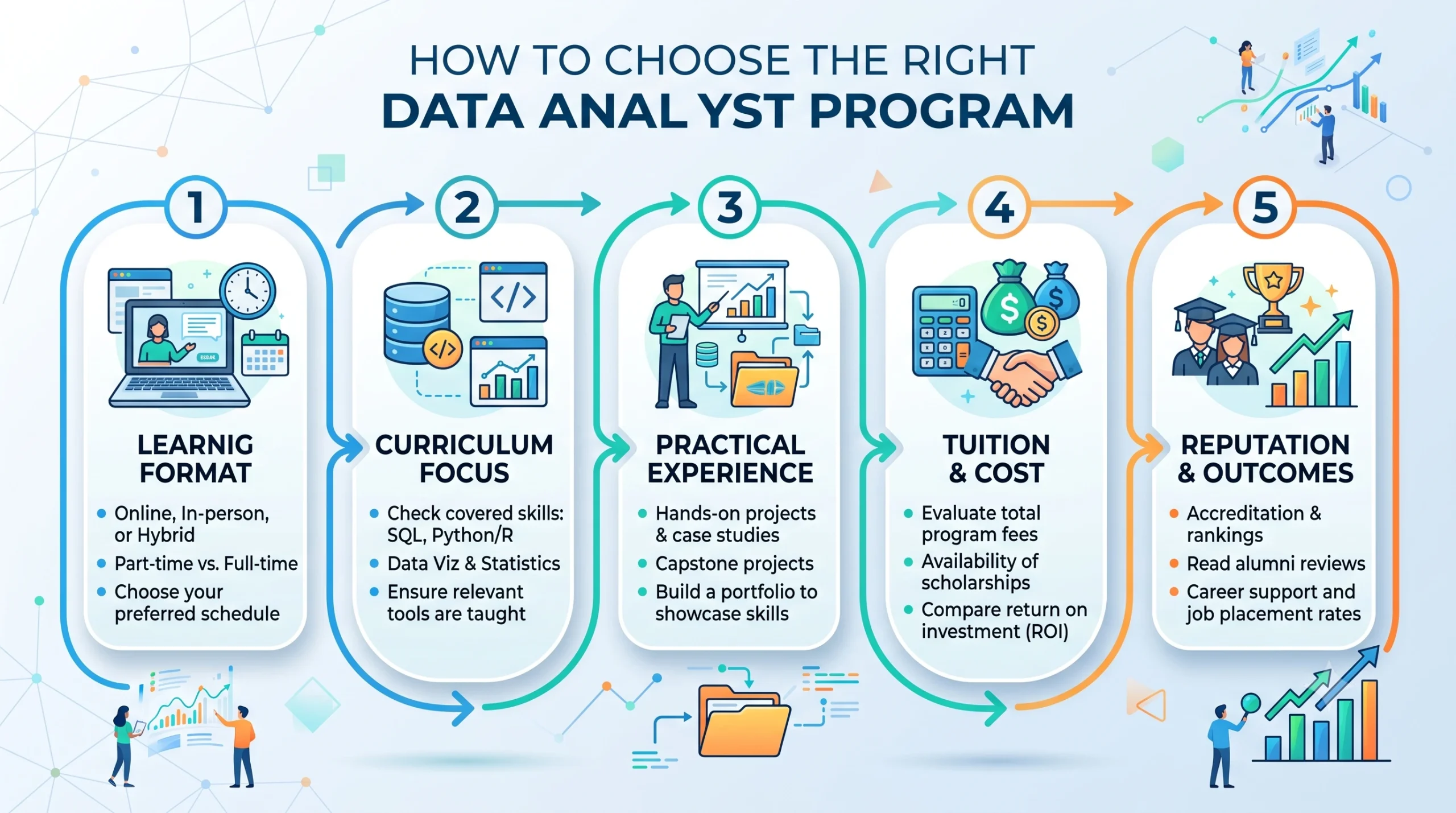
The best data analyst course in Bangalore will depend on your individual requirements. Instead of selecting a program solely because it is popular, consider the following factors.
1. Check the Curriculum
Start by reviewing the complete syllabus.
Does it cover Excel, SQL, Python, statistics, visualization, and business analytics? Does it progress from beginner concepts to more advanced topics?
Avoid programs that simply list numerous tools without explaining how they are applied.
2. Look for Practical Projects
Projects are particularly important when learning data analytics.
A course should ideally include practical assignments, case studies, portfolio projects, or capstone projects.
For example, learners could work on sales data, customer behavior, marketing performance, financial information, or operational datasets.
Projects give you an opportunity to practice the complete analytical process—from cleaning data to presenting insights.
3. Evaluate the Learning Format
Consider whether you learn better through classroom instruction, live online sessions, recorded lessons, or a combination.
If you are working full-time, an online format may provide greater flexibility. If you prefer direct interaction with instructors and classmates, classroom learning may be more suitable.
4. Consider Faculty and Mentorship
Instructor quality can significantly influence the learning experience.
Look for programs that provide access to experienced instructors, doubt-clearing sessions, mentorship, or project feedback.
The ability to ask questions and receive feedback can be particularly valuable when learning technical subjects.
5. Check Certification
Many learners specifically search for a data analyst course online with certificate because they want documented proof of course completion.
A certificate can demonstrate that you completed a structured learning program. However, it should not be the only factor in your decision.
Consider the institution issuing the certificate, the curriculum behind it, and the practical skills you will gain.
6. Review Career Support
If your goal is to enter the data analytics job market, investigate what career assistance the program provides.
Career support should complement—not replace—the development of actual technical and analytical skills.
7. Compare Course Duration
Course duration can vary significantly.
Short programs may provide an introduction to analytics, while longer programs may cover multiple tools, projects, and advanced concepts.
Choose a duration that allows enough time for practice rather than selecting a course simply because it can be completed quickly.
8. Compare Fees and Overall Value
Course fees should be considered alongside the curriculum, projects, mentorship, certification, learning format, and career support.
A lower-priced program is not necessarily better value, and a more expensive program is not automatically better.
The right question is: What skills and learning support will I receive for the total investment?
Data Analyst Course Online vs. Classroom Program
Both online and offline programs have advantages.
Classroom Learning
Classroom courses provide a structured environment with direct interaction. They may suit learners who prefer fixed schedules and face-to-face discussions.
However, commuting and fixed class timings can make classroom programs difficult for working professionals.
Data Analyst Course Online
A data analyst course online can provide greater flexibility. Learners can attend classes remotely and may be able to balance professional or academic commitments with their studies.
Online programs may include live sessions, recorded lessons, assignments, projects, mentorship, and discussion sessions.
Before enrolling, check whether the program offers sufficient instructor interaction and opportunities for practical work.
Should You Choose a Data Analyst Course Online With Certificate?
Searching for a data analyst course online with certificate can be a practical starting point, particularly if you want a flexible learning format and documented course completion.
However, the certificate should be viewed as one part of the overall program.
Consider these questions:
Who provides the certificate?
What does the curriculum cover?
Are there practical projects?
Is there instructor support?
Does the course include assessments?
Can you build a portfolio?
Does the program provide career support?
A certificate can strengthen your professional profile, but your ability to demonstrate analytical skillsthrough projects and interviews remains important.
Key Skills to Develop Alongside Your Course
Completing a course is only one step toward becoming a data analyst. You should also develop complementary skills.
Analytical Thinking
Learn to break down business problems into smaller questions and determine what data is needed to answer them.
Communication
Analysts often need to explain their findings to people who may not have a technical background. Clear communication is therefore essential.
Problem-Solving
Data analysis often involves incomplete information, inconsistent datasets, and unexpected results. Developing a structured problem-solving approach can help.
Business Understanding
Understanding how businesses generate revenue, acquire customers, manage costs, and measure performance can help you interpret data more effectively.
Data Storytelling
A dashboard should not simply display numbers. You should be able to explain what the numbers mean, why they matter, and what action they may suggest.
Who Should Enroll in a Data Analyst Course?
A data analytics program can be suitable for a variety of learners.
Students and Fresh Graduates
Students from business, commerce, technology, economics, mathematics, or related backgrounds can use data analytics training to develop practical skills.
Working Professionals
Professionals can use analytics skills to improve their current role or explore opportunities in data-focused positions.
Career Switchers
People from non-technical backgrounds can begin with foundational courses and gradually develop technical skills.
Business Professionals
Marketing, finance,operations, sales, and HR professionals can use data analytics to improve decision-making within their existing domains.
Career Opportunities After Data Analytics Training
After developing the required skills, learners can explore different roles depending on their experience and specialization.
If you are starting from scratch, a structured approach can make the learning process easier.
Step 1: Learn Excel Build a foundation in spreadsheets, formulas, data organization, and basic analysis.
Step 2: Learn SQL Practice querying databases and answering business questions.
Step 3: Develop Statistical Understanding Learn the statistical concepts needed to interpret data.
Step 4: Learn Python Use Python for data manipulation, cleaning, and exploratory analysis.
Step 5: Master a Visualization Tool Learn Power BI or Tableau and practice creating dashboards.
Step 6: Build Projects Work on realistic datasets and create portfolio projects.
Step 7: Develop Communication Skills Practice explaining your analysis and presenting business insights.
Step 8: Prepare for Interviews Revise technical concepts, SQL problems, analytical case studies, and project-based questions.
Final Thoughts
Choosing the best data analyst course in Bangalore is ultimately about finding a program that matches your learning needs and career objectives.
A strong program should provide a balanced combination of technical skills, practical projects, business understanding, mentorship, and career preparation. Core areas such as Excel, SQL, statistics, Python, data visualization, and business analytics should form an important part of the curriculum.
For learners who need flexibility, a data analyst course online can make it easier to balance education with work or other commitments. A data analyst course online with certificate can additionally provide formal recognition of course completion, but the quality of the curriculum and practical exposure should remain the primary considerations.
Before enrolling, compare the syllabus, duration, projects, faculty, learning format, certification, career support, and overall cost. Most importantly, choose a program that gives you opportunities to practice solving real analytical problems.
With the right combination of structured learning, hands-on practice, and continuous skill development, you can build a stronger foundation for pursuing data analytics opportunities in Bangalore and beyond.
Frequently Asked Questions
The best program depends on your career goals, experience, budget, preferred learning format, and desired level of specialization. Compare the curriculum, practical projects, mentorship, certification, and career support before making a decision.
Yes. A data analyst course online can be a suitable option for students and working professionals who need flexibility. Online programs may include live classes, recorded content, assignments, projects, and mentorship.
It can be useful if the program combines a recognized certificate with strong technical training and practical projects. However, the certificate should not be the only factor you consider when choosing a course.
Important skills include Excel, SQL, statistics, Python, data cleaning, data visualization, business analytics, analytical thinking, and communication. The depth required can vary depending on the role you want to pursue.
Not necessarily. Learners from different academic and professional backgrounds can build data analytics skills through structured training. Beginners should start with foundational concepts and gradually progress to SQL, Python, visualization, and more advanced analytical techniques.
Shubham Lal
Lead Software Developer
Shubham Lal joined Microsoft in 2017 and brings 8 years of experience across Windows, Office 365, and Teams. He has mentored 5,000+ students, supported 15+ ed-techs, delivered 60+ keynotes including TEDx, and founded AI Linc, transforming learning in colleges and companies.
 HOME > BLOG > Data Science and BI Analytics > Best Data Analyst Course in Bangalore: How to Choose the Right Program
 August 31, 2026
 9 min read





 Key Insights
 ChatGPT
 Perplexity
 Claude
 Grok
Grok







 ROI Calculator